
Studying the Max Pain Concept: Holy Grail or Pain for Traders?

Max Pain, or “maximum pain,” is an idea that helps explain at what price level at expiration the total payout to option holders will be minimal, and therefore the losses of option buyers will be maximal.
Put simply, Max Pain is the price level at which the largest number of option contracts expires without profit, which is maximally unpleasant for option buyers.
The Max Pain concept is one of the most intriguing and controversial ideas in the options markets. For a beginner who is just starting to understand calls and puts, understanding Max Pain can become the key to reading the hidden scenarios that play out in the market every day.
There is a lot of debate about Max Pain on various trading forums. One can even speak of the existence of a certain “Max Pain sect,” whose followers believe in an all-powerful and evil market maker and think that the Max Pain concept is almost a Holy Grail that makes it possible to catch a move toward Max Pain.
But the market maker is neither evil nor all-powerful. It simply performs its function, sometimes taking advantage of the market situation and the liquidity imbalance, sometimes not. And yes, market makers also take serious losses if something goes wrong. But that is a separate story.
In this article, we will talk about the Max Pain concept and the features of its application for analysis and trading.
What max pain is in simple terms
Max pain (maximum pain) is a theory according to which there is such a value of the underlying asset price at the time of options expiration at which the total losses of option buyers (calls and puts) will be maximal, and the payouts of sellers will be minimal.
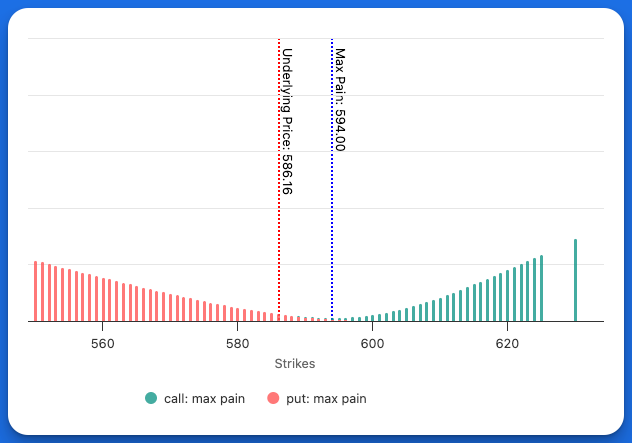
Put simply, max pain is the expiration price at which the total cash payout to option holders is minimal. The consequence of this is usually that most options expire out of the money (OTM) and with zero payout.
Let us translate this into plain human language. An option buyer (both a call and a put) pays a premium. Their maximum loss is this premium. They hope the option will make a profit: the asset price must be above the strike price at call expiration and below it at put expiration.
In turn, the option seller receives the premium immediately. Their profit is limited to this premium, but the risks can be huge. Therefore, their main goal is for the option to expire worthless (Out of The Money, OTM). Then they simply keep the entire premium received.
The Max Pain theory claims that large sellers, who hold large volumes of options, have the motive and partly the ability to influence the price by expiration, pulling it toward the level where the largest number of those options loses its value for buyers. This allows sellers to maximize their profit and minimize losses.
As an example, let us take exchange X, where 1 option on BTC or ETH has a contract size of 1 BTC or 1 ETH respectively (as on Deribit). This means that one options contract gives exposure to exactly one coin, and payouts are calculated in USD (through the strike and expiration price), but the base unit is precisely 1 BTC or 1 ETH.
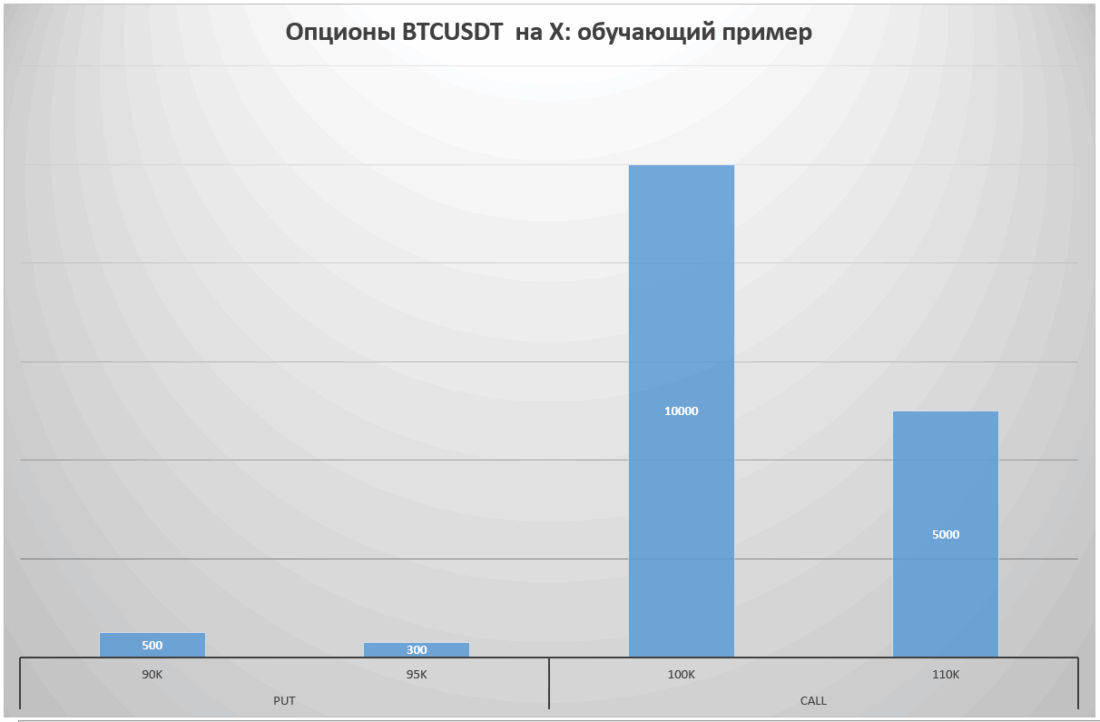
So, here is the situation.
By the time the options expire, the price of 1 BTC is $94 000. The following open interest is present:
Calls
- Call 100k: 10 000 contracts
- Call 110k: 5 000 contracts
Puts
- Put 95k: 300 contracts
- Put 90k: 200 contracts
At an expiration price of 94 000 USD, the maximum number of options will be out of the money: all calls, and there are 15 000 of them, will be OTM. Also OTM will be the puts with the 90k strike.
Meanwhile, all puts at the 95k strike (300 contracts) will be in the money (ITM). Thus, payouts on the 95k strike put options will amount to 300 000 USD.
We obtained this figure as follows. First, we calculated the difference between the strike and the expiration price: strike 95 000 minus the actual price at expiration 94 000. After that, the $1 000 difference was multiplied by the open interest of 300 contracts.
Where is the Max Pain level located in this example?
An astute reader immediately understood that Max Pain in this example lies in the range from 95k to 100k, because option sellers will not have to pay anything to buyers. In the 96-99k range, absolutely all options will be out of the money, and at the 95k and 100k strikes some options will be at the money (ATM), for which payouts are also zero.
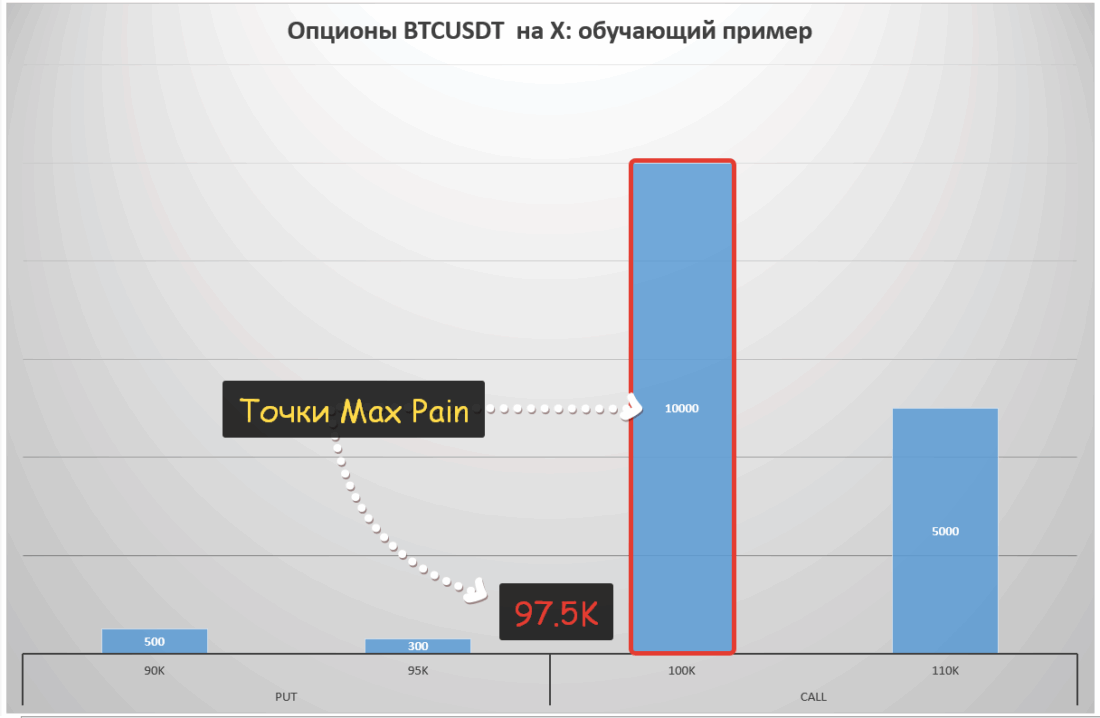
If one needs to choose a single Max Pain point, they more often take:
- either the point of concentration of the maximum OI that will end up ATM+OTM, i.e. $100 000, because 10 000 calls are concentrated there,
- or the midpoint of the range when smoothing the payout curve, i.e. $97 500.
So, in our example only 300 contracts ended up in the money (ITM) and received 300 000 USD in payouts at a price of 94k. This raises the question:
Why were the sellers in this example unable to pull the price to where all options are out of the money?
Because, for example, at 94.5k there is a serious sell wall within a short impulse and it does not allow the price to hold above the 95k mark at expiration. That is if we are talking about an impulse situation.
On the other hand, in the real market sellers always pay something to buyers. And the 94k strike in our example produces the smallest amount of payouts. Already at 93k the payout will be 600 000 USD, and so on. This means that even if the quote is in a short impulse, according to the Max Pain concept option sellers should try to pull the price within a correction at least to 94k in order to pay out less money.
So, let us sum up.
The method of calculating Max Pain is based on open interest data for all strikes of the selected expiration date.
To calculate Max Pain, they take the OI distribution for calls and puts, then for each possible closing price level they calculate how many dollars would have to be paid to option holders at such a close: payouts on calls are estimated as the positive difference between the closing price and the strike, multiplied by OI and by the contract size; payouts on puts are the positive difference between the strike and the closing price, multiplied by OI and by the contract size.
After summing all payouts, they obtain the payout curve, a curve of the total “payment obligation” depending on price, and the minimum point of this curve will be Max Pain.
The formula and practical calculators can be found on specialized sites where there are built-in tools for calculation.
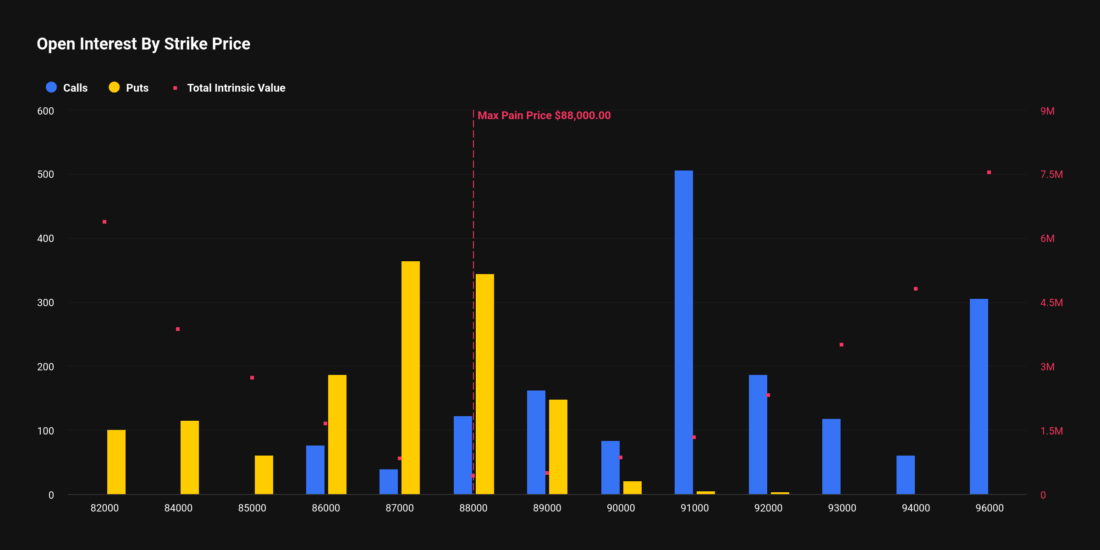
Here is a live example. A daily option on the Deribit exchange expiring on January 26, 2026 has Max Pain at the $88 000 strike.
And here is the distribution of ATM / OTM / ITM options at that same moment in time: only 21.27% of options are in the money, the rest are out of the money.
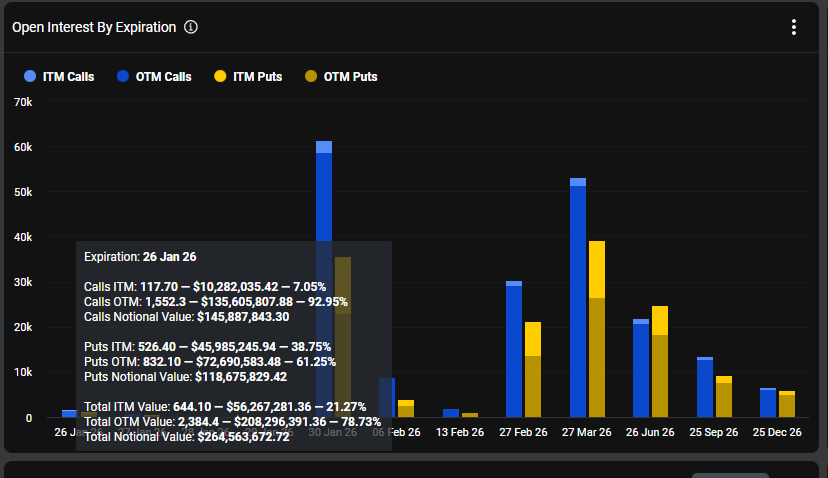
Let us look at these figures in a little more detail.
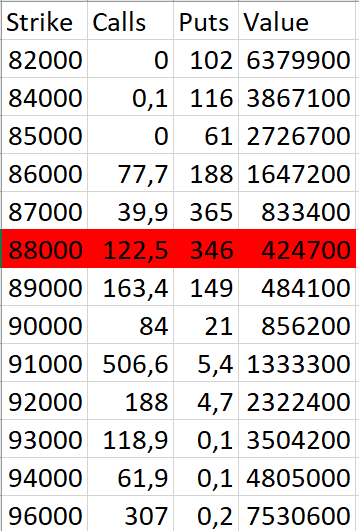
The price of BTC at the time of writing is 77 700 USDT. Deribit does not separately single out ATM options, although everything around the 88 000 strike at the current price is a normal at-the-money option, because its potential payouts are minimal. But let us agree with Deribit: put options at the 88 000 strike can also be regarded as ITM.
The empirical rule “where there is more OTM, there is Max Pain” is it a mistake or not?
It should be understood that Max Pain takes into account not the number of contracts, but the monetary effect.
The empirical notion that where there is more OTM, that is where Max Pain is located, in some situations is not entirely correct, because the mathematical calculation of Max Pain and the greatest concentration of OTM options differ. But most often the Max Pain price levels coincide with the levels of the greatest concentration of out-of-the-money options.
Let us imagine a situation where the level with the maximum number of OTM is not equal to Max Pain.
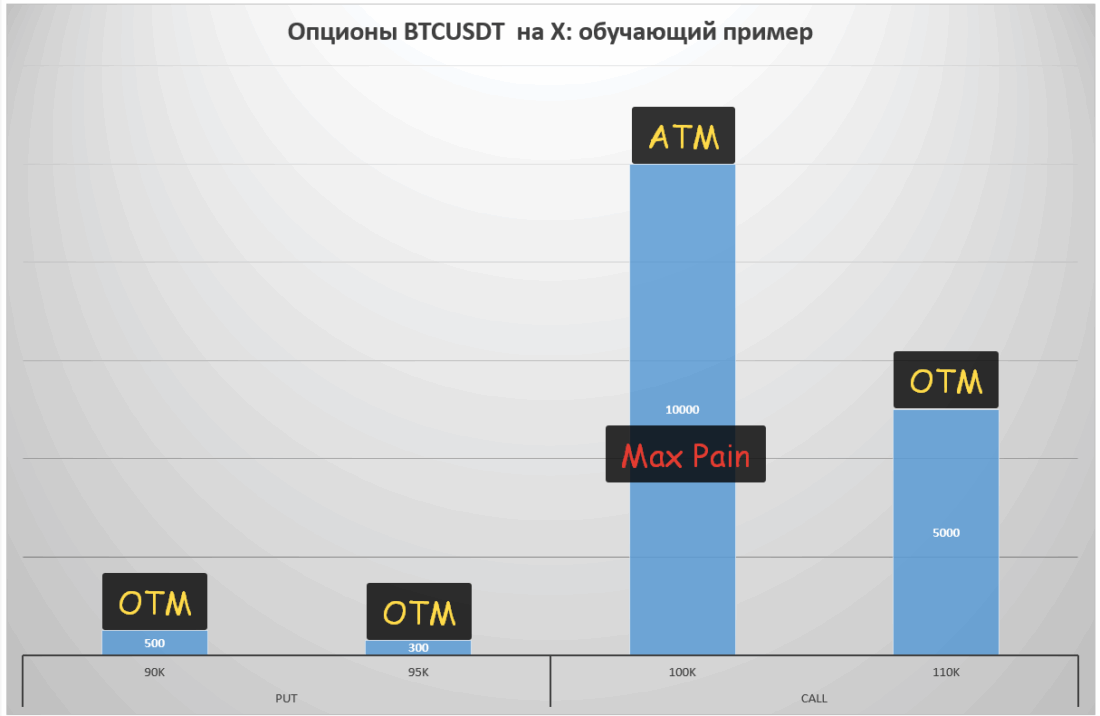
Let us take the situation from the previous example. We immediately recommend paying attention to the imbalance: there are a lot of calls (15 000 in total), and few puts (500 in total).
The price at expiration is 100k: all puts are out of the money, 5 000 calls are also out of the money, while 10 000 calls are at the money (ATM). They receive no payout, but they have the right to buy BTC at the current price, losing nothing and gaining nothing.
I think it is now clear why Max Pain is the level where the aggregate “pain” of option buyers is maximal, and not simply the maximum number of out-of-the-money options.
Where to look at Max Pain for trading cryptocurrencies
In cryptocurrency markets, the Max Pain concept is applied in the same way as in classical markets, but it has a number of features related to high volatility, the centralization of options volumes on individual exchanges, and differences in contract sizes.
The main source of data on crypto options is the Deribit exchange, which provides a significant share of trading volumes in BTC and ETH.
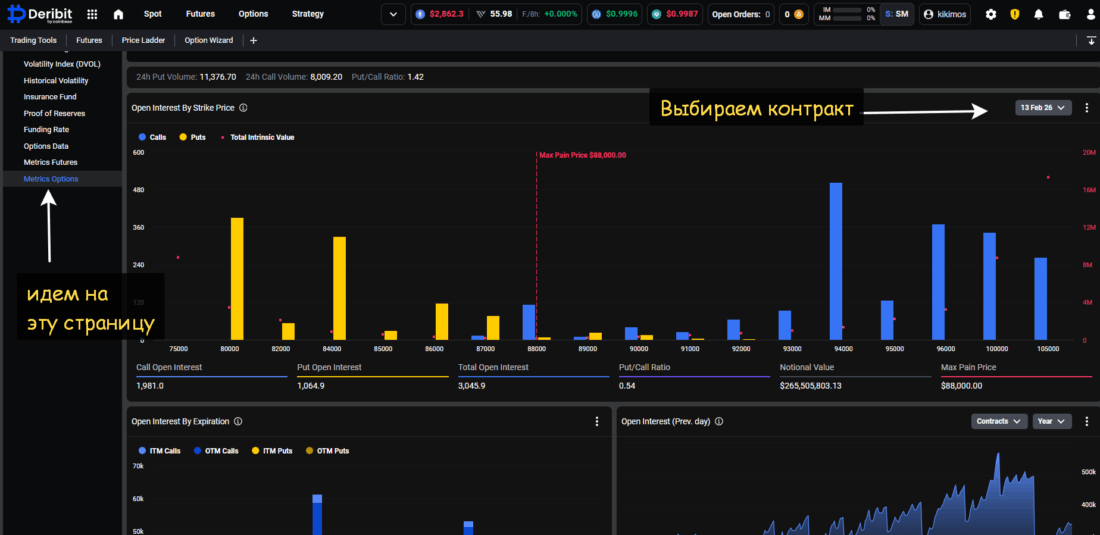
In addition, it is worth carefully following aggregators like CoinGlass, which provide a broader view of the distribution of strikes and open interest, because they collect data from several exchanges, including OKX.
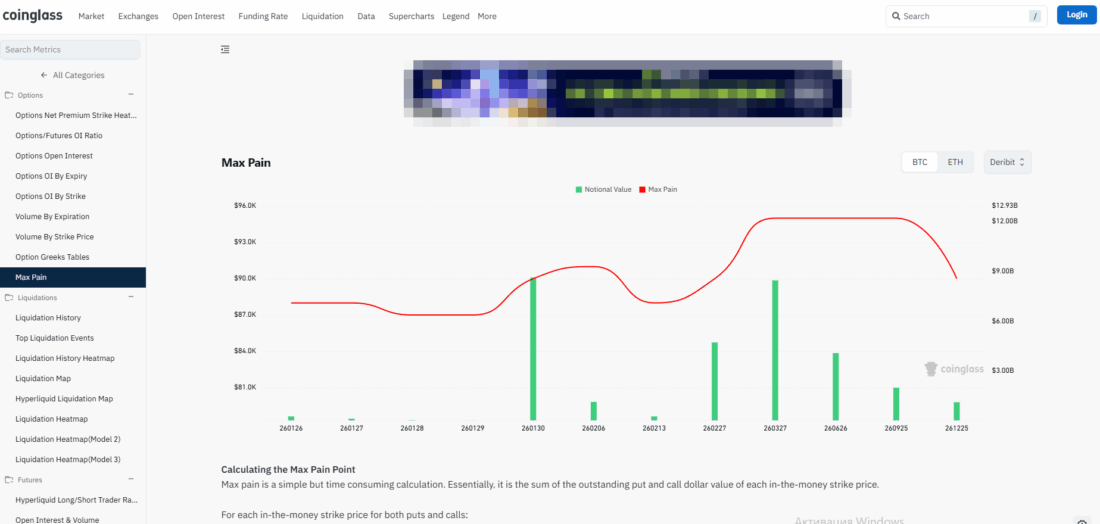
In any case, every resource where one can find Max Pain values for crypto options has convenient visual dashboards, which makes analysis easier.
How to use Max Pain in analyzing asset behavior
Max Pain is a tool for assessing the probabilities of reaching a certain price at a certain time. There are several ways to apply it in practice: both in linear spot or futures trading and in options trading.
Max Pain should be used in market analysis carefully and in a specific context. The Max Pain concept by itself does not guarantee that the price will come exactly to this level, but it gives an idea of where option exposure is concentrated and which strikes potentially create “pin risk,” that is, a situation where the price tends to settle near a certain strike on expiration days.
Attraction level (Magnet Effect)
The most popular use of Max Pain is based on the “magnet effect” hypothesis. Many traders believe that as the expiration date approaches (especially in the final hours), the price of the asset is highly likely to move toward the Max Pain level.
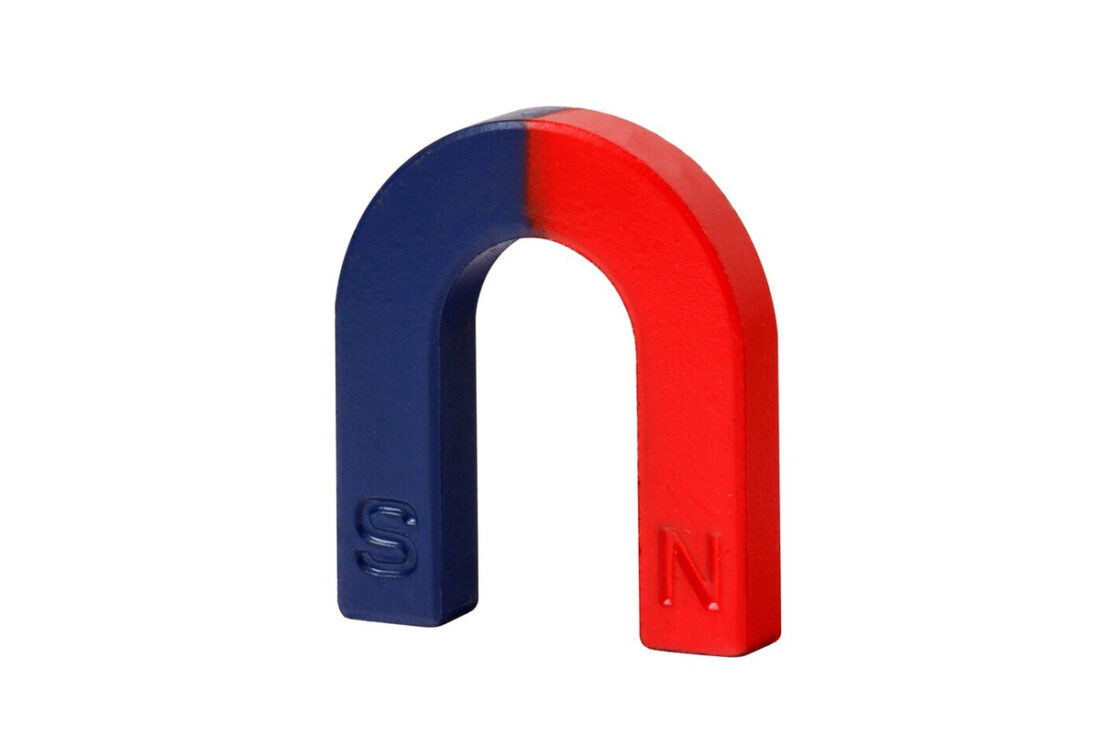
The logic here is simple.
If the price is significantly above Max Pain, this can serve as a bearish signal for short-term trading (a move downward toward the level is expected). If the price is significantly below it is a bullish signal. Here the maximum pain value acts as an attraction level.
If the price is already trading near the Max Pain level, one can expect consolidation (sideways movement) around this level until expiration.
It must be understood that this is a probabilistic assumption, not a law. The effect is stronger in conditions of low liquidity or the absence of strong fundamental drivers.
Based on personal experience, if the asset is in balance (a market phase), then the quote confidently moves toward Max Pain and reaches it. And here the Magnet Effect is vividly expressed.
But when the quote is within impulsive dynamics, the Magnet Effect is expressed more weakly: the quote approaches the maximum pain level, but most often does not reach it. Therefore option sellers pay out more money than usual.
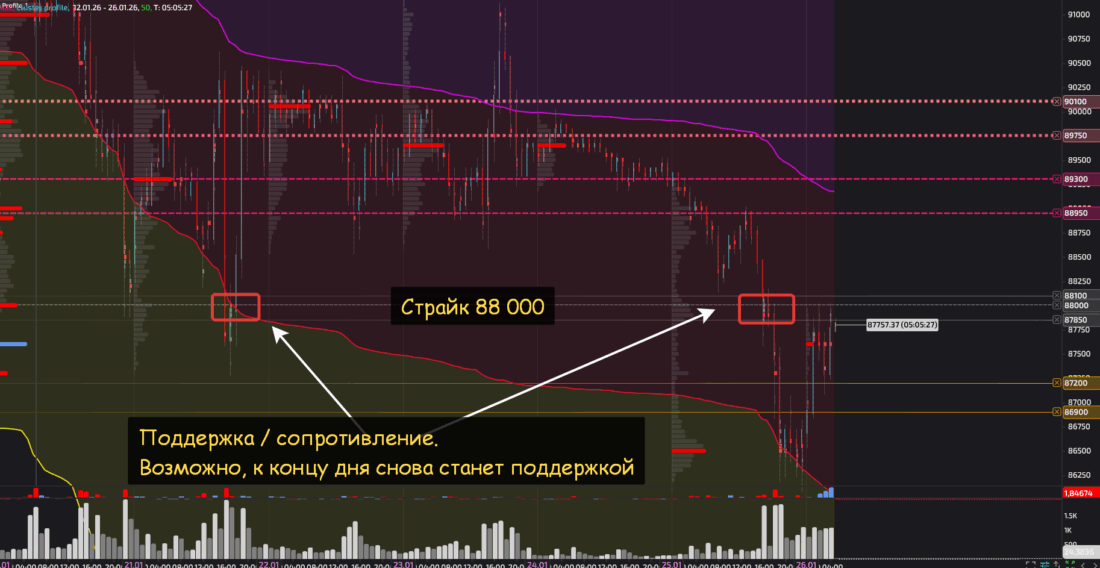
The picture above shows the example analyzed earlier. On that day (January 26), the Max Pain level is marked at the 88 000 strike. This level was strong support, it was sharply broken on 25/01 and reclaimed on 26/01. A clear magnet effect.
Identification of key support and resistance levels
Clusters of open interest (OI) at certain strikes, which form the Max Pain level, are in themselves powerful technical support and resistance levels.
“Call wall” (large OI in calls) above the current price often acts as dynamic resistance. Sellers of these calls, in order not to incur losses, may actively hedge by selling spot or futures, which creates pressure on the quote.
“Put wall” below the current price can work as support. Sellers of puts, so that their options do not become “in the money,” may buy back the asset, supporting the price.
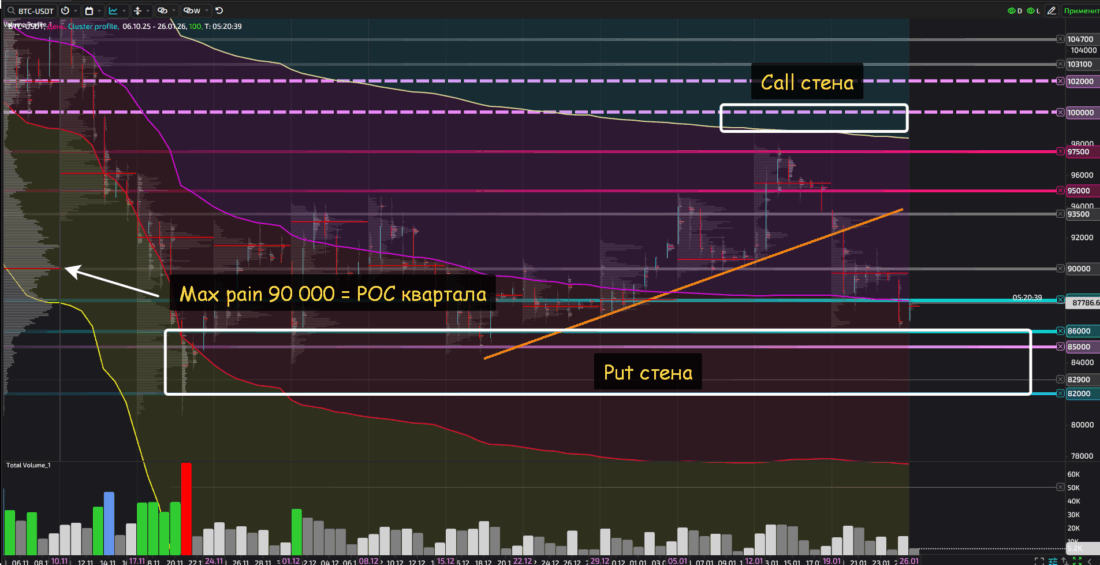
The Max Pain level as a balance point between these “walls” becomes the main attraction level. This is a situation of prolonged balance, when the Max Pain level almost coincides with the POC point of control on the underlying asset.
As an example, let us consider the maximum pain level not on a daily option, but on a monthly option.
Here the strike is at 90 000. The call wall is at the 100 000 strike. It is difficult to speak of a put wall: for that one needs to look at far-dated options, where it is visible that there are enough option volumes in the 80-85 thousand area.
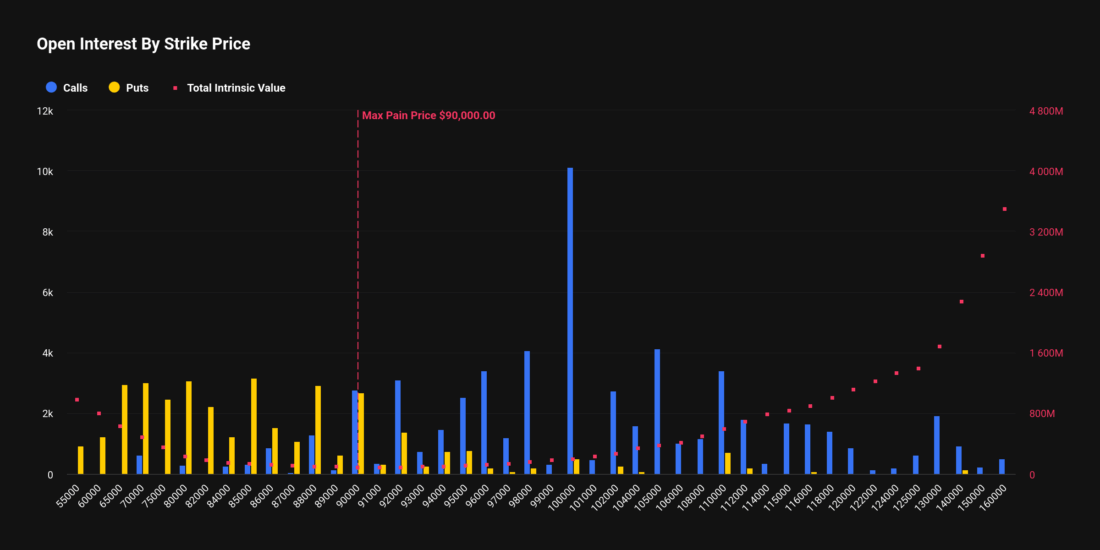
What is $90 000 on the spot chart? It is the point of control (POC) of the previous week and of the entire quarter. Strike 100 000 (the call wall) is a zone they cannot even reach. But they also cannot get below the put wall either: the decline was stopped there extremely aggressively.
A tool for making decisions on options
If you use Max Pain for buying an option, then closer to expiration you need to watch carefully where the maximum pain level is, which may well coincide with the values of ATM/OTM strikes.
If an option bought earlier is deep in the money and the expiration date is getting closer and closer, then it is worth thinking about selling it at the current price, thereby locking in profit. If your strike is far from the current Max Pain level, that is an alarming signal.
But if an option sale is open and the Max Pain strike is very far away, then the chances that the price will come to a favorable level by expiration are reduced. Of course, in this case the options are most often insured, but it is better to consider additional risk-reduction options.
Max Pain in action: examples from the world of cryptocurrencies
Let us break down three main scenarios of trading the Max Pain level with a simple example.
Scenario “Classic attraction”
Situation. One day remains until monthly expiration. BTC is trading at $61 000. The calculated Max Pain is $58 000: huge clusters of calls at $65 000 and puts at $55 000 (Max Pain exactly in the middle).
Price behavior. On expiration day, despite neutral news, BTC begins to decline smoothly from $61 000 to $59 000. In the last 2-3 hours of trading, volatility increases, and the price moves toward $58 500-$58 800. Fully reaching the exact Max Pain level is not guaranteed, but the movement in its direction is obvious.
Scenario “Magnet break” by a strong trend
Situation. Unexpectedly positive US macro news comes out. A powerful bullish trend begins across all markets. Max Pain for BTC is $60 000, but the price is already $63 000 and rising quickly.
Price behavior. The price ignores the Max Pain level and rushes toward $66 000. The “call wall” at the $65 000 level does not act as resistance, but is broken through.
Why this happened. The fundamental driver (news) turned out to be stronger than the local options mechanics. Sellers of the $65 000 calls are forced to take losses or actively re-hedge by buying spot (which further fuels the rise).
Scenario “Pin bar” at a critical strike
This is a tactic used by large players. Suppose Max Pain is at $59 000, but the biggest OI is in puts at $58 000.
Maneuver. In the final minutes of trading, a sharp stab in price (pin) may occur slightly below $58 000 in order to bring those puts “into the money” and trigger chaotic hedging or position closing, and then rebound upward just as sharply. The goal of the maneuver is to profit in futures or trigger the stop-losses of small traders.
A beginner in the last hour before the expiration of large options needs to be cautious with orders near strikes with large OI.
Criticism of the Max Pain concept
Despite its popularity among retail traders, the Max Pain theory is subject to justified criticism. The main arguments of skeptics are as follows.

Self-fulfilling prophecy. Max Pain works precisely because thousands of traders and algorithms believe in it. Seeing the level, they begin trading in its direction, thereby moving the price. This is not proof of the theory, but proof of its mass acceptance.
Ignoring real volumes. Max Pain is calculated on the basis of Open Interest (the open interest, that is, the number of “hanging” contracts). It does not take into account the day’s trading volume (Volume). A large institutional player may quietly close its giant position a day before expiration, OI will fall, but Max Pain calculators may not see this in time.
This applies more to traditional markets; in crypto, the closing of OI is visible immediately. But the retail trader can still be late even taking this information into account.
Simplified participant model. The theory assumes that all option sellers are one big “professional” camp with shared interests. In reality, there are thousands of option sellers: large funds, market makers, and small traders selling covered calls. It is impossible to coordinate their actions.
Trend strength and fundamental factors. As we saw in the example, a strong impulse, especially one fueled by news (the Fed’s decision to launch QE, BTC halving, etc.), easily outweighs local options mechanics.
Coincidence with other levels. The Max Pain level often coincides with important technical levels (psychological round numbers, where usually very large speculators place their limit orders, Fibonacci levels, clusters of POC/VAH/VAL volumes), which makes it harder to determine the true cause of the price reaction.
In the critics’ noteworthy opinion, Max Pain is an interesting indicator of sentiment and concentration of interest, but it should not be regarded as an independent trading system or a guaranteed forecast. It is only one of the pieces in the overall mosaic of analysis.
Conclusion
Max Pain is the level where the maximum number of option buyers loses.
In practice, one can observe scenarios where, in the absence of strong news, the price really “sticks” to the Max Pain level in the last hours before expiration, but when a major news factor appears, this effect immediately breaks down and the price moves far away from the expected level.
The cryptocurrency market, with its high volatility and blockchain transparency, is an ideal arena for observing the Max Pain phenomenon. It is important to use services with fast data updates and pay attention to which exchanges the OI data is aggregated from, since differences in the strikes with the maximum open interest affect the calculation of the maximum pain level.
Max Pain is a secondary indicator. It works best in flat (sideways) or uncertain conditions. In a strong trend, it is better to ignore its signals.