
Pump and Dump Schemes in Cryptocurrencies: How It Works and Can You Make Money from It?
 "Crypto pumps" are one of the hottest topics associated with the cryptocurrency market. It is almost impossible to find a social media community, forum, or Telegram channel dedicated to cryptocurrencies where there are no offers to "make 300% on the pump of coin X" and no heated arguments between the "pumpers" and their opponents. However, what does Pump and Dump mean when applied to the crypto market, and is it really possible to make good money on these schemes? Let us find out.
What Is It?
 Pump and Dump is one of the classic scam schemes on exchanges that appeared long before the very idea of cryptocurrencies. It consists in the asset owner artificially raising its price in order to then sell it as expensively as possible. After the initiator of the scheme "dumps" their share, the asset price collapses and investors lose their money.
In the traditional stock market, Pump and Dump usually uses so-called "junk" stocks, cheap securities of small companies with low market capitalization. Such assets can be bought up cheaply, and a relatively small number of investors is enough for a sharp rise in price. To create increased demand, fake positive news, forged financial statements, and "leaks of insider information" about a coming rise in the stock price of a particular company are used.
The natural response to the activity of fraudsters was tighter regulation of the "junk" stock market, which began in the early 2000s. Many pump organizers received very real prison sentences. Even more, however, managed to avoid punishment or buy their way out with a small share of the profits.
However, the crypto market is practically unregulated, which gives fraudsters free rein. At the same time, there are now more than a thousand little-known coins with low capitalization (junk ones), and the development of social networks and messengers has greatly simplified attracting investors. Because of this, the Pump and Dump scheme in the cryptocurrency market is extremely popular.
How Does Pump and Dump Work in the Crypto World?
 There are no fundamental differences from an analogous scheme in the stock market.
Having chosen the exchange and the coin that will be used for the scam, the organizers first buy up the tokens for pennies (in small portions so as not to trigger a price increase ahead of time). Then the "pump" begins, work on increasing the price. In the exchange chat, social networks, and messengers, information is spread about the inevitable imminent growth of this coin's rate (or it is said directly that it is being pumped, but more on that below), while on the exchange itself the pump organizers' bots place and remove many large orders to buy it, essentially moving money from one of their pockets to another.
Then many investors, attracted by the prospect of easy money, begin buying the currency, and its rate rises even higher. The pump organizers sell the accumulated token reserves at an inflated price (dump), and the rate crashes. The "pumpers" count their profits, investors get losses and coins no one needs.
Pump Coins
Pump organizers, as a rule, use little-known currencies with low capitalization, the so-called pump coins (a less delicate name is shit-coin).
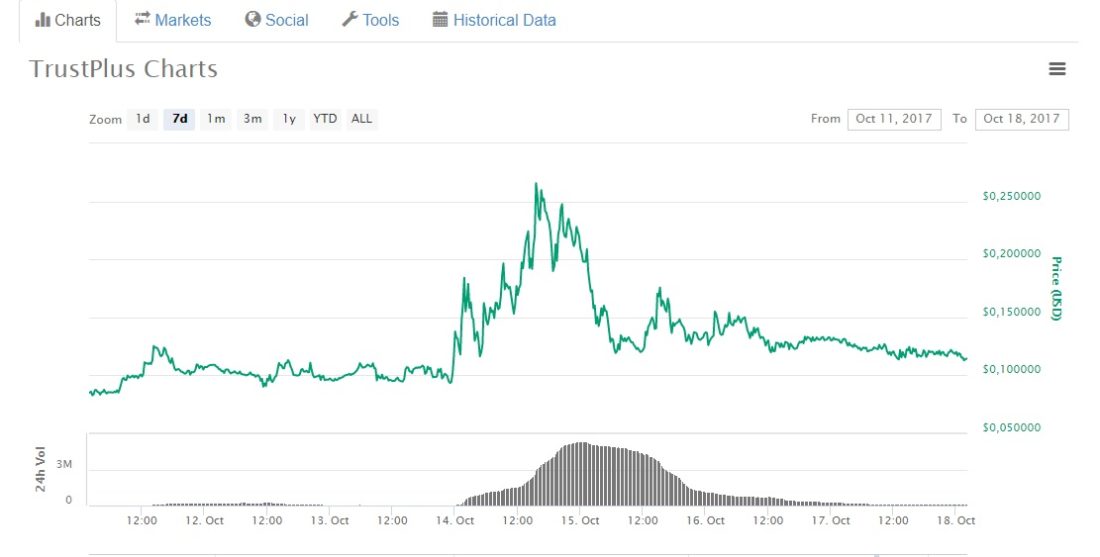
For example, TrustPlus is a typical pump coin. And on the chart below you can see a typical Pump and Dump using this coin as an example. In just one day, the rate managed to triple and then fall almost back to the original level. Capitalization during that same day rose from 3 million dollars to 8.5, and then fell to 4 million. So the speculators earned their couple of million.
However, because of the comparatively small overall volume of the crypto market, pumps also happen with fairly large currencies. For example, TRON has often recently been called a pump coin, its rate in January 2018 managed to triple in a day and then fall back.
But carrying out such scams with currencies whose capitalization is measured in billions of dollars (at the start of the pump) is possible only for major market players, unlike shit-coins with capitalization of a couple of million.
Pump Exchanges
Most major cryptocurrency exchanges are not suitable for pumps. This is partly connected with attempts by a number of platforms to limit the activities of fraudsters, but mainly with the limited list of cryptocurrencies traded on major exchanges, which usually includes only "top" tokens. Pump organizers, however, are interested in platforms that support a large number of small coins.
On a global scale, the largest pump platform is considered to be Bittrex. It is in the top ten crypto exchanges by trading volume (over the past month, from 0.5 to 1.8 billion dollars per day) and supports more than two hundred tokens. The TrustPlus pump shown on the chart above took place on Bittrex.
But Bittrex is still the domain of relatively large players. The true embodiment of an "exchange for pumping" is the Yobit platform, well known in the CIS (see the review of this exchange here). It is located near the end of the first fifty exchanges by trading volume and has a terrible reputation because of problems with deposits, money periodically getting "lost" during withdrawals, and reports of the administration's involvement in a number of scams. Nevertheless, in the Russian-speaking segment of the internet this exchange still enjoys some demand.
A multitude of cryptocurrencies are traded here, and their number is constantly increasing (currently more than 600). Many tokens traded on Yobit cannot be found anywhere else (including because coins with a capitalization of several thousand dollars are of little use to anyone). What makes Yobit especially "tasty" for pump organizers is the possibility of listing your own cryptocurrency on the exchange for a modest sum (no more than 0.5 BTC).
 Pump Channels
Today, the main way of recruiting investors for pumping cryptocurrencies is through channels in the popular messenger Telegram. At the same time, there are comparatively few channels that use the "old-fashioned" scheme of throwing in "insider" information about the soon-to-come growth of a particular coin.
The creators of most pump channels gather subscribers by openly stating that they will be pumping tokens. However, they assure them that subscribers will know about the pumps in advance and will be able to earn money, unlike the rest of the market participants. Naturally, they are the main source of money for the organizers, who openly call the process "shearing the hamsters."
There are also paid pump channels where the "hamsters" also pay in order to be "shorn."
In addition to this, channel owners also try to retain subscribers. To do this, after the dump they publish posts from those who managed to earn together with the organizers (with the message, "you will get lucky next time"). Sometimes they add something like, "do not worry, the coin is promising, in a couple of months it will rise on its own."
So the way pump channels operate would have impressed even Ostap Bender: people pay money so that even more money can be taken from them, and then ask for more.
Attempts to Combat Pump and Dump Cryptocurrencies
The lack of regulation in the cryptocurrency market virtually guarantees that the organizers of pumps will face no significant punishment. At least, not in the near future. However, the prevalence of such schemes negatively affects the crypto market as a whole and undermines trust in digital currencies. In this regard, many exchanges are trying to fight speculators, and they are striking first and foremost at their “investment base” - for example, Bittrex warns that the exchange will block the accounts of pump participants.
For now, however, these measures have not achieved any significant result. Still, the current trends toward tighter regulation of the crypto market suggest that the “window of opportunity” for Pump and Dump will gradually narrow.
Advice for Traders
 The main problem with trying to profit from Pump and Dump for those who are not its organizers is that, even if you recognize a pump in time, it is almost impossible to predict the exact timing of the start of the dump “from the outside.”
Recognizing a Pump
The skills of recognizing a pump are useful not only for trying to profit from it, but also for those who want to reduce their risks and avoid “falling for” the sudden rise of one coin or another.
The main signs of a pump:
- A sharp surge in exchange activity (primarily an abundance of large buy and sell orders) and a rise in the cryptocurrency's rate in the absence of positive news;
- The absence of similar growth on other exchanges where this cryptocurrency is traded;
- Active calls to buy this cryptocurrency in the exchange chat, on forums, Telegram channels, and on social media.
Profiting from Pumps
Trying to profit from a “short” pump is pointless - it is impossible to react to it in time without being among the organizers.
Profiting from a “long” pump is theoretically possible - traders who managed to buy the currency during the pump (point 1 on the TrustPlus chart below) and sold it as quickly as possible have a chance to make a profit (on average about 30-40%). However, in reality there are only a few minutes to place an order.
And you need to be prepared for losses, the probability of which is roughly equal to the probability of a successful trade. At the same time, if you are late in selling the coin, you should sell it as quickly as possible, locking in some loss; otherwise, the losses may be much greater.
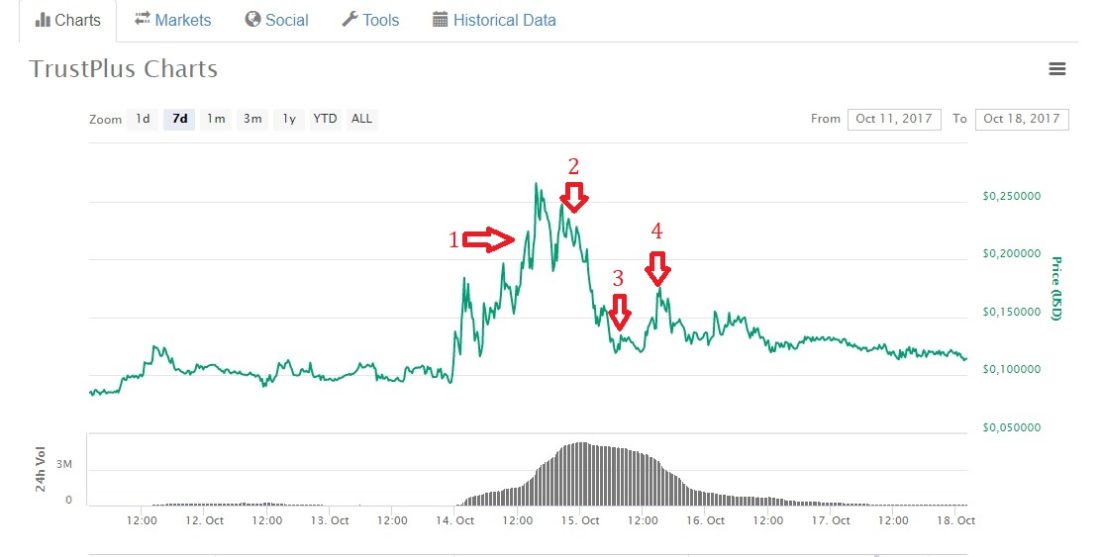
However, pumps have one feature that is relatively predictable - after the first collapse, a new short-term rise often occurs, when “hamsters” join the trading - it is clearly visible from the second, smaller peak on the chart. Thanks to this, by selling the currency at point 2 (even at some loss), you can buy it at the low (point 3) and “try again” by selling it at point 4. But under no circumstances should you buy the coin during the second rise after the pump - losses are guaranteed.
You also need to understand that “secondary peaks” are not typical of very small shit-coins with a capitalization of less than a million dollars. So getting involved in pumps on Yobit is not worth it - the risk is high, and the potential profit is negligible due to the low trading volume.
Does It Make Sense to Subscribe to Pump Channels on Telegram?
Large pump channels, such as Pump Notifier/Trading Signals (almost 30 thousand participants), can provide useful information about pumps. The scams staged by the organizers of such channels usually take place on major exchanges (such as Bittrex), with fairly large volume, and last for at least several hours. So an attempt to take a risk and earn some extra money may make sense.
Channels with an audience of several thousand people (and any channels working with the Yobit exchange) are created purely to “scam” subscribers, and dealing with them is more trouble than it is worth.
Conclusions
 The cryptocurrency market repeats the history of the classic stock market - the same laws, the same manipulations (albeit with the addition of new nuances). Attempts to profit from Pump and Dump schemes in the crypto world are risky and in many ways akin to gambling in a casino - in the end, their organizers still win. So you can “join pumps” only if you have spare funds that you are ready to part with easily.
Respectfully, Alexey Vergunov TradeLikeaPro.ru