
Profiting from Bitcoin's rise and fall with the help of the Yuan

Hello, fellow currency and cryptocurrency speculators!
Digital assets are the youngest and most promising market, which leads to certain problems in analyzing trends. The high volatility of pairs creates many false signals in technical indicators, while the absence of a single trading center and the presence of a large number of trading venues lead to differences in quotes and errors in technical analysis.
In today's article, we will try to figure out how the rate of one of the most popular crypto instruments, Bitcoin, can be forecast with the help of the Yuan, a crafty tactic that still few people know about.

Fundamental analytics for cryptocurrencies is only beginning to take shape; Bitcoin and altcoins react differently and often unpredictably to economic and political news, and ties with the stock market and Forex currencies are still developing in non-obvious ways.
The most accurate indicator predicting the rise in the price of digital assets may be the flow of investments. By constantly observing this value, a trader can easily detect moments of increased investment that will provide a medium-term trend in Bitcoin for several days.
With such information, it is not difficult to determine an entry point by choosing a more "distant" stop-loss, the value of which can then be reduced as early as the next day down to the breakeven level. Large infusions of capital into the cryptocurrency market will cause a pump in the Bitcoin price on the very day of the trade.
It is impossible to obtain such information legally; for that, it would be necessary to get data on fiat deposits to the accounts of major clients of cryptocurrency exchanges and brokers who, according to the company's observations, tend toward a hold strategy rather than active speculation. In many countries, such information falls into the category of prohibited insider information, not to mention that the sale of personal information is itself illegal.
In fact, there is no need to hire hackers or bribe exchange staff: large players operate with large amounts of capital, which, because of its size, "leaves traces" sufficient for analysis. It is important to know which way and where to look: to forecast the rate, you need to watch China and carefully observe the fluctuations of the Yuan.
Facts and factors of China's influence on the Bitcoin rate

The LongHash crypto statistics research portal noted a unique feature of the digital asset market. Unlike many financial and commodity instruments, as well as Forex currencies, the most active period of Bitcoin trading falls during the opening and operation of Asian exchanges.
Take a look at the chart, where the histogram shows hourly changes in price ranges, taken as average values of trading sessions and summed over the last two years. The largest and sharpest fluctuations occur in the period from 24 to 2 UTC, which corresponds to the period from 3 to 5 a.m. Moscow time.
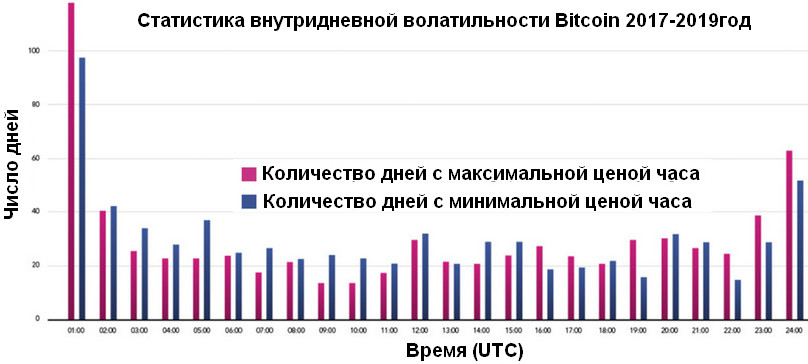
At this time, US exchanges are closed, although it is during the period of operation of American venues that most trends in Forex, stock indices, and commodity futures are formed. Indeed, cryptocurrencies often do not show a strong reaction to changes in the Fed interest rate or the release of GDP data from developed countries, but they may react excessively to Asian statistics, exceeding the figures of the yen, the leader in volatility among the major Forex currencies.
Among Asian countries, China still has the greatest influence on Bitcoin. Before 2017, this country's primacy in cryptocurrency trading was obvious; it was enough to estimate the trading volume of the national crypto exchanges.
The paradox of Bitcoin mining in China

Two years ago, the PRC authorities decided to ban Bitcoin and altcoins, which make it possible to move funds abroad anonymously and without hindrance. The country totally controls, strictly regulates, and limits any external transactions and even company investments.
The unofficial ban that followed led to the complete disappearance of cryptocurrency exchanges in mainland China. Companies moved their business to Hong Kong, Singapore, and offshore jurisdictions, greatly reducing trading volumes. Chinese business can no longer directly or indirectly participate in the purchase of Bitcoin because of the risk of being blacklisted and losing access to banking services.
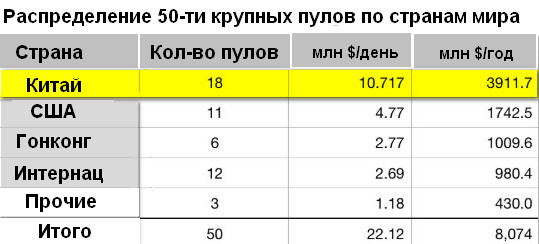
A paradoxical situation has emerged, since the PRC has retained leadership in BTC mining: the state accounts for 18 largest pools with daily coin mining worth 11 million dollars.
It is hard to assume that none of them sells the mined Bitcoin, or that large local business, with its developed network of branches and offices around the world, does not invest in digital assets.
After the authorities' unofficial taboo, investments in digital assets ceased to flow directly; no one can oppose the Communist Party of China, after whose call BTC/CNY turnover practically disappeared from exchange offices. There is, in principle, no data on such a pair on the worldwide Internet, except perhaps in hypothetical or calculated values through Forex market cross rates.
Chinese banks have a letter requiring them to identify and report direct investments of clients' Yuan into cryptocurrency; however, no one has forbidden the purchase of dollars. It was precisely this asset that became the intermediary for the purchase of Bitcoin, which enjoys the main demand.
The Chinese trace and stablecoins

For us, just as for Chinese banks, it is impossible to reliably track what percentage of the exchange of Yuan into dollars went into investments in digital currencies, if not for one feature of the crypto market by which traces of these investments can be found.
In 2016, the company Tether, affiliated with the Bitfinex cryptocurrency exchange, invented a unique thing: the stablecoin. This is a token issued on any reliable blockchain, the exchange of which is guaranteed by the issuer at a strict rate.
Tether exchanged fiat dollars for the crypto analogue USDT at a 1-to-1 peg, placing the received cash into a reserve fund. On the one hand, the issuance of tokens could be easily verified, since they were tied to the Bitcoin blockchain; on the other hand, they could always be exchanged back, receiving fiat from the fund, also 1 to 1.
The coin first found use on cryptocurrency exchanges that did not want to deal with national currencies so as not to face claims from regulators. Later, Tether spread in the USA, where traders exchanging one crypto asset for another could avoid paying taxes.
The above events boosted demand for the stablecoin, but as can be seen from the USDT capitalization chart, it crossed its first billion in 2018.
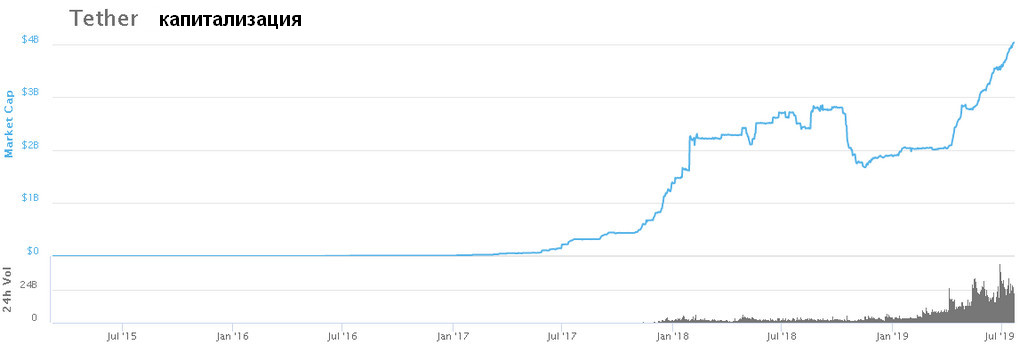
At that moment, cryptocurrency exchanges in the USA held a 39% share of the token's trading turnover, while the rest of the world accounted for 48%. At their peak turnover at sunset (Q4 2017), Chinese crypto venues "consumed" only 12% of USDT.
Crypto rating analytics agency Weis gathered statistics on the quarterly change in Chinese traders' interest in Tether USD. Along with the growth of the stablecoin's capitalization, China captured most of the trading turnover and continues to increase it in 2019.
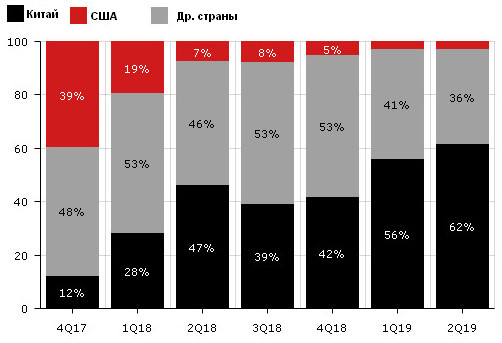
The 62% share figure clearly explains why Bitcoin and altcoins are the only financial assets in the world that react more to Asian session events and are also directly tied to PRC statistics and the monetary actions of the People's Bank.
Two Yuans

The yuan is not a freely convertible currency: 2% from the Central Bank rate is the maximum deviation allowed for banks and exchanges. Trends in the USD/CNY pair are entirely "man-made" and subordinated to the current monetary policy tasks of the Central Bank.
Like any artificial formation, the yuan's value curve does not fit into the "natural background" of the Forex market, so it is difficult to use it to forecast the Bitcoin rate. Of course, cryptocurrency rises as the yuan weakens, but exactly the same reaction will be caused by a strengthening of the national currency.
Both processes are easy to explain fundamentally. First, the People's Bank wanted to create a buffer by weakening the effect of rising tariffs from the USA and lowering the rate, while at the moment the financial regulator wants to slow credit activity when China's external debt has doubled the value of American debt.
The USDT/CNY rate does not obey Central Bank "orders"; the value of the yuan in crypto dollars is determined by market trading. It was shown above that by exchanging CNY for Tether USD, investors pursue only one goal: to invest funds in Bitcoin and altcoins.
By comparing the value and dynamics of the two yuans against USD and USDT, it is possible to draw unambiguous conclusions about the upcoming rise or continuation of the Bitcoin trend.
Methods for Forecasting the Bitcoin Rate by the Yuan's Value

The first method of forecasting the future BTC trend consists of constantly monitoring the yuan to USDT rate on the over-the-counter (OTC) market.
The most liquid venue for buying and selling USDT for CNY is the Huobi platform. By opening the company's information desk, you can get information on the current value of the yuan from the first three offers.
Compare it with Forex market quotes, which can be obtained in the Metatrader 4 terminal or in any financial application, for example, Google.
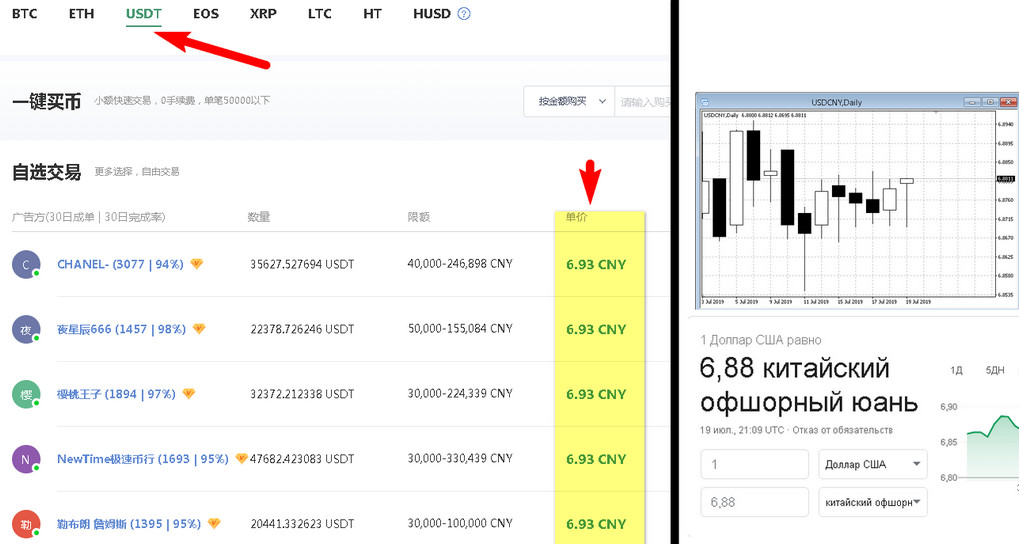
A positive difference in the spread (the cost of CNY for USDT) above 1% will indicate a medium-term upward trend, above 3% the danger of buying and a high probability of correction (overbought), equal value or a negative spread means a medium-term fall in BTC.
The measurement should be taken after 5 a.m. MSK using the day's yuan values. In overbought zones it is dangerous to sell: during negative news the spread can reach 10%, but the correction is flat and is quickly replaced by a further rise in the value of Bitcoin.
Combining the USD/CNY and USDT/CNY charts will help determine discrepancies visually; the latter can be found on the GATE.IO exchange. In this case there is no need to look at the price, only a graphical comparison of closed daily candles will do.
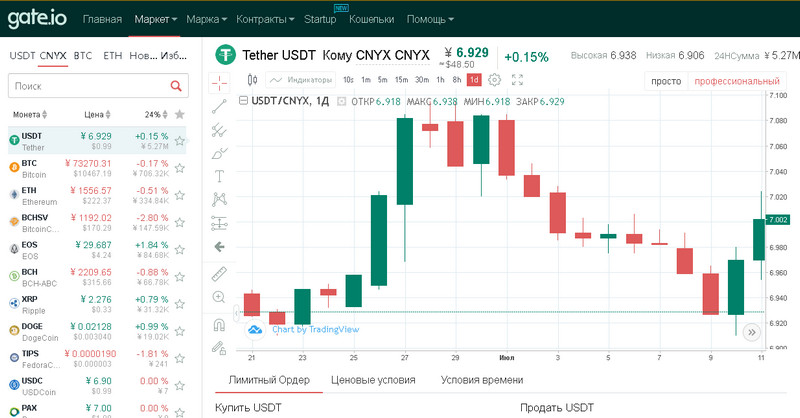
Divergence should be positive, the USDT to yuan rate should rise, while the USD/CNY chart should fall; this is a signal to buy BTC.
It is desirable that this be the first discrepancy found; if the trade went into the red and the divergence continues, it is worth holding the position for one more day, while placing the previous trade for closing at the entry price.
The reliability of the signal is determined by the size of the discrepancy: if one of the charts forms candle "stubs" (a small body and short tails), then such patterns should not be taken into account.
Despite the fact that the GATE.IO exchange uses the services of the TraingView portal to build a chart of trading results, it cannot be opened in the service itself outside the venue's online terminal, which leads to certain inconveniences during analysis.
The user does not have access to tools for comparing financial instruments on one chart, so they will have to combine three windows on their own: USDTCNYX from the GATE.IO site, USDTCNY and BTCUSD from the Metatrader 4 platform.
Analysis Algorithm

To compare the instruments and detect divergence:
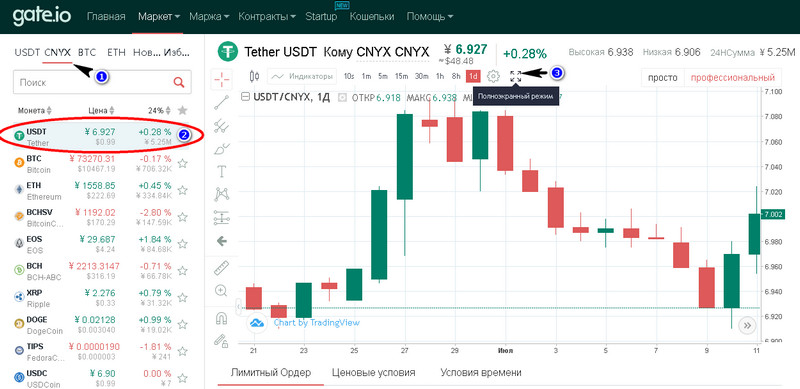
1. Open the website of the Gate.IO exchange, select the CNYX market tab on the left (1), and click the USDT row (2) to get the pair chart, which can be displayed in full-screen mode (3).
2. In the Metatrader 4 program, find the USDTCNY and BTCUSD pairs in the symbols list by displaying their charts.
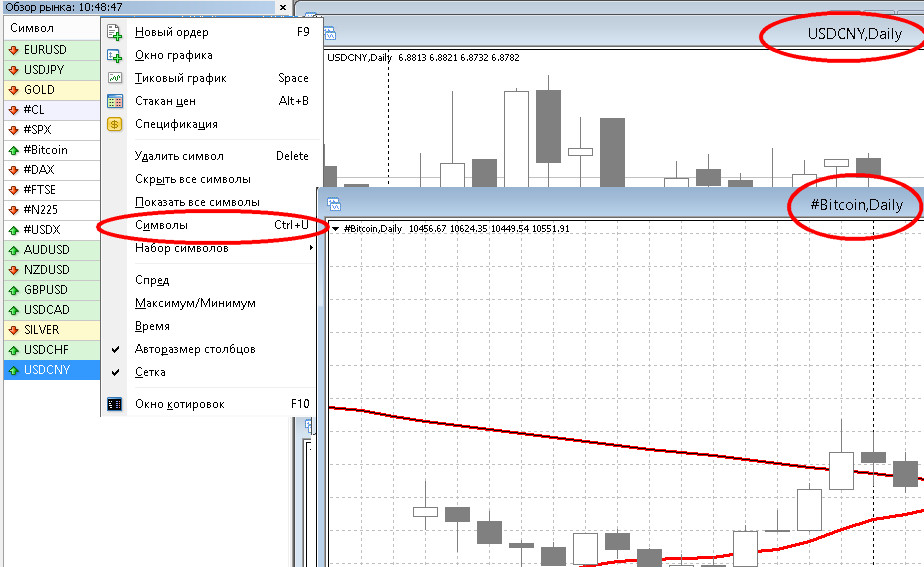
3. Arrange the three windows together, manually synchronizing the daily candles. Remember that there is no weekend trading in the USDCNY instrument, so such days will have to be skipped.
The trader's task is to detect a positive divergence (its beginning) in order to enter and hold a long position in Bitcoin.
The reverse (negative) divergence between USDTCNY and USDCNY may help forecast a correction, but it is not worth opening a speculative short in BTCUSD. During a long-term trend, cryptocurrency has high volatility at reversal points, which will lead to frequent triggering of stop-losses.
Conclusion

The topic of cryptocurrencies appeared 10 years ago, and exchange rules began to take shape in 2014. Each new year brings many changes and new innovative discoveries in the field of blockchain. It should be acknowledged that it is impossible to determine the class of these instruments with sufficient precision: they resemble a currency, but also have the characteristics of "digital gold" or stocks, if we consider the mining process as receiving dividends.
The amorphous classification and dualism lead to the fact that the price of Bitcoin may follow stock indices, may suddenly collapse during a rise in the dollar's value, or grow together with it because of global economic problems.
All of this complicates forecasting methods and the selection and search for analysis tools. The options found "today" may reliably predict trends, while "tomorrow" they may no longer match market tendencies.
Respectfully, Alexey Vergunov
Tlap.io
