
Price Action: Entering on a Pullback
 Pullback trading is one of the ways to trade Price Action patterns. Like breakout trading, this style involves the use of pending orders. Pullback trading is less popular than trading a pattern breakout, but when Price Action signals are used correctly, it can deliver more profit with lower risks. Why is pullback trading unfairly ignored by most traders, and how should orders be placed correctly to get the maximum profit?
Specific Features of a Pullback Trading Strategy
This strategy, like all other trading systems based on Price Action, is considered universal and multi-currency, suitable for any asset and timeframe. Nevertheless, it is recommended to trade liquid currency pairs, such as EURUSD or GBPUSD, on hourly or four-hour charts. D1 is also suitable for trading.
When trading pullbacks, traders place limit orders (unlike breakout trading, where "stop" type orders are used).
The Principle of Pullback Trading and the Order Placement Algorithm

The main idea of the strategy is that before moving in the desired direction after a pattern forms, the price most often pulls back, and if you catch the moment of that pullback, you can enter the same trade on more favorable terms, with a smaller stop-loss and a larger take-profit.
Pullback trading is carried out as follows:
- A Price Action pattern appears on the chart. This may be an engulfing pattern, a doji candle at a trend reversal, etc.;
- At the opening of the next candle, a Limit-type pending order is placed (a buy order if an upward trend is expected, and a sell order if a downward one is expected). The order is placed approximately at the middle of the signal candle;
- The stop-loss is placed a few points beyond the extreme of the signal candle (below the low if buying, above the high if selling);
- The take-profit is set at the trader's discretion. One option is to multiply the stop-loss size by 3 or 4, or place the take near the next key level so that when the price reaches that level, it is guaranteed to touch it
An Example of Pullback Trading

As an example, let us take a detailed look at pullback trading on the hourly EURUSD chart. As an alternative, we will also consider the option of opening a breakout order in this situation and compare the results.
Events developed as follows:
- After a strong bullish trend, a bearish doji candle formed, signaling at least a correction;
- At the opening of the next candle, a Sell Limit order was placed (in this case, the order was opened at market because the price at that moment was at the level of the expected pending order);
- The stop-loss was placed above the high of the signal candle, and the take-profit near the nearest support level;
- The stop-to-take ratio was approximately 1:2.5, which provides a positive mathematical expectancy for the trade;
- After 5 hours, the trade closed in profit.
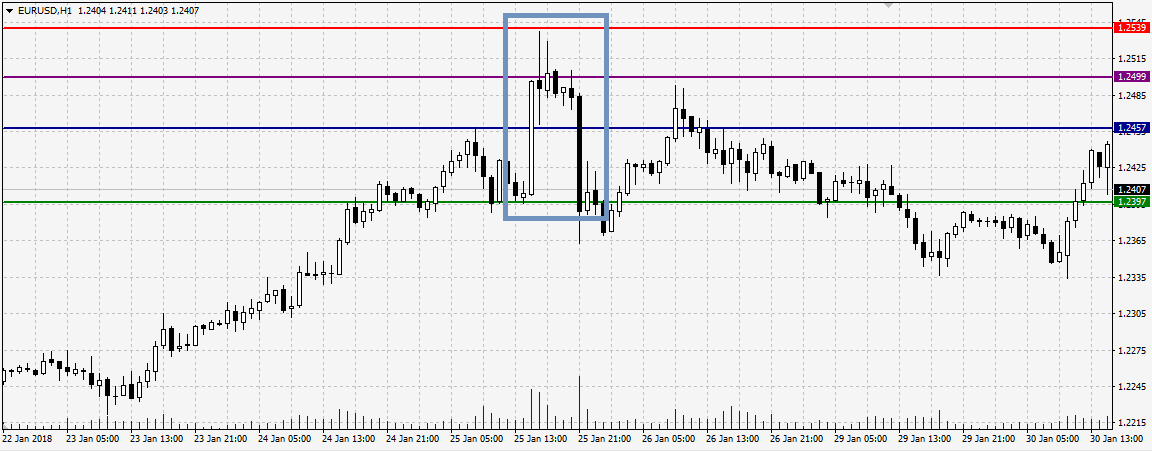 In the screenshot, the pullback trade entry level is marked in purple, and the alternative breakout trading option in this same situation is marked in blue. The stop-loss and take-profit (the red and green lines respectively) are the same for both trades.
In this case, both trades would have been profitable, but the profit from breakout trading would have been almost 2 times smaller, and the stop-to-take ratio would have been 1.5:1 not in favor of the take-profit, which is unacceptable from the point of view of money management.
Additional Nuances of Pullback Trading

Although in the example above pullback trading turned out to be more profitable than breakout trading, it cannot be claimed that this style is absolutely better. Pullback trading also has its drawbacks.
Unlike breakout trading, which can be applied to all possible Price Action patterns, limit trading is possible far from every situation. Because of this, the number of signals and possible trades is reduced, which means potential profit will also be smaller. Despite the fact that in breakout trading the take-profit is usually smaller than in limit trading. Due to the greater number of trades during the same test period, breakout trading can bring greater profit.
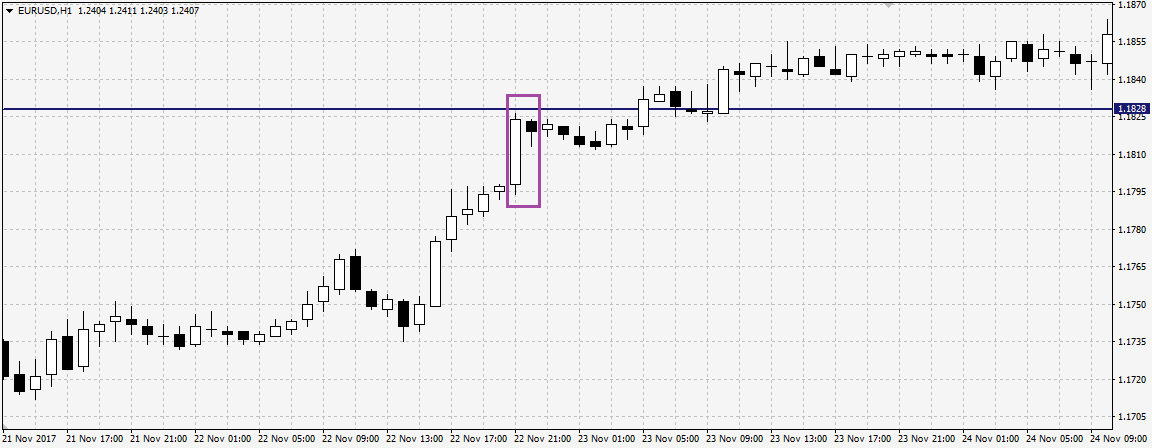 For example, the screenshot above shows the trend continuation pattern inside bar. In breakout trading, a pending order is placed above the high of the mother bullish candle, which opens a few hours later, and then the trend continues upward, bringing the trader profit. In this situation, there are no prerequisites whatsoever for limit trading.
It is impossible to place a pending order at the middle of the inside bar, and there is no logical justification for placing it at the middle of the mother candle.
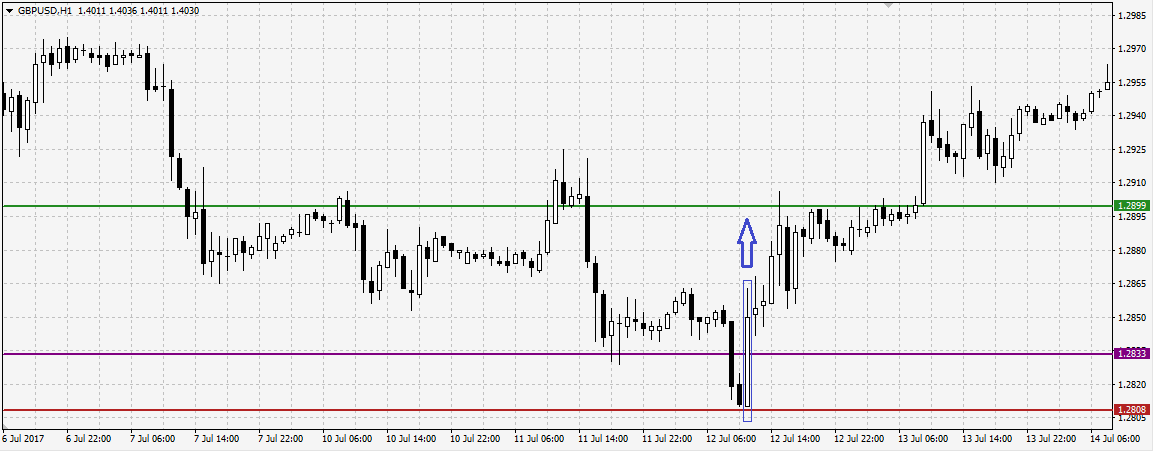 It happens that the signal to open a pullback trade using a limit order does not trigger, even when all prerequisites are present. For example, when an engulfing pattern formed in the screenshot above, placing a limit order at the middle of that pattern was quite logical.
However, because the signal candle turned out to be too strong, the pullback movement did not reach the placed pending order, and the trade did not open. In this same situation, with breakout trading, the trade would have opened on the very next candle, and a few hours later the trader would have locked in profit.
Conclusion

Price Action pullback trading has both advantages and disadvantages. On the one hand, this style allows you to make more profit with lower risks in the same situation where breakout trading shows less attractive dynamics. On the other hand, far from all price action patterns are suitable for this style, and moreover, even suitable signals sometimes fail to trigger, leaving the trader without profit.
The choice of trading style largely depends on the trader's temperament. The pullback method suits patient and conservative specialists who are ready to wait for a signal for days and even weeks. In the end, such waiting will be rewarded with high profits on each trade (and if some close at a loss, the losses will be minimal). More aggressive traders are better suited to breakout trading, which allows them to enter the market more often, compensating for the small profit size and probable losses with the number of profitable trades.
Respectfully, Pavel Vlasov TradeLikeaPro.ru