
No Stress Strategy - he who understood life is in no hurry
 Hello, ladies and gentlemen forex traders!
In this lesson, we will examine a strategy called No Stress, aimed at calm and measured trading. As follows from the name, the trading system fully corresponds to the principles of "preserve first of all", and only then multiply trading capital. It also draws attention by the presence of positive statistics and a PAMM account based on it.
Not so long ago, we discussed the advantages of long-term trading in the webinar "Secrets of D1", it is time to apply the knowledge gained in practice.
Trading System Characteristics
Platform: MetaTrader 4
Currency pairs: Any
Timeframe: H4-MN
Trading time: Around the clock
Recommended brokers: Alpari, RoboForex, TickMill
First of all, I would like to express gratitude to a participant of our forum - DiamondVVV for sharing this strategy.
Below is the monitoring of a real account for this system:
 Also, you can invest in the PAMM account for this strategy.
The Idea Behind the Strategy

Surely you have noticed those very long trends on H4 and D1 charts, the duration of which sometimes amounts to long months. It would seem - one could have taken a huge number of points - bought and waited. However, not everything is so simple - corrective movements knock traders out of the market.
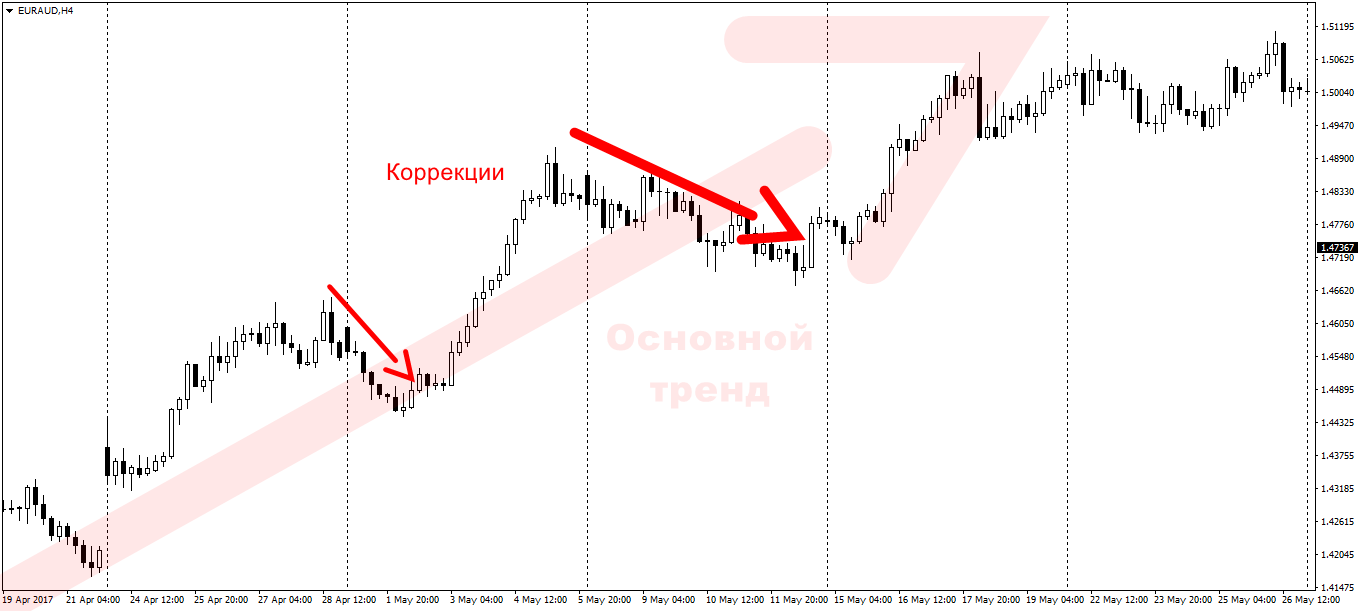 This strategy is precisely aimed at capturing those very large movements. Some balance has been found here between sensitivity to the entry and its significance. And this line, as we can see from the monitoring of the real account, has been chosen very competently.
Strategy Setup

Now let us move directly to the system itself. Installation is performed in the standard way. First open the terminal data directory through File - Open Data Folder. Move the No Stress.tpl template file to the templates folder. Move the indicator files to the MQL4 - Indicators folder, and restart the terminal. After that, select the No Stress template from the list.
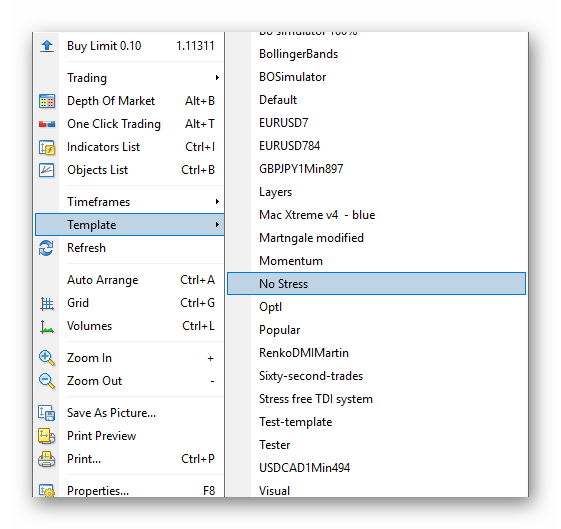 In total, the template consists of 6 tools:
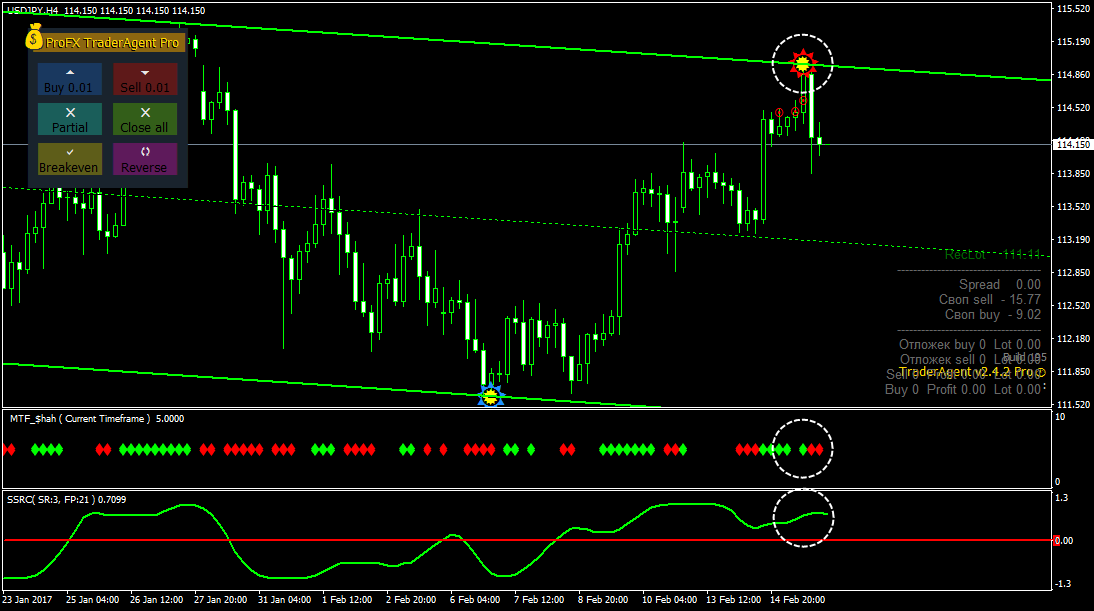
- The NB-channel indicator builds a channel based on the latest price extremes. We will use this indicator to determine the trend direction;
- FL11 is an indicator of non-standard fractals. It gives signals in the form of yellow circles with red or blue edging - we will call them a full sun. The remaining fractals (without edging) are less significant, but they will also be used;
- The next indicator is $hah. Everything is simple here - with a green signal we will identify buys, with a red one sells;
- Finally, the SSRC oscillator. In it we will look at overbought/oversold zones. That is, when the line is above zero - we will sell, when below - we will buy;
- There are also elements from the ProTrader auxiliary expert advisor on the chart. The author of the trading system uses the panel to set stop losses;
- In the lower right corner of the chart there is a small window with the spread and the recommended lot.
Trading Rules
The main timeframe is H4. We will enter with two orders of the same size. For example, 0.01+0.01 lots. The first thing we wait for is the appearance of a full sun on the H4 chart. After that, we look so that the slope of the channel is in the direction of the proposed trade. Next, the $hah indicator should turn red (for a sell) or green (for a buy). SSRC is in the overbought zone (for a sell) or oversold zone (for a buy).
Thus, the sequence of actions for opening a position looks like this:
- A full "sun" has appeared;
- The slope of the channel is in the direction of the proposed trade;
- $hah has turned the color of the proposed trade (green = buys, red = sells);
- SSCR is in the opposite direction from the proposed trade, relative to its zero level. That is, for buys it should be BELOW the zero level and ABOVE for sells;
- After all the conditions are met, move to the D1 timeframe. The latest FL11 indicator signal must correspond to the one on H4. If on the daily chart there is not a full sun but a corrective one, we do not enter the trade.
To place the stop loss, look for the previous full-fledged sun of the same direction and place the stop loss behind it. Undoubtedly, the stop loss may turn out to be large, but, on the other hand, the system is also long-term.
Let me remind you, we enter the market with two orders, which we will close separately. To close the first order, the following conditions must coincide:
- First, a full or corrective sun of the opposite direction has appeared;
- $hah has shown a color against our trade;
- The SSRC indicator is on the side unfavorable for us. In the case of a buy, this is the overbought zone, for a sell, the oversold zone.
An important point! When closing the first order, we immediately move the second one to breakeven.
A logical question is what we will do next with the second order? So, first we wait for a full sun against us on H4, then we wait for a full sun on D1. Next, we check the same on the weekly and monthly charts.
This approach is quite conservative. But you can also close the trade when a full opposite signal appears. Most likely, it is the opposite signal that will appear earlier.
Trading Recommendations

Possible situations may arise when a full signal appears at a better price. That is, after opening, the price moved against us, forming a new signal. In such a case, scaling in is allowed.
Since the holding time of trades is quite long, some elements of carry trading can be applied. That is, we open trades only in the direction in which a positive swap can be earned. In this way, you can get a small addition to profit.
Money management is 1% of the deposit per order and 2% per trade. That is, a total of 2% risk across two orders. For automatic lot calculation, the strategy author uses the popular ProTrader utility. Alternatively, you can use the lot calculator. The calculator is located in the Tools section on our website.
Examples
First of all, we note the appearance of a full sun with a red outline, a signal to sell. Next, we look at the slope of the channel. The channel slopes downward, that is, in the direction of our trade. Then, we wait until the $hah indicator turns red, and the SSRC moves into the overbought zone (rises above zero). As soon as these conditions are met, we move to D1.
 The latest full sun on D1 must match the direction of our trade. If the condition is met, we enter the trade with two orders.
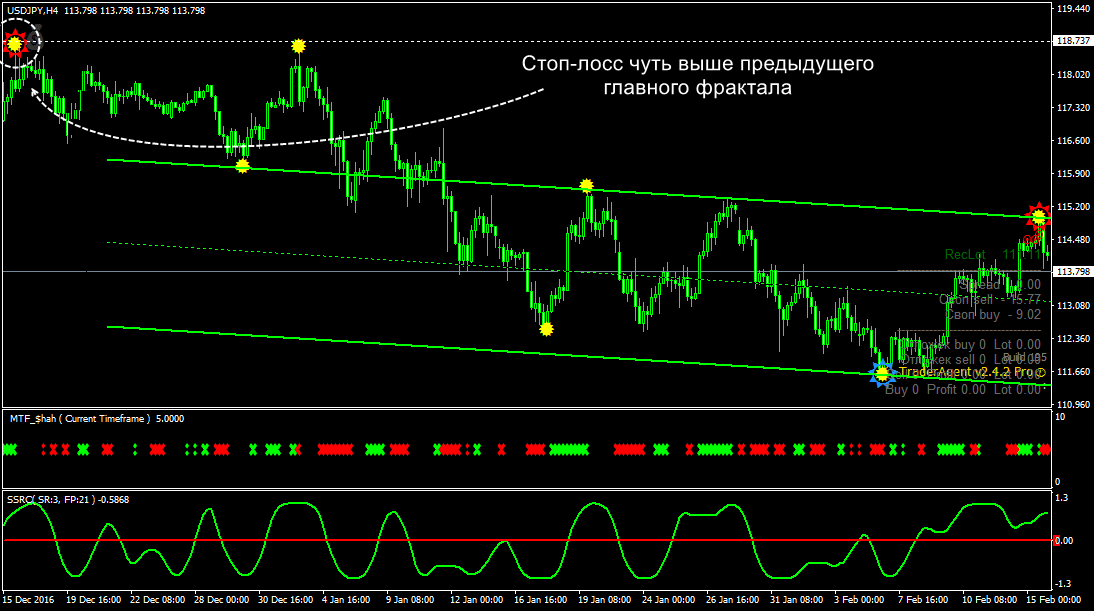
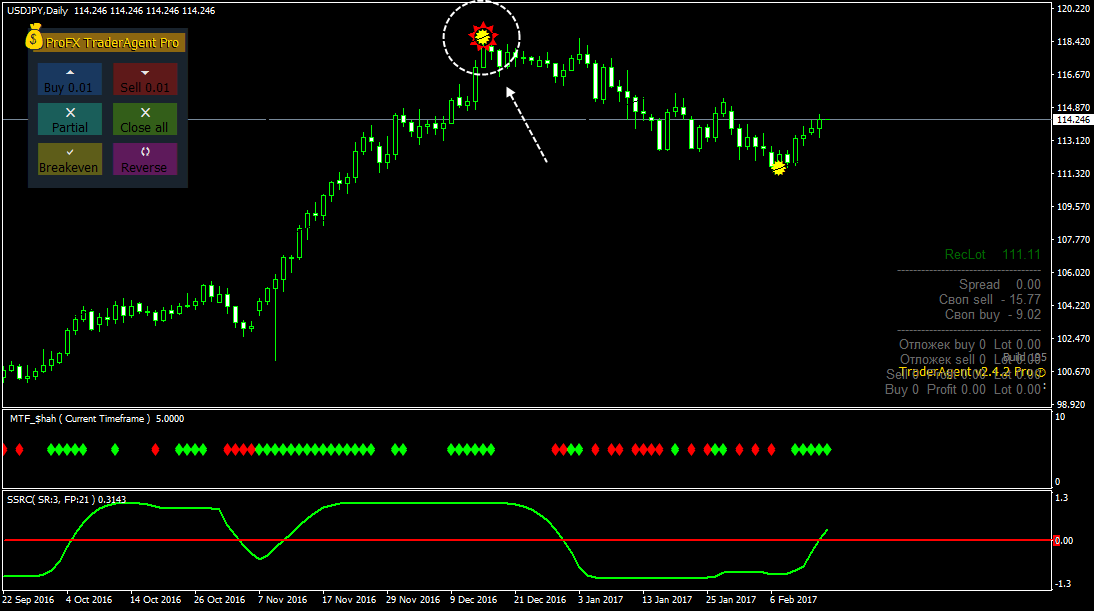 To place the stop loss, we return to H4. We set the stop behind the nearest main fractal (full sun) of the same direction (excluding the signal one).
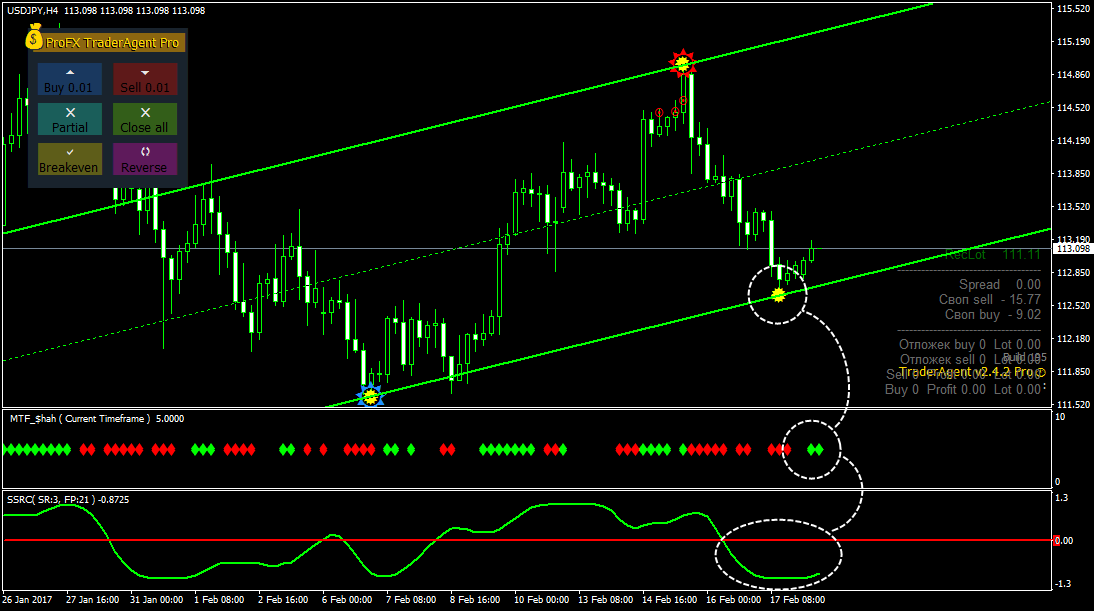
 To close the first trade, we need 3 conditions to be met: the appearance of an opposite fractal (full or not); $hah has turned green; SSRC is in the oversold zone. After closing the first order, we move the second to breakeven.
 We close the second trade when full suns appear on the H4, D1, W1, and MN timeframes. That is, the latest full sun on all of the specified TFs must be opposite to the direction of our position.
Otherwise, we close the trade on the opposite signal. That is, first we check that the conditions match on the H4 chart.
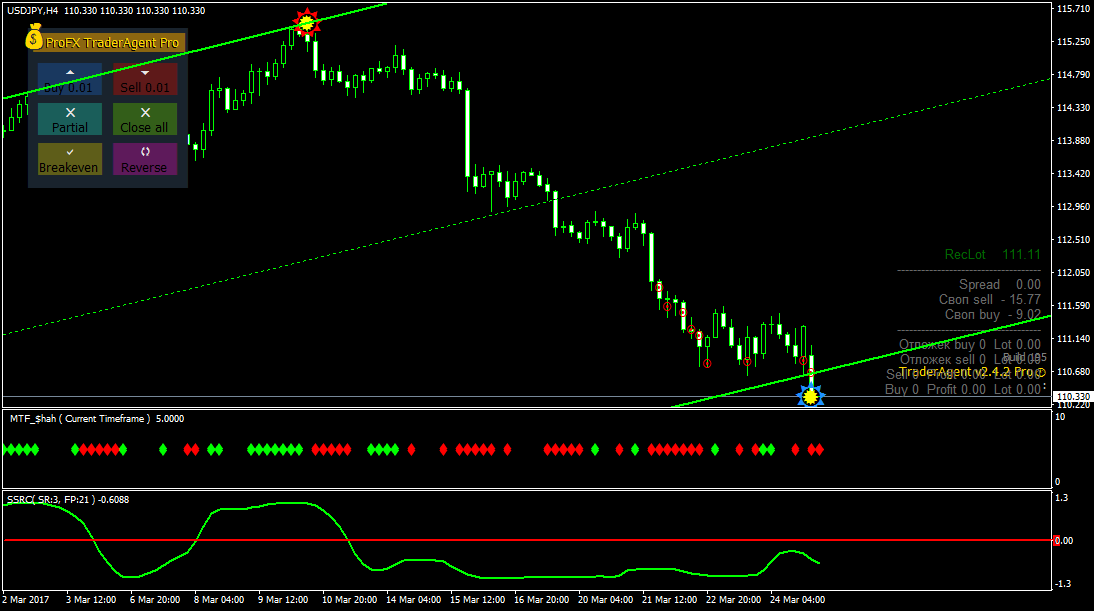 Then the presence of a full sun on D1.
Conclusion

Given the presence of live monitoring, the strategy's effectiveness should not raise questions. Overall, the trading system is interesting, but it will not suit those for whom earning money in the market is primarily entertainment and a way to "blow off steam." That is, this is long-term trading in its truest form, which has some obvious advantages: it does not require a high percentage of profitable trades and allows you to save on spreads and commissions. For the best results, be sure to study the forum thread. Also, do not forget about money management and, most importantly, be patient.
Download the No Stress Strategy Files

Sincerely, Pavel Vlasov
TradeLikeaPro.ru