
Is It Worth Trading Exotic Currencies: Arguments For and Against

Hello, fellow traders!
The greatest attention in the Forex market is paid to the major currencies. This happens for simple and understandable reasons: high liquidity, relatively low volatility, and protection from local crisis events. However, each of us, to one degree or another, tracks at least one exotic currency in which our own country's money is denominated.
In today's article, we will examine the pros and cons of trading exotic instruments.
The name "exotic pairs" includes a broad definition of uncommon low-liquidity national currencies paired with the dollar or euro. They may belong to European countries (Norway, Denmark, etc.) or large Asian countries (the Hong Kong dollar, the rupee, the Korean won), but mainly these are the currencies of developing countries with a low level of contribution to the global economy.
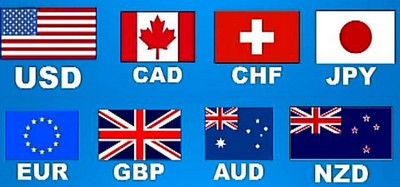
A simpler definition of exotic pairs is any pair that goes beyond the 28 combinations of 8 major currencies:
Why do traders trade exotic currencies?

The most common reason for trading "exotics" is home currencies. Each of us knows the "ailments" of our own state's currency, hedges inflation risks, and protects income.
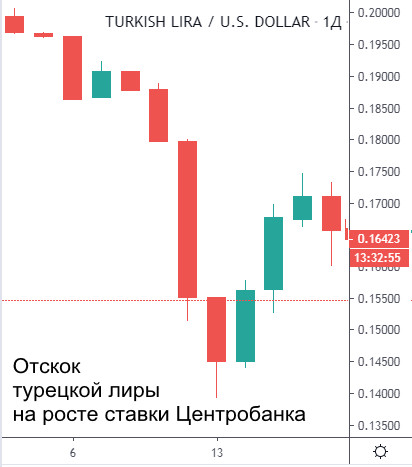
The greatest influx of traders into exotic currencies is observed when some country experiences a local economic crisis. Problems do not disappear in one day, and volatility and short-term weakening against the dollar and euro give speculators an opportunity for "currency hype."

Such earnings last until emergency measures are taken by the local Central Bank, which can lead to a strong rebound at the most unpredictable moment. The risk of hype justifies minimal investment, high leverage, and potential earnings of 3000-4000 pips over a very short period.
For regular trading in exotics, the following strategies can be used:
The currency derivative "protects" the borrowed funds from depreciation in case of an unexpected fall in the value of the national currency. Interest on a foreign-currency loan may be several times lower than the rate of the national Central Bank; this difference will be guaranteed and almost risk-free earnings for the trader.
Most "exotics" have a so-called special exchange-rate regime. The national Central Bank is obliged to maintain a rigid peg to one currency or a basket of major currencies. The IMF allows the local regulator to keep the rate not in a specific linear relationship but within a certain corridor, the parameters of which are public information.
A directed regime means that the Central Bank is obliged to ensure a one-to-one peg of the national currency to the euro, the U.S. dollar, or other "anchor" major currencies. This is impossible to maintain in everyday exchange trading, which gives traders the opportunity to catch deviations from the currency constant above and below.
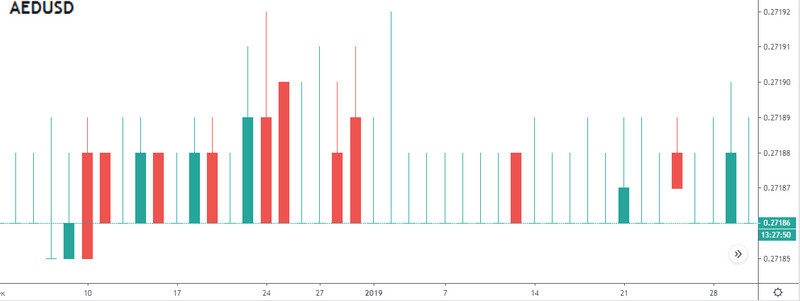
The Emirati dirham (AEDUSD) is an excellent example of the stability of an exotic's rate against the U.S. dollar, where the tails of the candles provide daily opportunities to make a profit.
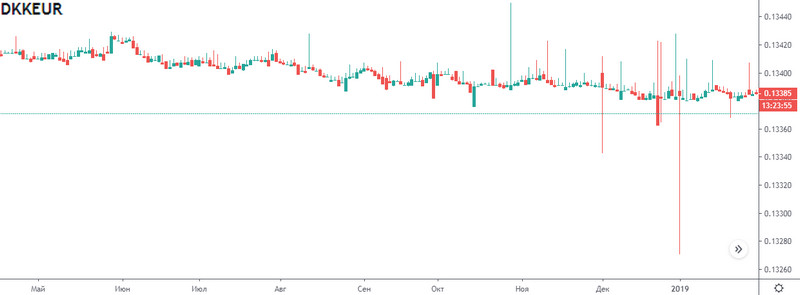
A similar example for the euro is the Danish krone: the local Central Bank seeks daily to finish trading at a 1:1 rate with the euro, but deviations are still present on the chart.
Developing countries often have an export structure with a sharply dominant share of agricultural products or minerals, rising prices for which can lead to strong trends in the national currency. The effect of commodities on the exchange rate, the nuances, and trading strategies are described in more detail in a separate article on our website.
If a trader is able to forecast crop yields, has access to raw-material consumption forecast analytics, and knows the country's local news, they will be able to create medium-term strategies for certain exotic currencies.
Any tradable instrument, whether a currency, stock, bond, or commodity, has features the knowledge of which allows a trader to study and create a set of specific patterns that guarantee a high probability of profitable trades:
Trading major currencies gives 8 pairs and 28 different combinations of them; this is enough to implement the principle of a multi-currency strategy and free trading from the unpredictable movements of exotic pairs. They may arise due to a state's internal policy or the specifics of the current local economic situation.
Why shouldn't you trade exotic currency pairs?

Traders are often attracted by the high volatility of exotic pairs. In a day, a currency can bring three to five times more profit than "fast" pairs with the yen. But high volatility increases the loss because of the size of stops, and brokers often limit the amount of leverage on such instruments.
Daily preparation for the trading session requires mandatory study of the economic news calendar. Exotic currencies will increase the time this process takes, since the trader will have to track a mass of information on each country in order to be ready for unexpected intraday moves or to stay aware of changes in monetary policy.
Trading exotic currencies is quite specific and requires additional time to study the features of each of the selected currency pairs. It will be difficult for a trader to trade exotics using technical analysis; some of them have limited intraday trading time, while volatility and gaps introduce a high margin of error into the values of indicators that generate many false signals.
Such a phenomenon can often be observed in "home currencies"; for example, speculators trading the ruble on Forex earn money during tax periods, spikes in volatility during the Bank of Russia's activity in the market, and so on.
Exotics make it possible to occupy your own niche by working out nuances that market makers and large players, busy speculating on major currency pairs, do not pay attention to.
Respectfully, Ivan Petrov
Tlap.io
Conclusion

Trade exotic currencies is quite specific and requires additional time to study the features of each of the selected currency pairs. It will be difficult for a trader to trade exotics usingtechnical analysis, some of them have limited trading timeintraday, volatility andgapsintroduce a high error into the valuesindicators, generating many false signals.
On the other hand, the specifics of exotic currencies, with a careful study of history and fundamental features, will give the trader a set of patterns that bringprofitin the long term.
This phenomenon can often be observed in “home currencies” - for example, speculators trading the ruble forForex, make money on tax periods, surges in volatility during work on the Bank of Russia market, etc.
Exotics allow you to find your niche, working out nuances that are not paid attention tomarket makersAndmajor players, engaged in speculation on major currency pairs.
Best regards, Ivan Petrov
Tlap.io
