
How to Trade the Ethereum Cryptocurrency
 Hello, fellow forex traders!
Earlier we already discussed how to trade Bitcoin, and now it is time to look at the new popular cryptocurrency, Ethereum.
A logical question is why would I need some newfangled hipster cryptocurrencies when there is the good old EURUSD? Everything is very simple: if on old instruments the market long ago learned to work out all the typical inefficiencies, then on new ones there is an untouched field of opportunities. Put simply, on new instruments even the most basic technical analysis strategies can bring hundreds of percent in profit, while on established currencies you would hardly even break even with similar systems.
The very fact that the popularization of the Bitcoin cryptocurrency has disturbed the shaky foundations in the minds of lawmakers already speaks to the viability and potential power of the new technology. It turns out that there really can exist a currency not subject to any state. And the point is that we are no longer even talking about bitcoins, but about many other currencies built on blockchain technology, whose popularity is growing exponentially. A natural question arises: what does the future of cryptocurrencies belong to? So let us figure out whether that ideal cryptocurrency has been found and what exactly it should represent.
What Is Ethereum
 The founder and one of the main developers of the project is Vitalik Buterin, a Canadian programmer of Russian origin. He was born in the Moscow region, in the city of Kolomna, and moved to Canada at the age of six. In July 2014 he received a grant of 100 thousand dollars for the concept of a new cryptocurrency, and in the same year he became the winner of the World Technology Awards.
 The development is based on that very blockchain, a technology of decentralized bookkeeping. In the context of cryptocurrencies, blockchain is a distributed database for storing transactions. It is within it that all transfers between wallets are confirmed and synchronized.
The Ethereum concept tries to develop the idea of Bitcoin into something more large-scale. In essence, Ethereum is a platform for developing decentralized applications. In Ethereum it was decided to implement at the protocol level the untapped potential of the Bitcoin scripting language by adding a tool for creating smart contracts to the network.
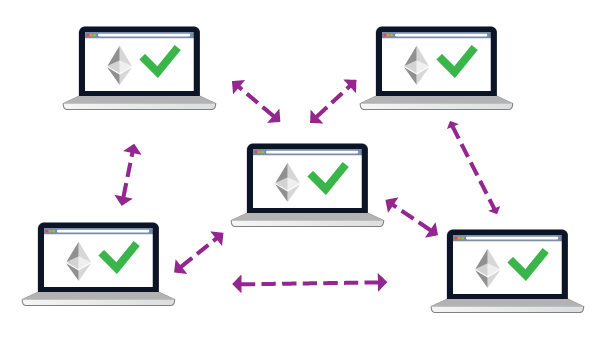 A smart contract is an attempt to automate transactions, where all conditions and the result of the transaction are accounted for in advance. This simultaneously ensures security and reliability, since no third parties are involved in the procedure and the contract conditions cannot be changed.
With the help of such contracts, for example, it is possible to carry out a real revolution in microcrediting. The terms of such a contract may imply the transfer of ownership of some digital property in case a loan is not repaid by a certain date, repayment taking accrued interest into account, and much more. In essence, the capabilities of smart contracts make it possible to create your own currency inside another currency.
In theory, Ethereum is capable of completely displacing Bitcoin from the market, being its more advanced alternative. This is helped by the presence of a coordinated team of developers and a focus on active development. However, the stability of Ethereum's operation is still in question.
In fairness, it is worth noting that the implementation of the same smart contracts also exists on Bitcoin, provided a separate setting is used. If this mechanism gains popularity, Ethereum's future will not be obvious.
Main Problems

One of Bitcoin's big problems is the size of the blockchain. With the arrival of the new currency, the problem has only become worse, which is why launching the wallet requires a simply unacceptable amount of time. This factor can seriously slow growth once a certain mark is reached, because it will directly affect the spread of the currency.
Another extremely unpleasant story not long ago happened with the decentralized crowdfunding project “The DAO,” built on the basis of Ethereum smart contracts. Thus, about a third of the entire fund (approximately 50 million dollars equivalent) was transferred to the wallets of a single person who took advantage of a vulnerability in the smart contract code. The problem is that all responsibility in a decentralized system falls on computer code, which, if it contains errors, can lead to a large-scale failure, which is exactly what happened.
As a result, it was decided to create a parallel branch of the project and fix the discovered problem. This led to a split in the community, since the original ideology of the free open source project was aimed at eliminating financial corruption and the absence of manual interference in the functioning of the network. Now we have the “corrected” Ether from the main project branch, ETH, and the “classic” unchanged Ether, ETC (Ethereum Classic), to which everyone who disagreed with the hard fork decision moved.
In general, investors react very emotionally to any rumors regarding the project. Thus, the fake news that appeared on the evening of June 25 about the death of the founder of the cryptocurrency project accelerated the fall in the rate even more. In truth, after that the rate recovered to its previous value.
Where to Get the Chart
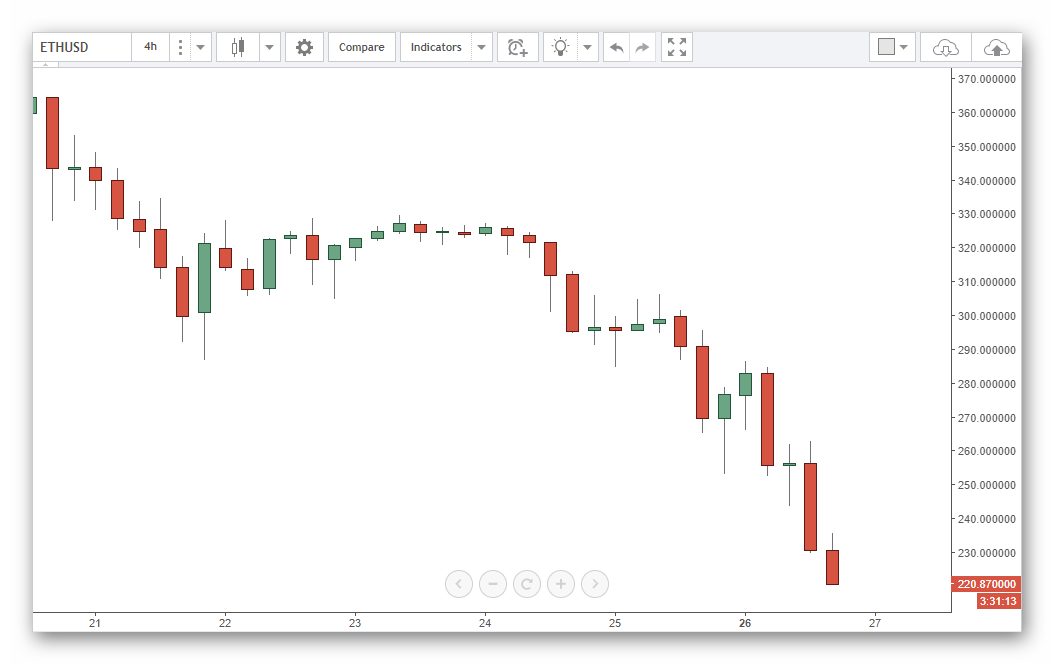
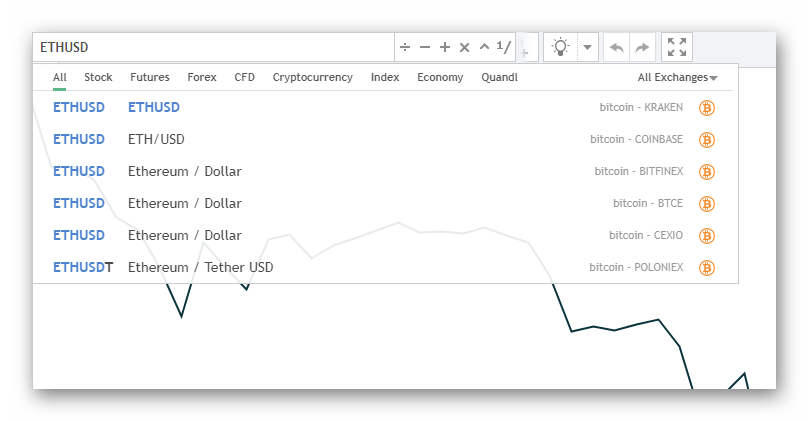
 You can get the currency chart through the TradingView service right on our site in the online charts section by specifying the ETHUSD instrument name.
 Here you can immediately choose which exchange's quotes you are interested in. For analysis it is better to choose the most popular exchanges (Kraken, BTC-e, Bitfinex), since quotes can differ greatly depending on the venue.
 Among well-known brokers, Ethereum is already available for trading at FXOpen and AMarkets. Below will be the specifications for an account in USD.
At A-Markets, the minimum lot for the cryptocurrency equals 0.1, which is equivalent to 1 Ether. Be careful, because when opening 1 lot ETHUSD, the instant minus will amount to about 30-60 dollars, taking into account the commission and the current spread. The leverage is 1:5, which means the margin will be 20% of the full contract value.
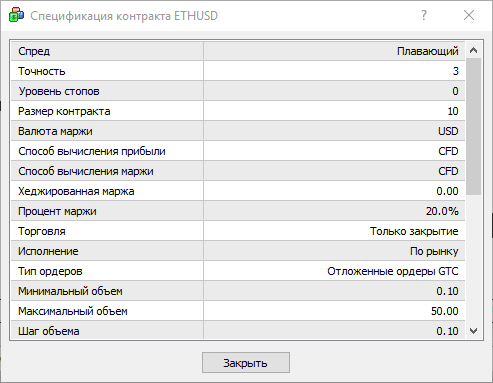
FXOpen also makes it possible to trade contracts from 1 Ether, but provides the standard 1 to 3 leverage for cryptocurrencies and a much smaller spread. With 1 to 3 leverage and the current rate of 210 usd, opening 1 lot will require 70 dollars.
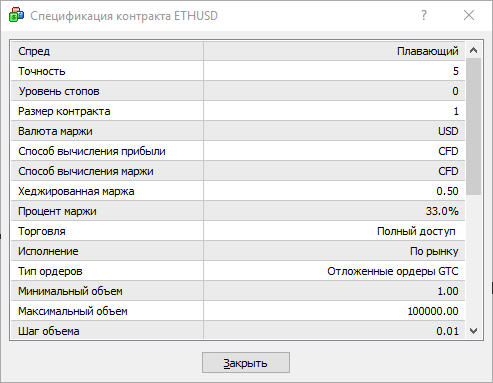
Main characteristics of the ETHUSD pair:
| Broker | AMarkets | FXOpen |
| Min. order size | 1 unit of the base currency | 1 unit of the base currency |
| Number of decimal places | 3 | 5 |
| Min. volume | 0.1 lot with a 0.1 step | 1 lot with a 0.01 step |
| Value of a point | 0.01 | 0.00001 |
It is best to first try opening a couple of trades on a demo account in order to get used to the trading conditions. The contract specifications on demo and real accounts do not differ.
Trading Strategies

The cryptocurrency is traded 24 hours a day, 7 days a week, and is in constant motion. This is a trending instrument where short consolidations are present. Therefore, trend strategies will work well.
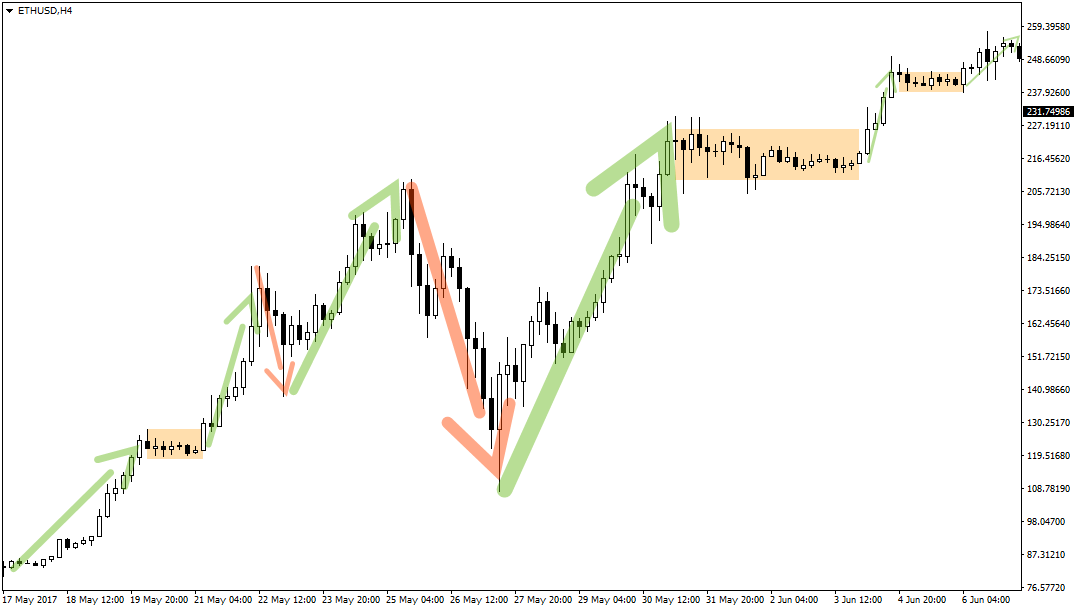 At the same time, the global trend tends upward, while rising volatility generates ever stronger corrections.
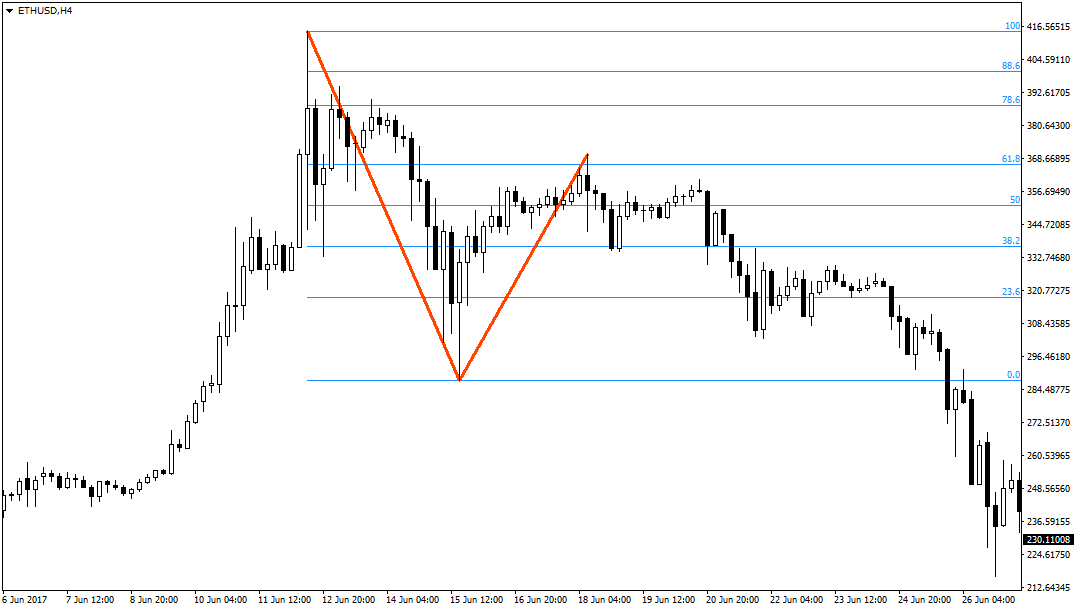
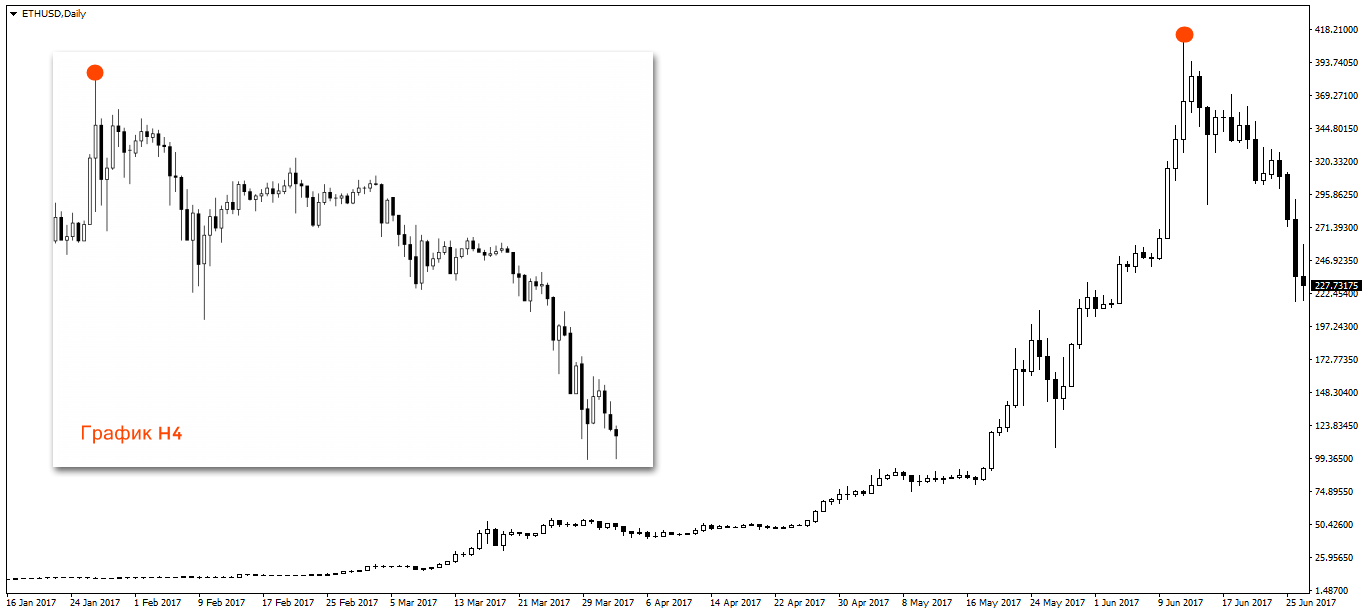 Fortunately, Fibonacci levels work well for measuring pullbacks.
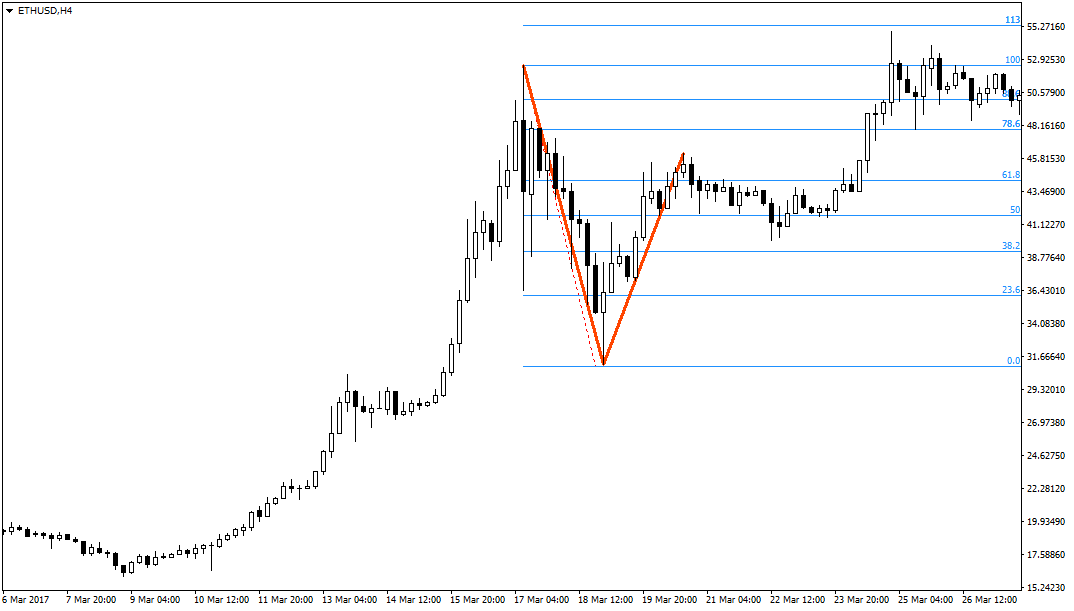
Thus, it is possible to determine the zone where the correction will end. Most often, the price stops at the 61.8% level.
For Ethereum, strategies that have already outlived themselves on popular currencies will be suitable. Thus, for example, a significant difference in quotes from various exchanges speaks of the currency's suitability for trading classic arbitrage. The essence of arbitrage is extremely simple: buy where it is cheap, sell where it is expensive. Naturally, in real life, the transfer of funds between exchanges and the commissions charged in the process can become a pitfall, but with proper calculation arbitrage can quite well work.
On the other hand, no one forbids using statistical arbitrage. After all, cryptocurrencies are still quite young as trading instruments, and therefore possess a large number of inefficiencies. By analyzing the correlations of different cryptocurrencies, you can determine those very hidden dependencies and try to trade them. But because of the high overhead costs (spread + commission), the main attention should be paid to long-term dependencies.
Bitcoin, for example, is sometimes used as a buffer zone, to insure funds against excessive volatility. Given the volatility of Bitcoin itself, this sounds strange, but it is easily explained by its political neutrality. A good solution would be to create a market-neutral portfolio that includes both traditional fiat currencies and cryptocurrencies.
Still, expect and be ready for crashes. In less than two weeks, Ethereum lost 40% of its value for no obvious reason, and such volatility spikes are quite typical for a developing cryptocurrency.
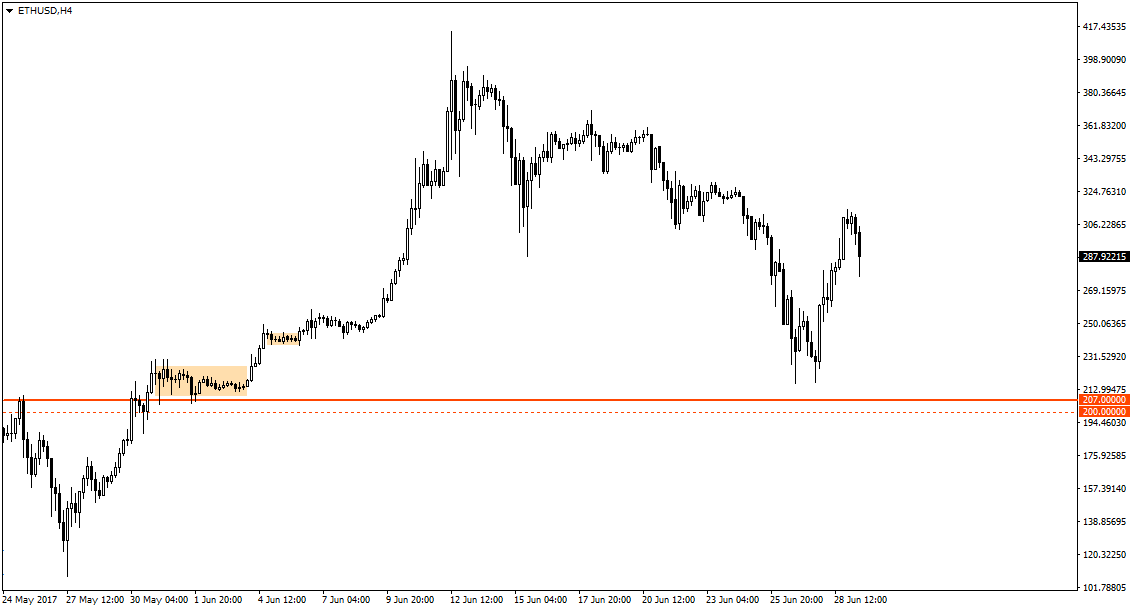 Something similar has already happened with Bitcoin as well, and with sufficient regularity. Except that this decline looked more like a sharp correction rather than a gentle descent, as in the case of Ethereum. The instrument is still too young for investors to have the opportunity to adequately assess its potential and risks.
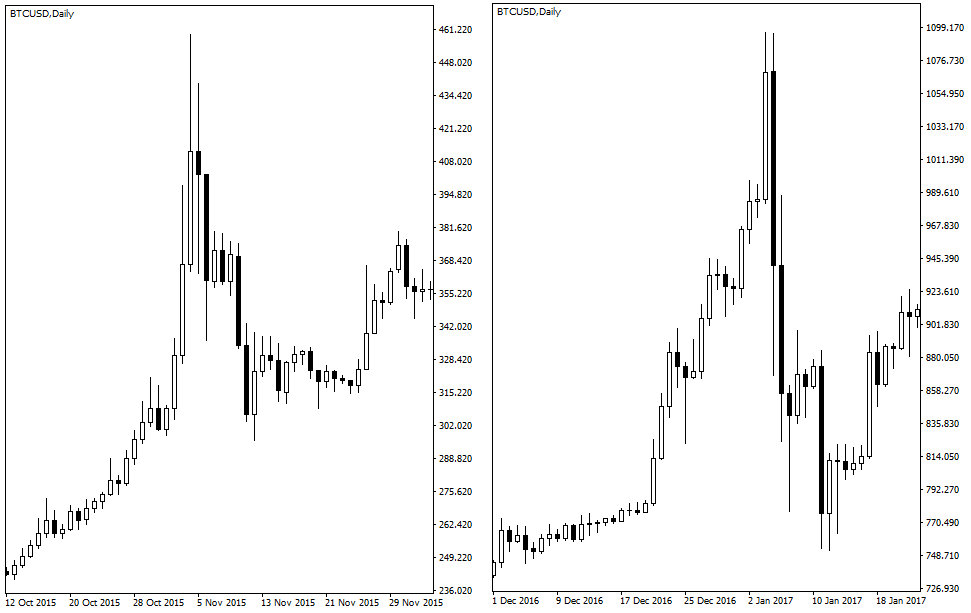 In general, Ethereum is now at the formation stage and, most likely, will go through several more similar stages of inflating and deflating the bubble, during which it will be possible to earn fairly well.
If you are aiming at long-term investing, wait until the pair falls to the lowest possible mark (by your individual assessment) and go long. Most likely, the global upward trend will remain in place.
As for intraday trading, even the most primitive strategies will work there. You can use technical analysis, fundamental, astrological... But, given the instability of the market as a whole, you need to pay special attention to the release of relevant news. Anything can provoke a sharp collapse or rise, and you need to stay alert in order to have time to take appropriate measures.
Conclusion

The cryptocurrency market should definitely not be ignored. In a certain sense, trading cryptocurrencies is even easier, given the huge number of unprocessed inefficiencies and the absence of centralized aggregators. Nevertheless, such trading is unlikely to suit beginners, given the unpredictable volatility spikes, high overhead costs, and low liquidity.
Brokers and Exchanges Where Ethereum Trading Is Available

- Amarkets
- FxOpen
- Forex Club
- RoboForex
- FortFS
- Yobit
- Exmo
Best regards, Alexey Vergunov TradeLikeaPro.ru
