
How to Trade NonFarm Payrolls?
 Good afternoon, ladies and gentlemen, forex traders!
Today we will talk about trading the Nonfarm payrolls news release (Nonfarms, nonkies, NFP, whatever people call it). About what kind of news it is, why traders always wait for it, when it is released, where to find it, and most importantly, why the market "flies" when NonFarm Payrolls comes out and how we should trade this monthly statistic with a 100% probability of making a profit (I will reveal a secret strategy).
What Is Nonfarm Payrolls?

Nonfarm Payrolls (NFP) - is the number of new jobs in non-agricultural sectors of the economy over the past month.
The released figures show the dynamics of changes (increase, decrease) relative to the previous period. If translated literally, Nonfarm - means "non-agricultural," and Payroll means "payroll sheet," that is, the paper used to issue wages.
This statistic covers about 500 sectors of the economy: construction, trade, business services, transportation, logistics, the financial sector, healthcare, tourism, and so on. The calculations do not include workers in agriculture, non-profit organizations, and self-employed citizens.
A change in the NFP value of 100-200 thousand jobs will lead to strong volatility in the quotes of world currencies in pairs with the US dollar, gold, and stock markets.
When Are These Data Released and Where Can You See Them?
The calculation and publication of NFP are handled by the US Bureau of Labor Statistics (BLS), releasing preliminary data on the first Friday of the month, at 15:30 or 16:30 Moscow time depending on the daylight saving time shift. Given the significance of the event and its impact on the global economy, reposts of these statistics can be seen in any economic calendar, and the primary source is on the website of the BLS.
On the tradelikeapro.ru website, the economic calendar is located in the drop-down menu of the "Tools" tab
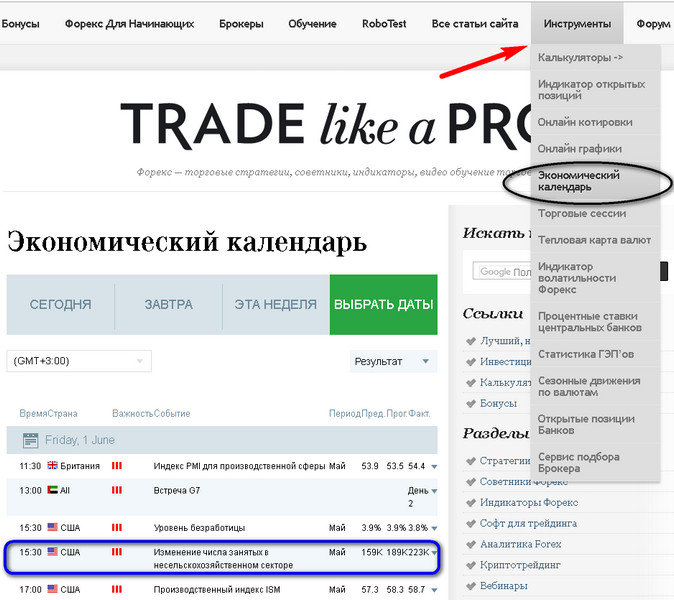
Upcoming economic events can also be viewed on the popular service Forex Factory.
The release time of the news depends on the Bureau of Labor Statistics of the US. A trader should check the exact release time and date every time, because it depends on the readiness of the Bureau of Labor Statistics calculations.
Any calendar indicates the data format as three numbers: previous, actual value, and forecast.
How Does the Market React?

Traders evaluate the released data according to several criteria:
- A match with the forecast or with the previous value. With such figures, a burst of volatility may occur without a strong and directional short-term movement;
- Strong changes cause global shifts: reversals or strengthening of long-term trends, and changes in historical volatility values.
An increase in jobs - is a leading indicator of US economic growth. New hands in the office or in production are the final stage of the preparatory work a company has done to expand its business. By that time it has:
- Attracted investment;
- Expanded production capacity or sales departments for products that have already been purchased.
Growing employment leads to US GDP growth, while low nonfarm data are a sign of an upcoming crisis.
This is clearly visible in the all employees chart, built from the dynamics of NFP changes since the beginning of the calculation, where the periods of global economic crises are marked.
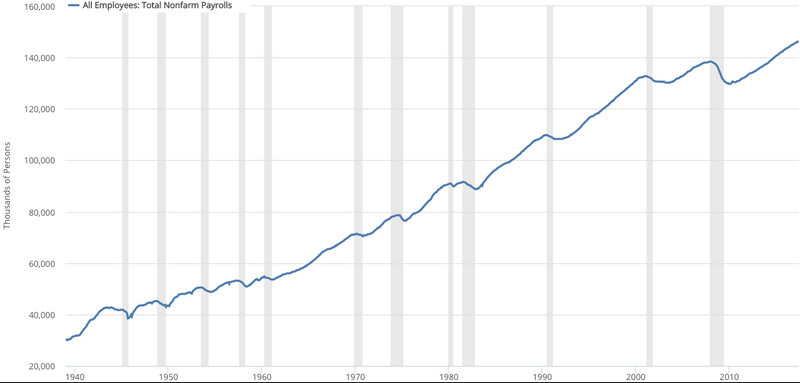
- The long-term reaction to rising nonfarms is a weakening of the US dollar against the basket of major Forex currencies;
- The short-term reaction is unpredictable because of a sharp price spike, which leads to the triggering of many pending orders and an unpredictable outflow and inflow of huge amounts of money into the markets over a short period of time.
The data released on June 1, 2018 on the change in jobs at 15:30 left the current EURUSD rate unchanged. Despite a 50-point spike in volatility, with the start of the American session the quotes returned to the price level of the news release.
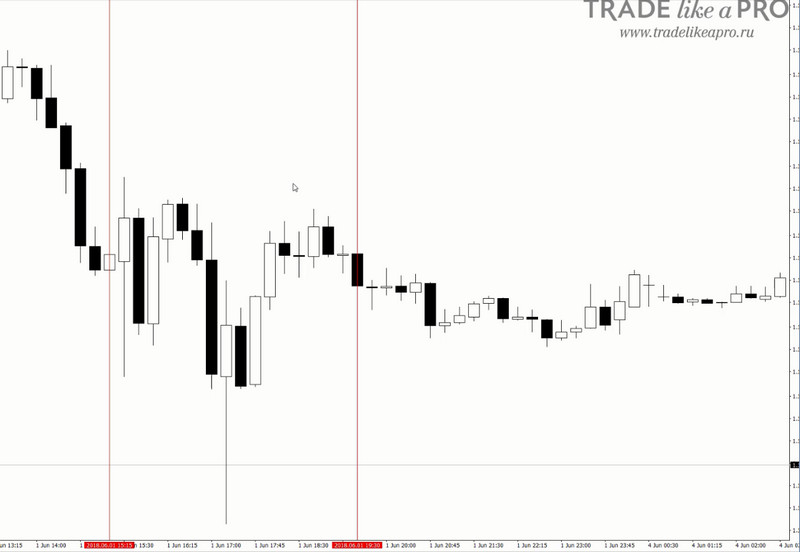 According to the statistical data of our study of historical quote changes on news releases, the reaction of the major currency pairs to NFP is as follows:
- 50-60 points is the average movement and happens most often;
- 100 points is much less common, but it also happens;
- 150-200 points is an extremely possible reaction, it happens rarely, but this option should be taken into account;
Why Does the Market "Fly" on NonFarm Payrolls?
Significant exchange-rate changes that occur on the Forex market when macroeconomic indicators are released are connected with the lack of quote support from market makers.
During the release of important news, there is no need to maintain market liquidity, since the attention and funds of large players are attracted. As was said above - the value of the indicator - is a signal to reconsider long-term trends, so huge sums of money are set in motion.
The absence of a market maker leads to negative consequences:
- A widening of the spread (the distance between the buying and selling price);
- Low volumes of nearby orders in the order book.
Therefore, the entries of large players literally "sweep the order book" - instantly taking out orders at all price levels; the same applies to exits from positions. The market moves by 50-150 points, which is an acceptable margin of error for long-term positions, but deadly for stops limiting the losses of intraday players.
On our site, the mechanism of the behavior of market makers is described in detail, and the reasons for changes in liquidity in the order book are examined in detail.
Roughly speaking, the market "flies" during the release of NFP because it is relatively easy to move the price at that time. And not because all the traders in the world are panic-selling/buying currency.
Nonfarm Trading Strategies

Common trading strategies for Nonfarm payrolls:
- Building positions (buying/selling) before the news release based on a forecast;
- Pending orders "in both directions" with take-profits at 50 pips and an entry level plus/minus 20-30 pips. When one of them is triggered, the second order is canceled.
- Variations of the first two approaches;
In the second case, the trader assumes that only one of the pending orders will be triggered, but as the experience and the chart of recent NFPs show, the fluctuation can open both entries, thereby taking a loss into a Lock - a lock, i.e. bringing a guaranteed minus instead of the expected profit.
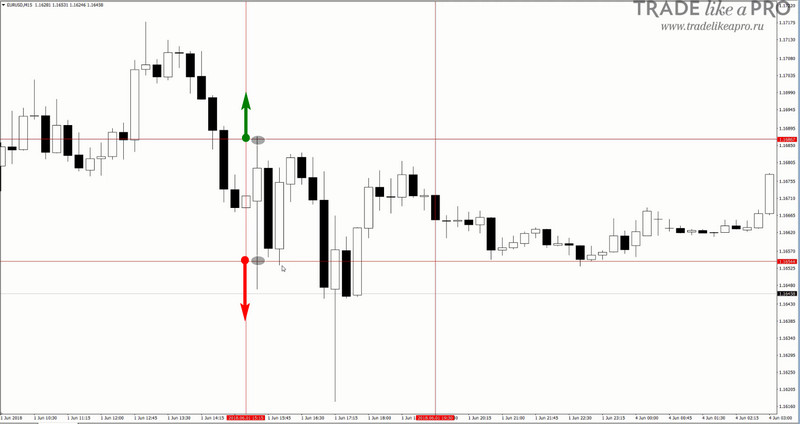 The same thing happens if you enter with pending orders on price pullbacks. In the example considered, the price went up, which means that a buy order should have been placed at the news-release point or lower, expecting that the first impulse would indicate the direction of the short-term trend, while the correction would allow an entry at a more favorable price.
It does not matter at what level the EURUSD purchase would have been made - (1) or (2) - both options would have closed at a loss.
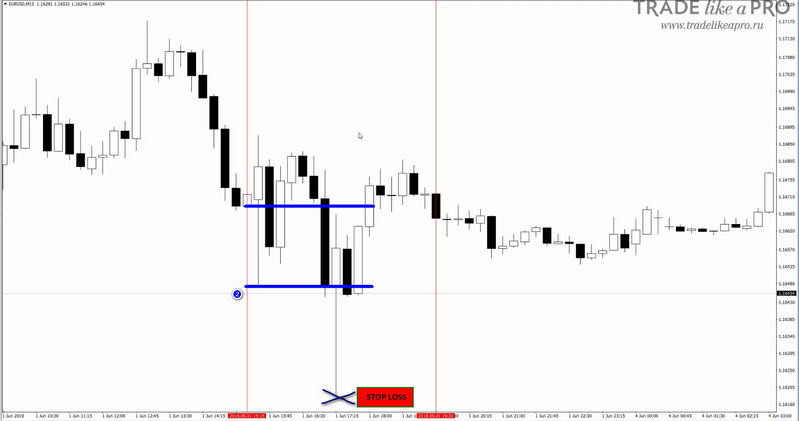 The examples above clearly show the disadvantages of strategies for working on the news, which can easily be verified by conducting an express test on the nearest historical values of economic indicators and quotes.
Add to this slippage, terminal freezes, banal non-execution of orders, and other delights that are frequent companions of trading during the news. In addition, the news release causes an overload of brokers' servers; the number of requests increases, like a DDos attack.
First of all, the "dedicated channels" of large clients are serviced; with small ones - "however it goes". Pending orders are stored on the broker's - server; a robot may fail to place a stop or take-profit in time, execute the order at a price "worse than the market", etc.
Overall, according to unofficial broker statistics, news traders (traders trying to trade the news) are unprofitable. They run from one bucket shop to another, looking for lenient auto-confirmation of trades, but they are quickly identified and either pressured (because, technically, news traders are very troublesome for the broker, their orders are hard to process), or hedged out (sent to the interbank market, which makes order execution on the news slow).
So What Should I Do If NonFarm Payrolls Are on the Calendar Today?

There is only one one-hundred-percent profitable way to trade nonfarms! So how should we trade them?
NO WAY
Yes, yes, that is right. If you see that NFP is coming out today, then:
- When trading intraday, close all positions half an hour before the news release;
- When trading long-term, remember that the average price movement is 50-60 points, the maximum is 150-200 points. This must be taken into account; you may need to change the stop-loss;
- Remember that after an average of 6 hours, the price often returns to the same level as before the news release;
But here is an interesting point: if you study many strategies, you will see that on large timeframes (H1, H4, D1), news that brings changes can serve as (attention!) a push for strategies, a trigger. The market prices in the data with a "second wave", after the volatility calms down, on a flat movement, market makers will begin building a position. The tactic is called a "step"- a step: at the end of oscillations in a narrow channel, a strong impulse and a directional trend arise, actively shifting markets to new price levels.
Conclusion

Let's sum up the rules of the 100% profitable Nonfarm Payrolls trading strategy:
- Half an hour to an hour before a major news release, we simply remove all positions from the market. Even if there will be a small loss there, most likely it will be better to close them.
- About two hours after the release of the nonfarm, you can trade again as usual. But since it is already Friday and evening, there is no point in trading. So an hour to half an hour before the nonfarm, we close all positions and go rest.
That is such a gorgeous trading strategy for nonfarms, you're welcome.
Sincerely, Pavel Vlasov TradeLikeaPro.ru
