
"How to Stop Blowing Accounts on Forex?" - that very webinar
 Hello, fellow Forex traders!
It is time to talk frankly. About what hurts most. About losses in the market. For those who are tired of marking time. For those who feel that success is literally missing just a couple of details. Secret tricks and techniques, little hacks that people do not usually talk about, which can give your equity curve a serious kick)
We will talk about all of this at the webinar "How to Stop Blowing Accounts on Forex?".
What will be in the webinar?

We will not talk about how important it is to keep a trader's journal and use a checklist for opening trades. You already know that perfectly well and use it, right?
There will be concrete advice on the matter. We will go over stops, money management, exit techniques, and a bit of psychology (I know you ignore it, because everyone wants the holy grail, sure...). But there will also be unusual techniques, you will like them, plus a couple of crafty tricks that you are unlikely to hear anywhere else. No fluff.
Webinar recording
Key webinar points

First, let us look at the poll data. This poll was conducted in our VKontakte group. We have ordinary people there, not some elite traders, not the "best of the genre." Ordinary people, just like you and me. The poll itself was quite simple: How much have you blown on Forex? It should be taken into account that about 1000 people had voted by the time of the webinar. What do we see? Of course, some answered as a joke, but overall I think the result that got the most votes, from 100 to 1000 dollars, matches reality. On average, people lose up to 1000 dollars on Forex before they achieve success, or without ever achieving success at all. The reality is that people come and go, having lost money and never really figured out what is what.
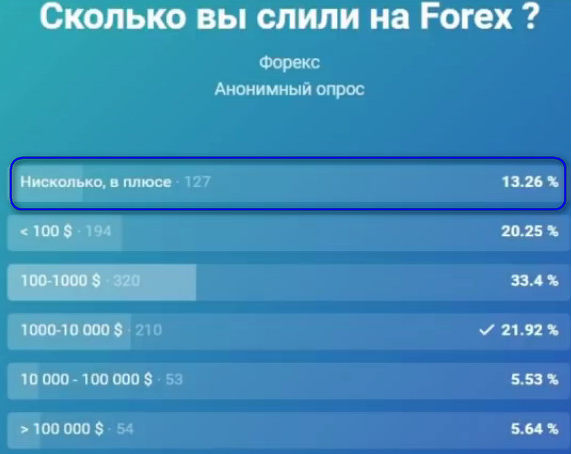 People are blowing accounts, and today we will talk about what can be done about it. We will break down techniques, tricks, and secrets that can give you an edge in trading.
Stops when opening and managing a trade
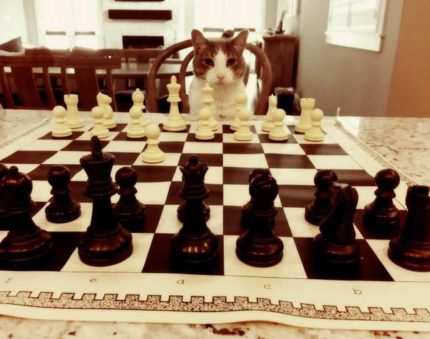
- For many years I was a fan of tight stops. If the market goes in our direction, then it will go, and if not, the losses are minimal. But with experience I came to the conclusion that the optimal stop size is where it becomes clear that we are wrong. Not 75 points, not 1%, not 2 ATR, the market does not care what you calculated there. There is an extreme, there is a level, there is an indicator value, if you use them, where will it become clear that your bounce from the Bollinger Bands did not work out? Stops should be placed exactly at the level where it becomes obvious that your signals did not work. By calculating a stop, for example through ATR, you tie it to a logical point where it becomes clear that you were wrong and the trade will not work out, or the signal has lost relevance.
- Most traders use stops that are too tight when opening a trade, and at its final stages, on the contrary, excessively wide ones. When their trade goes into profit, they switch to a rather wide trailing stop because they hope they will be able to get a large profit and at the same time do not want to be knocked out of the market. But you should do the opposite: once a certain profit is reached, reduce the stop size significantly.
Time-based stops

The most profitable trading systems today are breakout systems and night scalpers. Trends change, but I recommend focusing on breakout systems for the sake of high profitability.
After entering a trade, once several days have passed, do not build illusions for yourself that the market remembers your position. Most likely, the market has already processed that information and moved on, while you are still expecting something from it. Look at your strategy and assess how you can apply time-based exits to it. "Exit after N candles" is a universal rule that says that if you entered a trade and, over, say, 5 candles, nothing significant changed, it is better to close it with a small plus or minus than to simply sit and wait. Choose the optimal time frames for yourself, the ones that fit your trading system.
Take into account the possibility of 4 stops in a row
The table gives examples: if your average risk is 2%, then after 4 stops in a row you will have an 8% drawdown; if it is 3%, then 11.5%. But if your risk is 10%, then the drawdown percentage grows sharply, reaching 34% already.
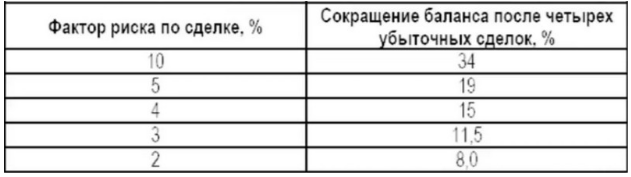 As for optimal F, Ralph Vince did not study it for years for nothing. Optimal F is for account accelerators; for everyone else, those who do not need to win a contest or prove something, optimal F is not needed. I believe 2% is enough, because 4 stops in a row is not much, it can even be 10 stops. Beginners stop trading their system, on average, after 3 stops in a row, while those who decide to stay in the game after 4 stops have a chance to become successful traders) A 0.5%-1% risk is the golden mean, but it all depends on your goals and on how important the amount in your deposit is to you.
Stages of trader development

There are 4 stages of trader development in total:
- Trade profitably;
- Stability;
- Scaling;
- Expand to a larger number of instruments.
But most traders start skipping over stages, feel like they are on horseback, and skip the stability stage. It is better to earn fixed profit for several months than to rush forward headlong.
It is important to focus on the current stage and develop gradually. Expanding instruments is a serious step; many traders use only one instrument in their arsenal and make money. It is like a brother to them, they know everything about their instrument and feel it perfectly. You should not expand your set of instruments too much.
Several orders

An important and interesting technique is to enter a trade with several orders without increasing the risk. If we had entered with a 0.1 lot, then in this case we enter with several 0.025 orders and then use several exit strategies:
- in the first trade, we set, say, a 30-point stop loss and a 300-point take profit;
- in another trade, an easily reachable take at 1 stop;
- in the third, a close trailing stop;
- in the fourth, we add on as the move develops until we are taken out by the trailing stop or the advancing stop.
We get an entry signal, but divide the risk across different exit strategies. In case of failure, we will not lose more than in the case of entering with a single order.
Martingale?

Martingale is increasing the lot size when the price moves against your position. This makes it possible to reduce the average entry point. Martingale is used by almost all PAMMs, almost all funds, but under different names.
All traders criticize martingale, but that does not stop them from using this method to support their positions. If even PAMMs use it, then we should also think about using this technology.
But it should be applied wisely; you can learn the key points here from the article Safe Martingale.
Enter Less Often

Paradoxical advice, rooted back in the samurai code. It urged warriors to draw the sword from its scabbard as rarely as possible, only in extreme cases. We love action, because since childhood we have been taught that to get money you need to be active, otherwise nothing will happen (he who does not work, neither shall he eat).
If you are looking at the chart in search of a place to enter, stop and do not enter. The best trades are the ones you cannot pass by. A truly profitable trade itself beckons you to enter it. This technique is especially applicable to scalpers, because their eyes get blurred by a large number of trades.
You should enter only a market that has volatility. If the market is moving sideways, it is impossible to predict its further future accurately. A dead market can go anywhere, and it is impossible to predict its fate.
An important technique is to enter a trade with a 10-minute delay. When everything is ready for your entry, watch the situation and wait. This is called strategic patience. Jennifer Roberts, an art history teacher, taught her students patience. During the assignment they had to spend a painfully long time in front of a chosen work of art. The break will let you cool off, look at the charts with a sober eye, and reduce the total number of impulsive trades.
One Stop a Day

The rule works especially well for beginners. If you catch a stop during the day, stop trading, turn off the computer, and do other things. Today is not your day; it is better to spend the time on analytics, working on mistakes, or devoting a few hours to your family.
The situation is similar with takes: after three successful trades, go play golf or do some analysis. The fact is that after a certain number of successful trades a trader falls into euphoria and loses vigilance.
It is better to do less, but better!
Exit Losses Faster

Statistics from brokers show that traders exit profitable trades much earlier than losing ones. On average, losing positions are held 4.5 times longer than profitable ones. It is all about psychology; the trader still does not lose hope that the rate will recover and that they will be able to reduce their losses.
The average loss amount is 7 times greater than the profit. Try to use statistics to your advantage and exit losing trades earlier.
A useful rule is to stay in a profitable trade for at least 10 candles, and to leave a losing trade no later than 5 candles.
Tests and Yet More Tests

Before using a new strategy, use it in test mode, check the patterns, and only then apply it on your main account.
Use a demo account to find the 20% of trades that bring 80% of the profit. The Pareto principle has never let anyone down yet.
The main advantage of a test account is that you lose nothing. You can try fresh techniques, check the reliability of signals, and even find your own.
The "Addict" Account

The gambler's account, the compulsive-gambler account: open a cent account; it is important that this is not a demo but a real account. If you have a desire to make a strange trade that you are not sure about, open the trade on the cent account. At the same time, use the main account only for trades you are 100% sure about. Do not trust Martingale, but wanted to try it: go ahead, use the gambler's account.
With it, you can successfully let off steam. Believe me, it calms you down perfectly and helps you save your money and nerves. This is very important for a trader.
5 bullets in the revolver

Another psychological trick. You have the opportunity to open only 5 trades per week on your main account. Limit yourself by opening 1-2 trades a day, this will train you out of entering unreliable trades. Naturally, this rule should be adapted to suit yourself by increasing or decreasing the number of trades depending on your trading style. You can spend all the "bullets" in one day, but then for the rest of the week you will be kicking yourself while looking at the charts.
An unusual approach to martingale and the like

Suppose you have a trade open on a demo account where you used Martingale. A large drawdown forms over several days. We enter a trade on the main account, and when that drawdown closes on the demo account, you close the trade on the main account as well. Minimal risk, but at the same time you enter much less often.
An excellent strategy for maintaining an ideal account. You increase the probability of success.
Suppose you have a strategy, and in the process of implementing it on a demo account you hit the stop three times in a row, then you increase the probability that you will catch a trend. If you write it down as a clear rule: caught three stops on the cent account, the next entry is on the dollar account.
100 trades without blowing the account

This challenge is perfect for those who just cannot stop blowing accounts. Open a cent account and try not to blow it in 100 trades. Your task is not to make money, your task is to survive one hundred trades without blowing the account. At first glance, it seems like a simple task, but it is not. Stubborn gamblers will quickly realize that this task is impossible for them without changing their strategy.
It turns out to be quite difficult to make that many trades without losing money.
Working with anger and rage

Many books on trading devote a large amount of information to fighting greed and fear, while anger and rage are given very little attention. This is a fundamentally wrong approach, since anger is a much more serious problem because it affects not only the strategy, but also the trader's own health.
Three stages for dealing with anger:
- Release your emotions. I have a punching bag set up, a great thing! Hit it with all your anger, hit the bag for the market, MetaTrader, the idiot in the chat, and everything else in the world. A simpler option is a desktop punching bag, a cheap alternative that lets you vent your anger without leaving the spot. It is useful to go to a shooting range and fire at targets. Some people use games, for example, "Tanks" works well;
- Figure out the cause. Suppose you got angry because of another stop, this is the right time to understand the cause. Take a pen or open a notebook, start writing "my stop triggered once again" or "someone stepped on my foot." Your task is to understand the cause of your anger. This will make it easier for you next time to perceive what happened more calmly;
- Acceptance. "I myself can step on someone's foot," or "there were cases when the stop-loss triggered 5 times in a row, and now it is only once." You are not acting as the one who forgives, your task is to reduce the negative emotions to nothing.
All those "distance yourself, imagine yourself looking down at the earth from the clouds" or "sit down and meditate" do not work in 95% of cases. If that is exactly what helps you, keep going in the same spirit, but for everyone else I recommend trying this technique for working with anger.
Working with fears

Everyone has fears, if you have no fears, you are not human. Fear paralyzes the making of adequate decisions, blocks thoughts about possibilities, and does not let you evaluate information effectively. Fears should be worked through. The most common fear is being wrong. To get rid of it you need an assistant, but you can solve this problem on your own as well.
Say: "I am afraid of being wrong in trading."
Your assistant should repeat your words: "Okay, you are afraid of being wrong in trading, what next?"
You: "Then in my own eyes I will become incompetent in trading, even though I have been doing it for two years already."
Assistant: "In your own eyes you will become incompetent in trading, even though you have been doing it for two years already, what next?"
And so continue your dialogue until you understand that you are finished, usually it ends in laughter. This way you will come to understand that your fears exist only in your head, while reality is far less terrible. Do not be afraid to go too far, in the end it will bear fruit.
It sounds strange, but in fact this very effective technique can rid you of fear through living through that very fear.
Morning pages

Morning pages are a widely used and well-known tactic of psychological unloading through keeping a personal diary. Describing thoughts, transferring everything that occupies your head in the morning, helps remove the burden of problems and worries until the evening.
Unlike a diary, "morning pages" are not a narrative about life or an evaluation of events, they are simple unsystematic writing on all topics that occupy your thoughts. The pages do not need to be read; once the work is finished, they are torn up or burned.
You simply take 3 A4 pages and write there all the thoughts that are currently in your head.
Conclusion

The presented tactics and strategies work provided they are applied in a comprehensive manner. Particular attention should be paid to psychological techniques, some of which have not yet been described in widespread trading methodologies.
The webinar was created to familiarize you with the full existing range of techniques for improving performance regardless of the strategy used by the trader. More detailed information on many of these techniques can be found in articles on our website.
Respectfully, Pavel Vlasov TradeLikeaPro.ru
