
Market Makers in Forex - are they hunting for your money?
 A person who has entered Forex for the first time and started trading thinks little about from whom they buy currency and to whom they sell it. For a trader, what matters more is the quality of the trading platform, the speed of order execution, the size of the spread, the availability of currency pairs and other financial instruments. But when losses begin because of unexpected trend reversals and lightning-fast exchange-rate jumps, it seems to the trader that the market is set against them.
And behind the scenes, the mysterious gray cardinals of the market are pulling the strings - the Market Makers. Who are they? How do they trade? Do they really watch every one of your stops? Let us try to figure it out.
The search for a specific culprit begins. Of course, the guilty ones are easy to find. They turn out to be brokers and market makers. Most traders do not understand these terms, or understand them incorrectly. Especially since on the internet you can find many stories from "authoritative traders" about how market makers and brokers manipulate prices and do everything they can to rob their clients.
The reason for such sentiments lies in ignorance of the mechanism of how the currency market functions, and the role and goals of each of its participants. A beginner trader should understand their role in this market, and what happens after they press the "Buy" or "Sell" button. To whom the order to buy or sell currency is sent, at what price the order will be executed, who determines that price, and from whom the currency is bought or to whom it is sold.
Who is a Market Maker?

In the classical definition, a market maker is a financial organization that undertakes to provide liquidity for certain securities on a stock exchange. Exchange market makers include large commercial banks and brokerage companies. They are obliged to comply with exchange rules and financial legislation. Market maker literally means "market creator" - this is the most important participant in the market process, ensuring its viability.
Although the Forex market is decentralized, all its participants are interconnected. Ordinary traders trade through intermediaries — brokerage companies and market makers. If a broker does not have enough of a certain currency to carry out an exchange operation, it turns to liquidity providers, or more precisely, sends client orders to the interbank market. Brokers also route orders to liquidity providers when they do not want to risk their own money.
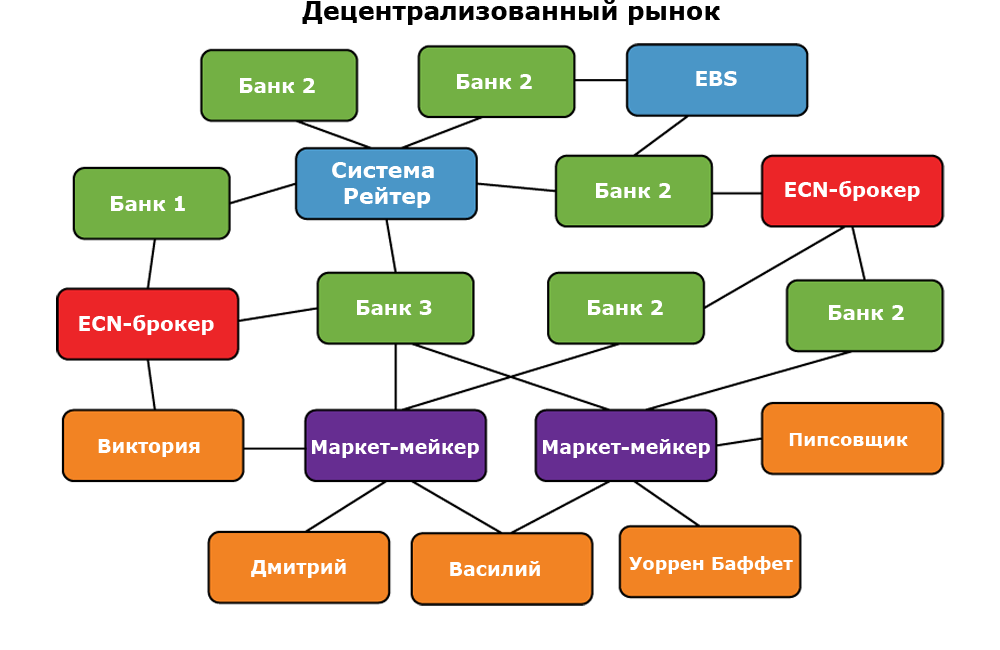 There are many market makers on exchanges, and each has its own tasks. A market maker enters into an agreement with the exchange under which it undertakes to provide liquidity for certain securities or currencies. Under the agreement, it must sell or buy financial instruments in cases when there are no other buyers or sellers. And the main activity of an MM is intermediation in deals between sellers and buyers. By collecting sell and buy orders, they form prices.
Market makers have been known since the founding of stock exchanges. But after the organization of the international currency exchange market, their influence grew significantly. The turnover volume of the Forex market is about 5 trillion dollars per day, and the main part of operations is carried out by market makers.
More than 50 percent of all currency turnover is provided by four banks. First by volume is the American Citybank, followed by the German Deutsche Bank, slightly less by the British RBS (Royal Bank of Scotland Group plc) and Barclays, as well as the Swiss UBS. The American Bank of America, Morgan Stanley, and JP Morgan also have a fairly significant share. Standard Chartered Bank and Mizuho Bank dominate on Asian exchanges, while Rosbank and UniCredit dominate on Russian ones.
A standard contract on the interbank market is 5000000$. Few banks can operate with such capital. Therefore, market makers collect lower-volume orders into a larger one called a "pool." Orders into "pools" are submitted by large intermediary companies (prime brokers).
A prime broker is a bank directly connected to trading channels. At the same time, it is also a market maker bearing obligations to the broker that concluded a liquidity supply agreement with it. Prime brokers accept orders worth from 10000 dollars (and in some cases even less). Such orders are submitted to them by retail brokers that provide services to ordinary speculative traders.
Working as an intermediary, a broker earns from markup (an addition to the spread) and commissions. In turn, Forex clients gain access to interbank quotes with comparatively small deposits. It turns out that such a scheme is extremely beneficial both to the broker and to its clients: the former does not risk its capital, while the latter gets access to liquidity.
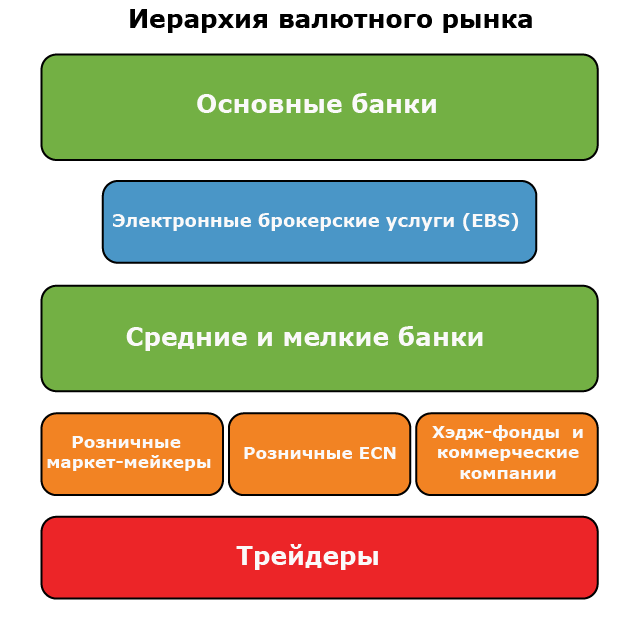 Thus, under current Forex market conditions, the role of market makers has changed somewhat. Market makers have the right to conclude currency exchange contracts using their own funds. This is how rumors about price manipulation appeared. In reality, market-maker banks buy or sell currency in cases when buying or selling volumes in the market fall sharply. In this way they stabilize prices, preventing chaos. Market makers perform their task of providing liquidity, rather than moving prices.
Order Offsetting (Matching)

Forex is a large multi-level system of currency exchange orders. Most independent traders operate at the lowest level through intermediaries. These intermediaries differ in their quote acquisition and order processing schemes. There are brokers that only receive quotes from information systems, but do not send traders' orders to the interbank market. They are also called dealing centers, from the English name of this scheme, Dealing Desk. Domestic traders call such brokers a "kitchen," because everything is cooked in one place there.
Many brokers sum up buy and sell positions for each financial instrument, and route the difference to the interbank market. This is called "matching" and happens automatically.
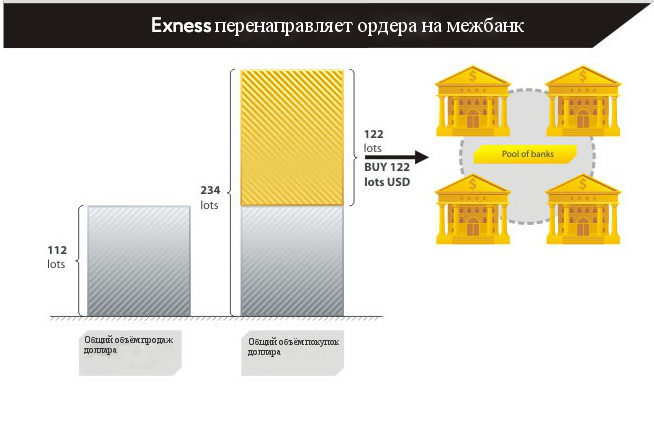 Brokerage company Exness is one of the small market makers. However, it is a prime broker that collects orders from retail brokers. In this picture you can see how 112 lots of sell orders are offset within the company, while 122 out of 234 buy lots are redirected to the interbank market.
Thus, an order to sell dollars from trader Vasya in Russia can be offset by an order to buy dollars from Mr. Chen Li, trading with a Chinese broker.
Brokers are also distinguished by A-Book and B-Book operating schemes. A broker's operating scheme in which all client trades are routed to the interbank market is called A-Book. The broker's earnings consist of commissions or markups added to the market maker's spread. Under such a scheme, it is profitable for a broker to have profitable traders with large deposits. For such brokers, the minimum deposit may amount to $5000-$10000.
If a broker works under the B-Book scheme, then trades do not reach the interbank market, and the broker's profit is the client's loss. The reason for such work may be low maintenance costs, which gives advantages in competition. There are also hybrid models when both schemes are used simultaneously. In this case, the trades of successful traders are routed to the interbank market, while the rest are traded within the brokerage company.
Risk Hedging by Market Makers

According to exchange rules, a market maker is obliged to buy when no one wants to buy, and to sell when no one wants to sell. This contains substantial risk, and to compensate for it and generate income, banks and brokers quote a buying price above the selling price. Such a difference is called the spread. By buying currency cheaper and selling it more expensively, the market maker earns income. The size of the spread can change depending on the market situation. A decrease in the difference between the buying and selling prices is called spread narrowing, and an increase is called spread widening.
The spread can be fixed in the case of highly liquid currencies, or floating depending on supply and demand. Spreads widen during periods of an unstable market, and also before important economic or political events. A wide spread helps reduce market activity and compensates for losses of banks and brokers. To hedge risks, in addition to widening the spread, market makers use hedging, that is, making an offsetting transaction. If, for example, a bank sells a contract on its exchange, then it buys the same contract on another one.
Prohibited Strategies

An undesirable flow of orders is called in trader jargon a "toxic flow" or "toxic." Toxic flow is usually generated by traders who profit from imperfections in MM algorithms or in the underlying trading infrastructure.
Practically 100% of toxic flow comes from algo traders, that is, from their high-frequency trading (HFT). Roughly speaking, this is a very large number of trades in a very short period of time.
Prohibited strategies can include:
- Arbitrage on differences in providers' quotes;
- News trading;
- One-sided trading of large volume.
Despite the large aggregate volumes, positions do not stay in the market for long, because of which ordinary traders do not have time to take advantage of the additional liquidity. Such trading leads to an imbalance in the market maker's positions and ultimately to losses.
Market makers can combat such trading strategies by changing or stopping price formation for clients creating toxic flow. At the same time, it does not matter whether you trade through a broker or directly with a bank. ECN gives certain advantages in this regard, since your orders are mixed with others, which makes it harder for a market maker to identify a specific trader.
It is practically impossible to classify manual trading as toxic, provided that you do not trade through a kitchen. Therefore, by trading in a measured way, you will never become a problem for a market maker.
Conclusion

You should not blame market makers for every failure. It is they who provide Forex with liquidity so that you can buy or sell currency at any moment at an acceptable price. In the case of ordinary trading, it does not matter to the market maker whether you won or lost. Problems may appear in the case of high-frequency algorithmic trading or during the release of news. But if you do not use strategies that are risky for the market maker, then the problems of big players will not affect you in any way.
Best regards, Alexey Vergunov TradeLikeaPro.ru
