
DOM MT4 Indicator: A Scalper's Price Ladder for MetaTrader

Hello, fellow forex traders!
Today we will look at a proprietary order volume book indicator (price ladder) for the MetaTrader 4 terminal. The tool is notable for taking information from the Chicago Mercantile Exchange (CME) and broadcasting it directly into your terminal.
The DOM (depth of market) indicator can be used as an addition to any trader's trading strategy, regardless of whether you use technical or fundamental analysis. Scalpers should pay special attention to it. The developer of the indicator is our well-known forum member.
Indicator Characteristics
Platform: MetaTrader 4
Currency pairs: EURUSD, USDCAD, USDJPY, AUDUSD, USDCHF, GBPUSD, BTCUSD, XAUUSD.
Timeframe: M1 - H4
Trading time: around the clock
Recommended brokers: Alpari, TickMill, AMarkets

Trading currency pairs on the Forex market has a decentralized and multi-level structure. The main volume of currency transactions takes place between institutional clients who interact with commercial entities, brokers, and small exchanges.
It turns out to be a kind of parallel currency trading, but it does not lead to different currency prices. The development of technology and trading platforms provides traders with reliable exchange-rate data for trading on standard accounts with a dealing desk. Electronic ECN systems (NDD, STP, etc.) provide real quotes directly from the interbank market, where broker client orders and positions of brokers and large banks are combined "in one book."
This is the name of the book of pending orders of the Buy/Sell Limit or Stop type, summed by quantity and arranged by price levels. The order book contains order volumes; this parameter is absent in the MetaTrader trading platform. The Volumes indicator is a tick counter of the number of trades on the trader-selected timeframe.
Volumes are shown by the MetaTrader order book, which is available in the right-click drop-down menu.
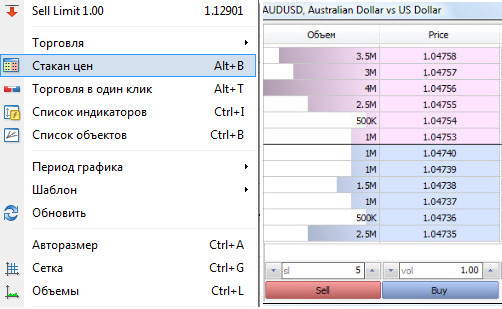
The problem is that these are data from participants in the ECN system to which it is connected. It is impossible to say exactly what share of the Forex market turnover is represented by the order book observed in MetaTrader; surely it is not even 1%. How much can such figures be trusted?
Our site also has a similar Order Book service; it displays pending orders and open positions of clients of broker Oanda. It is believed that the company accounts for 1% of the total Forex market turnover, enough to reflect the real picture of supply and demand in the selected currency pairs.
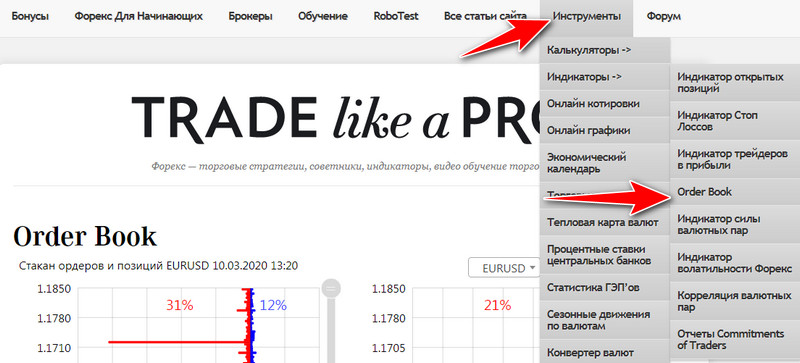
But the most objective variant of real pending demand for currencies is provided by the Chicago exchange CME Order Book.
Chicago CME Exchange: Currency Section
CME Group is the world leader in trading financial and commodity derivatives, with a total annual trading turnover of $1 quadrillion. The exchange has a "truncated" currency section where only the futures of major currencies are represented.
CME traders turn over on average several hundred billion dollars a day in just one liquid pair, EURUSD. This is comparable to the transactions of institutional clients in the interbank Forex market.
The Chicago exchange, like any other operator, is required to keep detailed reporting on all trades online. The information disclosed on the website on Open Interest and futures margin requirements is used by traders in various strategies to analyze currency pairs.
Such statistics are suitable for medium-term and long-term analysis. To get a broadcast of the order book or the trade tape, you need to open an account with a broker accredited with CME Group. As a rule, such companies provide a limited-time demo account, and to receive real quotes you will have to make a minimum deposit.
The DOM MT4 indicator, developed by Roman Chadaev, solves this problem by broadcasting the order book of currency pairs represented on CME directly into the MetaTrader version 4 and 5 terminal.
Description of How DOM MT4 Works

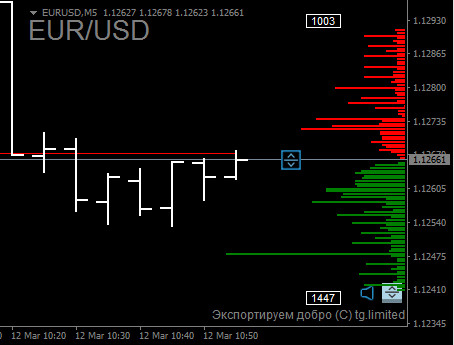
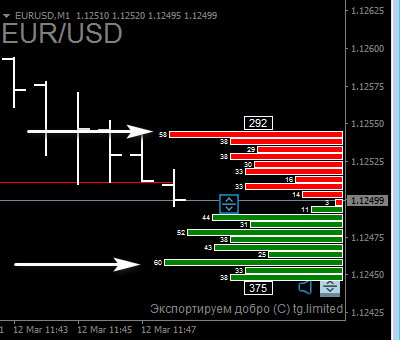
The DOM (depth of market) indicator transmits the order book of the CME exchange currency section into MetaTrader. It is presented in the form of a histogram with bars scaled by the volumes of aggregated pending orders:
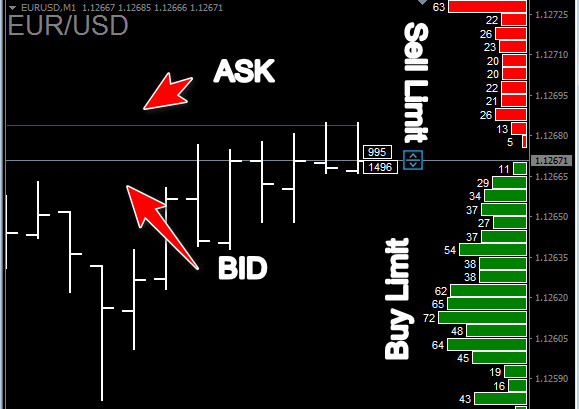
The Bid and Ask lines are the trading spread, which can be synchronized with the terminal or selected from incoming CME data. In this case, the trader can get an additional signal that limits trading. As a rule, a widening of the spread points to strong movements, for example before news or because of insider information received in advance by market makers.
Currency futures of different calendar periods are traded on the CME exchange. By default, the indicator selects the contract with the highest Open Interest. This leads to quote-broadcasting problems when switching to a futures contract of a new calendar period. Many traders do not wait for expiration, transferring (rolling) positions into the new contract, which can lead to strong fluctuations of OI in both derivatives.
Once again, I want to draw your attention to the fact that the DOM MT4 indicator does not provide trading signals. It is suitable for a trader who practices scalping strategies. The tool is best used on the M1 timeframe as a "high-precision" entry indicator based on the signals of a trading system operating on higher time periods.
Broadcasting the CME exchange price flow may lead to load and freezing of the terminal; to avoid technical problems, the trader will have to limit themselves to 1-2 currency pairs.
Broadcasting the CME exchange price stream may cause loads and freezesterminal; to avoid technical problems, the trader will have to limit himself to 1-2 currency pairs.
Installation and configuration of the indicator

Please note: a separate program is posted that reduces the load and speeds up the indicator. It is better to download it first, before installation begins; the installation process itself is described in the readme file in the archive.
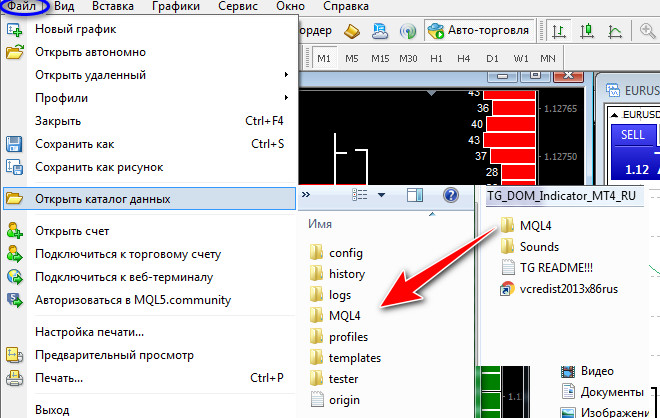
Roman Chadaev, registered on our forum under the nickname chadaevr, placed the scripts in the MQL directory. It must be copied to the MetaTrader 4 folder with the same name, which can be found via the "Open Data Folder" option in the drop-down list of the "File" menu.
When copying, the system will prompt you to replace files, and you need to agree. The installation process ends with moving the domtg.tpl presets file. This is a template for setting up the indicator workspace, which must be installed immediately after copying the files and restarting MetaTrader 4.
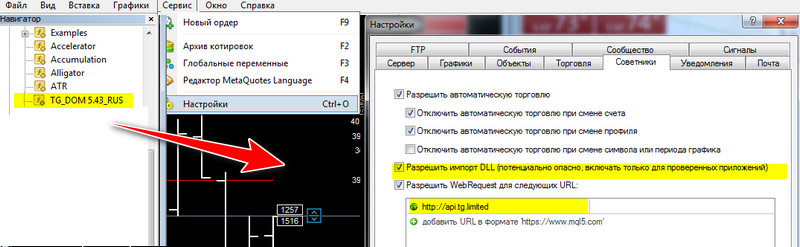
Before launching DOM MT4, terminal setup will be required: through the "Tools" menu, open the "Options" item. In the window that appears, on the "Expert Advisors" tab, enter the URL address "http://api.tg.limited" and allow DLL imports.
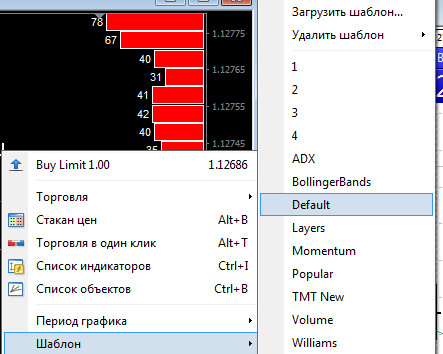
After installing the presets, drag DOM MT4 onto the selected pair window from the "Navigator" field or the "Custom" option of the "Indicators" section in the Insert menu.
When DOM MT4 is first attached to the chart, the indicator settings window will open. Pay attention to the order book depth: by default, 10 price levels of orders are built on each side of Bid/Ask. This is enough for scalping trading.
The historical mode of past order book values, necessary for virtual trading, is disabled by default. The remaining settings are service-related in nature: you can set custom colors, the contract date, alerts, and terminal time settings. By default they are configured for working with DOM MT4 on the first launch.
After clicking the "OK" option on the settings tab, the indicator will appear on the chart in about a minute. If the wait lasts longer, remove DOM MT4 from the chart, restart the terminal, and install the tool again.
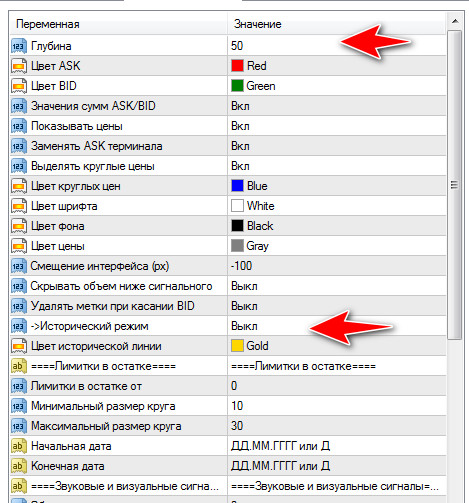
After clicking the "OK" option on the settings tab, the indicator will appear on the chart in about a minute. If the wait lasts longer, remove DOM MT4 from the chart, restart the terminal and install the tool again.
Examples of using the indicator

Historical observations of the DOM MT4 order book show that above and below the depth of ten bars, large volumes rarely appear.
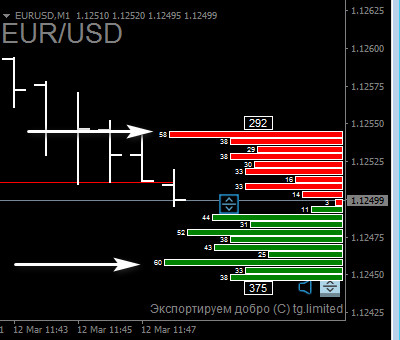
The maximum level (ML) serves as a reference point for the stop-loss, placed:
The exact location of the price level of the maximum orders in the order book can be obtained by clicking on them with the left mouse button. The mark is canceled in the same way, with one click.
Various overbought, oversold, and similar indicators will also work, but it is important to understand that the order book provides precisely the stop level; the size of the loss depends on the trader's entry point. In theory, it can even be at the current price.
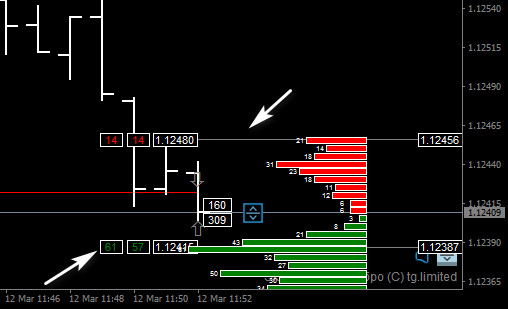
The rationale of this tactic is that speculators will not raise or lower the exchange rate of a currency pair to the level where a large number of orders is concentrated. Only large players ready to "buy out" the placed limit orders will be able to pass above or below the maxima indicated in the order book.
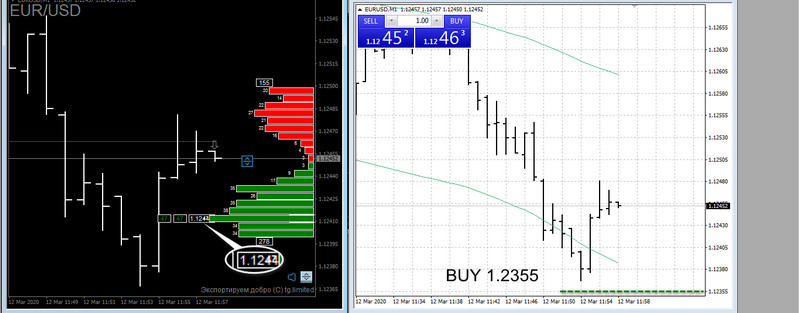
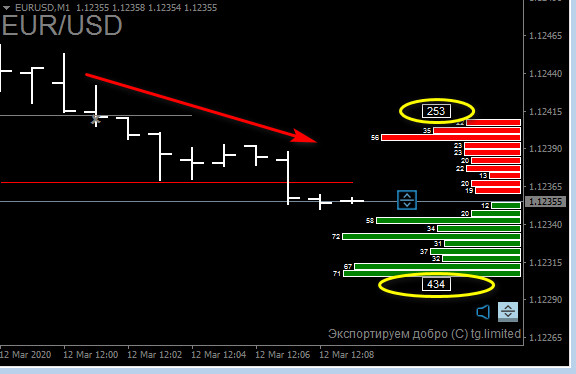
Below and above the order book, the figures show the total number of Sellers' and Buyers' limit orders. Comparing these values gives the trader an understanding of the current market sentiment:
The reason for this tactic is that speculators will not raise or lower the rate of the currency pair to the level of accumulation of a large number of orders. Only themajor players, ready to “snap up” the installed limit bars.
The DOM MT4 indicator does not provide trading signals. The strength of order levels and changes in sentiment, determined by the number of Buy/Sell Limit orders, are very relative concepts that differ for each pair and the time of the session. Threshold figures are determined in the course of long observations of the Forex market, so scalpers often specialize in only one instrument.
Order-book trading is designed for a profit of 2-3 pips and a large number of trades. This will require opening a special account with a floating or minimal spread. The trader must limit the holding time of the trade and definitely use a take-profit equal to at least two average values of the current spread.
Conclusion

Scalping is the highest-yielding type of trading, fulfilling every trader's dream of leaving the market with a daily profit. This is possible provided that discipline and special technical equipment are in place (internet speed, accurate broker quotes, absence of lags and slippage, automatic placement of stop-losses and take-profits in one click).
Order-book trading can only be done manually, which creates a high emotional and physical load. The trader must make decisions in seconds, watch the trading time, avoiding news and the moments when European and American exchanges open.
The combination of the above factors creates a high risk of losing funds, exceeding the probability of making a profit. The indicator must be tested in demo trading mode. Observing the order book and practicing will help the trader better understand the actions of market makers and learn to make accurate and fast entries.
Respectfully, Ivan Petrov
Tlap.io
Conclusion

Scalping- the most profitable typetrading, fulfilling the dream of every trader to leave the market with daily profits. This is possible subject to compliancedisciplinesand special technical equipment (Internet speed, accurate broker quotes, absence of lags andslippage, automatic settingstop lossesAndtakesin one click).
Trading by order book can only take place manually, which causes highemotionaland physical activity. The trader mustmake decisionsin seconds, followtrading time, avoidingnewsand the opening moments of European and American stock exchanges.
The combination of the above factors ensures highriskloss of funds exceeding the probability of profit. The indicator must be tested in the modedemo trading. Monitoring the order book and practicing will help the trader better understand the actions of market makers and learn how to make accurate and quick entries.
Best regards, Ivan Petrov
Tlap.io