
Cryptocurrency Staking: How to Choose a Project, Assess Risks, and Calculate Returns
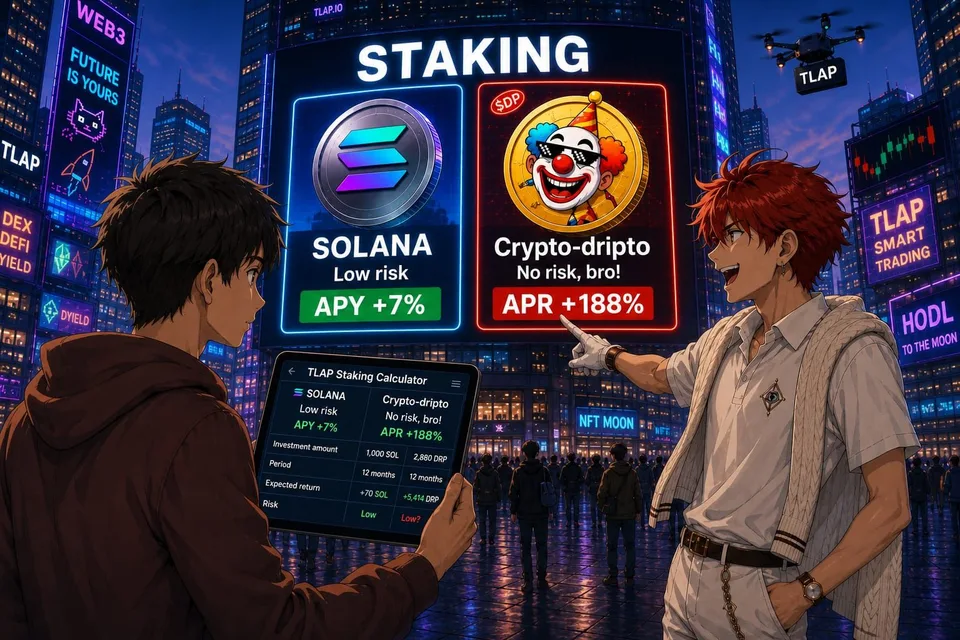
Staking is no longer just a buzzword, but one of the most popular ways to earn on crypto: for some it is a way to receive passive income in cryptocurrency, for others it is a tool for participating in network governance.
Naturally, beginners have many questions. What is staking in simple terms? How do you choose a reliable project? Why does one service promise 5% per year, while another promises 100%? And does a high rate really mean bigger profit? Spoiler: no, attractive rates often hide token inflation, hidden risks, and funds being locked on unfavorable terms.
In this article, you will find answers to all the main questions, learn about the risks, learn how to use the staking yield calculator, and understand how to choose a project for long-term investment.
What Is Staking in Simple Terms
Staking is a way to receive rewards for holding cryptocurrency on a blockchain. You can learn more about staking in our main article, while here we focus on evaluating a coin before deciding to stake it.
When a trader sends coins into staking, they help the network confirm transactions and maintain its operation. In return, the blockchain accrues a reward.
To explain it as simply as possible, staking resembles a bank deposit:
the trader places funds;
does not use them for some time;
regularly receives income.
The main difference is that income is accrued not in rubles or dollars, but in cryptocurrency. Therefore, the final profit in fiat depends not only on the rate, but also on the coin's price.
How Staking Works
Staking is used in blockchains that operate on the Proof-of-Stake (PoS) algorithm.
Instead of complex calculations, as in mining, the network chooses participants who already own coins and are ready to lock them temporarily.
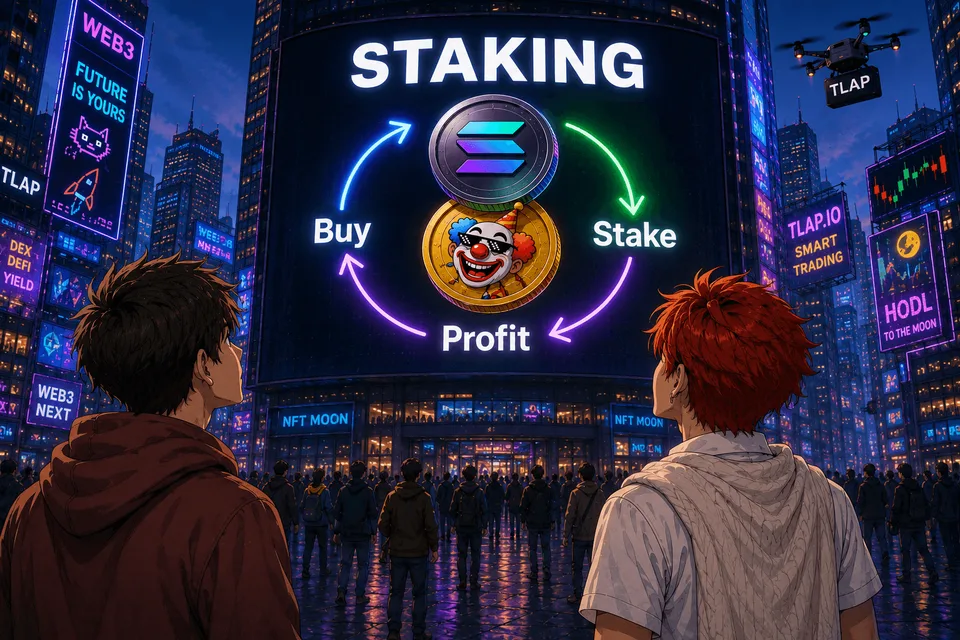
The scheme looks like this:
The trader buys cryptocurrency.
Sends it into staking.
The coins participate in the operation of the network.
The trader receives new coins as a reward.
The more coins participate in staking, the higher the network's security.
What Types of Staking Exist
It is important to have an idea of the types of staking, because their risks are completely different.
Native staking (PoS). The trader delegates coins to a network validator (Ethereum, Solana, Polkadot). This is the safest option: the assets do not leave the wallet, and the risk comes down to choosing an unscrupulous validator (slashing is a penalty for its unstable operation).
DeFi staking and farming. The trader deposits tokens into the smart contract of a decentralized exchange or lending protocol. The yield is higher, but the risk of a smart contract vulnerability is added.
Liquid staking (Liquid Staking). The trader receives a derivative token (for example, stETH instead of ETH), which can be used in other DeFi protocols while the original is locked. It is convenient, but adds a layer of risk related to the derivative token's price peg to the underlying asset.
Locked staking on exchanges and in wallets. This is the simplest, but often the least transparent way. The trader entrusts funds to a platform, which decides on its own how to use them.
How to Choose a Project for Staking
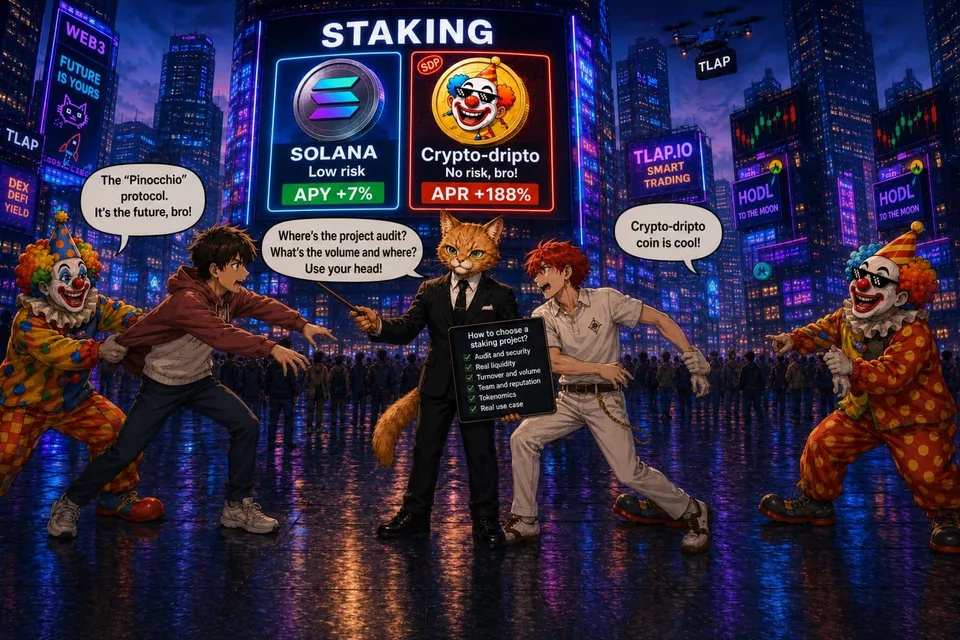
When seeing a yield of 300% per year, your hand almost reaches for “Deposit”. But high yield is far from the main criterion for choosing a project.
Before investing, it is necessary to assess the project by the following parameters.
Team, audit, and reputation.
Who is behind the project? Public figures with experience or an anonymous group with no history? Anonymity is not always a verdict, but it raises risks.
Have smart contract audits been conducted? A trader needs to check for reports from reputable firms (CertiK, Trail of Bits, OpenZeppelin).
Have critical vulnerabilities been closed? Is there a bug bounty program? How often are updates released?
And what about how long the project has existed? High total value locked (TVL, Total Value Locked) and a project age of six months or more already filter out many scams.
Another question: is there an active community? The presence of a community indicates strong interest, which also means high chances of cash flow.
Thus, if a project has existed for a long time and continues to develop, the risks are usually lower.
Tokenomics and unlocking.
Withdrawal rules are no less important than the percentage. In many projects, it is impossible to withdraw coins instantly. After staking is disabled, a waiting period begins, which may last several days or weeks.
The unbonding period: how many days after a withdrawal request must you wait to withdraw the coin and/or reward? In native staking (for example, Solana), this can be 2-3 days; in Cosmos, 21 days. In DeFi, you can exit instantly, but often with a fee.
Lockup for the team and funds: could it turn out that a month after entry the developers start unlocking their tokens and selling them on the market, crashing the price?
Also, before buying, it is necessary to understand:
how many coins are already in circulation;
how many more will be issued;
whether issuance is growing right now.
If supply increases too quickly, the token price may decline.
Liquidity.
The coin should be easy to sell.
Therefore, it is important to know the total trading volume and daily turnover, as well as to count how many exchanges the asset is traded on. The coin's listing on Binance and/or Bybit is a plus for the coin.
Yield.
Beginners often choose projects with returns of 100-300% per year.
At first glance, it seems this is the best option. But most often, high yield is explained by high inflation, a low token price, the youth of the project, and a high level of risk. Sometimes the coin falls in price faster than rewards are accrued.
As a result, the investor receives more tokens, but their total value turns out to be lower than the initial investment.
So the first question to ask is: where do the interest payments come from?
If from inflation of the token itself (the network prints new coins), a high nominal yield may simply compensate for dilution of the investor's share. It is necessary to look for projects where inflation is balanced by fee burning or where network growth outpaces issuance.
A more sustainable model is earning income from protocol fees.
If income is generated directly from attracting new users (a Ponzi scheme), it is better to avoid such a project, although at the initial stage the scheme may be very interesting.
Returns above 15-20% per year in stable assets (ETH, SOL) are highly likely to be either temporary (due to additional incentive emissions) or connected with extreme risk.
You should not trust a "dynamic" rate that is 40% today and 4% tomorrow. It is necessary to carefully study the APR change chart over recent months.
What to choose: APR and APY model.
When choosing staking, you need to pay attention to two indicators: APR and APY.
APR | APY |
Simple annual return | Return including compounding |
Does not account for reinvestment | Accounts for reinvesting rewards |
Suitable for simple calculation | Shows potentially higher income |
If a trader regularly sends received rewards back into staking, the choice is APY; if there is no reinvestment, it is APR.
Validator commission.
The validator withholds part of the reward. For example: 3% 5%, 8%.
The lower the commission with a good validator reputation, the higher the income and the more reliable the project.
TLAP staking profitability calculator: how to quickly evaluate a project in numbers
A staking calculator is an online service that helps calculate possible profit in advance and shows approximate income based on current network conditions. This is especially useful if you are comparing several projects.
TLAP has developed its own staking yield calculator, which helps conduct a quick assessment of a project before sending coins into staking.
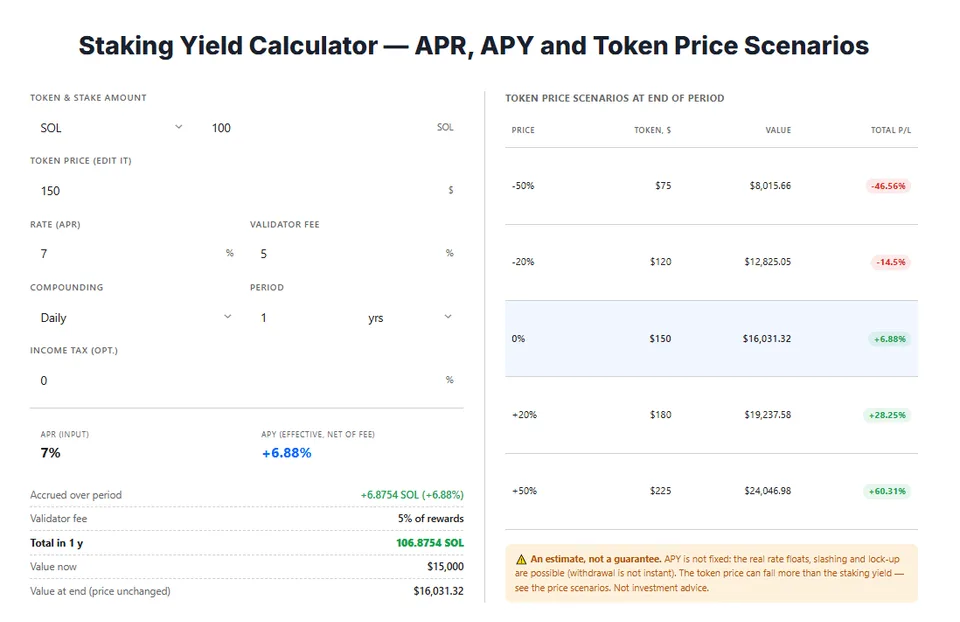
Step 1. Specify the token and stake amount. For example: 100 SOL; 1000 ATOM; 5 ETH.
Step 2. Specify the token price in $.
Step 3. Specify the APR rate in %.
Step 4. Specify the validator commission in %.
Step 5. Specify compounding (daily, weekly, monthly, quarterly, without reinvestment).
Step 6. Specify the staking period. For example: day, month; year.
Step 7. Specify income tax (optional).
Step 5. Get the forecast.
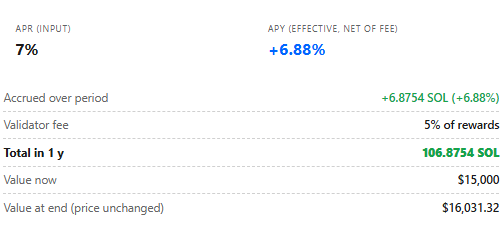
The TLAP service also shows the final profit or loss depending on the token price at the end of the period.
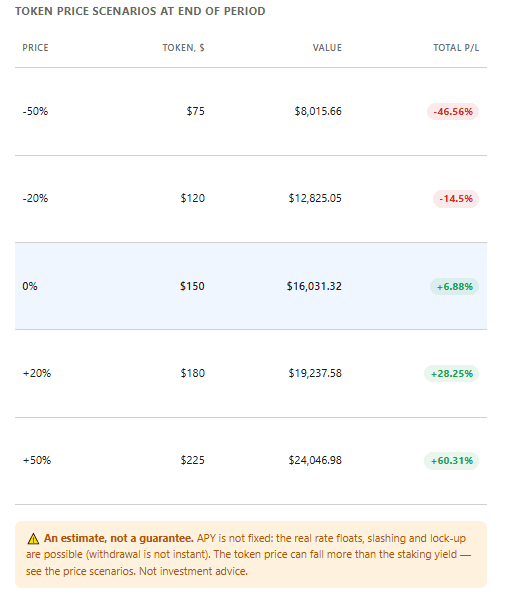
Remember: the calculator cannot predict the future cryptocurrency rate and the real, not expected, income.
Frequently Asked Questions
Can you lose money in staking? Yes. The main risk is not connected with staking, but with a decline in the value of the cryptocurrency itself.
How much can you earn? It all depends on the chosen project, the investment amount, and the placement period. Returns can range from a few percent to tens of percent per year.
Can you withdraw coins at any time? Not always. Many networks have an unlocking period during which assets no longer generate income but are not yet available for withdrawal.
Which is better: holding coins or sending them to staking? If you plan to hold cryptocurrency for a long time and understand the risks, staking lets you earn additional income. If you trade actively, locking funds may be inconvenient.
Does staking guarantee a profit? No. Rewards are accrued in cryptocurrency, and its market price can either rise or fall.
What are the main mistakes? The most common mistakes are:
buying an unknown token only because of high returns;
failing to account for a price drop;
failing to account for the lock-up period;
sending all your funds to staking;
choosing the first validator you come across.
Avoiding these mistakes is much easier than compensating for losses later.