
Staking in Crypto: Passive Income with Elevated Risk

Staking (from the English stake, meaning "share") is the process of a user locking up their cryptocurrency to support the operation of a blockchain network, for which they receive a reward in the form of additional cryptocurrency. Put simply, staking in crypto is, in a sense, an analogue of a bank deposit, only in the world of blockchain.
In this article, we will explain what staking is, compare it with traditional financial products, and show the risks associated with it.
This material is for informational purposes, cannot and should not be regarded as a consultation or advice.
What staking in cryptocurrency is in simple terms
Staking is a way to earn from cryptocurrency simply by holding it in the network. A trader "freezes" (locks) their coins in a special smart contract or wallet, and the blockchain network uses them to confirm transactions and maintain security. For this, the crypto trader receives a reward, usually in the same coins that are staked.
Staking in crypto is similar to a mix of a bank deposit, a bond, and participation in infrastructure.
It resembles a deposit in that, by staking crypto, the trader hopes to receive income in the form of interest. The similarity to bonds lies in the fact that the trader receives a regular reward for providing capital to support infrastructure.
One of the key differences between staking and traditional instruments, besides the financing mechanics, is the often absent legally fixed percentage in an agreement: the reward depends on the protocol rules. In addition, the risk is usually higher than with classic banking instruments.
By opening a bank deposit, a Russian investor could count on a yield of up to 18% as of September 2025. By staking a coin such as ETH, one can count on a return of 2.9–3.1% and even up to 4% APY (annual percentage yield).
Speaking about the situation in April 2026, bank deposits yield no more than 13% (actually less), while staking, for example, ATOM on Bybit offers a substantial 17,99%.
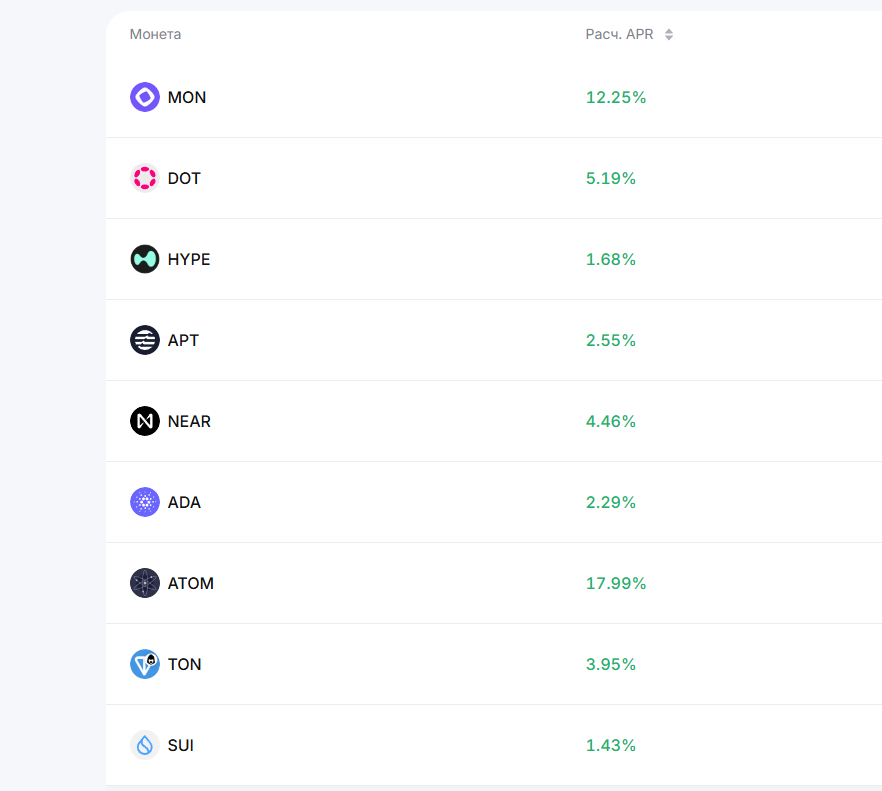
At the same time, it should be remembered that the more investors join staking in a particular cryptocurrency, the more significantly the overall yield decreases.
How staking works: the path from PoW to PoS
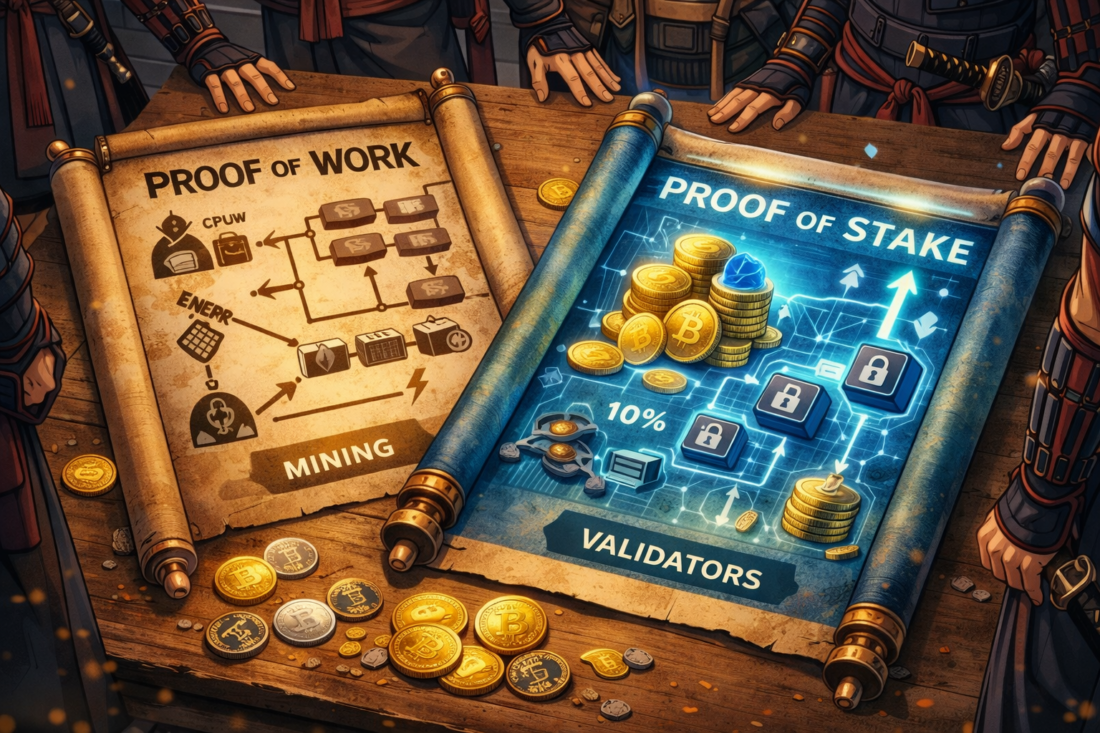
To understand staking, let us dig a little into the history of blockchain.
Earlier (and still today in Bitcoin), Proof-of-Work (PoW) was used. Miners solved complex mathematical problems, spent electricity, and received new coins. This was energy-intensive and not environmentally friendly.
Modern staking is based on the Proof-of-Stake (PoS) consensus mechanism, which translates as "proof of ownership share."
In a PoS blockchain, the right to create new blocks and verify transactions is given not to miners with powerful hardware, but to validators, participants who have locked a certain number of coins. The network chooses a validator randomly taking their stake into account: if you have 1% of all coins, you get the right to process about 1% of blocks and receive 1% of all rewards.
Validators (or "nodes") are special computer nodes that verify transactions, form new blocks, and add them to the blockchain. For their work, validators receive fees and newly issued network tokens. To encourage honesty, their locked coins serve as collateral: if fraud is attempted, the validator may be fined (this is called slashing).
The key advantage of PoS is energy efficiency. Unlike Bitcoin mining (PoW), which requires a huge amount of electricity, staking consumes thousands of times less energy. For example, Ethereum's transition from PoW to PoS reduced the network's energy consumption by about 99,95%.
"People's" staking, accessible to a trader with any amount of capital, is a development of the PoS idea. The difference is that each investment enters the staking pool of a serious validator. The more retail investors there are in the pool, the higher the chance that the network will first choose the pool and then the specific trader.
If compared with traditional finance, this model resembles an ETF, where the fund grows along with the number of investors, thereby increasing its influence on the market.
The types of staking are shown in the table:
| Parameter | Proof-of-Work (PoW) | Proof-of-Stake (PoS) | Staking in crypto |
|---|---|---|---|
| The essence of the mechanism | Miners solve complex problems | Validators block coins | User delegates or locks coins |
| How a block is created | Through calculations (mining) | Through the selection of a validator by share | Through participation in PoS (directly or through the service) |
| Who is participating | Miners with equipment | Validators with capital | Regular users and validators |
| Entry threshold | High (hardware, electricity) | Medium/High (eg 32 ETH) | Low (you can start with a small amount) |
| Income | Block reward + commissions | Validation Reward | Share of validator rewards |
| Expenses | Very high (electricity, technology) | Low (server, support) | Minimum (service commission) |
| Risks | Falling prices, obsolescence of equipment | Slashing, validator errors | Loss of liquidity, service risks |
| Environmental friendliness | Low (high power consumption) | High | High |
| Examples | Bitcoin | Ethereum (after transition) | Lido, Binance Staking |
| Liquidity of funds | High (coins are not blocked) | Limited (there is a blocking period) | Depends on conditions (sometimes withdrawal is not immediately available) |
Main types of staking in crypto
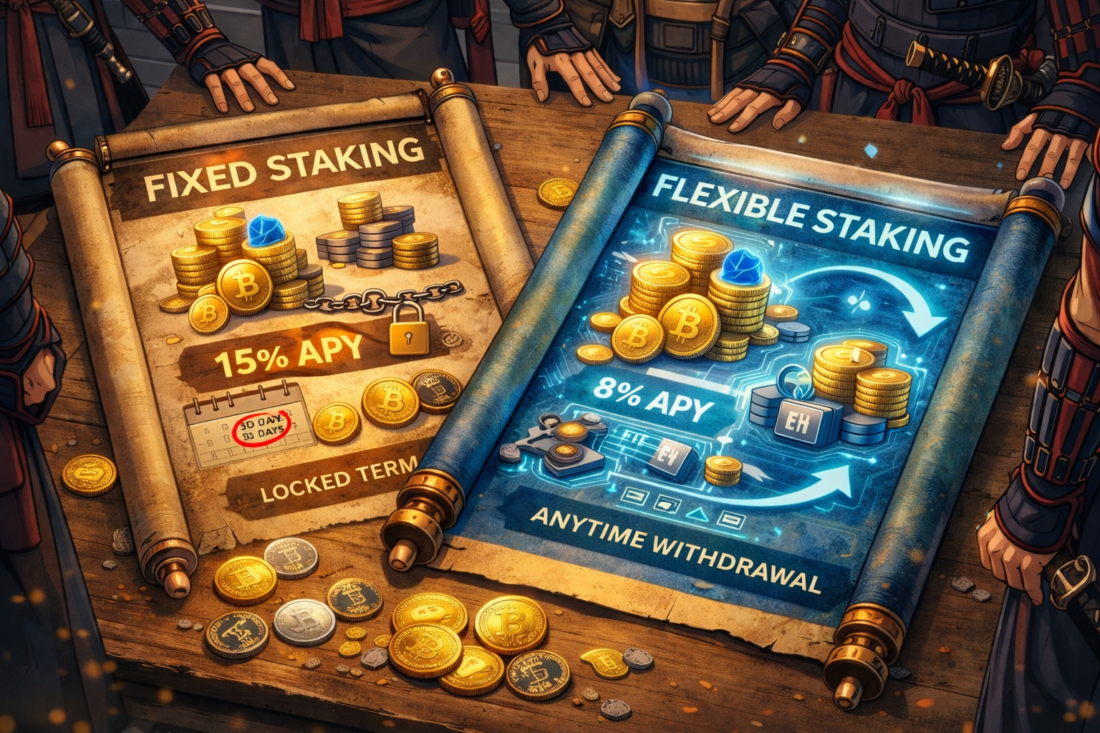
Fixed staking (also known as Locked Staking) is the locking of crypto coins for a pre-agreed period, after which the trader gets their assets back together with the accrued reward. In essence, fixed staking is the closest analogue of a term bank deposit in the world of cryptocurrencies. The drawbacks of fixed staking are penalties for early exit.
Flexible Staking is an option in which the trader can lock their coins without a fixed term and withdraw them at any moment at their own discretion. The yield here is lower than in fixed staking, but that is the price of flexibility.
The difference in yield between fixed and flexible staking can be quite significant. As an example, I will show data from the Bitvavo platform (current as of October 2025).
| Assets | Fixed staking (APY) | Flexible Staking (APY) | Difference |
|---|---|---|---|
| Polkadot (DOT) | 9.00% | 3.00% | +6% |
| Solana (SOL) | 6.00% | 1.70% | +4.3% |
| Cosmos (ATOM) | 11.84% | 3.90% | +7.94% |
| Ethereum (ETH) | 2.50% | 0.60% | +1.9% |
| Avalanche (AVAX) | 3.60% | 1.20% | +2.4% |
The difference in yield is especially noticeable in "altcoins." For example, for Cosmos (ATOM), fixed staking brings almost three times more income than flexible staking.
Main ways of staking in cryptocurrency
Centralized staking (through an exchange)
The trader transfers their coins to a crypto exchange (Binance, Bybit, OKX, etc.), which handles the technical part itself and distributes the rewards. This is the simplest and most popular method for beginners, requiring minimal knowledge.
Pros: low entry threshold, convenience, no need to manage nodes.
Cons: the exchange keeps a commission (in some cases up to 25% of income), and the funds are under the control of a third party (custodial risk).
Decentralized staking (independently or through DeFi)
The trader stakes coins directly in the blockchain network through special wallets (Trust Wallet, MetaMask, Rabby Wallet) or decentralized applications (DApps). This requires more experience, but gives full control over the assets.
Delegated staking
The trader "delegates" their coins to an existing validator, which processes transactions. The reward is shared with the validator. This is how Cardano, Cosmos, and Polkadot networks work.
Liquid staking
In exchange for locked coins, the trader receives derivative tokens (for example, stETH instead of ETH), which can be used in trading. Income from staking helps preserve liquidity.
Main risks of staking
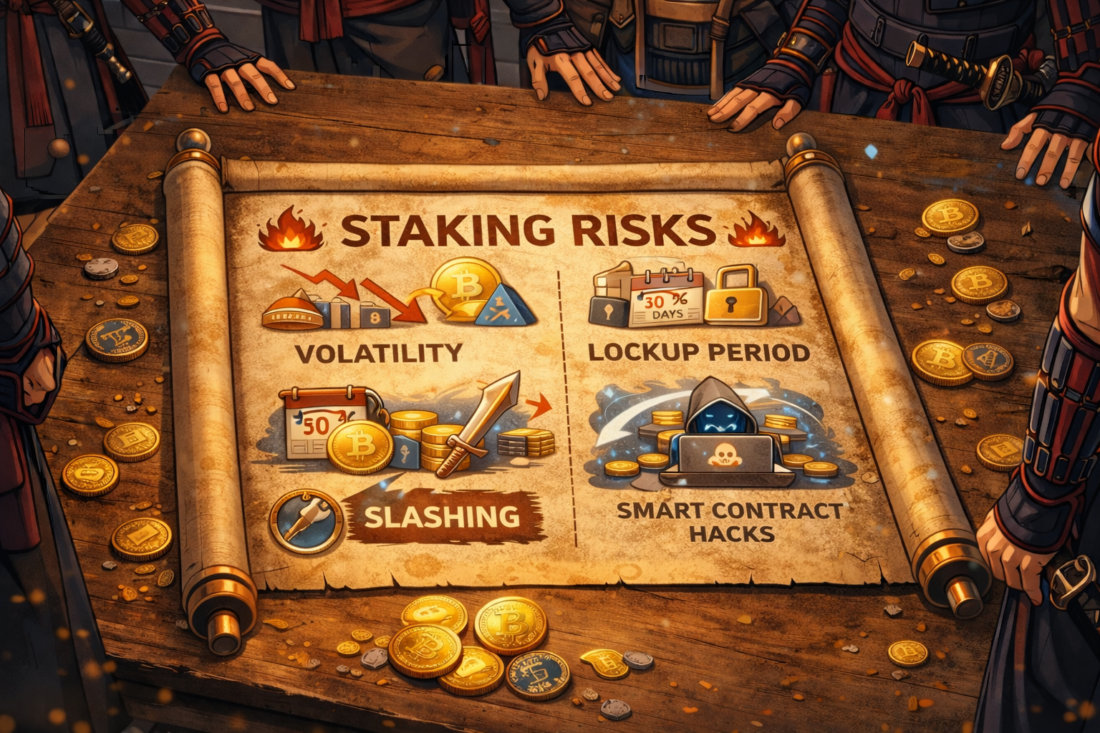
Price volatility. The main risk of staking. The trader receives a reward in the same cryptocurrency they stake. If the coin price falls by 50%, the income in fiat terms may become negative despite the accrued interest.
Slashing. If the validator to which the coins are delegated violates the network rules (for example, signing the same block twice), it may be fined and lose part of the staked funds. In some cases, delegators are affected as well.
Funds lockup. In classic staking, cryptocurrency is "frozen" for a certain period during which it cannot be sold or transferred. This is especially dangerous during a sharp market decline.
Technical risks. When staking independently, node failures, internet connection problems, and configuration errors are possible, and all this can lead to penalties.
Counterparty risks. On centralized exchanges, funds are held by a third party. In the event of an exchange hack or its bankruptcy, you can lose all investments.
Smart contract risks. When using liquid staking protocols, there is a possibility that the smart contract itself may be hacked, which can lead to a total loss of funds.
How staking differs from traditional financial instruments

Bank deposit. Money in a bank deposit account can earn interest, and funds in banks are insured within the limit set by the regulator. This is a fundamental difference from staking: staking has no government insurance protection.
Bond. A bond is a debt security: the issuer borrows money from an investor and undertakes to return it with interest. In a fixed-income bond instrument, the rate is known in advance. In staking, there is no issuer in the classical sense and no legal obligation to return income within a set period.
Dividend stock. A stock gives a share of ownership in a company, and dividends are part of the profit that a company may pay to shareholders. Dividends are not an obligation of the network and can change or disappear. Staking does not give a share in a company; it only gives the right to participate in ensuring the operation of the blockchain and receive network rewards.
Term bank deposit. This type of passive income implies "freezing" money for a certain period: the amount is fixed, and early withdrawal is usually associated with a penalty or the loss of part of the interest. Staking has a similar idea of locking an asset, but the mechanism is different: restrictions and periods depend on the network or service, and the risk may include not only a penalty for early exit, but also network sanctions.
| Column 1 | Column 2 | Column 3 |
|---|---|---|
| Parameter | Bank deposit | Staking in cryptocurrency |
| Profitability | 4–8% per annum (in Russia in the first half of 2026 the average rate is ~12%) | 5–20% per annum (in cryptocurrency), but may be higher |
| Safety guarantee | Insured by the state (up to 1.4 million rubles in the Russian Federation) | There's no insurance |
| Risk of loss of capital | Extremely low (only if the bank’s license is revoked) | High (coin rate drop, hacking, slashing) |
| Blocking funds | Can be withdrawn at any time (with loss of interest) | Often strict blocking for a certain period of time |
| Inflation protection | Partial (rates below real inflation) | Depends on the rise/fall of the cryptocurrency rate |
| Taxation | Standard interest tax | Depends on jurisdiction, often complex accounting |
The income sources differ: a bank pays interest from lending profits, while staking pays from the issuance of new tokens and network fees.
Conclusion
Staking can be a good way to earn passive income, but it is far from suitable for everyone.
In my opinion, in the realities of 2026, cryptocurrency staking works well if a trader's capital is concentrated in blockchain. It can also be an interesting option if the investor received their cryptocurrency after vesting and unlocking.
Contributing fiat funds to earn percentage income (and staking is precisely percentage income) in a situation where decent coins provide yield comparable to fiat instruments, with increased risks of a decline in value, is not the best idea.
But when altseason arrives, this idea will become quite viable.
If there is still a desire to take part in cryptocurrency staking, then the key rules are as follows:
- never invest your last money in staking
- before staking cryptocurrency, it is worth studying how the coin works
- do not forget about diversifying coins for staking
- use only reliable platforms
Staking is not just a fashionable word from crypto slang. It is a way to make digital money work without traditional intermediaries. But, as in any investment, it is important here to understand the rules of the game: which coins to stake, on which platform, for what period, and with what risks.