
All About Martingale in Forex
 Hello, ladies and gentlemen, Forex traders!
It is no secret that martingale is one of the popular methods of working in Forex, and quite a few traders use it both in trading on personal accounts and in PAMM accounts. The latter, by the way, can gather hundreds upon hundreds of thousands of dollars under management and work, without exaggeration, for years (we have several such examples on our forum). In today's material, we will touch in detail on the topic of martingale, look at how the martingale principle is applied in Forex expert advisors in particular and not only.
What Is Martingale and Why Traders Like It

Martingale (Eng. Martingale) is understood to mean a risky Forex strategy in which, after losing trades, the position size is increased in order to cover losses and make a profit. Schematically, it may look like this:
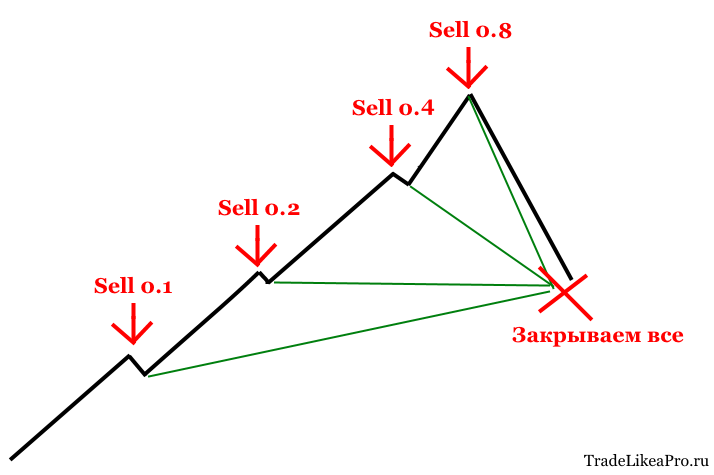 The trader opens a position, the price continues to move against him and the loss increases. Then another order is opened with an increased lot size. If the price keeps moving against the trader, all actions are repeated: after a certain distance, new orders are opened with a larger lot size than the previous ones. As a rule, the price does not move for long in one direction, pullbacks and corrections occur, and in such a case the fattest orders bring a very good profit: all trades are closed at one point and profit is recorded in the account (in monetary terms it can be like this: the first order minus 300$, the second order 0$, the third order 400$, the fourth order 800$ = total result 900$).
What can be achieved by applying martingale in your strategy? Why do Forex traders like it so much? And the answer is: simply crazy goals can be achieved. One of our forum members (with the nickname Silentspec) once managed to turn 168$ into more than 10000$. For reference, trading was conducted using this strategy. Yes, this is possible in Forex, and if you suddenly manage to accelerate like this (with a decent broker), then the dealing center will pay you that profit as well (and we have such cases on our forum). But I will disappoint beginners right away: such cases are still rare; to some extent this is not only a combination of a sound strategy and proper money management, but also luck and good fortune (and the author of this wonderful account acceleration admitted it himself). Yes, it is possible, but among everyone who tries to accelerate this way, only 1 out of... 10000 traders will succeed. So not everyone should count on such acceleration: not everyone will be able to trade this way, and even those who can will not be able to do it constantly; sooner or later large risks and trading without stops will lead to losing the deposit.
Among PAMM accounts, here is a rather good example:
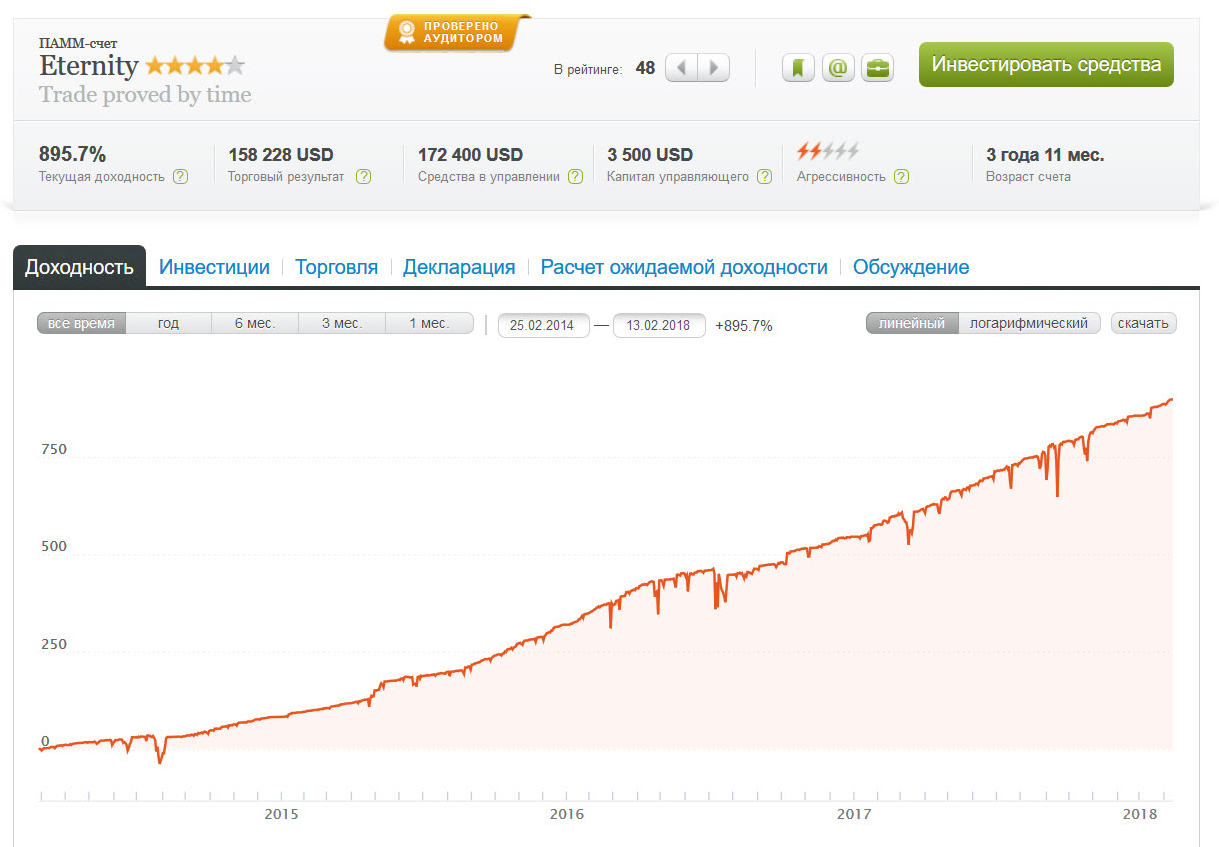 The account manager writes that an advisor with elements of martingale is used here; this is no secret (moreover, this robot can be downloaded from us). As you can see, over almost four years of operation the result is very good. Just in case, here is a link to the PAMM topic on our forum.
 Another monitoring of the work of a martingale bot from our forum. The EA has been working since 2013. I think comments are unnecessary...
Thus, martingale in Forex will probably never be abandoned.
How to Identify Martingale on a Chart

Let us touch on such an aspect as how to determine whether martingale is being used on an account (a PAMM account). Monitoring on MyFxBook makes this possible. We will have a picture with a monitor, something like this:
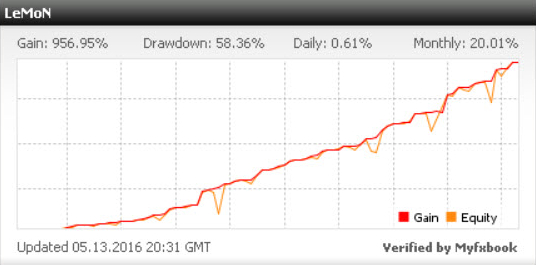 The red curve is the balance (that is, the deposit size), the yellow curve is equity, that is, free funds (for example, we have a 1000$ deposit, we entered with a full lot and the price moved 50 pips against us: we have a 500$ loss; as a result we have a 1000$ balance, 200$ equity (a 500$ loss + 300$ margin for a full lot); or, if the price moved 50 pips in our direction, then the balance will be 1000$, equity 1200$: profit 500$ minus 300$ margin for a full lot).
The lower the peaks formed by the yellow curve, the deeper the account goes into drawdown. In trader jargon, these peaks are called "snot". Of course, if the trading history is closed, this may not always mean that martingale is being used: the trader may simply trade without stop losses and sit through the loss, waiting for the price to reverse and take his take profit. Nevertheless, it is worth paying attention to the "snot" on the chart.
The History of the Emergence of Martingale

The martingale method has been known since the 18th century. At first, oddly enough, it was used in casinos. There is no exact data on the origin of the name: some sources claim that it came from the name of the French city of Martigues, others that this system was developed by John Henry Martindale (and the name came from his surname). In any case, this term came to us from the French language, that is known for certain; as for the rest, if information from different sources contradicts each other, we cannot verify such information with certainty.
Types of Martingale

There are quite a few types of martingale, and if you think that martingale is only increasing the bet size by two after a loss, that is far from the case.
Standard/classic martingale is exactly the case when, after a loss, the initial bet is multiplied by two. We even have one strategy on our forum that satisfies such conditions. It is worth mentioning that this very method of work was used in various kinds of casinos and roulette: when a bet on black or red turned out to be unprofitable, the next time it was doubled in order to cover losses and make a profit. If it again turned out to be unsuccessful, then the new bet is again increased twofold, and so on until there is a win that covers the losses and gives a profit. After that, there is again a return to the initial bet size.
It is worth disappointing those who think they will be able to beat the casino this way: they are not fools there either, and the maximum bet size in the casino is limited. If you try to make money this way on Forex, then perhaps you will not reach the maximum lot size (and there, as a rule, there are also limits; see the website of your dealing center for details), but in that case you will need an enormous deposit size (not to mention psychology). Getting 5-6 stops in a row is elementary. Proven by thousands of traders.
Aggressive martingale means that a very large multiplier is used to increase the lot size in a new order: 3 (three). The goal of such trading is for the take profit to be as close as possible to the current price and for the grid of orders to be able to close as simply and quickly as possible. The danger of this method is that if the market falls just short of the target (literally a few points), reverses, and continues moving against your grid of orders, then with those lot sizes the loss will grow very quickly and the deposit wipeout will happen instantly. See for yourself: our initial lot is 0.01 and the multiplier is three; as a result we have:
1 order - 0.01
2 order - 0.03
3 order - 0.09
4 order - 0.27
5th order - 0.81
6th order - 2.43
7th order - 7.29
8th order - 21.87
...
From this calculation it is clear that we will not be able to open more than 6-7 orders, because the lot sizes will be simply colossal, requiring enormous margin deposits (at the highest possible leverage), and the loss on such lots will also be colossal. In a word, the method is very aggressive and dangerous for your deposit. But despite this, we have a trading system on the site with exactly such working conditions.
Reverse martingale - with this method, both a gradual increase and a gradual decrease of the multiplier for increasing the lot size are assumed. For example, during a series of losing trades, the lot increase each time will not be 1-2-4-8 (doubling), but gradually 1-2-3-4-5 - this will help avoid excessive pressure on the deposit and minimize the risk of a complete account wipeout (though it does not guarantee against a total loss, of course).
Anti-Martingale is another variation of the system. The principle of application is similar to the classic version, when each subsequent stake is doubled. However, here the following rule is used: the stake is increased in case of a win, not a loss on the previous trade. For example, you have a deposit of 1000$, and you risk 1% on a trade - 10 dollars.
Suppose you managed to earn 30 points - 30$. Next, you increase the lot to 0.3 and risk only the 30$ profit, no longer risking the deposit. If the trade is losing, you lose the profit, but lose nothing from the deposit and again return to the working risk/lot of 1%/0.1. If you then take, say, another 30 points, you earn (30pp * 3$) 90 $. Then you can increase the lot again (by the amount of profit), and so on. When the stop order is triggered, you return as usual to risking 1% of the working deposit.
This approach should be used, first of all, by those who have already made it as traders, have their own working strategy, and know their trading statistics. That is, if you sometimes have several profitable trades in a row, then why not try it.
Positive martingale - this way of working assumes increasing the order size only three times; if you could not bring the situation into profit, then you need to return to the initial lot size. This is primarily connected with the goal of preventing catastrophic losses on your account, simply put, so that you do not blow the deposit on a no-pullback section of the trend. We discussed this method in more detail here - there is a corresponding calculator and training video.

Let us also touch here on how the lot size can be increased when working with martingale.
- by a certain multiplier - from 1.1 to 3 (for example, a multiplier of two and the lots will have the following order: 0.01, 0.02, 0.04, 0.08, 0.16, 0.32, and so on);
- gradual increase (0.01, 0.02, 0.03, 0.04, and so on);
- according to Fibonacci numbers (for example, 0.01, 0.02, 0.03, 0.05, 0.08, and so on).
Martingale in Expert Advisors

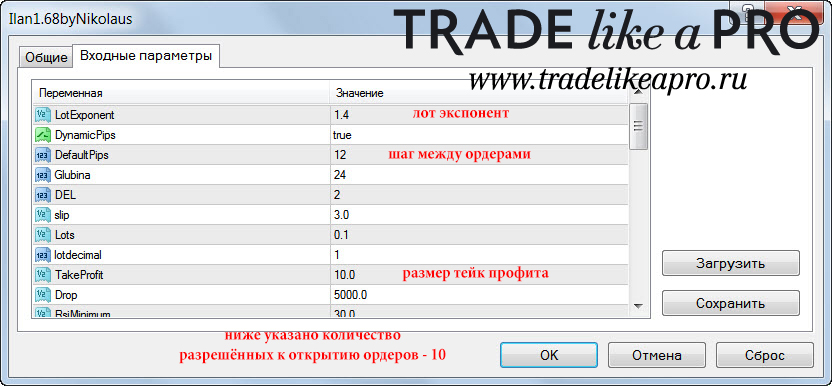
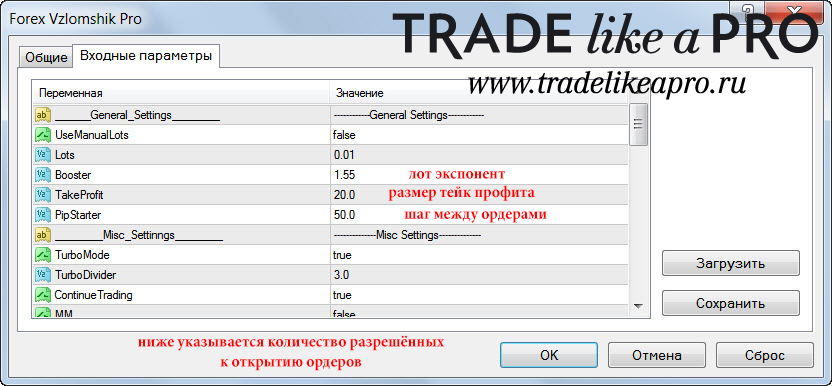
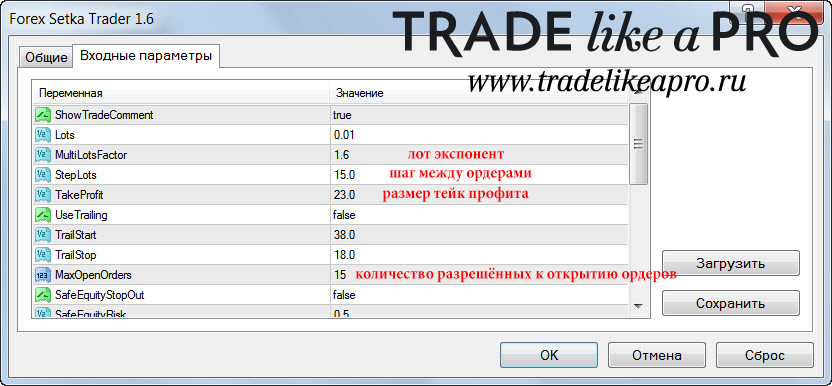
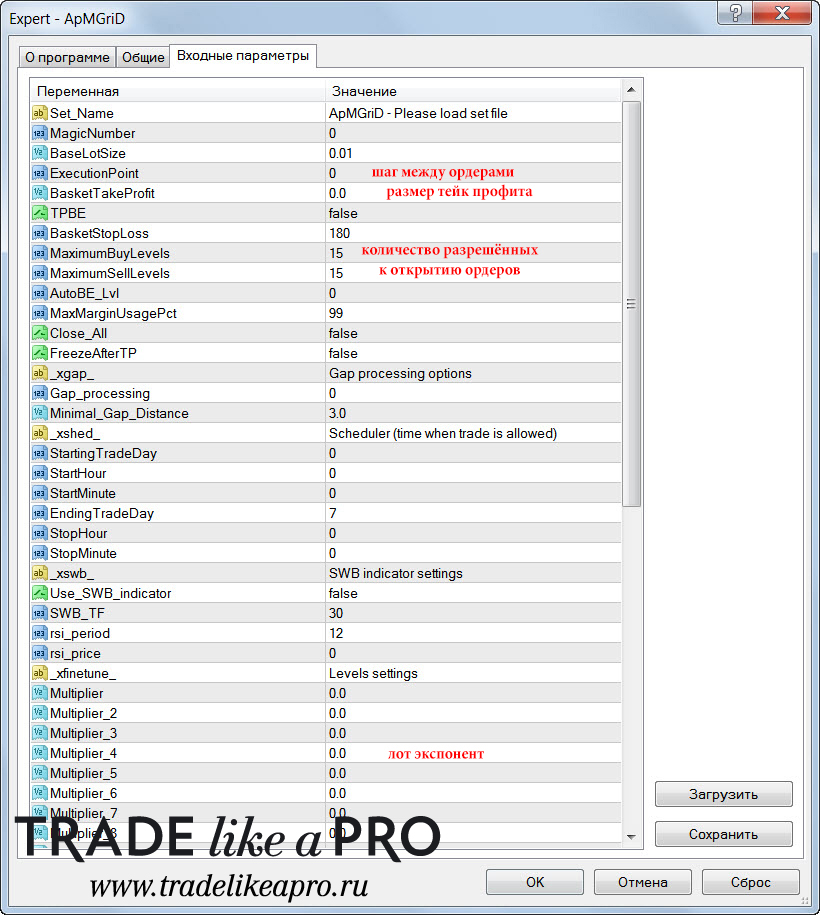
Martingale has long been automated, and on the internet you can find hundreds and hundreds of robots using this strategy in their work. Moreover, more and more new martingale expert advisors appear regularly. In trader slang they are called little monkeys (it is obvious why). In all the variety of robots and various settings for operation, there are several parameters that are the same and present in every expert advisor. These are the multiplier for increasing the lot in grid orders, the step between orders, the number of orders, and the size of the take-profit. Let us look below at where these settings are located in various expert advisors:
 In auxiliary helper expert advisors, which do not trade on their own but only make a trader's routine easier, there is a block for averaging orders. You can use this even without working with classic little monkeys, but the main averaging settings are still the same.
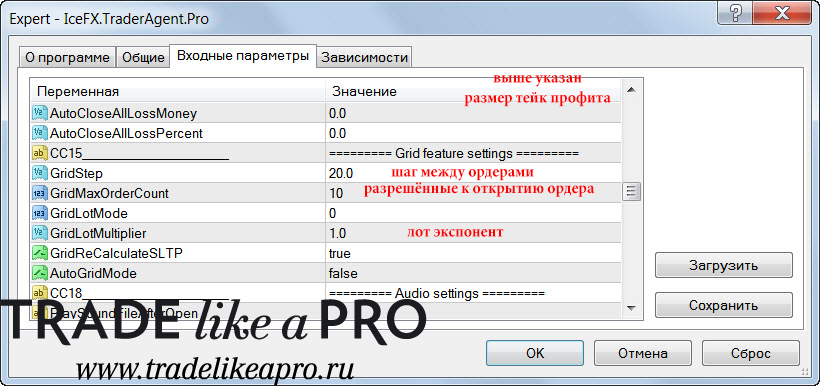
Universal trade averager, ArgoAverager helper expert advisor
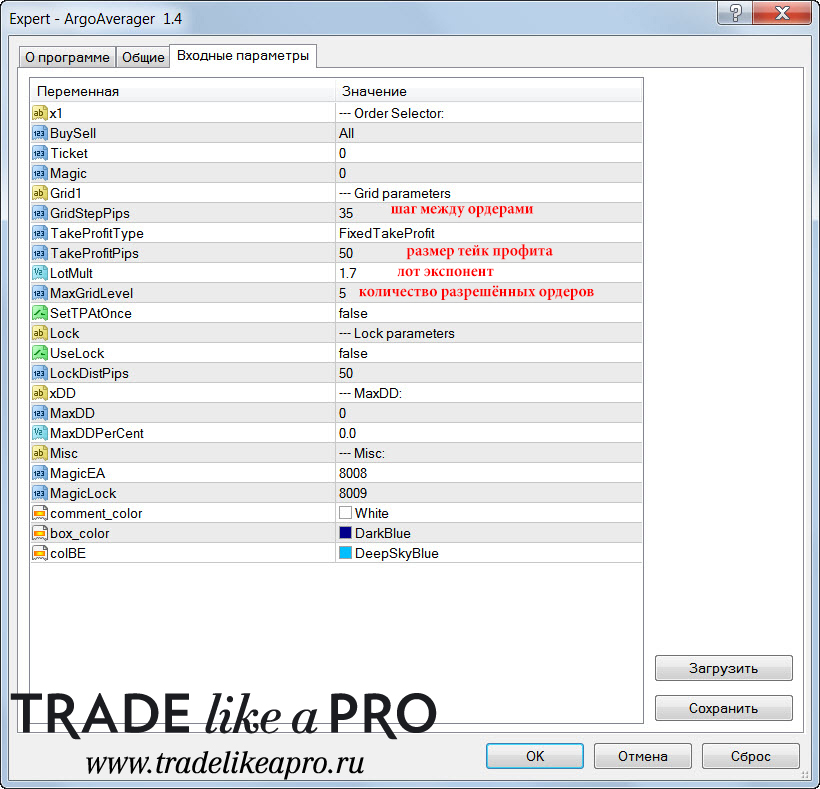 As you can see, by and large it does not matter whether we have martingale in its pure form or a helper expert advisor that can average our trade according to our settings - the essence is the same. Next, we will touch on these settings in more detail.
Multiplier for increasing the lot - in different expert advisors it can have its own designation: lot exponent, multilot, and so on. The essence of this number is simple: depending on its size, the lot of a new grid order will be multiplied by it and will become larger. If you set the multiplier to 2 (two), then each new order will have a lot twice as large as the previous one - 0.01, 0.02, 0.04, 0.08, and so on. If we set 3, then it will be 0.01, 0.03, 0.09, and so on. And, as was already mentioned above, in different expert advisors the most diverse algorithms for increasing lot size can be implemented.
Number of orders is also a fundamentally important parameter. By adjusting it, you decide how many orders the expert advisor is allowed to open to average the position, in order to eventually bring it into profit. A small number of orders and your grid may remain stuck in drawdown for a long time; a large number of orders will create increased pressure on the deposit, which can ultimately lead to its loss. The choice here is not simple. As a rule (depending on the settings), 5-15 orders are allowed to be opened.
Step between orders is no less an important parameter in monkey bots. The step determines after how many points the EA will open a new order with an increased lot size. Depending on the instrument and settings, the step can range from 10-15 to 50-100 points.
Take profit is also an important parameter, measured in points. There is an interesting nuance here: since, as a rule, several orders are opened, in most cases they generally have the same TP value. What is this connected with? When the price reaches the target value, the entire grid of orders will be closed: the very first orders with small lots at a loss, and the very last orders with increased lots (according to the lot exponent multiplier) at a profit. The take value itself can vary from 3 to 30 points, depending on the EA, the instrument, and the objectives in the work. But the goal of any EA, or auxiliary bot averaging your unsuccessful order, is to close the whole series of orders at an overall profit and increase your deposit.
Other settings are all the remaining settings in expert advisors, which can be divided into informational ones (various info panels with data on the spread, the number of orders, the total lot volume, and so on) - they are certainly useful, but will not affect the course of trading in any way; and auxiliary ones (various work schedulers, algorithms for a variable step between orders, a ban on building new pyramids of orders at the end of the week, and so on) - these settings are designed to improve the expert's performance, minimize drawdown, and, in a word, increase the EA's survivability during a no-pullback trend. All this can be compared with additional options in a car: power steering, air conditioning, parking assistants, and so on. Broadly speaking, you can drive without all of this, but with extra options your trip will be more pleasant and comfortable.
How do the main settings of monkey bots affect one another?

When one of the main parameters in martingale EAs is changed, the other main settings will automatically change as well, regardless of your desire; if you want, you cannot fool physics, just as you cannot fool the market. Below we will look at everything with specific examples. If you are just starting to work with this type of EA, I directly recommend that you open several demo accounts and independently run experiments with very different (mutually opposite) monkey-bot settings, so that in practice you can see and understand how everything works there.
Lot exponent. By increasing the multiplier size to 2, 2.5, 3, we reduce the distance to take profit, so the EA can close the grid of orders more easily and quickly. The flip side of the coin is that we increase the load on the deposit: too many lots require margin and carry drawdown when the market moves against you. If no pullback occurs, it will be easier for an EA with large-lot orders to blow the account. By reducing it, we lower the risks, but the distance to take profit also increases; in that case, a large market move will be required for you to make a profit. The market simply may not travel that many points, and your grid will remain hanging until better times.
Number of orders. By increasing this parameter, the EA can cover the entire no-pullback trend with orders, and on a small pullback/correction it will quickly close the entire grid of orders at a profit. But there is also a downside: if there is no pullback and the EA has opened many orders, blowing the deposit becomes more likely. By reducing the number of orders, we can protect the deposit, the drawdown will decrease, but at the most inconvenient moment the EA will lack one (the last in the grid) order with the largest lot, and it will not be able to close the order network at a profit, leaving a floating loss hanging for an indefinite time.
Step between orders. If it is increased, we will improve the expert's resistance to no-pullback trends and increase its survivability, but to close the grid of orders at a profit, more points will have to be traveled to take profit, regardless of how many points we reduce the TP value in the settings. If the step is made very small, then only a small pullback will be required to close the grid of orders. However, if it does not happen, the EA will open the entire grid of orders and the trend will continue further, and a deposit wipeout will be inevitable.
Take-profit size. By increasing it, in theory you can earn more, but the price may simply fail to reach the set profit level, the pullback will end and the trend will continue further, while the EA already has a large grid of orders, and the probability of a wipeout rises. If this parameter is reduced, the size of the profit will also decrease, but the grids of orders will also close faster, on smaller pullbacks, which may reduce risks. However, the profitability of the bot will also be lower. Everything here is individual, and experiments and comparisons are necessary: what may work well with one EA may, on the contrary, interfere with another.
Usually in monkey bots, the take profit is set identically for all orders in the grid:
 That is, when the price reaches the specified value, all orders are closed at once: some in profit, some at a loss. As a rule, the very first orders end up at a loss, with small lots, and the orders themselves may be 100 or 200 points behind all the others; the EA averaged in this way, and it is clear that the price will not return for the sake of these orders (or maybe it will... in a year or two). But the fattest orders, with the largest lot sizes, bring the greatest profit and cover all losses, because the EA's task is to close the grid of orders at a profit.

What should be done with all this in the end? If you still do not have a good grasp of it even after tests on demo accounts, then at least use the set files for the experts that come with them. Naturally, do not forget all the recommendations of the developers/authors of the sets: put the bot on the required currency pair and timeframe. We also have material on our site about working with EA set files; you can find it here.
Another path is independent testing of the EA in various programs designed for testing manual and automated strategies. And then a logical conclusion follows: testing your settings on demo/cent accounts, in the real market, with spreads, commissions, slippage, connection outages, and other delights. This will be a very costly path, but also the very best one from the point of view of understanding how expert advisors work and gaining experience. You cannot do without knowledge of computers, various programs... This path is not for everyone.
How deposits are blown when working with martingale

No matter what tricks the developers of martingale EAs use, or how traders come up with algorithms to make martingale less aggressive, sooner or later the moment will come when the trader will have to part with the deposit. The market can stage such a force majeure, such a no-pullback movement, that either did not previously exist in history or happens once every 10-20-30 years (events like Brexit or the franc's unpegging from the euro, and so on). In general, a deposit wipeout will look the same regardless of whether you use an EA, average your unsuccessful trade with an assistant bot, or independently increase the lot with each new order.
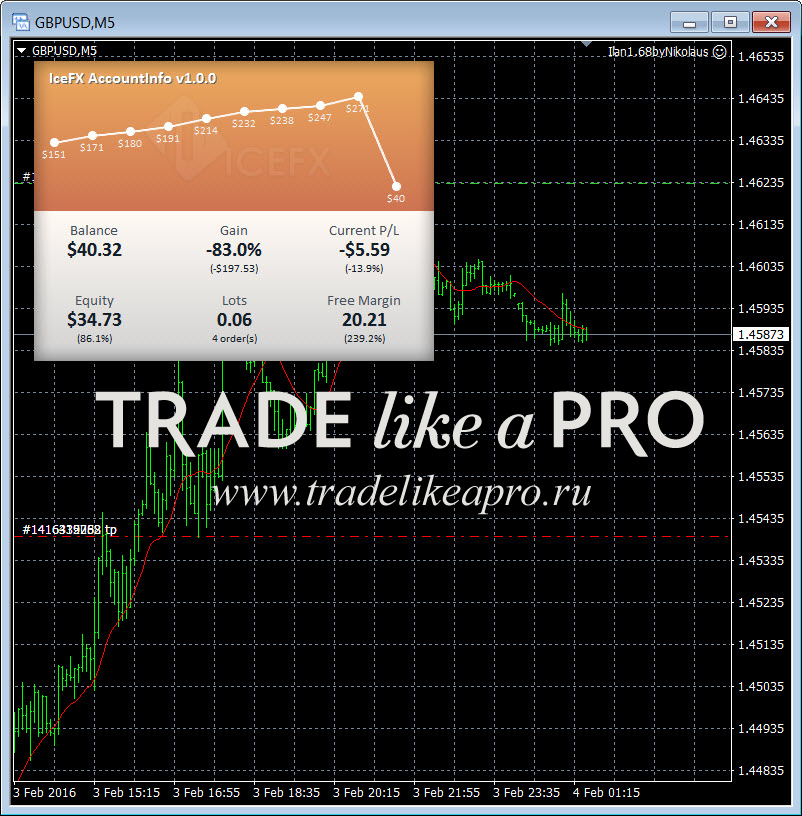
For an example, we will look at how a martingale EA will blow the deposit when it was launched specifically to show... the blowing of the deposit. So, an ECN account for $150 is open, which is very little for running a monkey bot; our task is to blow up quickly. Before the collapse of the depo, the following picture may be observed:
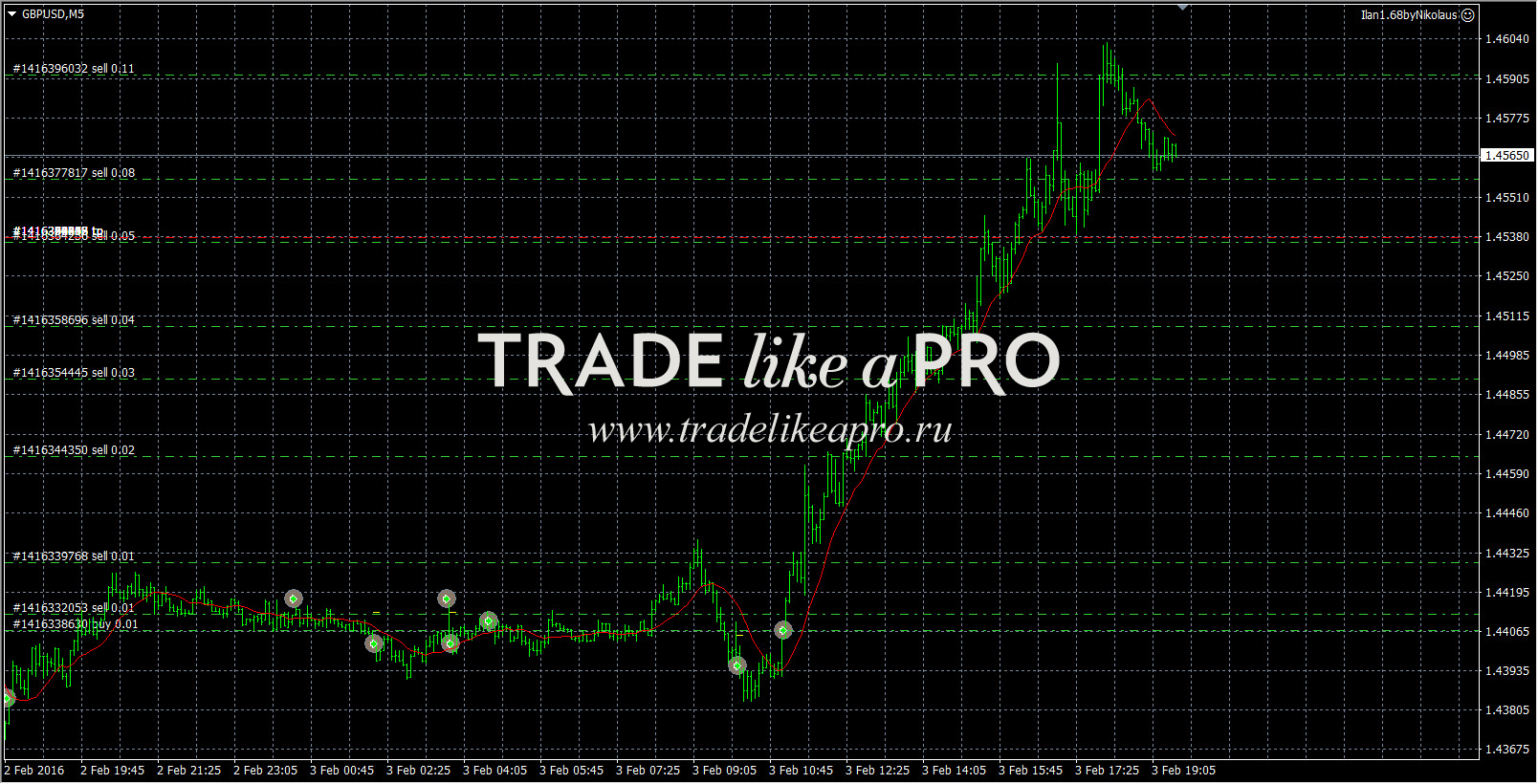 Here we see that the EA opens orders as the price goes against it, the robot averages in, all settings are specified by the user: the step between orders, the multiplier for increasing the lot in new orders, the number of orders. If the price suddenly reaches the red line (this is the take profit for all orders in the grid), the entire grid of orders will close by TP and we will celebrate a deposit increase, as had been the case for a week. But not this time. In accordance with the leverage, the bot will open as many orders as there is enough money in our small deposit for.
When all the money is exhausted and there are no free funds, the robot cannot open new orders for further averaging and exiting the drawdown; at the same time there are no free funds in the deposit, and the broker begins closing positions starting with the most unprofitable one (because a broker will never lose because of a trader's mistake, and it will not let its own money, which it gives the trader as collateral according to leverage, be harmed). Here are the EA's last trades:
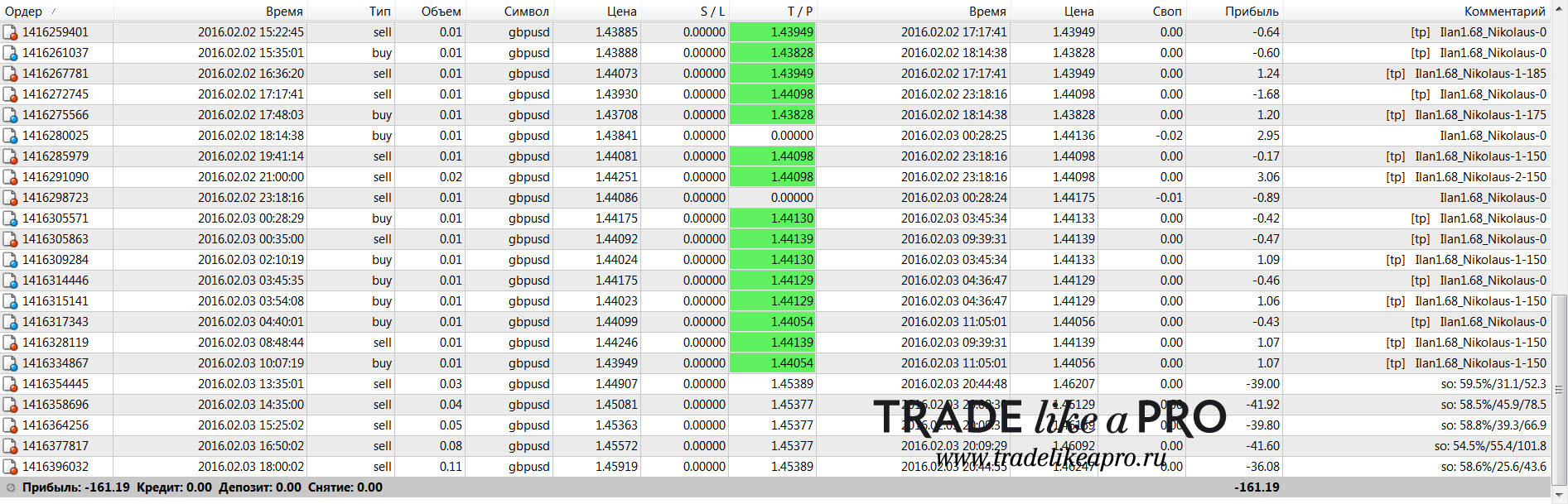 Here the very bottom orders come with the comment stop out. A stop out is a signal for the forced closure of a position, which is sent by the server if the client is found to have insufficient funds in the account to maintain the open trade. Each broker sets the stop-out level individually. As a rule, a trader's losing positions are closed at the current market price. If a trader has gone negative on several positions, the forced closure begins with the most unprofitable of them (from Alpari's glossary). There will be plenty of similar entries in the Experts tab of the MetaTrader 4 terminal:
The expert advisor writes that there is no money, our deposit is too small. No money, it is that simple (for the sake of experiment, you can try opening two lots on a deposit of, say, 500$, and nothing will come of it, the broker will show you the message Not enough money).
So what does a blown deposit look like on the chart?
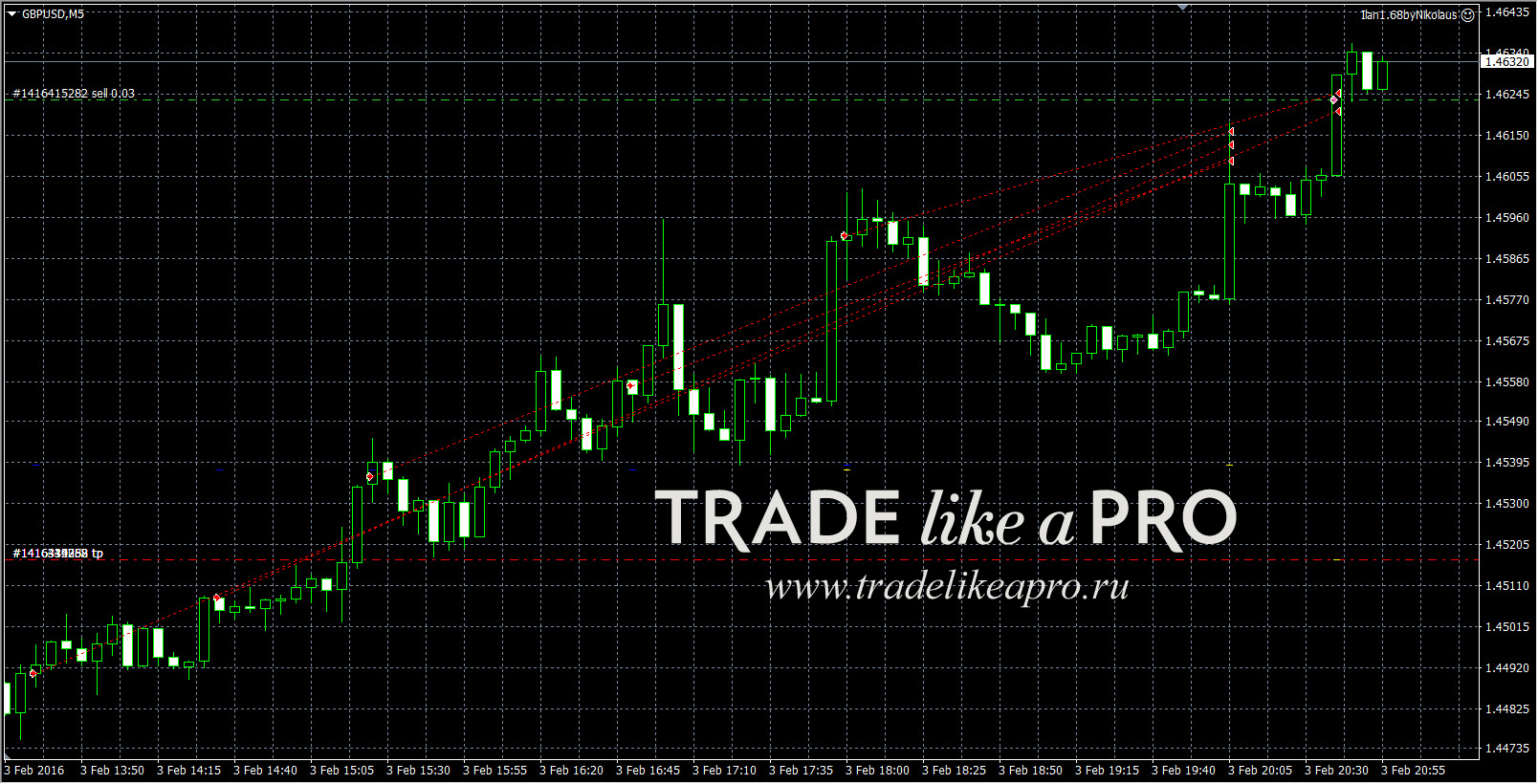 Something like this. The broker closed the most unprofitable orders, a loss has been fixed on your account (which is what is called the account being blown), and only those positions for which there is enough margin remain in the market (collateral, simply put, there is enough of the remaining money to maintain them). In MyFxBook monitoring (and similar services), there will be a similar picture on the chart:
 In traders' jargon, this picture is called a "poker"; there really is a certain resemblance to this tool))) One way or another, this is roughly how most traders have lost their deposit, are losing it, and many, many, many more beginners will lose their deposit this way.
How can you avoid blowing your deposit, and can it be avoided at all? It would be a good idea, before starting work, to calculate all the lots of all the orders in the grid, take into account how much money will be tied up as margin if all the orders are opened; then take into account the drawdown for each order. When this is done, you will approximately know how many points of movement without pullback your grid (your EA settings) is designed for; then look at the volatility of the instrument (for example, here) where you are going to average in, and whether that will be enough for you. Excel spreadsheets may be useful; if you are too lazy to calculate everything manually, you can download ready-made ones here.
You can also try this option: set the expert advisor at the beginning of the month, and by the end of the month look for when the drawdown is minimal and close all positions with a small loss but with profit for the month. A new month begins, launch the EA again. That is, do a restart every month. This can help avoid many deep drawdowns.
Pros and Cons of Martingale

Pros:
- oddly enough, high profitability; when the market is flat, some skilled traders squeeze 100 percent or more per month out of martingale EAs;
- operation in any volatility, both when the market is relatively lively and trending and when everything is barely moving;
- when trend-following, scalping, and other expert advisors blow up or tread water, martingale bots always make money.
Cons:
- they periodically blow deposits on trends without pullbacks;
- drawdowns do occur, and at such moments it is not entirely clear whether the deposit will be preserved or whether it will be lost;
- working with martingale requires strong nerves, which far from all currency speculators have.
Conclusion

Well then, ladies and gentlemen, in this article we have once again become acquainted with martingale, the history of its appearance, and its application in the context of the Forex market. Always remember that this method has its nuances in terms of money management, you should not raise your lot sizes excessively in pursuit of profit, and success will await you.
Good luck and until next time!
Sincerely, Pavel aka Pavel888 TradeLikeaPro.ru