
Your Stops Feed Other Traders' Accounts
A beginning forex trader asks: "Why does the market always take my stops?"
What if I told you that placing stop-losses is necessary so that larger traders can trade in the market, how would you feel? Would you believe it?
One of the first things you hear in forex trading is that, without placing stop-losses, you will only keep losing your money until you wipe out your entire account.
Our protective stops are vitally important for managing our risk, and just a single position opened without a stop order can lead to the suicide of your trading account. I do not think this statement can raise a lot of doubts. But how can this information help us outmaneuver other novice traders?
Stop-Losses in Trading

The uniqueness of stop orders lies in the fact that they, being pending orders, wait to be executed at a pre-set price. But they are executed at MARKET price. Market orders are executed at the best available price and are prone to slippage, especially in inactive markets and in conditions of pronounced volatility.
When stop orders are triggered, their important function is that they add momentum to the market and at the same time use the liquidity present in the market.
Why Is This So Important in Trading?
Depending on how you trade, the following information may help you:
- Prevent slippage;
- Trade on one side with larger players;
- Make a quick profit;
- Collect some cash from novice traders.
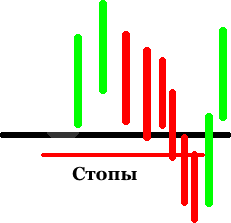
This picture below shows the generally accepted placement of a stop order. What has every trader heard about?
"When opening a position, place a protective stop slightly below the level of the price high/low."
The reason is that this level was identified as an important support level.
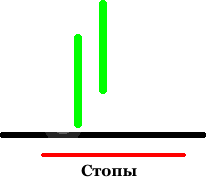
What else is placed in the support area? Traders' buy limit orders, from those who identified the support zone and are waiting for the time to open a position on a retest of the level.
Are there a large number of stops below each level? It depends on the size of the timeframe and on how quickly price leaves this area at the moment of purchase (for more details see Supply and Demand Levels).
- In general, price swings on higher timeframes will contain a larger number of stops than on lower timeframes. On the hourly chart, a reversal point may remain untouched longer, and therefore it may be seen by a larger number of people than on the 5-minute chart.
- A faster price move away from the support zone may explain the fact that this direction of price movement is supported by pronounced interest from traders, and, consequently, it may contain a larger number of market participants, larger positions, and, ultimately, a larger number of stops.
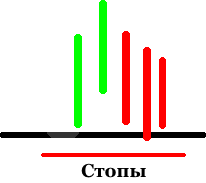
When price reaches this level, traders are still interested in long positions, but this time price does not bounce from this level as one might expect. It does not break through it, does not show lower lows, but displays lower highs.
If you were interested in opening a long position right now, what would you do? The average trader playing the "bounce" of price from the support level would open a long position, placing a stop slightly below the support level. If you had a limit order that had not yet been executed, I would hold off on the order. If you have been waiting for some time to enter longs, then refraining from entering the market would be a good idea.
- Candles/bars display lower highs;
- Price is not rising as fast as one might expect;
- You know that just below the support area there are plenty of stop orders.
What happens next? Price moves downward under pressure and breaks the stops of traders who have open long positions and, as we remember, when buyers' stops are triggered, these are market sell orders, and they force price to move further downward.
And traders waiting to open short positions do so because price breaks the support level, but then the market takes them out, "eats" them, because price goes higher.
What Else Is Important?

Those traders who were initially set on long positions and who were thrown out of the market by broken stops help push price upward. Now the chart looks like this:
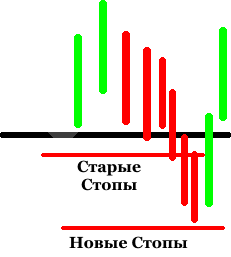
New stops are placed below the new level, and before us is "Groundhog Day." And everything that has just been played out will be played out again and again... only at different price levels.
Use This Information for Your Trading

I hope you understood the concepts of what is set out in this post. This can be used in different variations, for example, to make a quick profit when price knocks out the stop-losses of other players who are not as smart as you.
I will not describe any specific trading strategy, because:
- Understanding the concept is the most important thing
- Applying your understanding will allow you to develop your own strategy
You should find several valuable ways to apply this information. For those of you whose stop-losses the market usually eats up, this information may be a revelation.
Always think about where other players' stop-losses are placed and remember that the market will want to take them. After all, everyone wants to eat :)
Respectfully, Pavel Vlasov TradeLikeaPro.ru
