
The Yen Again Keeps the Market in Intervention-Waiting Mode

Introduction
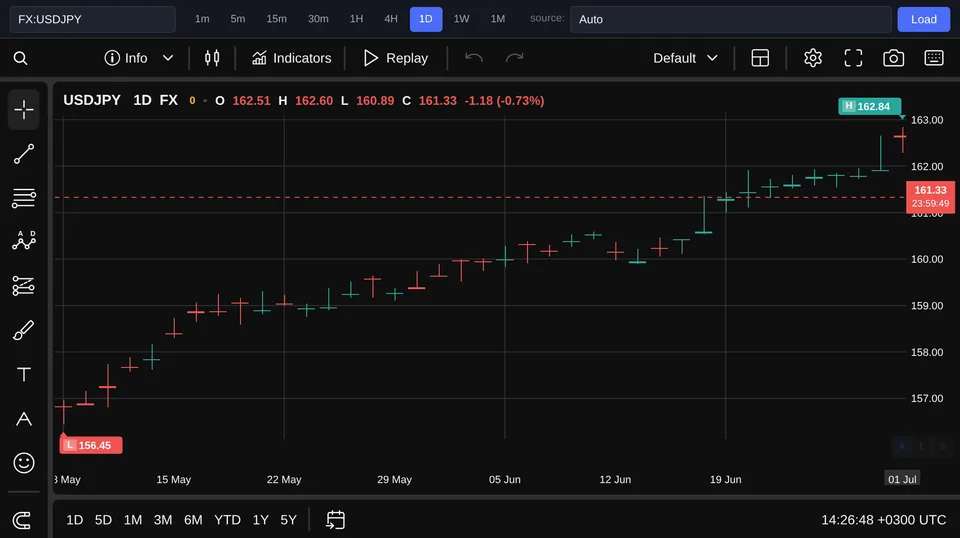
The main intrigue of the day in the currency market is again tied to the Japanese yen and expectations of a possible “yentervention”. The USD/JPY pair is at 161.3 JPY, showing a daily change of -0.79%, yet even this decline looks less like a trend reversal than a cautious risk reduction ahead of a potentially nervous session. The market remains too close to the 162-163 zone, where a historically weak yen is already becoming not only a market problem, but also a political problem for Japan.

The Yen Remains in the Danger Zone
The current USD/JPY level at 161.3 JPY with a daily move of -0.79% does not look sufficient to fully defuse the situation. For Japanese authorities, it is not only the level on the chart itself that is painful, but also the broader trading regime in which the yen stays near multi-decade lows and increases pressure through import prices. The main question of the day is not the 161.3 JPY level itself, but the speed of the move and the authorities' readiness to punish speculative momentum. Traders understand that Japan's Ministry of Finance usually reacts not to a round number as such, but to signs of a one-sided market, excessive leverage, and a sharp weakening of the national currency.
Why the Market Is Discussing 165
The basic rumor of the day comes down to the idea that the authorities may wait for USD/JPY to approach the 165 zone before moving from verbal warnings to direct intervention. This does not make 165 an automatic trigger, but it turns the level into a psychological reference point for option desks, macro funds, and players holding short yen positions. Against the backdrop of the 161.3 JPY price and a daily change of -0.79%, some market participants are clearly reducing leverage and taking profit, but this looks more like a tactical pause than capitulation by dollar buyers. The 165 zone has become a psychological reference point, but intervention risk may be triggered earlier if the move looks fast and one-sided..

A Thin U.S. Market Increases the Risk
Additional tension is created by pre-holiday liquidity in the U.S., when market depth is usually lower and individual flows can move prices more strongly. In such an environment, even a small impulse in USD/JPY can pass through stops, intraday levels, and option barriers faster than participants can reposition. That is why the pair's decline to 161.3 JPY at -0.79% on the day does not guarantee calm trading. In a thin market, the risk lies not only in an official statement from Tokyo, but also in the fact that a small flow can turn into a sharp move. For traders, short yen remains attractive for carry, but now this position carries an explicit premium for the risk of sudden intervention.

How Traders Read Today's Signal
The practical picture of the day looks like nervous stabilization, not cancellation of the main idea. USD/JPY at 161.3 JPY and a daily change of -0.79% show that the market has temporarily cooled, but dollar buyers may quickly return if they do not see a tougher signal from Japanese authorities. For short-term players, the focus has shifted from a simple bet on dollar strength to managing event risk. A short yen position is no longer a pure carry trade: it has become a trade against the patience of Japan's Ministry of Finance. Therefore, every new surge toward 162-163 will be seen as a test of Tokyo's reaction, while a move toward 165 may sharply increase the probability of real action.
Conclusion
The day's bottom line remains tense: the market has not received a final signal, but the trading regime has already changed. USD/JPY at 161.3 JPY with a daily decline of -0.79% shows a pause in pressure on the yen, not the removal of the threat. As long as the pair remains near 162-163 and participants discuss 165 as a possible red line, any sharp tick higher will be read as a new test of Japanese authorities' patience.