
Why Is the Central Bank of the Russian Federation Losing Money on Forex?
 Hello, fellow traders!
At the beginning of the new year, it is customary to sum up the financial results of the past period, so the Central Bank of the Russian Federation published statistics on the accumulation of gold and foreign exchange reserves, according to which the Bank's traders "lost" $9.5 billion on the Forex market. Journalists at finanz.ru drew attention to this. Some may be surprised by the absence of high-profile resignations following this report, but the result for 2017 was also negative - losses amounted to $4.5 billion according to research by the same portal.
The statistics give rise to various conspiracy theories: from sabotage to a decline in professionalism among the Bank of Russia's traders or their actions in "private interests." In fact, the issue of these "losses" is easy to understand: reports on gold and foreign exchange reserves and completed trades are available to everyone, and the figures are reliable given the organization's high and important status, its international position, and its integration into the global financial system. And the reasons for the losses are not at all due to the traders' incompetence. Let us figure out what really led to such impressive losses.
The Strategy of the Central Bank of Russia

Before discussing the course of the Central Bank traders' trades, one should understand the specifics of the strategy of the country's main financial institution.
The first-line bank acts in the interests of state policy, having no goals of commercial profit. The main task is to accumulate a "safety cushion" that serves as a buffer during external shocks and in support of internal economic reforms.
The government and lawmakers pursue a certain economic line, which the financial institution is obliged to accept and take into account, responding with its own monetary policy strategy. Ultimately, any actions and plans of the state are reflected in the formation of gold and foreign exchange reserves.
Russia's Gold and Foreign Exchange Reserves: What Was Wrong with Them in 2017-2018?

Russia's business media in 2017 and starting from the summer of 2018 criticized the Bank of Russia for "unjustified" losses of reserve funds during a period of stable economic conditions. The claims are logical: the Central Bank can and should lose foreign currency and gold during an economic crisis, but during a budget surplus period it is obliged to support continuous growth of foreign assets.
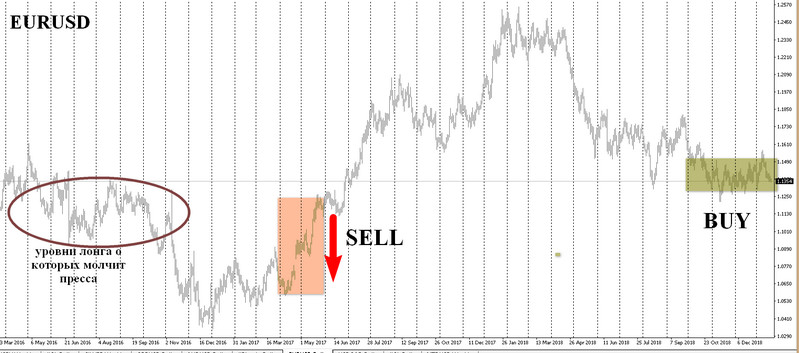
The Central Bank's trades in 2017 looked somewhat strange to the average person - the press blames it for buying US dollars in the first and second quarters of 2017 (19.5 billion euros were converted into USD). Holding the position continued until the end of 2018, until the Bank of Russia switched back to euros by converting the purchased dollars.
On the chart of the EURUSD rate shown below, the approximate moments of entry and exit from this position are marked. The euro was sold at the "worst" price of 2017, but the dollar was bought at the bottom of 2018. This already changes the picture of the loss. If we calculate the relative drawdown, taking into account reserves of more than $460 billion, then in 2017 it amounted to 1%.
However, the press keeps silent about the previous euro purchase price in 2016: look carefully at the chart - the Central Bank was closing the previous EURUSD long, which was "reopened" in 2018, essentially without losses, since the trades took place within one large horizontal price corridor:
 The Central Bank explains the rebalancing of positions as a move away from the negative yield of European Union government treasury bonds with the subsequent purchase of US securities, which, unlike the former, demonstrated a "peak" yield of 3%. At the same time, the Bank of Russia exited at the maximum levels of coupon payments, beginning the sale of Fed bonds in the autumn of 2018, as can be seen on the chart below.
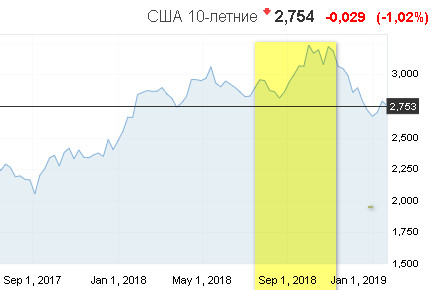 Thus, the overall real result of the trade was a balancing of the EUR currency into USD at break-even with the maximum profit earned on the bonds.
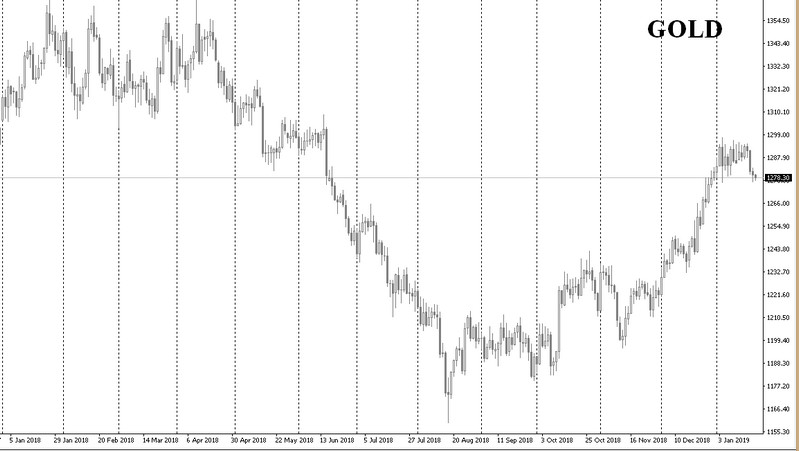
Based on the results of 2018, the business press blames the Central Bank of Russia for investments in the yuan and gold. However, the latter asset is no longer mentioned so often after its Christmas rally, which restored the price by 80% - to 2017 levels.
Let us dwell on gold in more detail. Starting from 2012, the Central Bank has been making constant purchases of gold, increasing volumes. In 2018, a particularly large batch of the metal was acquired - 270 tons. To understand the size of the trades, let us use Turkey as an example: it took second place in purchases of this metal, replenishing reserves by "only" 20 tons.
If the Bank of Russia carried out the bulk of its trades in the middle of the year, then it managed to gain a huge benefit by reaching an 18.5% share of reserves in the precious metal. Given the negative forecasts for the scale of the global economy, the profit from such investments will continue to grow.
 The losses in the yuan cannot yet be justified by anything - within the composition of gold and foreign exchange reserves, the Chinese currency took a 14.7% share, the purchases came at a time of constant weakening of the rate by the People's Bank of China, which dropped the national currency by 7.5%, leading to the current loss of $5 billion. The chart below illustrates the yuan's decline against the US dollar from 0.16 to 0.15$:
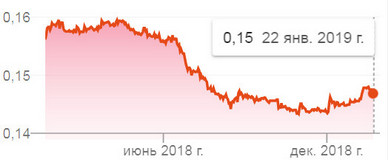 The Central Bank explains the trade by diversification of assets, but it can be assumed quite accurately that the purchase of the Chinese currency is more related to politics than to accumulation tactics, and this position can be discussed in a year.
How Does the Central Bank of Russia Trade on Forex?
Renat Valeev, a currency trader at the Central Bank of the Russian Federation, revealed some of the "secrets" of the Bank of Russia's trading on the Forex market. According to the now former employee, the country's main bank is "late" with trades a priori, because:
- It adheres to a long-term plan fixed in the shares of currency and gold relative to the total volume of reserves;
- The portfolio is rebalanced when there are significant deviations in percentage ratios, that is, always at the market maximum/minimum (in the opposite direction);
- Each trade goes through a bureaucratic approval procedure, which is preceded by a detailed analysis.
The Bank of Russia thinks on a significant time scale and adheres to plans that are designed for a period from one year to five years, so annual reports will show only an intermediate result.
You can familiarize yourself with the Central Bank's trading strategy in more detail on the pages of Renat Valeev's book, "The Art of Trading". The author also actively shares the knowledge he has gained by speaking at various seminars.
 Thanks to the book, the mechanism of the Bank of Russia's trades becomes clear - traders are given from "above" a plan for the percentage shares of the currency portfolio. For example, in the crisis year 2014, it looked like this:
- EUR - 42.5 %
- USD - 42 %
- GBP - 9 %
- CAD - 5 %
- AUD - 1.5 %
The traders' day-to-day work consisted of transactions that preserved the above-described balance, i.e., a rise in the euro that increased the dollar share to 43% led to selling off the American currency from the reserves. Thus, all types of transactions had a countertrend nature due to the specifics of the foreign exchange reserve balancing task.
Conclusion

The measure of the Central Bank of Russia's activity, as already indicated at the beginning of the article, is the volume of foreign exchange reserves, for which 2015, the post-crisis year, can be considered the reference point. The chart presented below clearly shows an increase in gold and currency reserves to $464 billion.
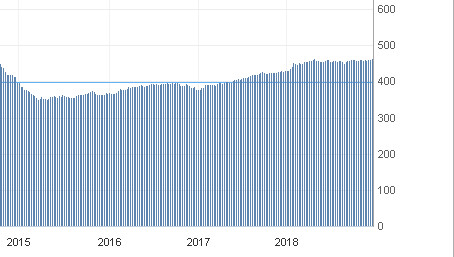 When reading materials that focus attention on the figures of "huge" losses, always compare that amount with the information provided and you will see that the Central Bank traders' losses on Forex do not exceed 2%. This is an excellent indicator of money management, given the clear trend toward increasing total reserves.
Respectfully, Alexey Vergunov
TradeLikeaPro.ru