
Where Do Trends Come From? Or Why Price Moves - An Inside Look

"If the market is moving in some direction,
then the probability of trend continuation is always higher than a reversal"
Hello everyone. Surely you have asked yourself more than once: "Why do prices on the chart move?" After all, there is a seller, there is a buyer, they made a deal - everyone is satisfied. Why should the price rise or fall? After all, if you buy bread in a store, that does not make bread prices rise. What is the secret here? Or is it part of a global conspiracy? What are brokers hiding from us?
Without a doubt, you have heard the good old saying "The trend is your friend." Have you ever wondered why trend-following forex strategies work, and why trading in the direction of the trend is such a widely recognized and accepted method?
The reason is simple. A tendency is more likely to continue than to stop. After a movement has begun, it is easier for it to continue in its current direction than to stop or, all the more so, reverse. This is one of the axioms of trading.
We give this phenomenon various definitions, for example, momentum. But what is its real cause? What is actually happening in the market, and what really moves price in the direction of the trend?
So why do prices move?

To answer this question, we must first examine what drives prices in the first place. As soon as we understand what moves quotes, we will immediately be able to understand why a trend develops.
The Forex market is a typical auction market. Think of an ordinary auction where you are, for example, trying to buy a painting. Initially a low price is set, then it gradually rises higher and higher because people make higher and higher bids. The prices that you see are the prices at which someone is "ready" to buy or sell, and these prices change without any deal or any buying and selling taking place.
The prices that we see on our charts represent bid and ask quotes. These prices are liquid, and they are offered by market makers.
Thus, for the price to change, there must be a corresponding change in these bid and ask quotes. And this can happen in two ways.
First of all, a bank - a liquidity provider - can simply change its quotes. Just imagine, they initially say that they are ready to sell us an asset at the price of 1.32400 (offer), and then 30 seconds later they change their mind and say that in fact they are ready to sell it to us at the price of 1.32450. In this case, the price simply jumped by 5 points. At the same time, no deal was made, nobody bought or sold anything. The market maker simply changed the price of its offer.
The second path that determines price movement is when someone absorbs market liquidity. On our charts we see only the best Bid and Ask prices on the market, but in reality there is a large heap of other bid and ask orders on both sides of the market price for various amounts, at which other banks and market participants are ready to buy this asset from us or sell it to us.
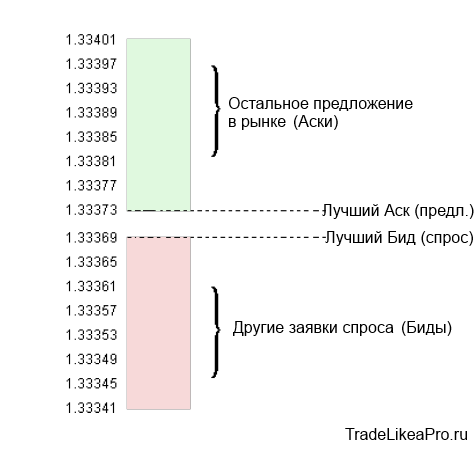
If we assume that there is the best offer at the price of 1,33373 for a total asset amount of 1 000 000 USD, then if a trader comes in and buys the asset for 1 000 000 USD at that price, he consumes all the available liquidity at that price, and that offer will be removed. At the same time, the next best offer on the market will be the one standing above it at the price of 1,33377. Thus, in this example the price jumps by 0,4 points.
Thus, in this second case, price movement is carried out thanks to the consumption of liquidity through demand for it from the buyer.
Now that we know how prices change, we can try to understand why a trend develops.
So where do trends come from?

Let us assume that you and I are both speculators, and I want to buy 100 000 USD, or 1 lot, of the currency pair EURUSD, and you want to sell 100 000 USD, or 1 lot, of the same currency pair.
My buy order consumes liquidity at the ask price, and your sell order consumes liquidity at the bid quotes (Bids). In this situation, if liquidity on the market were equivalent on both sides, we would cause the spread to widen. But the direction in which price actually completes its movement depends on the difference in liquidity volumes on both sides.
Suppose one bank offers at the best BID price an asset volume of 500 000 USD on your side of the market (on the sellers' side), while another bank offers a price with an asset volume of 500 000 USD one level lower, and so on downward. On the offer side (on the buyers' side), a bank offers to sell an asset volume of only 10 000 USD at the best offer price, and another bank offers an asset volume of 10 000 USD at a price above that level, and so on.
Imagine that both you and I came in with our market orders. You sell 100 000 USD, and I buy the same amount, 100 000 USD. Your sale is executed at the banks' quotes. But the quote was for 500 000 USD and your order was only for 100 000 USD, so your order was accepted and consumed only 1/5 of the total amount available. At the same time, there was still 400 000 USD left at that level, and thus the price did not actually move. Thus, the high level of liquidity on the lower side prevents the price from changing even after the sale.
However, my buy order would be 10 times greater than the available offer liquidity. That is, if I placed an order to buy 100 000 USD, I would buy 10 000 USD at the first bank's offer, then another 10 000 USD at the offer of another bank standing above it, then the next 10 000 USD at an even higher offer, and so on. My trade, exactly the same size as yours, would cause the price to move upward by 10 levels because there was not enough liquidity to execute it at one price. My order would consume all the liquidity that was offered at the first level and at each higher level. Thus, before you is an example of two trading orders of equal size in both directions: in one of them the price did not move at all after your order was executed because of the large amount of liquidity on your side, while in the other the price moved by 10 price levels after your order was executed because of weak liquidity above.
Consequently, this is how price movement will be determined. When two equal market orders of equal size are executed, the price will move in the direction of the least liquidity.
This is how a trend develops. The broker's profit lies in the spread, so in order to make their profit, they must buy and sell quickly before price changes occur. The broker buys from you and immediately sells that same amount to me, earning the difference. All the dealer needs to do is buy and sell almost simultaneously to make a profit, which is called the spread. If they fail to do this quickly enough, they can make losing trades and ultimately incur losses.
Since the price starts moving upward, as in the example shown above where dealers are selling with me while liquidity is limited on one side of the market, the dealer who traded with me is now taking losses. If another trader comes in and also buys from that same dealer, their loss may become larger, because they are once again forced to sell in a fast-rising market and may once again take losses.
They try to reduce further risk by decreasing the amount of the asset they offer to sell to anyone else after me. They sold to me, and to balance their order books they need to buy the same amount of the asset from someone else at a more favorable price. They, of course, do not want to keep selling in a rising market, because that will increase their losses. Their efforts are now directed toward buying in order to cancel out their trade with me. Thus, to limit the amount they may have to sell to anyone else, they reduce the size of their offers. This, in turn, reduces liquidity on the buyers' side even further, and therefore prices are even more likely to continue moving upward when any other traders enter the market trying to buy.
That Is Why "The Trend Is Your Friend"

This is a mighty continuing force that feeds itself and gains more and more momentum. This is what causes impulse. That is why intraday trends occur. This is the unspoken mechanics of a trend.
It is an imbalance between supply and demand. Both supply and demand have nothing to do with buying and selling, as most amateurs think. An uptrend does not necessarily have to occur because, along with people trying to buy, there are also people trying to sell (although, of course, it can happen).
The number of traders between buying and selling may also be perfectly balanced, as in the example given above, when you and I traded equal volumes. The trend occurs because liquidity on the selling side of the market is lower compared with the demand for this asset present in the market.
Summary

Thus, there may be an equal number of buyers and sellers on both sides of the market, people like you and me, yet the demand coming from my side as a buyer is greater than the supply of liquidity currently available on my side of the market, while demand on your side is lower than the offers present. This causes the price movement trend to go in the direction of my demand, and once it has occurred, the price will continue going farther and farther in the same direction.
This explains the technical side of a trend and explains the origin of trends and the continuation of their movement.
Sincerely, Pavel
TradeLikeaPro.ru