
USDMXN: The "El Dorado" Speculators Still Haven't Reached

Hello, fellow forex traders! Those who have been in the currency market for a long time remember how easy it was to trade the same EURUSD some 8-10 years ago. But not everyone knows that even now there are instruments on which it is easy to earn, it is just that not everyone knows about them ;) One of these instruments is the Mexican Peso. Namely the USDMXN pair. Technical analysis and Price Action work well on it.
Our review will discuss the structure of Mexico's economy, the features of the USDMXN currency pair, its volatility, the specifics of point calculation, correlation, and most importantly, suitable trading strategies. You will be surprised at how easy it is to trade.
Mexico's Economy
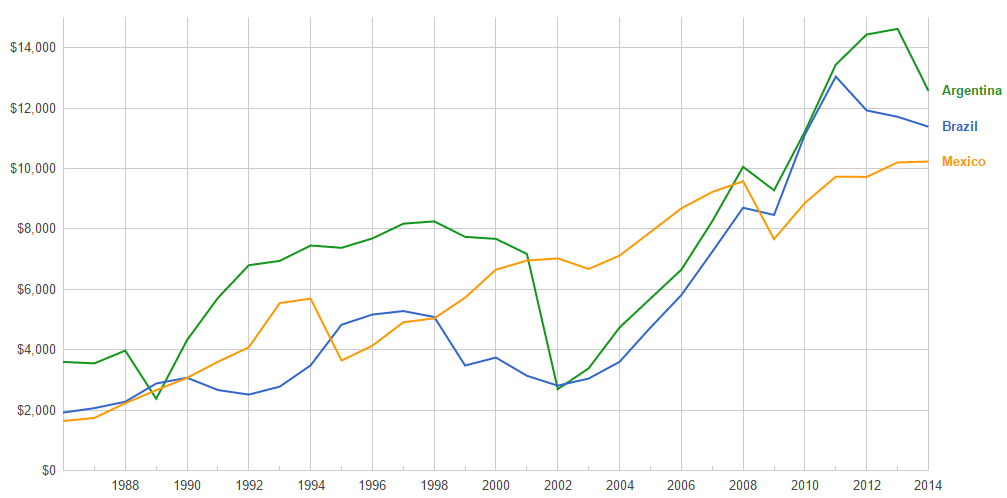
Steady GDP growth says a lot about the stability of a country's economy. As can be seen in the chart above, despite the significant impact of the crises of 1994 and 2008, after short periods of recession the indicators returned to their previous values within a short period of time. And, for example, the South American crisis of 2002 had virtually no effect on the country's GDP at all, showing albeit small but positive growth. Argentina's reaction, however, was much stronger, nearly reaching its 13-year minimum and only after that beginning the recovery process.
At a time when we are seeing an explosive rise in the popularity of currency trading, the rapid growth of the Mexican currency is driven by three main catalysts. So next we will try to consider the main macroeconomic factors and the approaching challenges, whose influence can significantly reduce demand for the Mexican peso in the coming years.
Oil
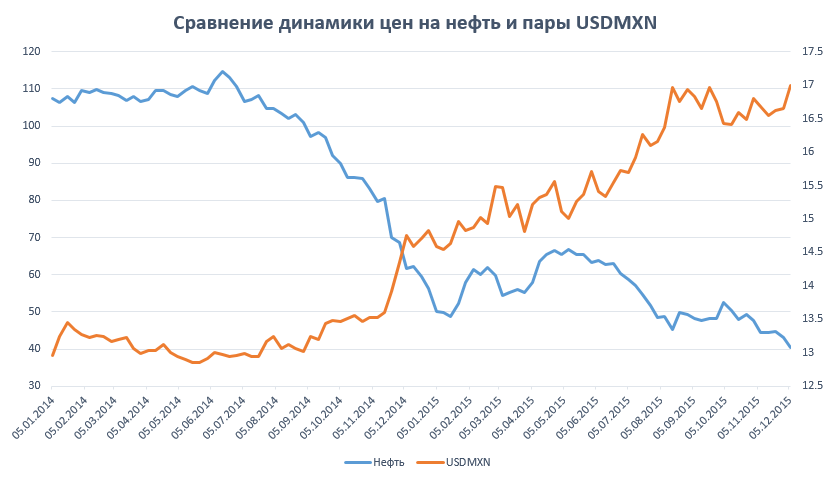
As the ninth-largest oil producer in the world, Mexico deliberately ties the value of its currency to commodity prices, since its extensive reserves serve as collateral for borrowing practices, which are actively used in designing government spending programs. International creditors are more willing to accept the risk of countries with a dominant oil industry when commodity prices are high, which translates into lower borrowing costs. Incidentally, this was precisely what caused the economic boom throughout Latin America after the price reached its all-time high in June 2008.
Oil production accounts for 10% of the country's export revenue, which is why sharp changes in commodity prices also amplify fluctuations in the national currency's exchange rate. In addition, the state levies high tax charges on Pemex, the state oil giant, which makes up about a third of the country's tax collections. Do you still have doubts about the peso's dependence on energy prices? In this respect, the Mexican peso resembles our Russian ruble.
Proximity to the USA
Mexico shares a long border with the United States, which results in broad trade agreements and constant political disagreements generated by the problem of immigration and drug trafficking. Such physical proximity also, to some extent, affects the value of the currency. Thus, densely populated regions near the borders of the states create extensive commercial interactions, which significantly add liquidity to the national currency and constantly adjust its value relative to the U.S. dollar.
In this case, the USDMXN currency pair is not only the most liquid Mexican peso pair, but also reflects the real state of the currency game between Mexico and the United States. The United States exported $240 billion worth of goods to Mexico in 2014 alone, while importing $294 billion, significantly adding liquidity to the Mexican currency. The trade balance showed large fluctuations over the last decade, while changes in the ratio also affected the relative value. Over the last 20 years, Mexico's currency unit has been in a losing position, showing a permanent decline relative to the U.S. dollar.
Challenges for the Coming Years
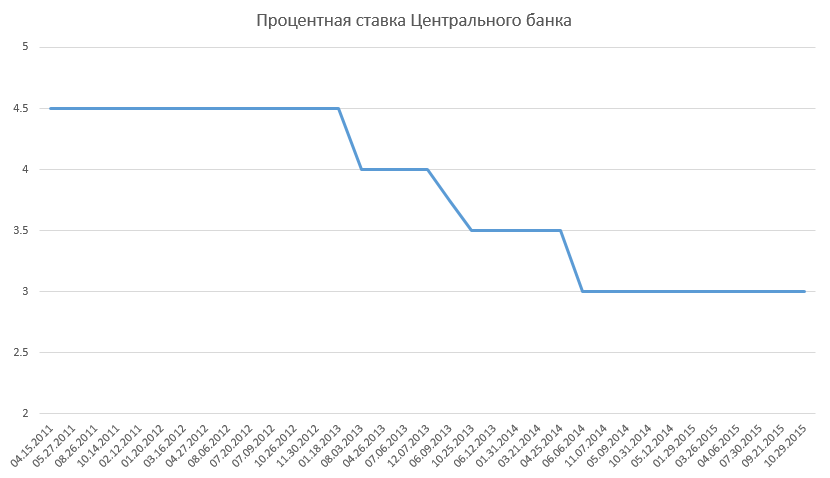
The fall in oil prices undoubtedly undermined the growth of Mexico's economy, while the level of commodity production continues to decline, thereby doubling the negative effect. As a result, this led to a historic collapse of the peso against the dollar and the euro. In addition, the inflow of hot money into the Latin American economy stopped, which together with the previous factors leads to a significant outflow of liquidity from the Mexican currency.
Meanwhile, the practice of quantitative easing in the United States has come to its logical conclusion, thereby encouraging an inflow of capital into local trading venues. As a result, the continued strengthening of the U.S. dollar has every potential to gradually drain liquidity from the Mexican peso over the coming years.
Against the backdrop of the national currency's depreciation and large dollar-denominated loans held by local companies, Mexico's policy remains practically powerless, and the use of short-term stimulus measures is hardly capable of stopping the increasing pace of capital outflow from the country.
The Mexican Peso
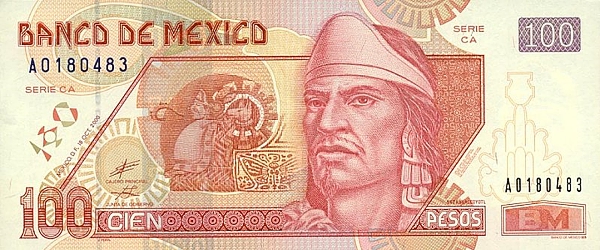
Originally, the peso was the name given to an 8-real coin issued by Spain in the first half of the 19th century. During 1863, the first coins denominated in centavos were issued, at that time equal to one hundredth of a peso. Following this, by 1866, coins with a denomination of one peso had already appeared.
Global Trend
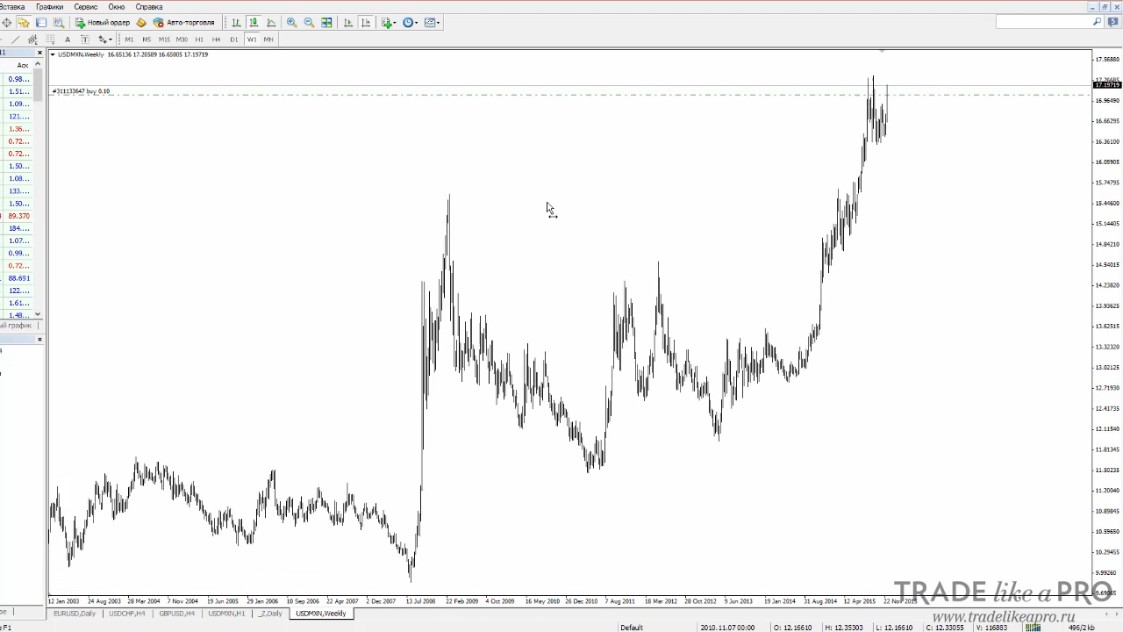
I have the weekly chart of the USDMXN currency pair open.
At a glance, it is clear that the trend in this pair is moving upward. This means that the Mexican currency is moving downward, while the dollar is rising against it.
Point Calculation
As for points on this currency pair, their large number can scare and mislead beginner traders.
If we open any order, this is the kind of picture that will appear before us:
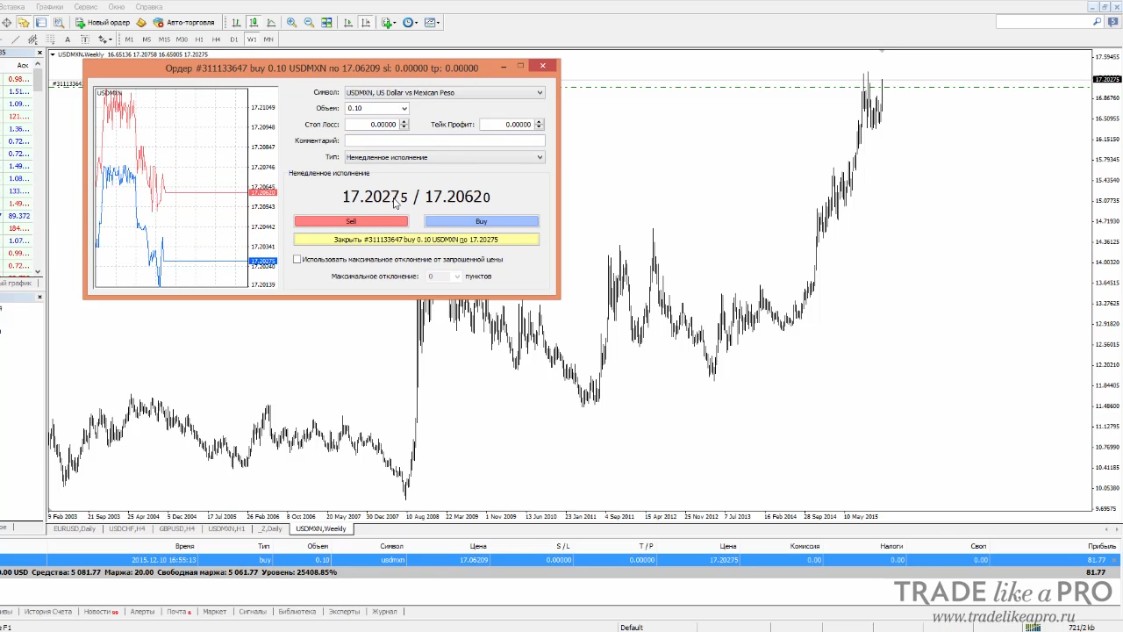
Many, upon seeing this, will suspect that something incredible is going on here.
To sort this out more quickly, let us break it down using my open buy position as an example:
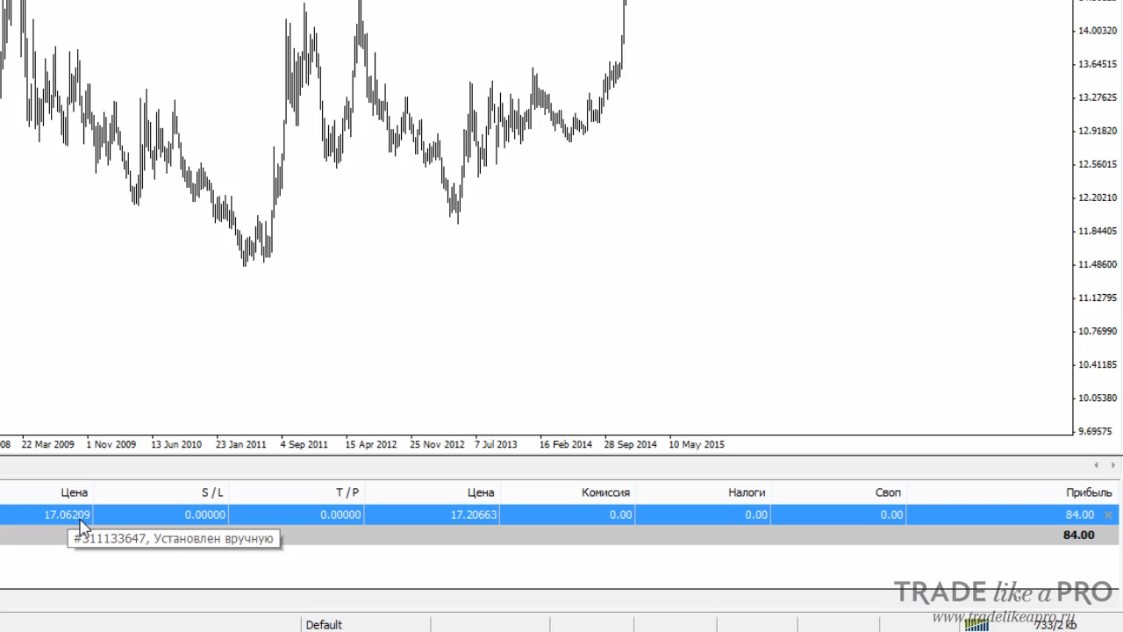
As you can observe, the profit is 84$ with a 0.1 lot.
If we take a ruler and measure the points gained on the chart, we will get some unreal number:
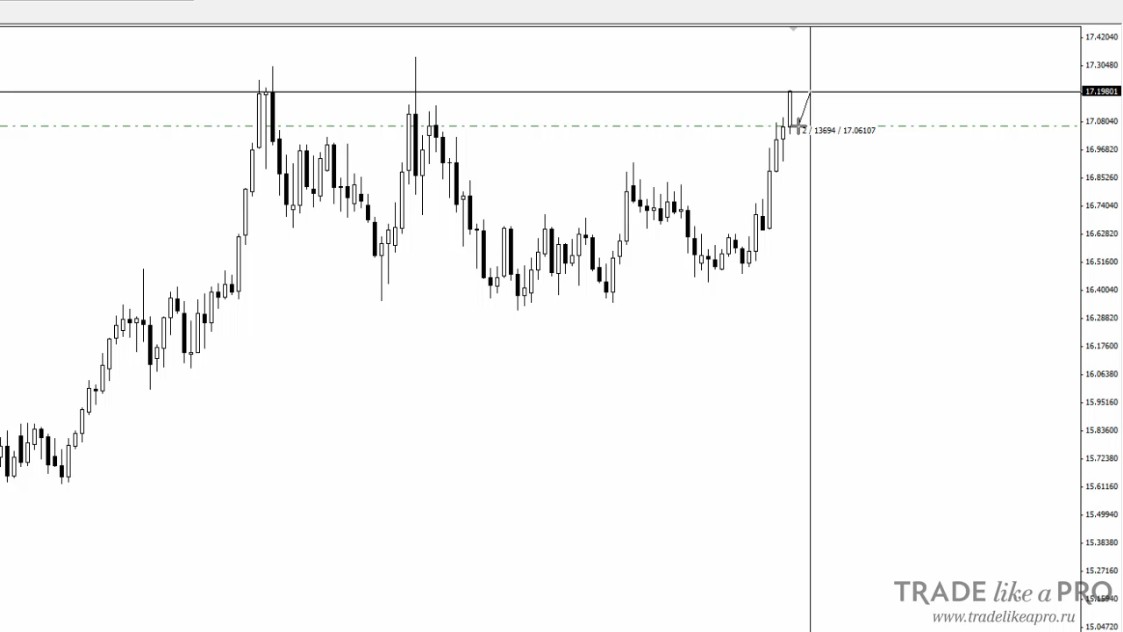
To bring some clarity to what is happening on the chart, you can use the calculator on your broker's website:
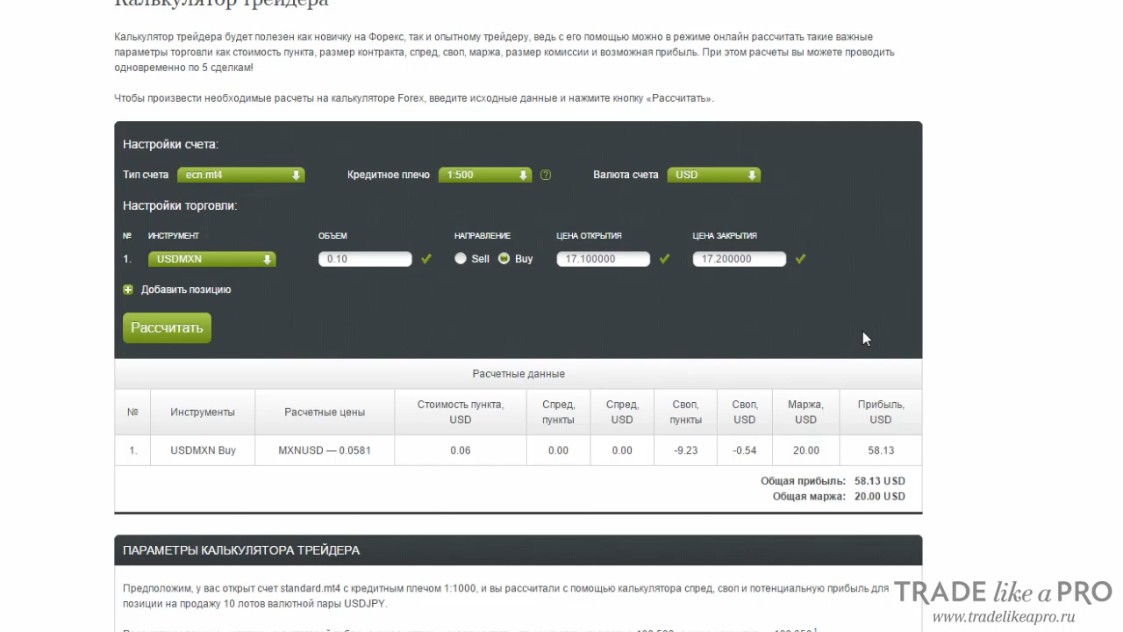
In the case of buying USDMXN with a 0.1 lot at 17.1000 and exiting the position at 17.2000, we would have earned 58$ or 1000 points. That is, the value of 1 point with a 0.1 lot is 0.06 $, or 6 cents. Nothing scary.
To calculate points, we look at the first 4 digits after the decimal point.
Swaps and Spreads
If we touch on the topic of swaps, then, despite the high values on this currency pair, they are not really worth paying attention to:
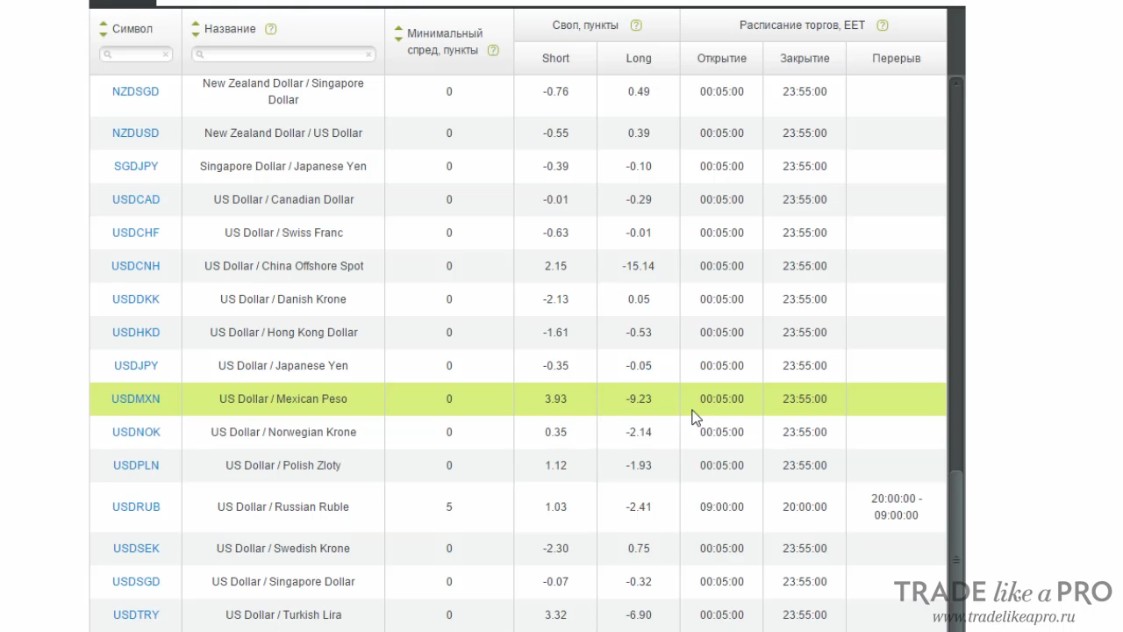
Points are cheap, so swaps do not make any real difference to our trading balance.
For the same reason, there is no need to be afraid of spreads of 20 points. There is no need to fear some unreal values just because this is an exotic pair. The spread is normal, and it can be worked with.
Quotes
When trading this currency pair, only the first 4 digits after the decimal point are counted.
To confirm the above, it is enough to go to the myfxbook, website intended for trading statistics and monitoring.
You can enter the currency pair in the search, find various systems, and open the history, which shows how points are measured according to this website:
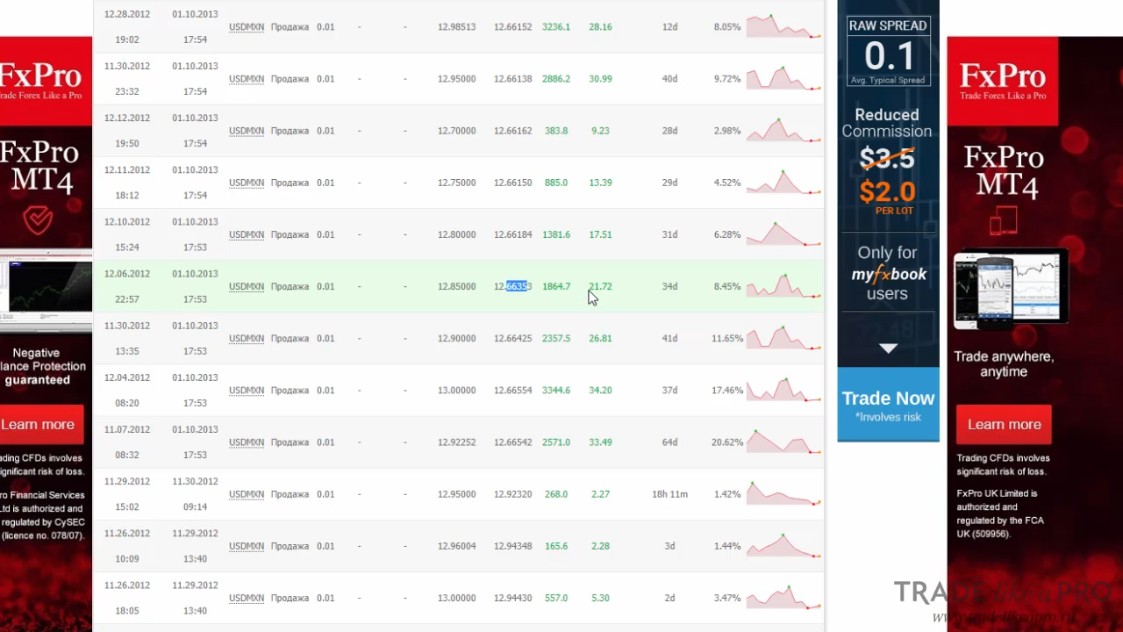
As you can see, myfxbook counts only the first 4 digits after the decimal point. It turns out that in reality 1000 points with a 0.01 lot will bring us only 6 dollars.
Volatility
Over the past 5 years, the volatility of this currency has been cyclical:
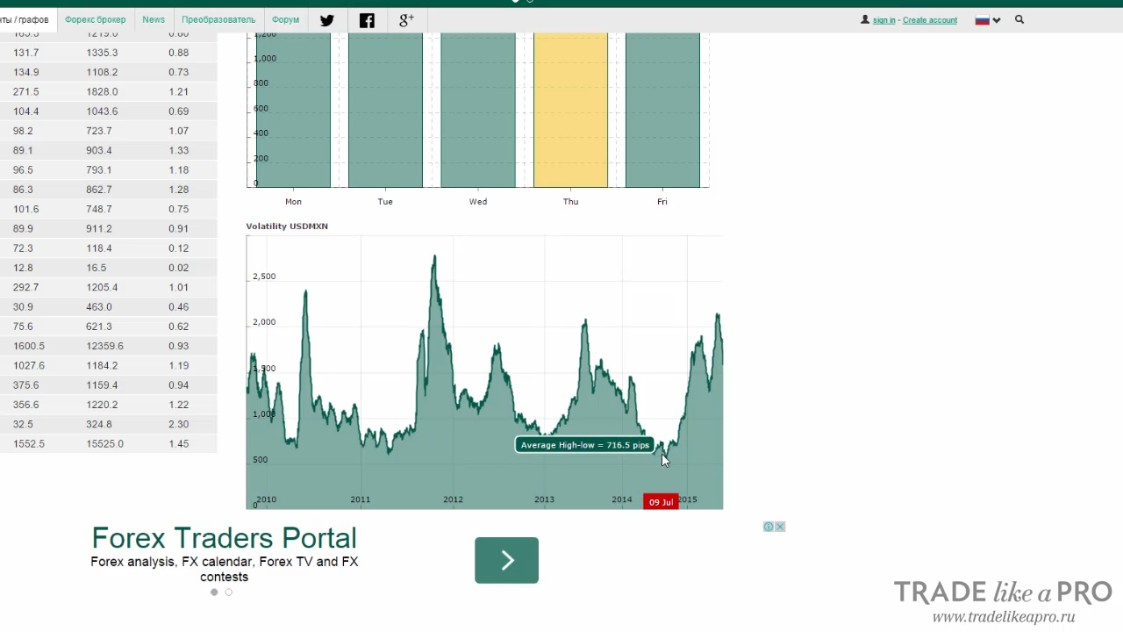
From time to time, bursts of interest in this currency appear.
The most volatile day for USDMXN is Friday:
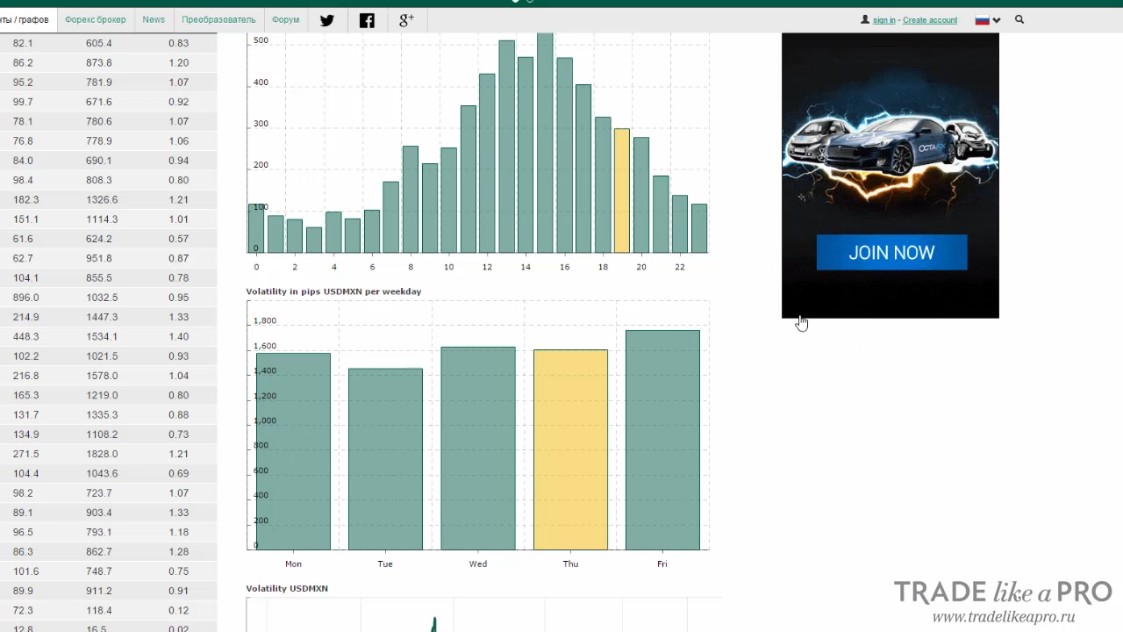
But overall, volatility remains at the same level throughout the whole week.
More interesting is the situation with volatility during the day. The greatest activity is observed from 11:00 to 18:00 Greenwich time:
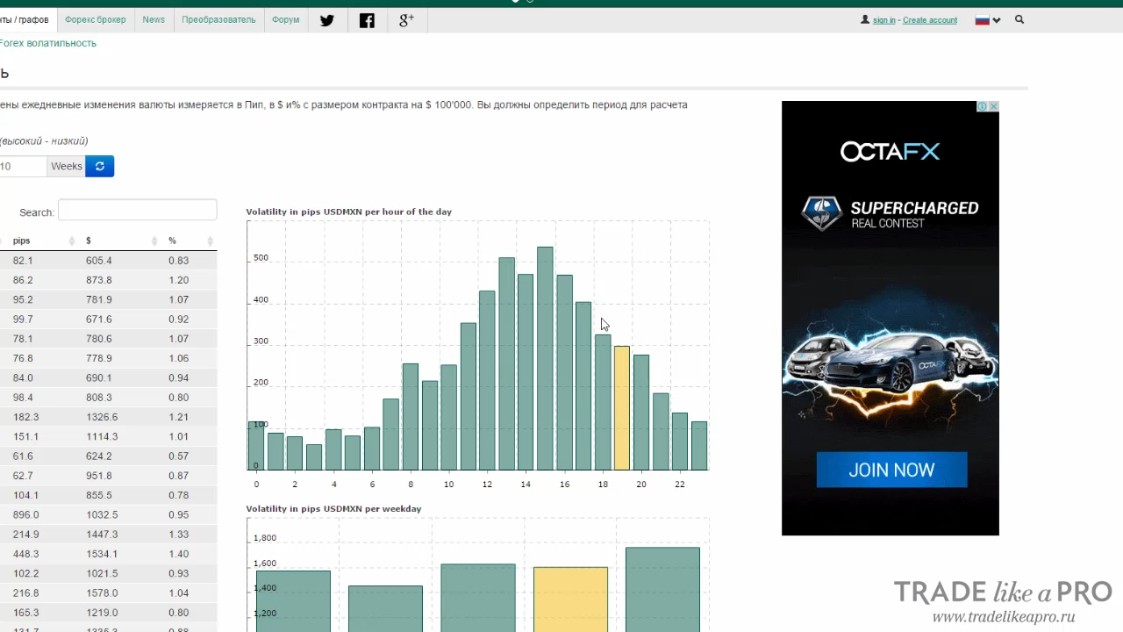
This feature of the currency pair can be used in trading, and we will return to this later.
Correlation
First, let us open the daily chart of USDMXN and oil:
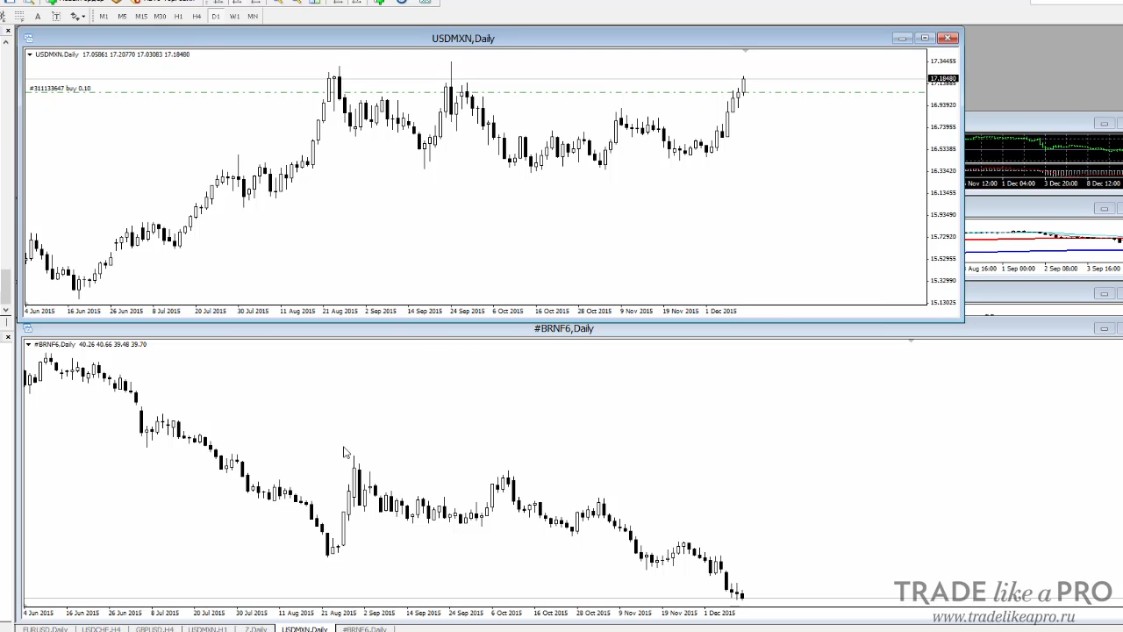
If you compare the two charts, the correlation is observed very clearly.
Just as in the case of the ruble, if some positive or negative decisions are made, for example by OPEC on oil, this affects the exchange rate of the Mexican currency.
You should be aware of the correlation with oil, since our native currency, the ruble, is very strongly connected with it.
The correlation with the UK stock market is also of interest to us, which at the current moment exceeds 70% . Namely with the FTSE 100 index:
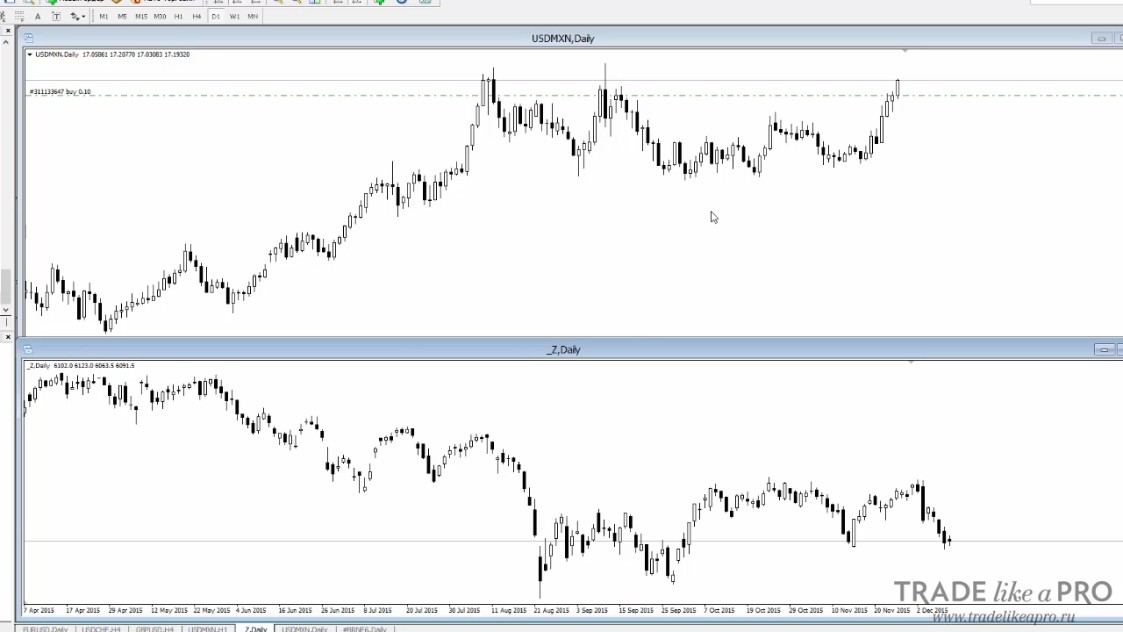
The charts are practically opposite. Since the stock market does not operate around the clock, at the peaks of the stock market you can enter opposite positions on the peso.
For example, a clearly pronounced minimum with a gap:
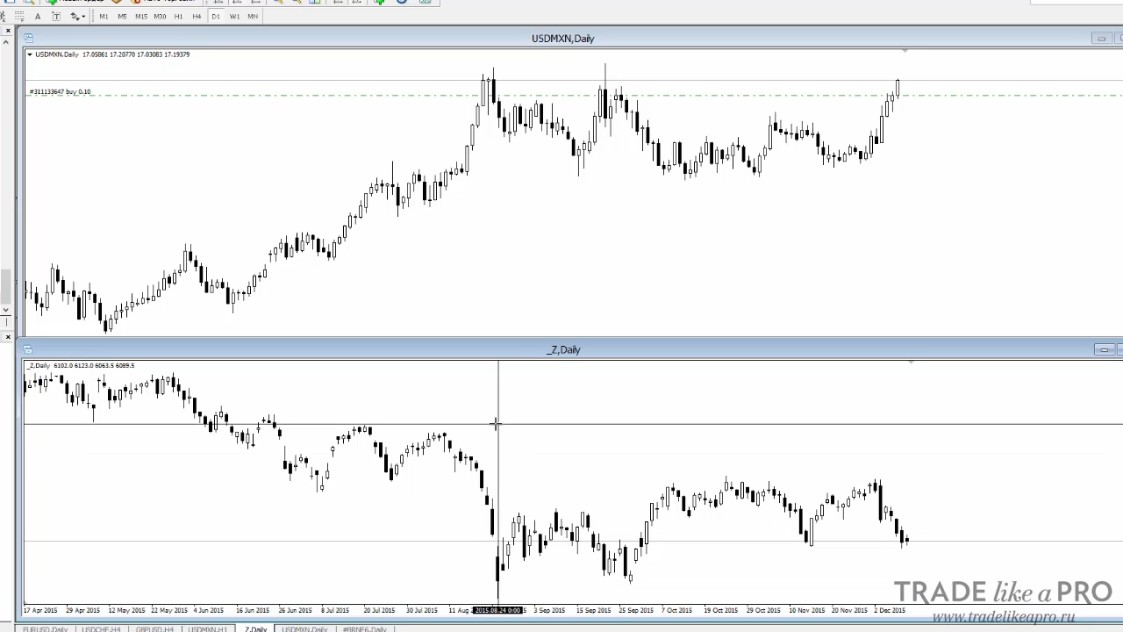
Here it was possible to open shorts on the peso, and the opportunity for entry lasted quite a long time, thereby providing an opportunity to sell to those who do not think very quickly.
The index acts as a leading indicator for the currency and this can be used in your trading.
Thus, the correlation with UC-100 is one of the ideas for trading the peso. But it is worth repeating that the index correlates with USDMXN not by 100%, but by approximately 70%.
Gaps
Just as in the case of the ruble, gaps on this currency do not get closed. If a gap appears, there is no particular point in trading toward its closure.
Technical Analysis
If you open the daily chart of the peso and compare it with the daily chart of euro/dollar, you will be able to see that trading the peso is significantly easier.
The currency has long and sustained trends. Technical analysis works well on it, and levels are clearly visible.
Overall, the peso resembles the EURUSD and GBPUSD currency pairs 10 years ago, when chart movements were more directional.
Therefore, it makes sense to apply time-tested classic strategies on the peso, such as: Price Action, trend-direction entries and then prolonged following of it, and in general virtually any technical analysis.
Strategies
As we found out earlier, the most active time for this currency pair is from 11:00 to 18:00 Greenwich time:
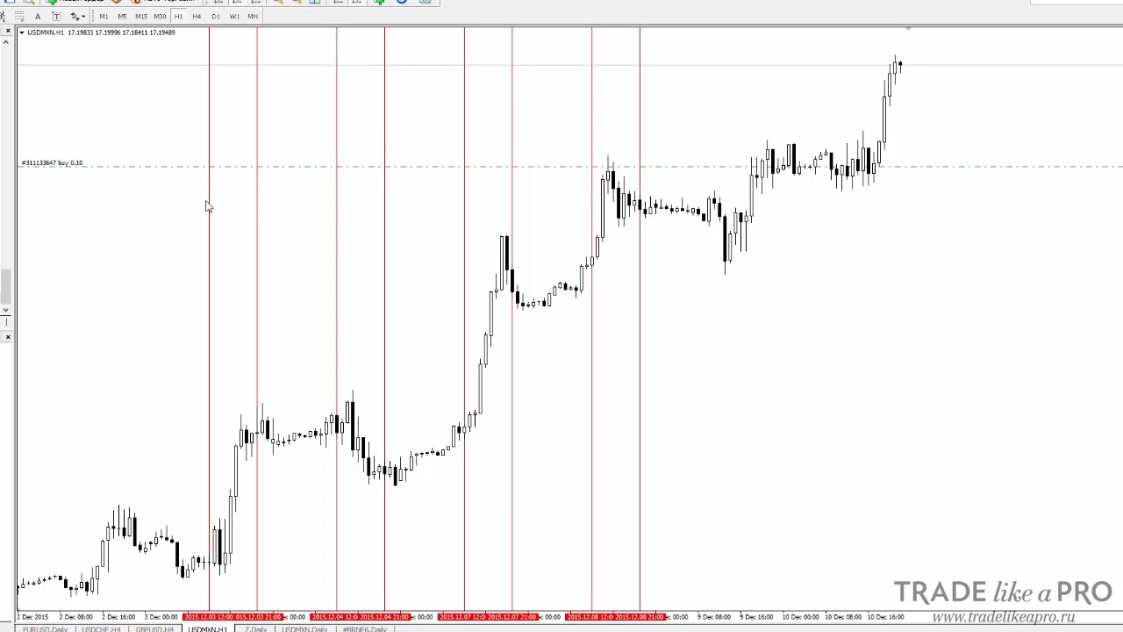
I made a slight shift for the broker's time and marked the intervals where you should understand everything yourself. On this chart, strategies like the London explosion will work perfectly.
At 11:00 Greenwich time, we enter in the breakout direction with a small stop and stay in the trade right up to the end of the volatility period, namely until 18:00 Greenwich time.
Entries here can be seen as if in a textbook:
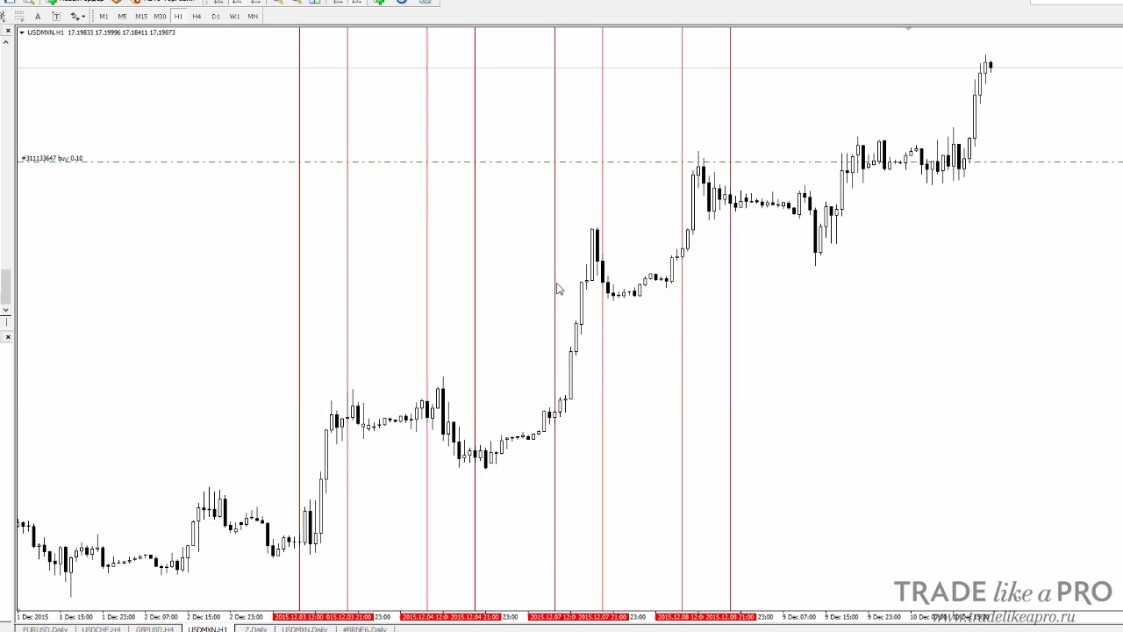
Sometimes they are ideal, with straightforward and understandable movements.
Therefore, I advise you to enter at 11:00 in the breakout direction and exit at 18:00. We set a stop, but do not place a take profit, since there is a chance to catch long moves, as in the screenshot below:
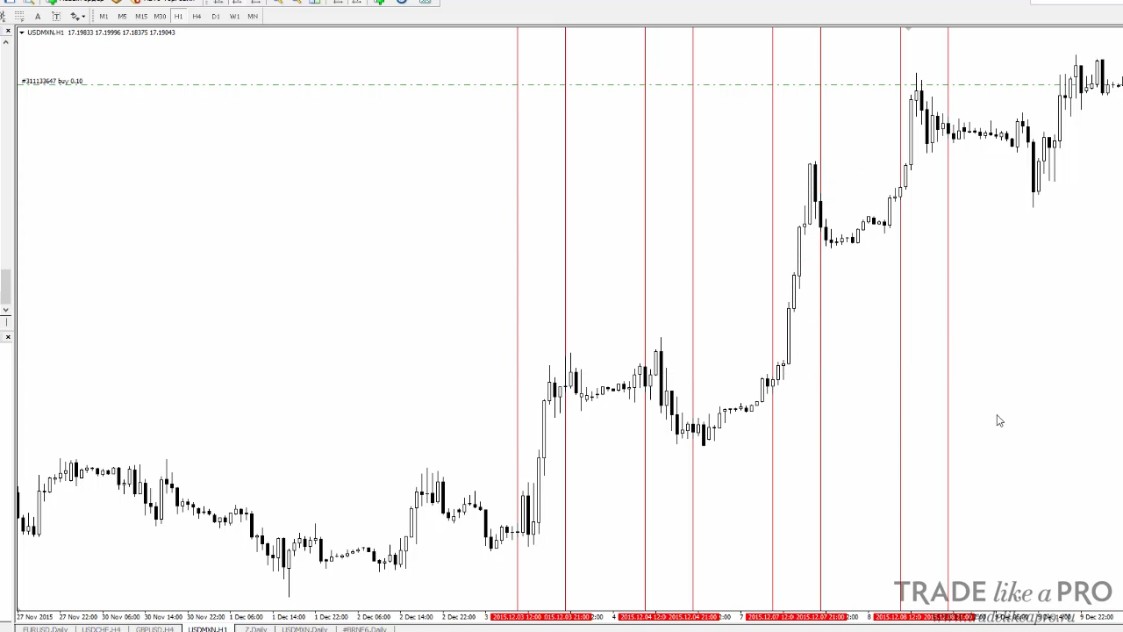
A logical question arises: why are the moves on this currency so easy for taking profit? The answer is that there are not as many speculators and market noise on it as on the more popular currency pairs. Therefore, the chart movements are clear and even, as if taken straight from a book on Forex trading.
Let's Summarize

- The dollar/Mexican peso pair generally resembles the dollar/Russian ruble pair, but at the same time it is more understandable for traders.
- You should not be frightened by the large number of points on the chart, since they are inexpensive.
- For the same reason, you should not be afraid of spreads and swaps. They are more than acceptable for trading.
- There is a high correlation with oil and with the FTSE100 British stock market index.
- Technical analysis works very well, so it is possible to develop various strategies based on breakouts during the periods of the most active volatility throughout the day.
- It is not worth trading gaps on this currency pair, since they do not get closed.
- Overall, both Price Action and technical analysis in general work wonderfully on this currency.
Brokers Offering USDMXN Trading

- Tickmill
- Roboforex
- Amarkets
- Forex4you
- Forex Club
- Instaforex
Sincerely, Pavel Vlasov
TradeLikeaPro.ru