
USD/JPY at 159: BOJ Rate Expectations Redraw the September Map

Intro

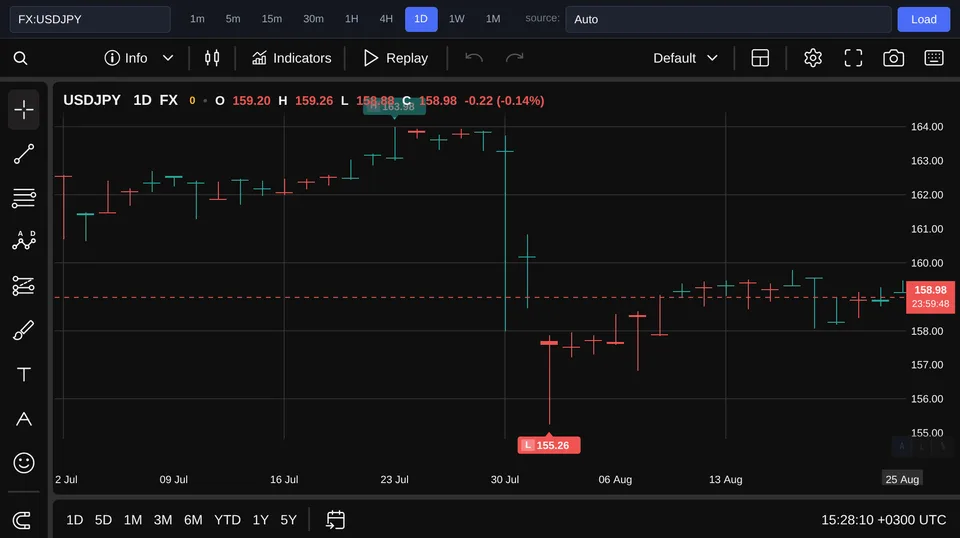
USD/JPY is showing why a modest daily move can still carry a large analytical message. The pair stands near 159.0 JPY, down 0.08% on the day, after advancing toward 159.5 and then retreating as low as 158.9. That is hardly a dramatic collapse, but the reversal reveals an important shift beneath the surface: traders are becoming more willing to believe that the Bank of Japan may raise its policy rate in September. The immediate question is therefore not whether the yen has already won, but whether this change in expectations can survive the next test from US inflation data.
📉 A Small Decline With a Larger Message
The current quotation near 159.0 JPY and the daily change of -0.08% describe a market that is cautious rather than disorderly. Nevertheless, the retreat from 159.5 to 158.9 matters because the pair failed to preserve an upward push at a moment when dollar buyers might normally have tried to extend the move. Selling appeared as the debate over Japanese monetary policy became more concrete, giving the yen a domestic source of support instead of leaving it entirely dependent on swings in the US dollar. The key signal is the rejection of 159.5, not the limited size of the daily percentage move. A single reversal does not establish a durable trend, especially in a pair that remains sensitive to differences between US and Japanese interest rates. It does show, however, that traders are less comfortable treating every dip in the yen as an automatic invitation to buy USD/JPY. The distinction is useful for short-term positioning. A market can remain close to recent highs while its internal balance changes, and that appears to be the case here. The price has not staged a sweeping breakdown, yet the burden of proof is shifting toward dollar buyers: they now need a fresh catalyst rather than simple continuation momentum.
🏦 September BOJ Expectations Move to Center Stage
The fundamental turn comes from a Reuters poll in which 57% of economists said they expect the Bank.
🇺🇸 PCE Could Restore the Dollar’s Initiative
The next major US variable is the Personal Consumption Expenditures inflation reading. PCE matters because it informs expectations for Federal Reserve policy, which remains the other half of the yield relationship driving USD/JPY. A result showing persistent inflation pressure could support US yields and the dollar by encouraging the view that the Fed must maintain a comparatively restrictive stance. Under that scenario, dollar demand could challenge the yen’s new support and push USD/JPY back through the upper part of its immediate range. A renewed test of 159.5 would then become plausible, but only after the pair recovers the nearby resistance area and demonstrates that the post-spike retreat has been absorbed. This is a conditional path, not a stand-alone target. A softer reading, or one that merely meets expectations without reviving concern about inflation, would offer the dollar less protection. In that case, traders could keep focusing on the possibility of a September BOJ hike, leaving sellers with the initiative. PCE is the event capable of deciding whether the current move remains a contained yen rebound or develops into a broader reassessment of USD/JPY. The reaction may matter more than the headline alone. If apparently supportive US data cannot lift the pair above nearby resistance, that failure would suggest the BOJ narrative has gained unusual traction. Conversely, a sharp dollar response would show that relative US policy expectations still dominate when the market receives a sufficiently strong catalyst.
🎯 The 158.75–159.20 Zone Defines the Near-Term Scenarios
The range between 158.75 and 159.20 is the principal short-term decision area. With USD/JPY around 159.0 JPY, the market is trading inside that zone rather than clearly choosing a direction. Intraday movement within it may generate noise, so a brief touch of either boundary carries less information than sustained trading and a convincing close beyond it. A durable break below 158.75 would strengthen the case that yen demand is becoming more than a temporary reaction to the economist poll. Such a move would confirm that sellers successfully defended the recovery attempts around 159 and would place greater emphasis on subsequent support formation. It would not, by itself, justify inventing distant downside objectives without additional price evidence. The opposite scenario begins with a recovery above 159.20. Holding above that level would weaken the immediate bearish impulse and indicate that dollar buyers have regained some control, particularly if the move follows firm PCE data. The pair could then revisit 159.5, the level from which the latest retreat began, and the response there would help distinguish a genuine resumption of strength from another failed advance. Traders should also avoid treating the whole zone as one precise line. Foreign-exchange prices often move through nearby levels before direction becomes clear, especially around important data releases. Positioning, liquidity, and the speed of the move should therefore be considered alongside the quoted boundaries.
Conclusion
The day’s USD/JPY story is a change in conviction rather than a dramatic change in price. The pair is near 159.0 JPY and down 0.08%, but its retreat from 159.5 reflects a meaningful reassessment after 57% of surveyed economists projected a BOJ rate increase to 1.25% on September 17–18. The outlook now rests on three observable tests: whether PCE reinforces the dollar, whether expectations for BOJ tightening remain durable, and whether the pair establishes itself outside 158.75–159.20. Until one side wins that range, conditional scenarios are more reliable than categorical forecasts.