
USD/JPY at 162: the market tests Tokyo's patience again

Introduction
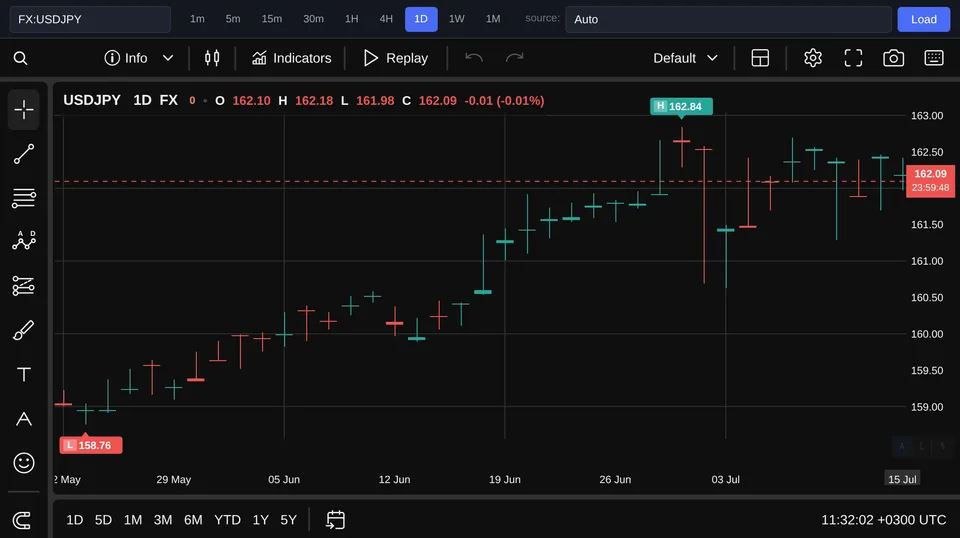
The currency market today is again watching USD/JPY as if the chart shows not candles, but a sign saying “caution, official comments possible.” At the time of writing, USD/JPY is trading near 162.1 JPY, down -0.05% on the day, while the DXY dollar index is at 100.5 USD and adds +0.03%. The daily move is almost cosmetic, but the level itself remains sensitive: here, not only technicals matter anymore, but also the patience of the Japanese authorities.

💴 Yen under pressure: small minus, big nerves
At first glance, USD/JPY dynamics look almost calm: 162.1 JPY and -0.05% on the day do not look like drama. But for the yen, what matters is not only the percentage move, but the pair's very height, because the area above 160 has long been seen by the market as a zone of heightened attention from Tokyo. The yen is not yet reversing the trend, but it is not letting dollar longs fully relax either. When the pair stands this high, even a small pause may mean not dollar weakness, but a cautious test: are market participants ready to keep betting on the carry trade if the risk of intervention is looming nearby? The dollar backdrop remains stable. DXY at 100.5 USD with a daily change of +0.03% shows there is no broad flight from the U.S. currency today, meaning USD/JPY is still getting support not only from local yen weakness, but also from general demand for the dollar.
🏦 Tokyo on the line: words first, then actions
Currency chats are again discussing the risk of verbal or actual Japanese interventions if USD/JPY continues to hold near sensitive levels. This does not mean that real intervention becomes the base case for every new tick higher, but the market must account for the possibility that rhetoric from Japanese authorities may become tougher. The first signal usually comes not through a market trade, but through officials' wording. Traders will closely watch for comments about excessive moves, one-sided bets, and undesirable volatility, because that is the kind of language that often prepares the market for more serious steps. For Japan, a weak yen is not just a line in a terminal. It affects import costs and inflation expectations, but direct intervention is not a free button either: if the rate gap between the United States and Japan remains wide, the market can quickly return to its previous logic.

📈 Rate differential: the dollar's main argument
The key support for USD/JPY still lies in the difference between U.S. and Japanese interest-rate expectations. As long as the market believes U.S. yields remain relatively attractive while the Bank of Japan moves cautiously, the dollar keeps a structural advantage against the yen. That is why a -0.05% decline in USD/JPY at a price of 162.1 JPY does not by itself look like a reversal signal. For a real regime shift, the market needs a weightier reason: a notable softening of Fed rate expectations, a more confident tightening signal from Japan, or a mass desire to cut crowded dollar positions. The DXY dollar index at 100.5 USD with a +0.03% gain neatly puts a cushion under the dollar. Not a luxury mattress, of course, but enough to make it difficult for USD/JPY sellers to declare a full-fledged break for now.

🧭 Trader positioning: risk is not only on the chart
At levels like 162.1 JPY, the main market risk often lies not in a single technical line, but in the density of identical ideas. A long USD/JPY position looks logical with a wide rate differential, but the more popular the trade becomes, the more painful sudden headlines from Tokyo are for it. The main intrigue of the coming sessions is whether traders will continue holding the long dollar or start taking profit in advance. If Japanese official comments become sharper, some participants may decide that partial profit-taking is cheaper than waiting for a possible political surprise. Three things are worth watching: the rhetoric of Japanese authorities, the direction of U.S. yields, and USD/JPY's ability to hold around 162.1 JPY without intensifying pressure. If DXY continues to stand higher and add from the current 100.5 USD, dollar bulls will keep their arguments; if the dollar starts weakening at the same time as tougher signals from Japan, the yen will get a chance for a more noticeable breather.
Conclusion
The day's bottom line is simple: the structure in favor of the dollar has not yet broken, but the USD/JPY trade is becoming increasingly politically sensitive. The pair stands near 162.1 JPY with a daily decline of -0.05%, while DXY remains slightly positive at 100.5 USD and +0.03%, so it is too early to talk about a broad move away from the dollar. The main risk for long USD/JPY positions now is not the chart itself, but a sudden strengthening of rhetoric or actions by Japanese authorities if the market continues testing Tokyo's patience. Practical takeaway for a Forex trader: the rule should be tested on a demo account, written into the trading plan, and applied the same way before every trade. Practical takeaway for a Forex trader: the rule should be tested on a demo account, written into the trading plan, and applied the same way before every trade.