
U.S. Tech Sector Buys the Dip: Market Awaits an AI Capex Test

Introduction
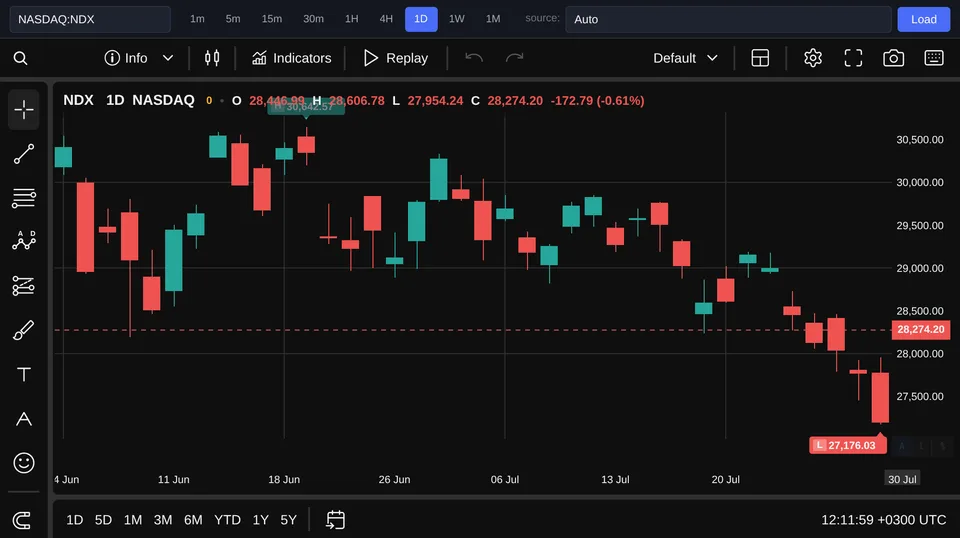
The American tech sector, after a sharp sell-off, is again trying to lift its head, and the day is unfolding under the sign of a careful return to risk. Nasdaq 100 is holding at 28,274 U.S. dollars and adding +0.60%, meaning buyers have returned, but they came not for a celebration, rather for a document check. The main question now is simple: can corporate AI capex continue to justify the high valuations of chips, clouds and software.
📈 Rebound after the sell-off
The first signal of the day: the fall in technology stocks has not yet broken the market's willingness to buy dips. Nasdaq 100 rising to 28,274 U.S. dollars with a +0.60% move shows that money is again flowing into sectors tied to AI infrastructure, data centers and enterprise software. But this is no longer the mode where any company with the three letters “AI” in its presentation automatically gets a valuation premium. The rebound looks not like blind euphoria, but like a cautious test of the thesis: demand for AI is still strong enough. For traders, this means a stricter filter: what matters is not slogans, but revenue, margins, orders and management forecasts. The market is ready to take risk again, but it is doing so selectively, because after a sharp sell-off any weak earnings report can quickly turn a lively rebound into an ordinary technical pause.
🧠 AI capex remains the main fuel
Corporate spending on AI remains in focus: servers, accelerators, networks, power supply, cloud capacity and everything that turns a beautiful model into a working business process. If companies continue to increase such budgets, the market gets an argument for a new move into risk after the sell-off. The weak point of this story is that valuations already price in a lot of future growth, so investors want to see not inspiring promises, but confirmation in orders and forecasts. If AI capex keeps its pace, quality chip and cloud names may again attract buyers; if the pace slows, the repricing risk quickly returns. The market is sniffing risk again, but no longer eating it straight from the bowl: it needs data on backlog, data-center utilization, customer contracts and spending plans for the next cycle. Comments on how long infrastructure investments will last are especially important, because they are what separate a sustainable capital cycle from a short wave of hype.
🧩 AMD faces the earnings exam
AMD is now at the most sensitive point of this trade, because the company is directly tied to the theme of AI accelerators and competition in data centers. At the time of writing, the stock is at 476.1 U.S. dollars and is down -1.90%, which is especially telling against the backdrop of the broader Nasdaq 100 recovery. This divergence says investors are not buying the chip sector wholesale and indiscriminately. For AMD, the market is waiting for proof on demand for AI chips, shipment pace, margins and the ability to take a sustainable niche alongside Nvidia. The company does not necessarily have to take the entire accelerator market, but it needs to show that customers really want a second major supplier, and that growth in data centers is turning into understandable revenue. If the report gives a confident accelerator forecast and visibility on orders, the stock may regain support. But if management limits itself to general wording about high interest in AI, the -1.90% decline at a price of 476.1 U.S. dollars may turn out not to be random nervousness, but a warning about inflated expectations. For the market, AMD now acts not just as a separate stock, but as an indicator of how broad the AI trade can be beyond the industry's main leader. The more convincing the data-center numbers are, the easier it will be for buyers to defend the idea of buying after the dip.
☁️ Amazon and Apple broaden the test
Amazon matters to the market not only as an e-commerce story, but as an indicator of cloud demand through AWS. If the cloud business shows steady growth, normal margins and a clear return on investment in AI infrastructure, this will support the idea that hyperscaler spending remains a long-term trend, not a short burst. But investors will look not only at the size of spending, but at its quality. For Amazon, the key question is whether AI capex strengthens the economics of AWS or simply inflates the investment bill. Strong signals on enterprise customers, capacity utilization and operating leverage may become an important support for the entire cloud segment. If spending growth looks faster than growth in returns, the market may again start arguing with multiples even in a good overall mood. Apple is going through a different test: its AI story is closer to the consumer, devices and services. The market needs to understand whether AI can become a reason for device upgrades, higher engagement and stronger services revenue, rather than remain a neat feature in a presentation. Together, AMD, Amazon and Apple cover three layers of one trade: hardware, cloud infrastructure and consumer distribution, so their reports can either strengthen the current rebound or show that the index has run ahead of corporate facts.
Conclusion
The day's result is cautiously constructive: risk appetite in the American tech sector is returning, but already with conditions. Nasdaq 100 at 28,274 U.S. dollars and up +0.60% confirms buyer interest in the dip, while AMD at 476.1 U.S. dollars and with a -1.90% move reminds us that the market remains selective. Next, direction will be set by the reports and forecasts from AMD, Amazon and Apple: sustained growth will require clear signals on AI capex, data-center revenue, cloud orders, margins and real AI monetization at companies from key links of the chain. For now, this is not a guaranteed turn in sentiment, but a test of whether there are enough facts to justify a new move into risk.