
U.S. AI Earnings: Market Tests the Economics of the Data-Center Race

Introduction
The U.S. market is approaching the reports of the largest technology companies with its old faith in artificial intelligence, but with a far stricter expression. Investors now ask not “how big will the AI story be,” but “who will pay for servers, chips, power and data centers, and when will that return as profit.” Against this backdrop, even strong indexes do not cancel the season’s main exam: megatech must show that AI capex is turning into cloud revenue, stable margins and clear guidance, not just making an elegant noise with its fans.

🤖 AI Spending Moves from Presentations into Earnings
Ahead of the results from the largest technology companies, the market’s focus has shifted from the usual question about revenue growth rates to a tougher question about the quality of spending. Investors want to understand whether AI capex is a future source of growth or an expensive bet whose payoff is still delayed. Capital spending on data centers, purchases of graphics processors, energy costs and management comments on the next quarters will be in focus. This is not a reversal against artificial intelligence as a theme, but the maturing of the market story itself. While AI was a promise, the market was satisfied with words about productivity, automation and new services; now it has taken out a calculator and asks to see the bill. If companies prove that infrastructure investments are already supporting customer demand and the expansion of cloud services, today’s high valuations will be easier to defend.
📊 Strong Indexes Raise the Cost of Error
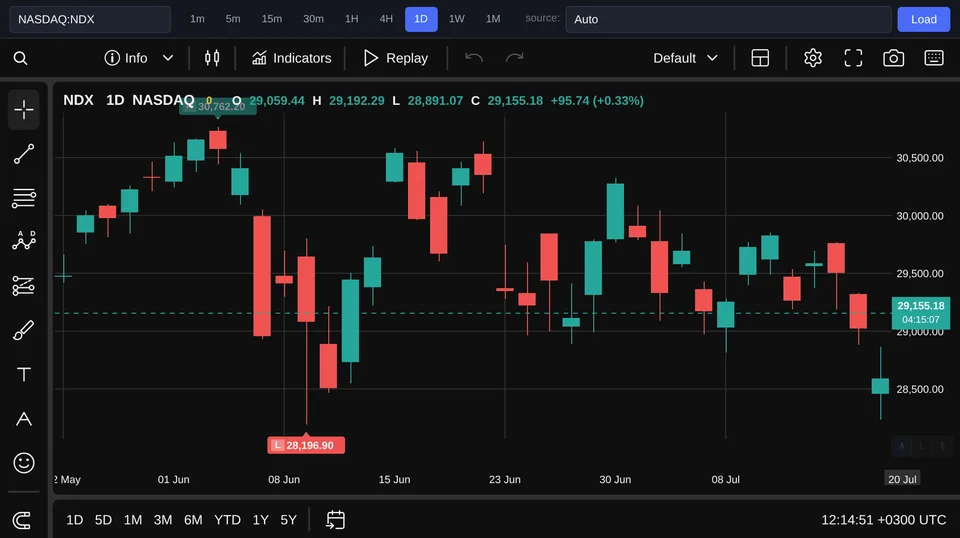
The market backdrop remains strong: the Nasdaq 100 is at 29 155 USD and is rising by +1.93% on the day, while the S&P 500 trades near 7 509 USD and adds +0.89% on the day. This dynamic confirms lively risk appetite, but at the same time raises the bar for earnings and guidance. When indexes have already priced in optimism, a merely decent quarter may not be enough for the move to continue. The Nasdaq 100 remains especially sensitive, as megatech’s influence on the overall index is very large. The S&P 500 is broader in composition, but it also depends on how investors assess guidance on cloud, chips and margins at the largest companies. Therefore the reaction can be sharp not only to actual results, but also to a single cautious phrase about future spending.

☁️ Cloud Becomes the Main Monetization Test
For cloud giants, the main proof will not be the number of AI mentions on the analyst call, but real signs of demand from corporate clients. Investors will watch whether workloads are growing, whether data-center utilization is increasing, whether long-term contracts are being signed and whether AI services are helping accelerate cloud revenue. The strongest signal for the market is growth in cloud segments with controlled pressure on margins. The weak point of this story is that data centers require huge upfront investment, while payback may stretch over several quarters or years. Chips, electricity, cooling, land and construction do not wait until the client finally decides how much AI it needs in business processes. Therefore companies must not simply announce new spending, but explain how this spending is connected to future revenue and cash flow.

🧩 Chips, Margins and the Risk of Multiple Repricing
Demand for chips remains the heart of the AI cycle, but for the market this is not only a reason for optimism. Strong orders confirm that the infrastructure race continues, yet they also show how much money megatech has to invest in order not to fall behind competitors. Therefore investors will compare capex plans with gross margin, operating leverage and free cash flow. If spending looks disciplined and is supported by growth in cloud revenue, the market may preserve trust in the technology sector’s high valuations. If, however, investment in AI grows faster than clear monetization, investors will begin to recalculate multiples more strictly. For the Nasdaq 100 and S&P 500 this matters because several megatech reports can set the tone not only for technology stocks, but for the entire U.S. market.
Conclusion
The day’s conclusion is simple: AI remains a key theme for U.S. equities, but now the market demands not inspiration, but a financial link between spending and results. The near-term dynamics of the Nasdaq 100 and S&P 500 will depend on whether companies can show that data centers, chips and cloud infrastructure lead to revenue growth, preserved margins and convincing forecasts for the next quarters. For investors, the season’s main signal will be not the scale of AI spending itself, but the quality of the explanation of its payback. Practical takeaway for a Forex trader: the rule should be tested on a demo account, written into the trading plan and applied the same way before every trade. Practical takeaway for a Forex trader: the rule should be tested on a demo account, written into the trading plan and applied the same way before every trade.