
U.S. Tariffs Bring Inflation Risk Back Into Prices

Introduction
Today the market recalled a simple but inconvenient thing: tariffs live not only in headlines, and then quite briskly move into prices, margins, and rate expectations. New U.S. import duties on dozens of countries brought back to the agenda the question of who will pay the bill: companies, consumers, or investors through lower multiples. This time the reaction looks less like panic and more like a careful repricing of risk, where every number is already starting to scratch the market behind the ear.
📦 U.S. Tariffs: Inflation Is Asking to Be Priced In Again
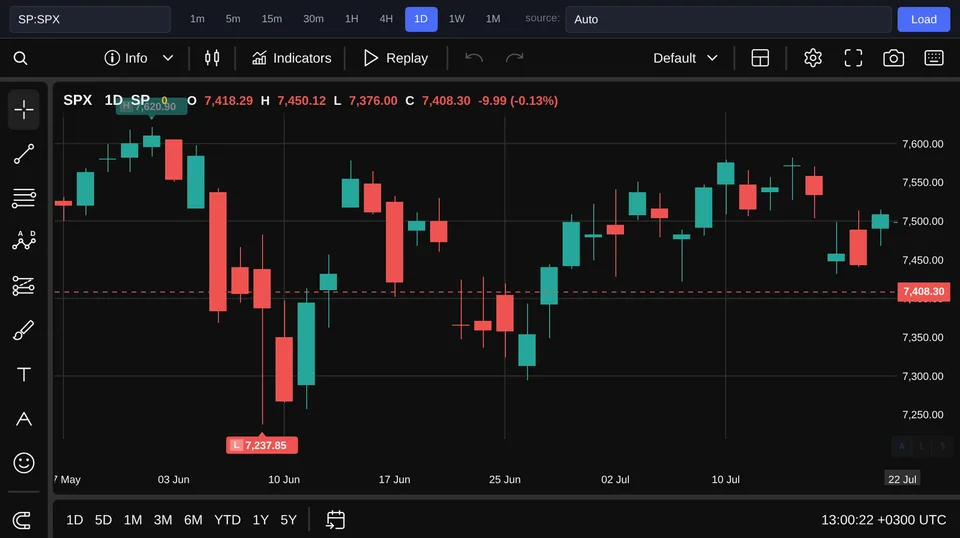
The first signal came from the equity market: the S&P 500 is at 7 408 USD, down 1.21% on the day. This is not a collapse, but it is a readable move: investors have stopped treating the tariff topic as background noise and are again pricing in the probability of rising costs. The main risk is that import duties work like a tax on supply chains. If companies absorb the additional expenses themselves, margins come under pressure; if they pass them on to buyers, inflation may become stickier. For the equity market this is an unpleasant combination, because it hits both profits and the discount rate for future earnings at the same time. An important nuance: the tariff effect rarely appears instantly or in a straight line. First companies revise contracts, then update price lists, then analysts change profit forecasts, and only after that does all of this finally enter the reports. Therefore, the current reaction of the S&P 500 at 7 408 USD and -1.21% for the day looks more like early risk adjustment than a final verdict.
🏦 The Fed and the Dollar: The Market Is Counting Tightness Again
The DXY dollar index rose to 101.4 USD, adding 0.29% for the day, and this fits well with the session's macro logic. The dollar is receiving support not only as a safe-haven asset, but also as the currency of an economy where the central bank may find it harder to ease policy quickly under a new inflationary impulse. Tariffs by themselves do not dictate the Fed's decision, but they change the set of arguments for the regulator. If duties start feeding through into CPI, PPI, and corporate comments, the market will be more cautious in pricing imminent easing. The Fed will probably look not at the fact of tariffs itself, but at evidence that they are really keeping inflation above a comfortable trajectory. For traders, this means the return of the old link: the higher the inflation risk, the stronger the dollar, the harder it is for expensive growth stocks. DXY at 101.4 USD and +0.29% for the day shows that market participants are already hedging against a longer period of tightness. Not dramatic, but noticeable enough for prices to stop pretending that all this is just paperwork in the “we'll sort it out later” folder.

🏭 Sectors: Who Hurts More, and Who Was Left a Window
The tariff story is also important because the blow is distributed unevenly. Exemptions for energy carriers and critical minerals leave room for sector distortions: some companies face less direct pressure on costs, while others run into more expensive imports, logistics, and components. At this stage the market is moving from an index-level reaction to an analysis of specific business models. Companies with high import dependence, weak pricing power, and thin margins are coming under heightened attention. Retail, industrial producers, consumer goods, and some technology equipment may face the same task in different ways: preserve profitability without destroying demand. Companies tied to domestic production, strategic chains, or exempt categories may look relatively more resilient. But there is no immunity here: secondary effects may come through currencies, wages, transport costs, and buyer behavior. Therefore, the nearest market work will not be to divide the market into winners and losers in one move, but to check balance sheets, margins, procurement structure, and the ability to raise prices.
📊 What Traders Are Watching Now
The nearest set of indicators is clear: inflation reports, company comments, margin forecasts, and the dollar's behavior. If management starts speaking directly about tariffs as a factor pressuring profits, analysts may revise expectations even before the full picture appears in macro data. The key question is whether tariffs become a one-off price shift or a sustained inflationary impulse. The S&P 500 at 7 408 USD and -1.21% for the day shows that investors are already demanding a premium for this risk. DXY at 101.4 USD and +0.29% for the day confirms the same idea from the currency market: when trade costs, inflation, and Fed uncertainty appear together, demand for the dollar rises. The base case is now better formulated conditionally, without heroic predictions. If tariff costs become entrenched in CPI, PPI, and reporting, the market may strengthen defensive positioning and reduce faith in rapid policy easing. If companies are able to stretch out the pass-through of costs and inflation data remain calm, the reaction may narrow to sector rotation instead of a prolonged sell-off across the whole index.
Conclusion
The day's bottom line is simple: tariffs have again become a full-fledged market variable, not just political noise. Stocks weakened, the S&P 500 fell to 7 408 USD and lost 1.21% for the day, while the dollar strengthened, DXY rose to 101.4 USD and added 0.29%. Next, confirmation or refutation of this move will come from inflation statistics and corporate forecasts, so selectivity is now more important for the market than broad confidence.