
Tracking Major Players - Analysis of COT Reports

At the numerous requests of traders.
Hello, friends! Today we will talk about one of the ways to find out what positions large speculators and investment funds are taking. As is known, the forex market is driven by money. Namely, big money. More precisely, we will talk about the analysis of COT reports (Commitments of Traders) provided by the CFTC (U.S. Commodity Futures Trading Commission). From the material below you will learn what these reports are, when and where to get them, and most importantly, how they can help us in trading.
COT Reports

From these reports, we can find out what position the major players are currently taking in forex. And, using this data, make more balanced decisions about our own entries and trades for analyzing the current trading situation in the market.
So, why do we need the movements of major players? The fact is that the market is driven by money. And it is driven by big money. Naturally, we with a lot of, say, 0.1 will change nothing. But major players: large traders, investment funds, banks, etc., by pouring hundreds of millions of dollars into the market, cause significant movements. And going against such a force is often unreasonable. Therefore, it may be useful for us to know which side of the market the "big guys" are on.
How to Find Out the Positions of Major Players?

One of the ways is COT reports provided by the U.S. CFTC.
The U.S. CFTC is an organization that monitors to ensure there are no violations in futures market trading. And all major players in the futures market report to this organization. In turn, this commission publishes reports called "Commitments of Traders" in free access. We can simply go to their website and view these reports without any obstacles. This is free information in the public domain. Naturally, these are reports from the futures market. And the futures market is far from all players in the currency market. But even from this data we can draw quite significant conclusions.
How Do We Get Access to These Reports?

Go to the "U.S. CFTC" website, find the "Market reports" section, and select "Commitments of Traders".
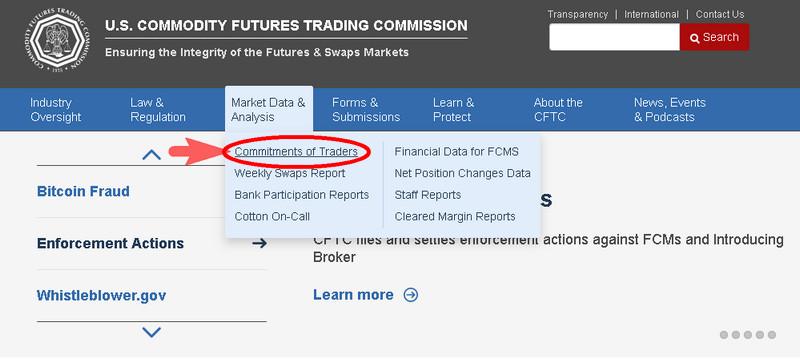
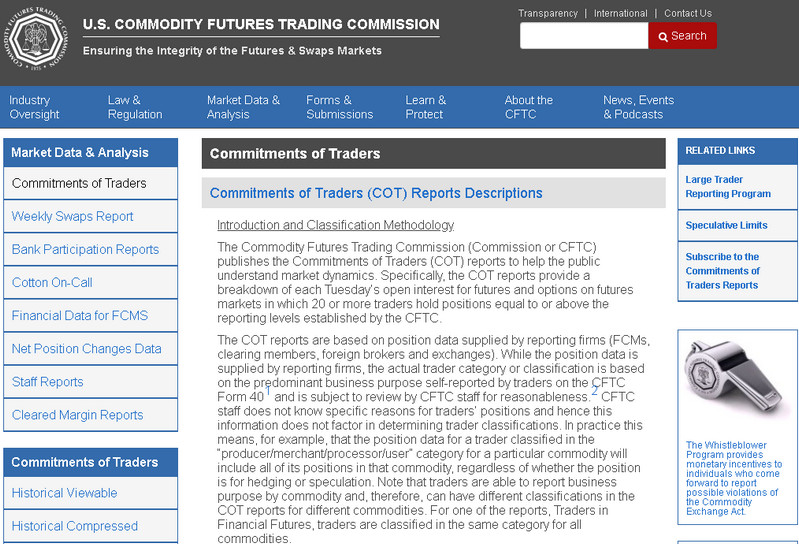
You should see a page like this:
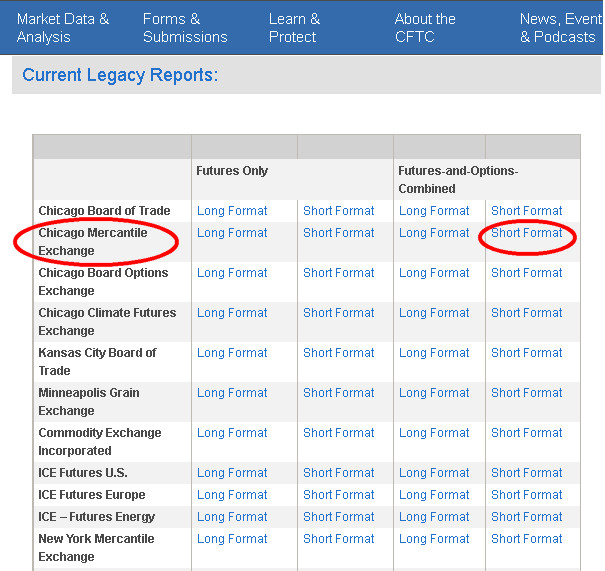
Scroll lower and find the heading CURRENT LEGACY REPORTS. Here select the Chicago Mercantile Exchange section. There is a table consisting of several columns here. We choose Futures and Options Combined from the second column, then select "Short Format".
The latest report loads. Speaking of dates, note that reports are published on Friday at the end of the week, but they represent a snapshot of data from Tuesday. That is, we receive the data with a delay of about 3 days. And since we receive it in the evening, we will only be able to apply the information from it at the beginning of the next week, together with the market opening.
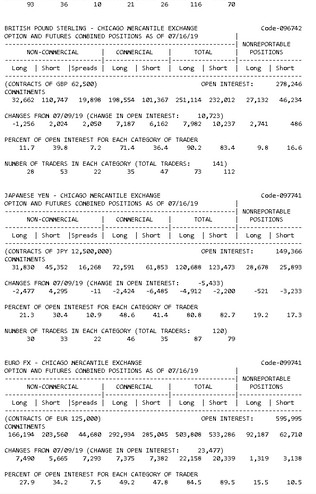
In the report, we can observe the following indicators: "NON REPORTABLE POSITIONS," "TOTAL," "COMMERCIAL," and "NON-COMMERCIAL."
NON REPORTABLE POSITIONS are small traders with insignificant positions. You can ignore them, since this is the "crowd" with small deposits.
NON-COMMERCIAL are large speculators. That is, banks or investment funds. As well as individual persons with large capital. Here you can see the number of long and short positions, as well as spreads.
Spreads are opposite positions opened by the same player. For example, buying and selling at the same time. Perhaps this is part of some complex strategy, since futures have different expiration dates. Perhaps something else. This is not of much interest to us. But such data is provided.
COMMERCIAL are data on hedgers. Data on commercial representatives in the market who trade not in order to somehow speculate and earn money, but in their own interests. That is, some large companies.
For example, some company finds it unprofitable for prices to rise on some raw material required for the production of their product. And they, accordingly, buy up raw materials or currency in advance so that if the price rises, they will have supplies for their goods and will not overpay. In simple terms, commercial players do not play in the market in order to profit from price changes, but act in their own interests.
In order to fall into this category, you need to submit a special application to the futures market commission. And only after that can you be accepted. But lately, not only large commercial organizations fall into this category, but also, for example, swap dealers in banks.
TOTAL is the sum of the long and short positions of major players and commercial hedgers. For each position there is a division into Long and Short, that is, into the number of long and short ones. This report has a lot of information that we do not need. There are various products and goods here. We are interested in currency, so you need to scroll the report down to the currencies.
We also have CHANGES FROM data.
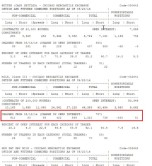
That is, changes since the last report. How many Long and Short positions were added and reduced among different categories of traders. There is also data on open interest.
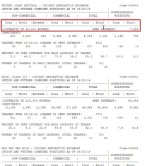
Put simply, open interest is the amount of money in the market.
How Do We Apply the Data from the COT Report?

In principle, you can study the data directly from the report, but on our site there is a tool that presents the figures as indicators for each individual currency pair.
It is located at the link:
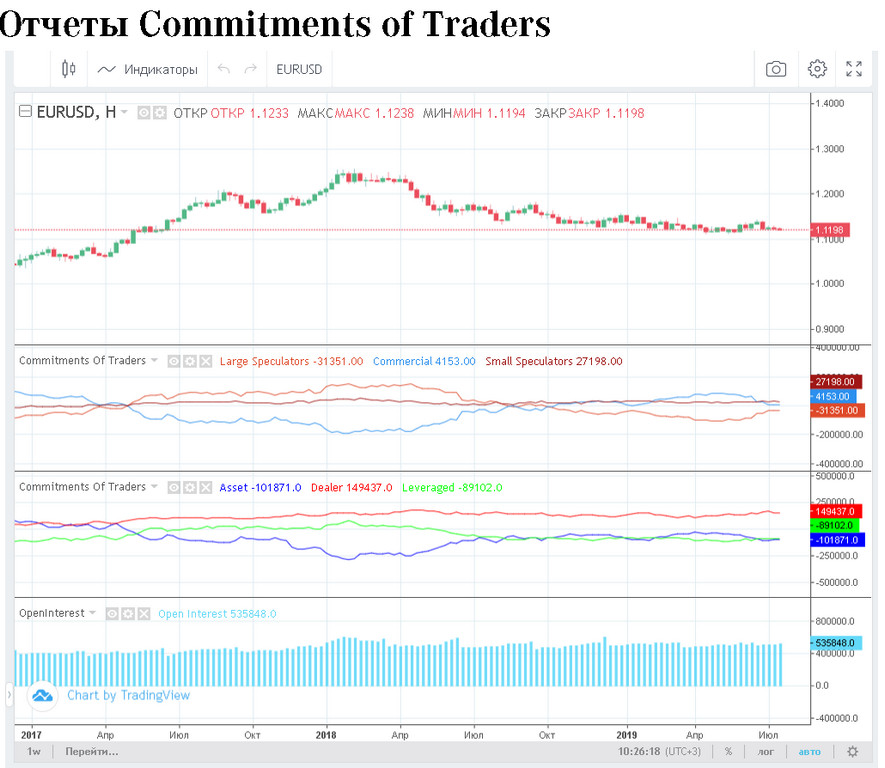
The figures from the CFTC Commission bulletin are spread across three charts located below the currency pair. You can select a specific instrument in the settings windows located above the chart.
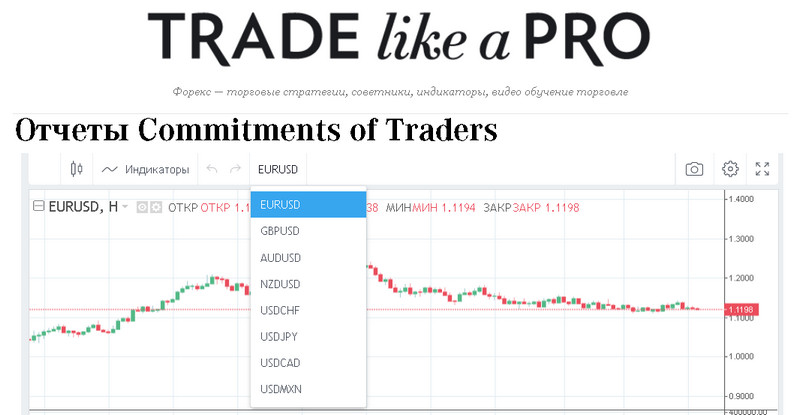
The number of pairs (8 positions) corresponds to the list of currency futures on the CME exchange. The other two settings windows are technical indicators and options for displaying quote types: candles, bars, etc.
The timeframe of the chart is strictly fixed to a weekly interval in order to synchronize the results of the reports and trading sessions.
The COT tools are built on the basis of the TradingView service, which makes it possible to use standard chart settings or remove some of the indicators.
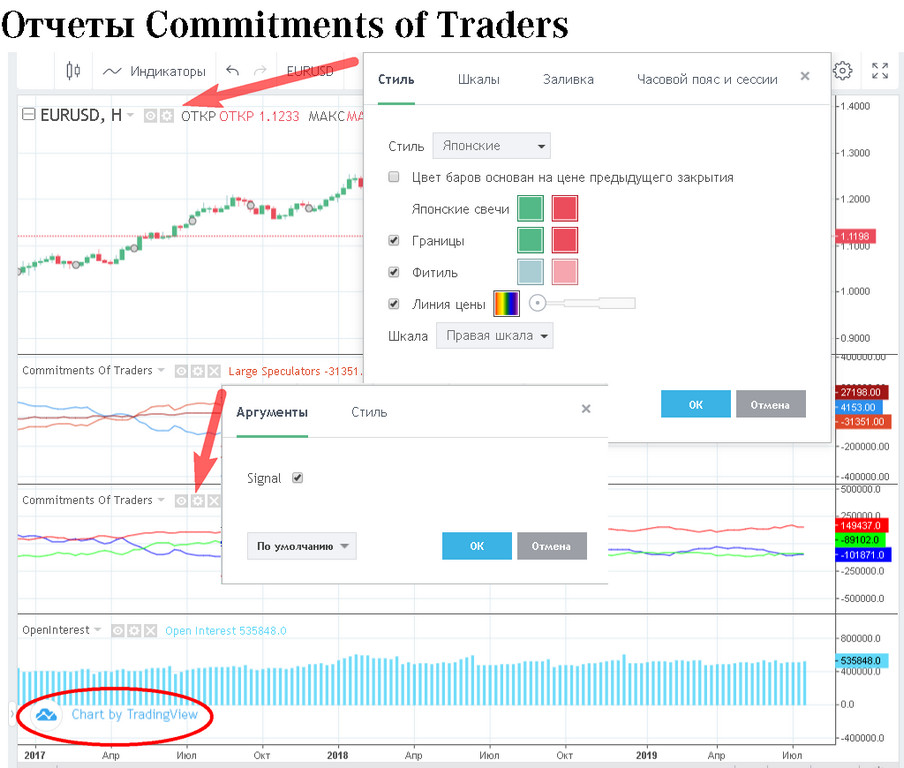
Having selected a currency pair, the trader receives three sets of data, among which the first window displays weekly positions:
The second window is positions:
The third window is the aggregate interest across all contracts (options plus futures), the summed Open Interest across all currency reports of the CME exchange.
The chart is updated once a week on Tuesday during the publication of the next COT bulletin, compiled from Friday's reports.
Before analyzing, we need to understand how large players trade, how hedgers trade, and how small players trade. Large players, like Asset managers, enter at the very beginning of trends, when they are just beginning to form. And they exit at the end of the trend.
Commercial players, like dealers acting as market makers and opening positions opposite to clients, go against the trend. And, as a rule, they begin some active actions against the trend. Moreover, often a little earlier than the moment when the trend becomes apparent.
Factors that are unavailable to ordinary people, but known to hedgers, prompt them to take some actions in advance. For example, buying a pound futures contract. And thereby protect their business from financial risks. Here you can clearly see an example on the Canadian dollar.
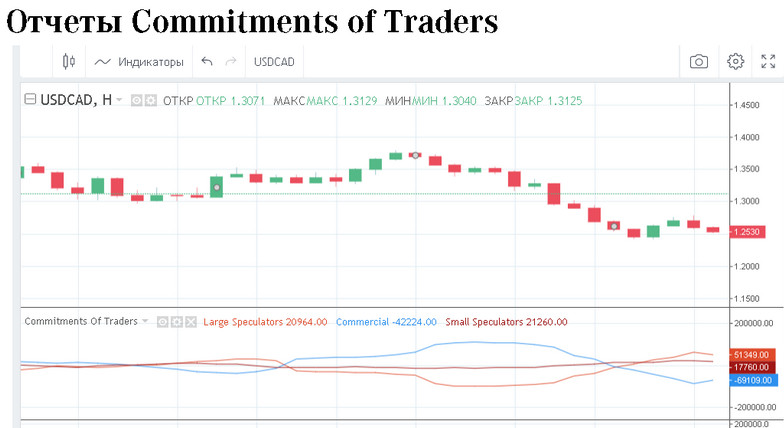
We had a prolonged downward trend. At that moment hedgers (Commercials) were in the overbought zone of the COT index. Practically the whole time while the trend was downward. And as soon as the trend began to rise upward, accordingly, the COT index for hedgers (Commercials) began to creep downward. They go against the trend in their own interests. And they often begin to go against the trend in advance.
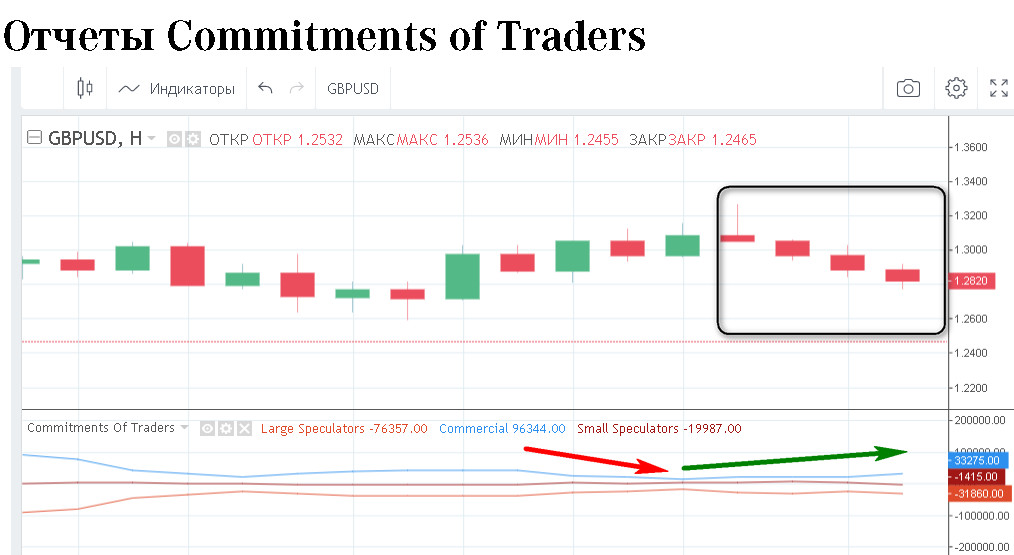
In our pound example, you can see that hedgers' positions are now increasing. And that means that we should expect the pound to move downward. As for large traders or speculators, as a rule, they go together with the market, since they make up a considerable part of it.
How should all this be analyzed?

It is worth paying attention to the situation as a whole. That is, watching hedgers (Commercials) and large speculators (Large Speculations), as well as small speculators. First of all, I want to warn you that using the COT index as a separate system is wrong.
If you proceed only from the COT reports, then you are unlikely to be able to trade profitably, relying exclusively on this information. It happens that the signals are false, and you will have to trade on weekly charts. To recognize this, very extraordinary training and experience are required. Plus the time factor. You will have to hold a position for a very long time and use huge stop losses.
Therefore I advise using COT reports as a filter for your system. That is, to assess the situation with the help of technical analysis, and to check trades and the general state of the market by COT reports. At the same time, you need to use all the information, not only some separate group of traders. And also pay attention to open interest, that is, how heated the market is.
Open interest is located in the lower part of the chart in the form of a histogram. I remind you that OpenInterest is the amount of money in the market. Let us look at an example of what was happening in the market. I draw your attention to the points when open interest is in critical positions. That is, either it is very low or high.
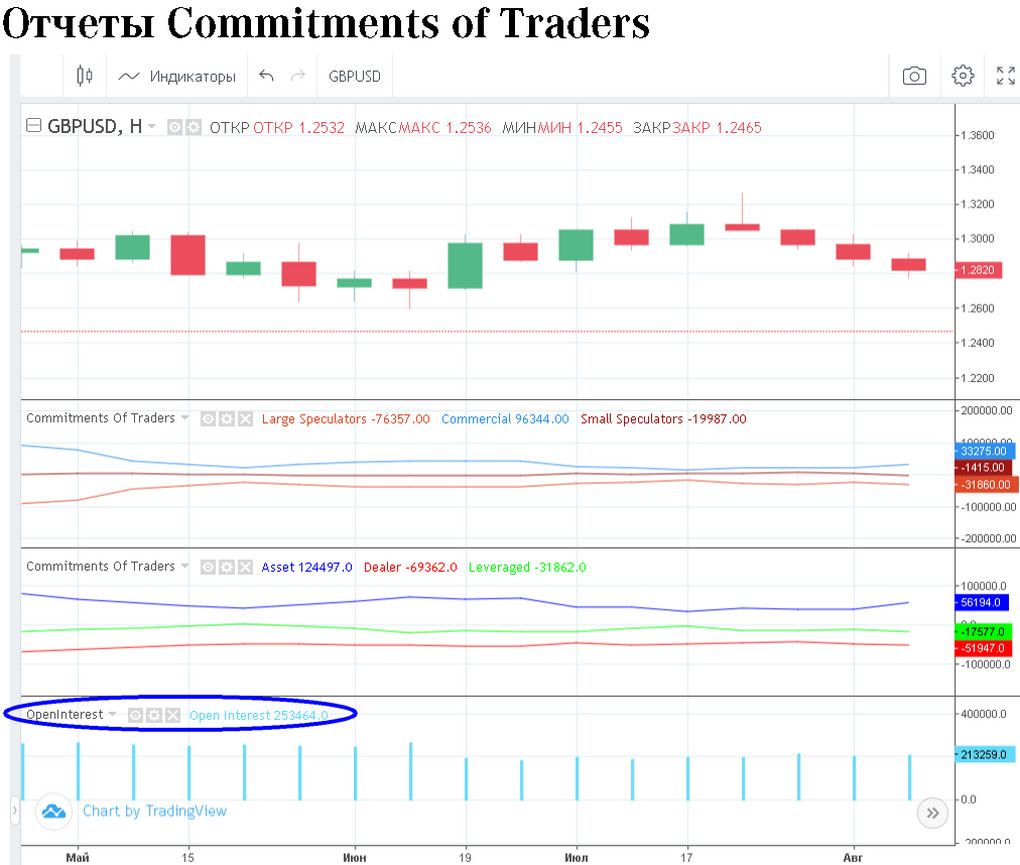
How high and how low it is, we can determine only by looking, in general, at the chart. At these points we pay attention to what the other groups of speculators are doing. Namely, large hedgers (Commercials) and small players (Small Speculations).
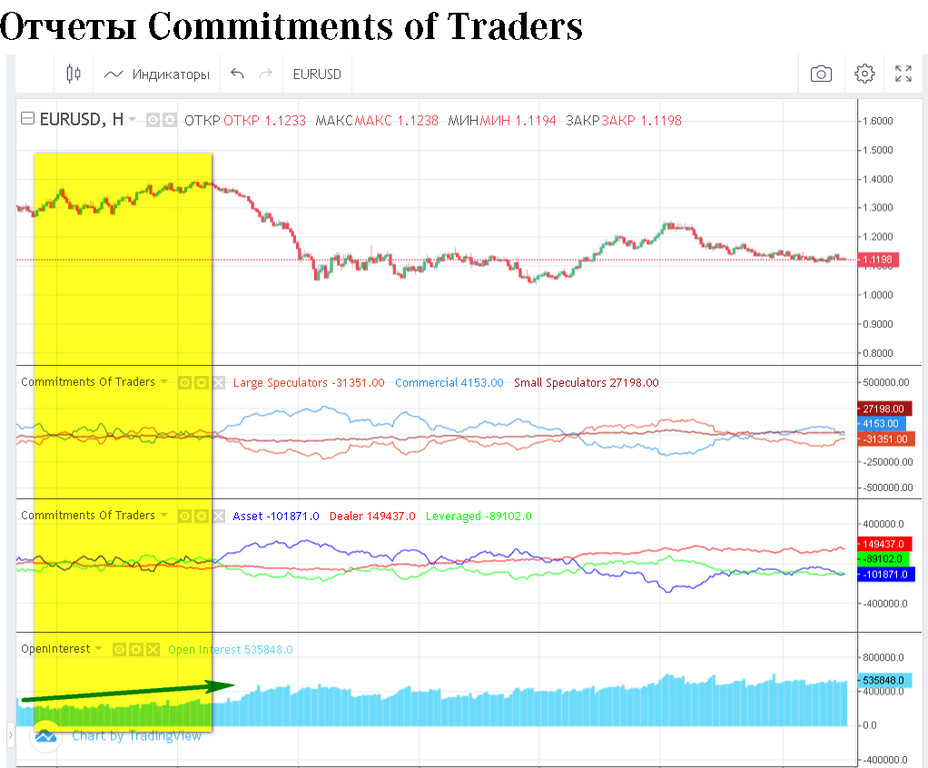
As can be seen from the picture above, low Open Interest resembles a flat; the lack of liquidity does not allow any of the participants registered in COT to build large euro positions.
Further, the chart shows that the situation of low volumes in futures and options was the calm before the storm. The Brexit referendum, the US elections, and the reversal of Fed policy caused strong movements in Forex, which were expressed in active trends and increased liquidity.
Critically high open interest means that the market is overheated. Hedgers' positions (Commercials) are at the bottom. The positions of large (Large Speculations) and small traders (Small Speculations) are at the peak of buying. What can happen here? Small speculators can easily be sent to the slaughter. Large speculators will most likely take profit by selling their positions to small speculators, who will willingly buy them. There is too much money, the potential for growth, at the moment, is exhausted.
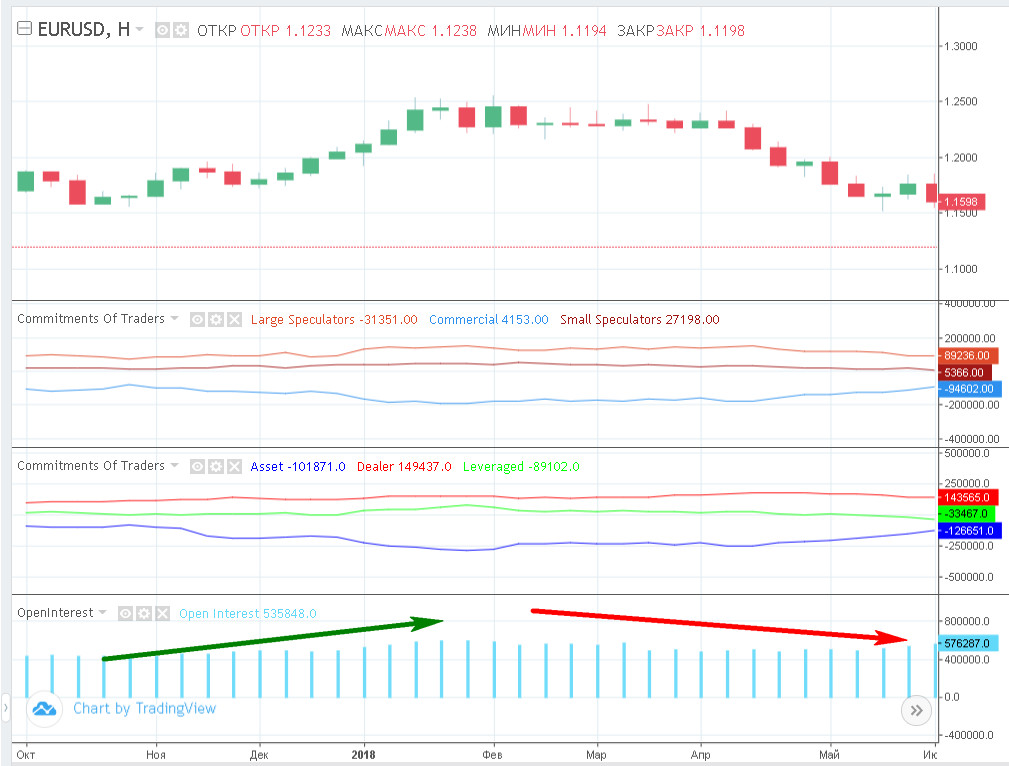
The fall of the euro does not take long to arrive: small speculators (Small Speculations), as always, did not guess the movement, large players and hedgers exchange volumes, the indicator curves move toward each other, part of the positions goes into cash, which is reflected in the decline of Open Interest.
The positions of hedgers (Commercials) and speculators (Large Speculations) can also be used as overbought or oversold signals. The minimum and maximum values of accumulated futures volumes often coincide with an abnormal surge or decline in Open Interest.
As can be seen from the figure below, they accurately predict breaks (reversals) in the exchange rate of the currency pair.
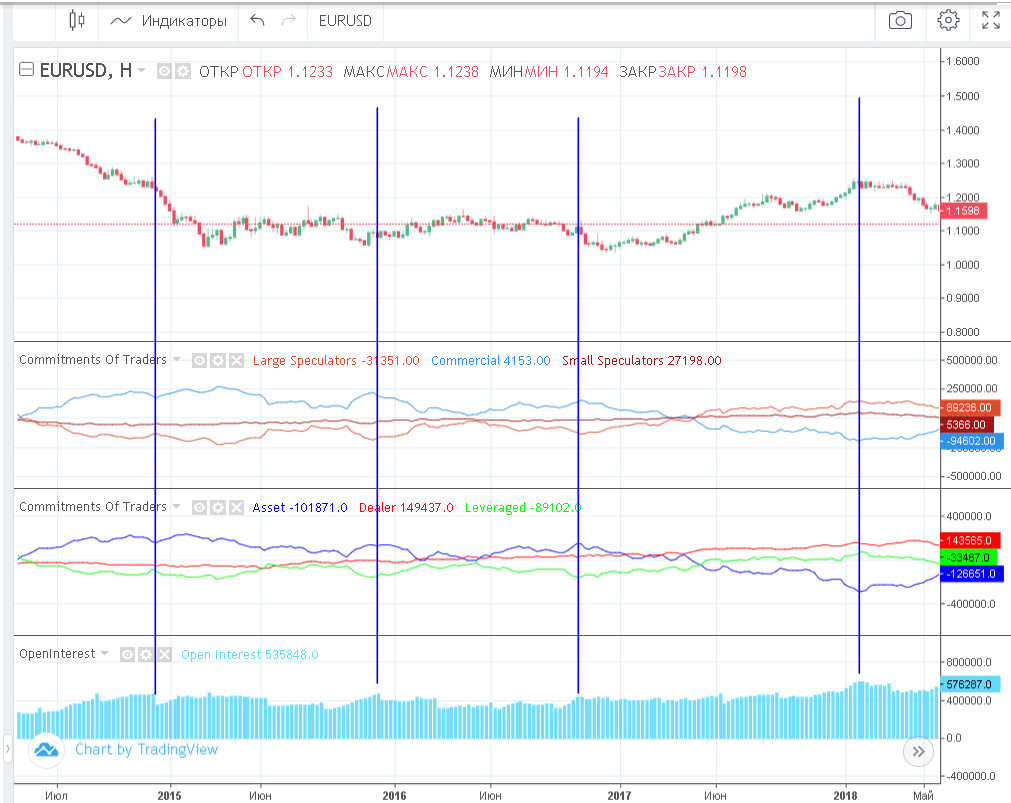
The main thing is to remember the rule: large speculators (Large Speculations) always increase long positions along the trend of the pair's rate. Hedgers always go against the trend. Small traders are almost always victims - they are often wrong, but the indicator curve should be traded according to the contrarian system, so sometimes they can be quite useful. That's all.
Conclusion

Do not forget that COT reports should be used only as an additional indicator of your system, which can be checked once a week before the market opens. Do not trade solely on COT reports, since this is, to put it mildly, very difficult and unreliable.
Thank you for your attention. See you next time!
Additionally:
Respectfully, Pavel Vlasov
Tlap.io
