
Stop-Loss and Take-Profit - the most important webinar
 Good day, fellow forex traders.
Stop-Loss and Take-Profit. The Alpha and Omega of Forex trading. The beginning and end of every trade. Just two factors, working with which will let you REALLY TAKE OFF in your trading. In the webinar, only practical tricks await you that you can apply in your strategy right now.
What will be in the webinar

- Which is more important: Stop-loss or Take-profit
- The whole truth about Murphy's law in trading
- Methods of placing stop losses
- Methods of placing take profits
- Practical secrets they do not talk about
- Mental skills for working with limitations in trading
- Answers to your questions
Recording of the past webinar
Below you will find a brief text version of the webinar.
Options for placing stop losses

Stop loss is a priori considered a more important element of trading than take profit. Setting an SL is strictly mandatory (at least in manual trading), a TP is optional.
There are many ways to place stop losses. Most of them are provided for by the rules of specific trading systems, but there are also universal typical options, which we will consider below.
At the last local extremum
The simplest way to place an SL is at the minimum/maximum of the signal candle, or at the level of the last extremum.
In the first case, the stop loss is placed a few points below the minimum of the bullish signal candle (in the case of buys), or above the maximum of the bearish one (in the case of sells).
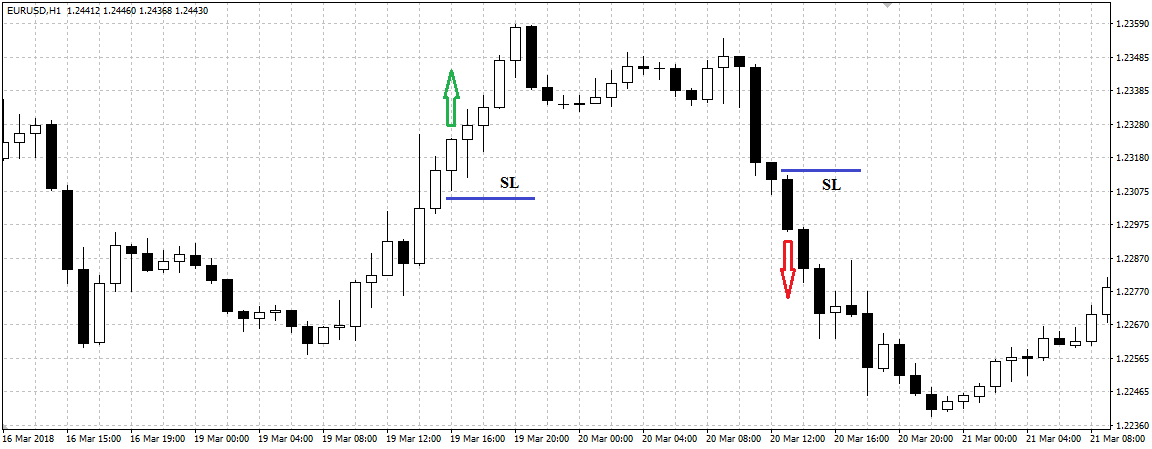 In the second case, the stop loss is placed a few points below the local minimum (in the case of buys), or above the local maximum (in the case of sells). That is, in this case we no longer focus on the signal candle, but on the last extremum.
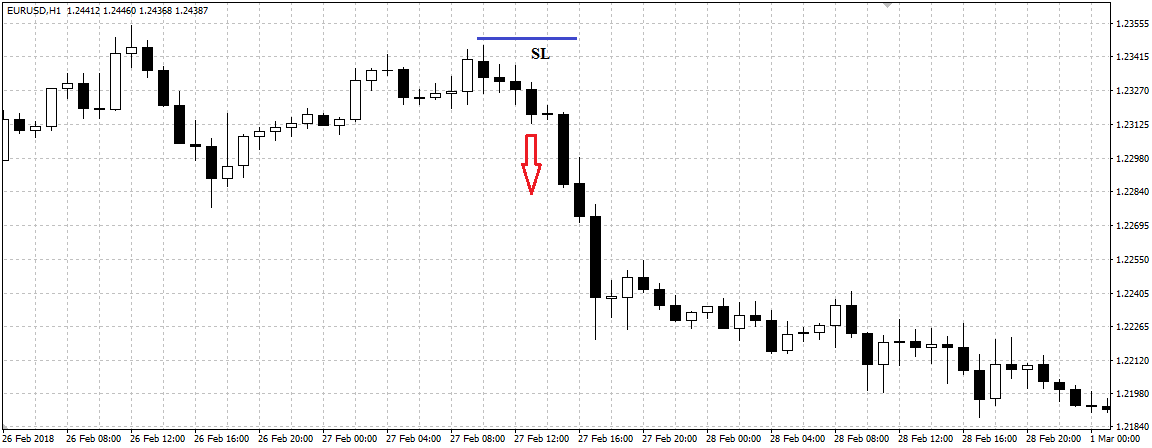 The disadvantage of this placement model is that market makers, and in general any experienced market participants, know this method well, it is easily read on the chart, which means it can be used against small traders. Market makers will move the price exactly to the level where, logically, the largest number of stops will be placed, and will knock them out, forcing traders to close at a loss, and then let the price go in the former direction.
By levels
Placing stop losses by levels is a more advanced option. It is good because at key levels there is a large concentration of orders, which are not so easy to knock out. Nevertheless, it is necessary to place the price a few points below the level when buying and above when selling.
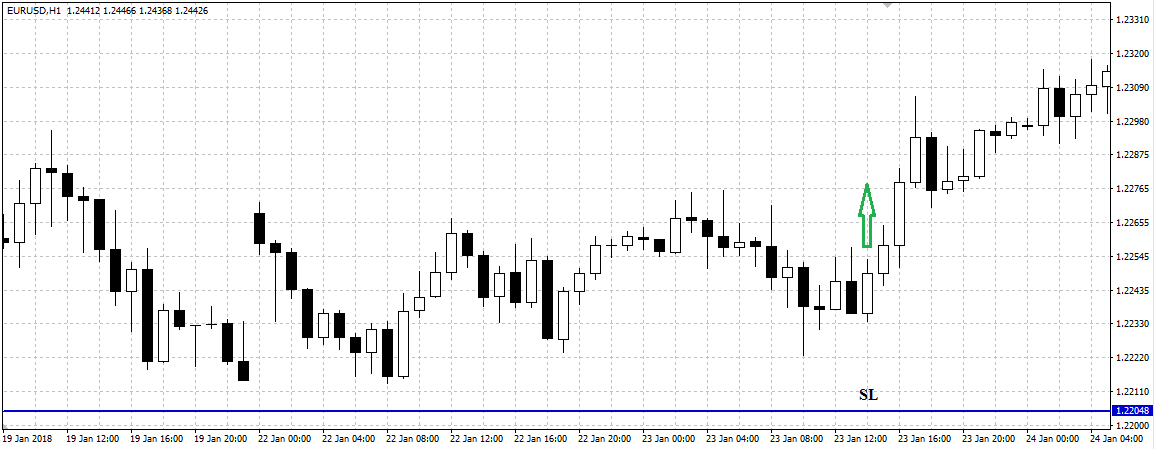 In addition, when buying, the stop loss should be noticeably below the last local minimum or above the last local maximum when selling. Thus, the trader protects their position from an accidental stop-out, possible with the first method of placing an SL.
By Parabolic SAR, ATR indicators
This method is quite simple, so it is used by many beginners, and is also a component of many trading systems that use these indicators. Parabolic is used more often than others for placing a stop loss, because it most clearly indicates the place where the protective order should be set: the SL is placed directly on the PSAR marker.
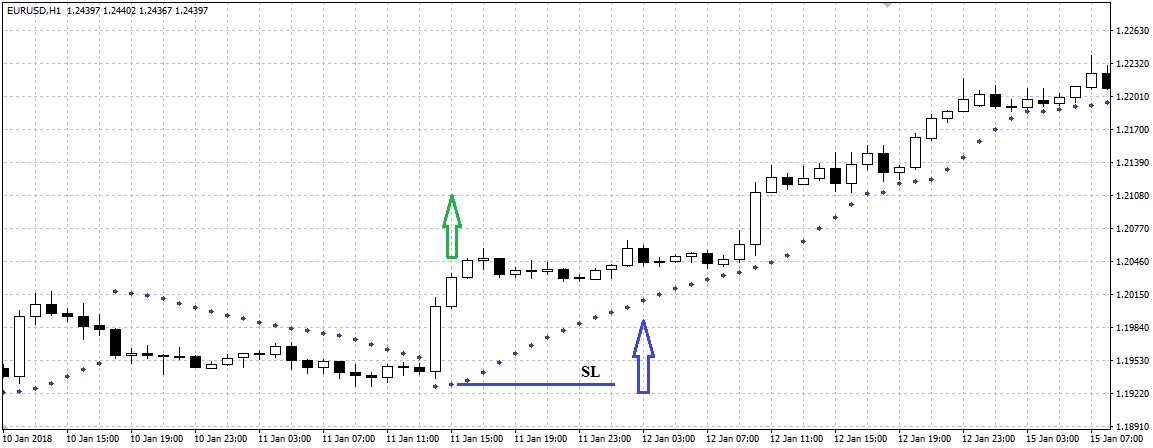 Placing an SL by the Parabolic marker has an advantage: such a stop can be moved manually on each new candle, imitating a trailing stop, but acting more flexibly.
On the other hand, placing a stop loss by indicators is as easy to calculate as placing it at local extrema, so the trader can become a victim of market maker manipulation, and end up knocked out of the market.
By fundamental factors
Exiting a trade by fundamental indicators is more often done manually than by a pre-set stop loss. For example, this can be closing a position after the end of the American session, when trading activity declines. It is also logical to exit the market 15 minutes before the release of important news because such events can move the price by dozens (if not hundreds) of points in a few minutes and push the price in any direction.
However, in some cases, a regular stop loss can also be set based on fundamental factors. For example, an SL at a distance equal to the size of the average daily candle for a specific asset. For GBPUSD, the average daily candle equals 80 points, which means that when trading this pair you can place a stop loss at such a distance.
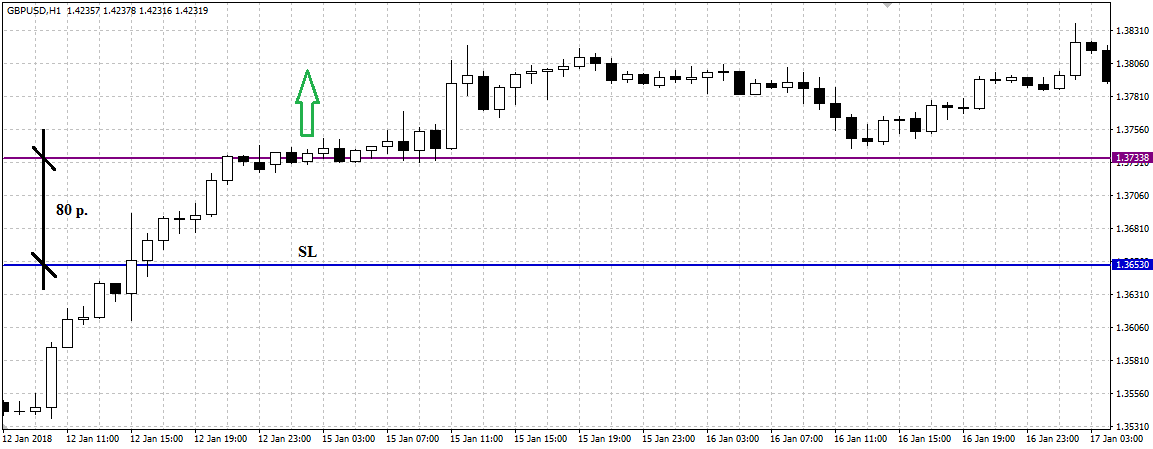 Technical stop loss
A technical stop loss is an exit based on any indicators, except for obvious ones like Parabolic SAR. This can be a crossover of moving averages or the entry of the Stochastic into the overbought/oversold zone.
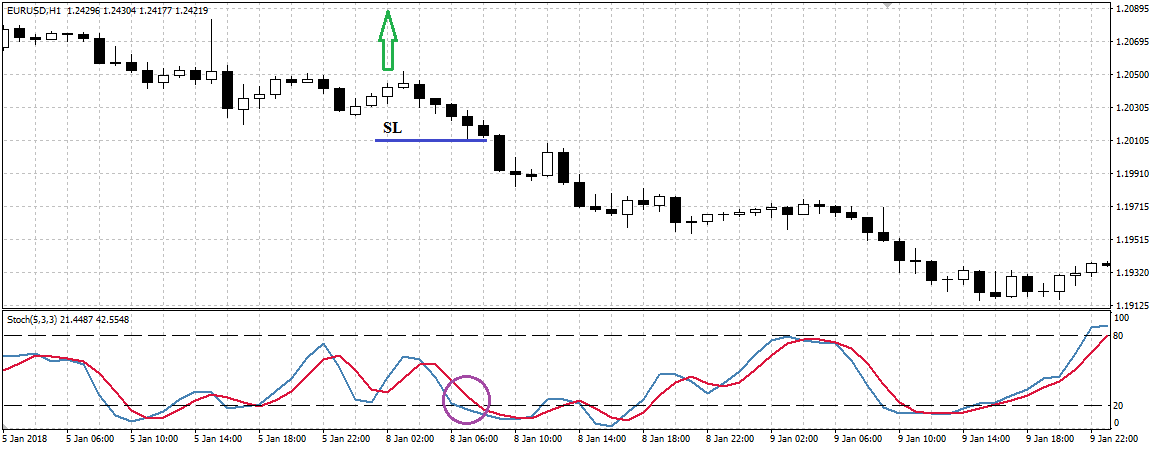 Such a stop is often executed manually, since the trader (or an expert advisor) tracks the indicator readings in real time and closes the trade when the tool gives a signal.
Psychological Aspects of Setting Stop Losses

Traders often perceive a trade being closed by stop loss as a personal defeat. Even if the SL was set correctly, the loss turned out to be relatively small, and the stop protected against much larger losses (that is, fulfilled its direct purpose), the trader may still feel upset, and if several trades are closed in a row, may even fall into a mild depression and lose faith in their trading system, or even in the market as a whole.
The frustration of locking in losses, on the one hand, is quite understandable. On the other hand, emotions should not interfere with trading. A professional trader should perceive a stop-loss closure as a completely normal occurrence, the same kind of systematic action as placing a pending order or taking profit at TP. However, the right perception needs to be developed.
Opening Trades Only with a Small Stop Loss
This measure is especially effective for beginners. It is a simple technique that will help you get used to exiting the market by stops and treat them calmly, since the losses will be minimal and quite acceptable.
At the same time, the stop loss should not be artificially reduced. All order parameters must be set strictly according to the trading system, but trades in which the stop loss is above a psychologically acceptable level should be ignored.
For example, if a signal to open a trade appears, but the distance from the potential trade entry point to the level is about 40 points (and the SL would have to be placed even farther) - for intraday trading these are numbers that are too large, and it is better to refrain from the trade. At the same time, it is possible that after some time the price will pull back, and another signal will be formed in the same direction, but now with a much smaller stop loss. That is exactly what happened on February 13 on USDCHF, where a trade was opened with a stop loss of 17 points - quite acceptable even for a beginner.
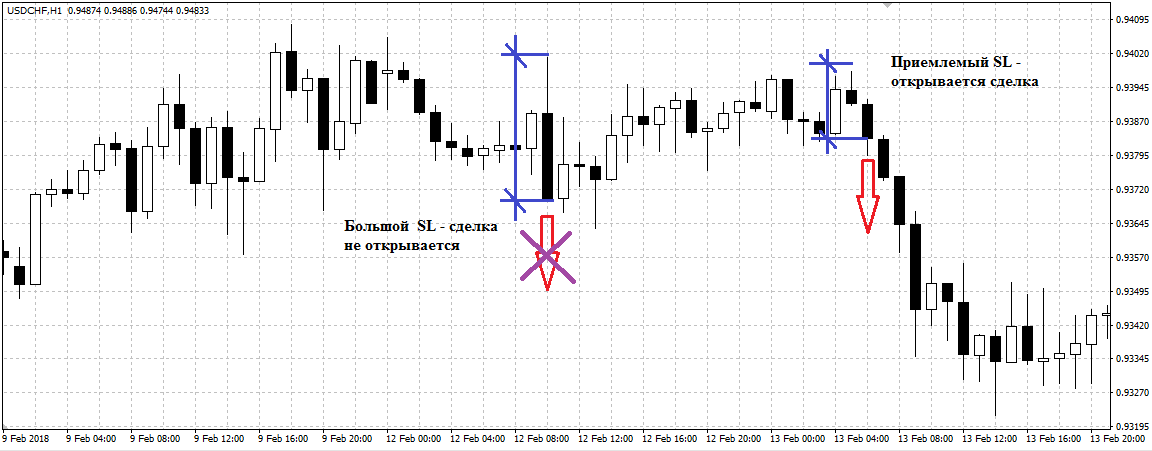 For the frequent triggering of a small stop loss to pay off in the long run, it is necessary to calculate the trade so that the potential profit is at least 3 times greater than the possible loss.
A Stop Loss "In Mind"
Some traders refuse to place a stop loss in the terminal, arguing that they have already set it "in mind" and personally control the trade. If the price goes in the wrong direction, they will close the position themselves when they see fit.
Even if we set aside the probability of technical failures and possible internet problems that would prevent closing the trade on time, the real problem in this case may be those same emotions. If, when trading on cent accounts, traders can easily remain detached, then when losses of real money begin, sometimes the "hand simply will not rise" to lock in a loss when the system requires it. As a result, the trader continues to wait and hope until a loss of 1-2% of the deposit turns into 10-12%, or even 50%.
To prevent this from happening, a stop loss "in mind" must always be duplicated in the terminal as well.
Working with Take Profit

Take profit is needed in order to lock in profit and not lose it during a likely reversal of the trend. According to the rules of money management, it is recommended to set the take profit 3 times larger than the stop loss, but the TP size must be reasonable. If there is no opportunity to place a large take profit, it is better to refuse opening the trade altogether.
There are several ways to set TP:
- A take profit larger than the stop by a certain number of times (3, 4, etc.). If the stop loss is 20 points, the take profit will be 60 (with a coefficient of 3). This method is the simplest, but its disadvantage is that such a take is outside the market, there are no grounds to believe that the price will reach exactly this mark. Accordingly, the probability of locking in profit at all decreases;
- Take profit equal to the size of the average daily candle. This method makes sense when there are no other factors to which TP can be tied, and setting it without any reference, by merely multiplying the stop loss, is impractical;
- Exit by oscillators. The trade is closed when the Stochastic or RSI enters the overbought zone (for buys) or the oversold zone (for sells). The downside of this method is that the price may continue moving down even after the oscillator enters the oversold zone, and a trader who closes a sell position in that case will lose part of the profit. This method is best suited for intraday trading, when trades are opened for a short period;
- Exit by time. Trades can be closed at the end of the day, week, or month, based on the fact that trading calms down at the end of the day and new factors will affect the price in the morning, many events can happen over two weekend days, and at the end of the month many financial organizations close positions to sum up results, which can cause increased volatility;
- By round numbers. In this case the focus is on round price levels, for example, 1.2500, 1.2600, etc. Trades are closed when the price approaches these levels, that is, when about 20 points remain to the level from above or below;
- Setting take profit by levels. This approach, as with setting a stop loss, is considered the most effective. In this case round price levels are ignored, and strong resistance and support levels serve as the reference point. This makes it possible to set take profit at a greater distance, having full grounds for doing so.
Specific Cases of Working with Take Profit

In addition to typical TP handling models, there are separate situations in which you have to change tactics and close a trade contrary to the previously planned scenario.
Sometimes the price, moving in the right direction, may fail to reach the take profit by 5-10 points and then sharply reverse in the other direction. In this case most traders, quite logically at first glance, leave the take at the same place and continue waiting for the price to reach the intended mark and for the profit to be fixed.
Despite the fact that trading psychology prescribes always acting according to the system and not changing its rules, in this case it is necessary to close the trade at market, without waiting for the price to reverse again. The fact is that after the price reversal the setup changes, a new signal appears, and the previous grounds for the price moving in the direction of the open trade lose their relevance. This signal can be considered played out, because 5-10 points is not that much, and the trade could quite well have closed by take profit if the reversal candle's wick had been just a little longer.
For example, on March 1 a sell trade was opened on USDCHF. The take profit was set above the support level formed by several local lows.
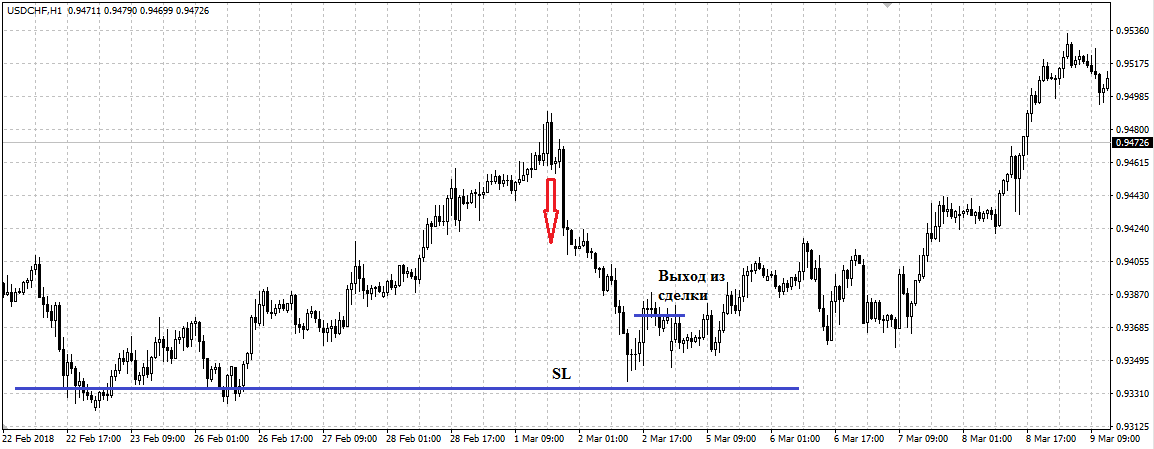 On March 2, after missing the take by a few points, the price reversed upward. In this case, the correct decision would be to close the trade immediately after detecting the reversal. Despite the fact that the price corrected downward several more times, it was on March 2 that a bullish trend began and, if the trade had not been closed manually, it would have closed by SL.
Additional Trading Tips

Finally, let us consider some ways of closing trades besides exiting by the stop loss and take profit set once at the time the trade is opened.
Moving to Break-Even
This technique allows the trader to move into a calmer emotional state, since it guarantees at least the preservation of their own funds.
It is recommended to move the stop loss to the trade's opening level when the price has traveled a distance twice as large as the stop loss. For example, if the stop loss is set at a distance of 20 points and the take profit at a distance of 60 points, the trade can be moved to break-even when the current profit reaches 40 points.
Trailing Stop
A trailing stop makes it possible to gradually reduce the size of potential losses, moving behind the price as profit grows. There are several types of trailing:
- Standard, built into the MT4 terminal;
- Trailing expert advisors and robots (many such ones can be found/downloaded here);
- Manual - the trader tightens the stop loss independently, for example, based on indicator readings.
In order for automatic trailing to work, the terminal must be kept turned on.
Partial Position Close
Sometimes, when the price approaches take profit, the trader may be visited by doubts that the trend has been exhausted and that they cannot get even more profit from this trade. If there are prerequisites for the trend to continue, the trade can be closed partially, and a higher target can be set for the remaining volume.
For example, if a buy trade is open and the take profit is set below a key support level, but prerequisites appear that the level may be broken, 70% of the trade volume is closed, and a higher TP is assigned for the remaining 30%. As a result, if the level does in fact turn out to be broken (even if not on the first attempt), the trader receives additional profit.
Conclusion

There are many ways to set stop losses and take profits, and there are even more nuances, special cases, and situations in which it is necessary to make a logical and reasoned decision, but contrary to the original plan. Understanding such situations, as well as the ability to make the right decisions, comes with experience. However, regardless of professionalism and fear of trading, the trader must remember that a stop loss is always set, and a take profit must always be greater than the stop loss.
Respectfully, Pavel Vlasov TradeLikeaPro.ru