
The SEC Opened the Door to Tokenized Stocks—But Which Blockchain Gets the Business?

Intro
The SEC has created a conditional five-year window in which eligible platforms can experiment with trading tokenized U.S. stocks on blockchain infrastructure. That raises a deceptively simple market question: does regulatory permission create a fundamental source of demand for Ethereum and Solana, or merely give investors a fresh narrative to trade? The distinction matters because permission, deployment, and profitable scale are three different milestones. The SEC has made the first one more attainable, while the market is already trying to price the third. That enthusiasm is understandable, but the bridge between them still needs to be built—and financial infrastructure rarely assembles itself overnight.
What the SEC decision changes—and what it does not
The confirmed development is that the regulator has offered conditional exemptions enabling qualified operators to test tokenized-stock trading for five years. This is not a blanket deregulation of securities markets: participating venues must still operate within specified conditions, while custody, investor protection, identity controls, disclosures, market integrity, and settlement remain central concerns. The practical change is a lower regulatory barrier to launching pilots, not an automatic migration of American equities onto public blockchains. The five-year horizon is important because infrastructure providers can now evaluate products against a usable experimental timetable instead of an indefinite policy debate. Exchanges, broker-dealers, custodians, transfer agents, stablecoin issuers, compliance vendors, and blockchain developers have more reason to invest in integrations if they can see a route to regulated testing. Even so, a temporary exemption cannot by itself manufacture customer demand, deep liquidity, or economical settlement. There is also unresolved policy risk. Broader legislation defining the structure of the crypto market remains stalled in the Senate, so the exemption advances one route for experimentation without settling every question around digital assets. The SEC has opened a controlled lane, but it has not finished the highway code. That makes the initiative meaningful while keeping its long-term commercial implications uncertain.
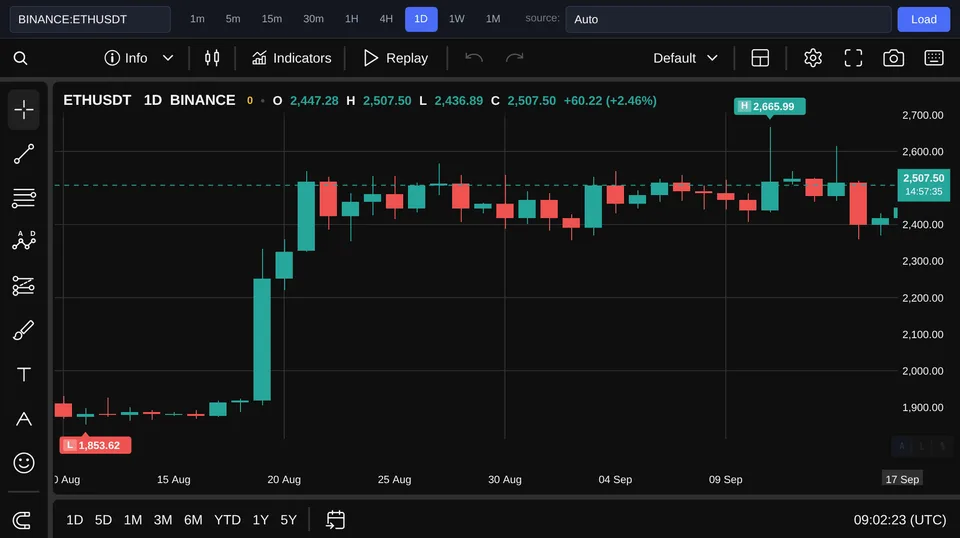
Three explanations for the rise in ETH and SOL
The immediate market reaction provides the first clue, but not a verdict.
The likely first winners are closer to the trading venue
The most defensible working hypothesis is that the SEC decision initially benefits the firms capable of operating the experiment. Regulated trading venues, qualified custodians, identity and compliance providers, transfer and settlement specialists, and stablecoin infrastructure companies can sell necessary services regardless of which ledger sits underneath the product. The exemption creates an addressable business opportunity for regulated intermediaries before it creates a measurable revenue stream for any particular blockchain. This does not make public networks irrelevant. Ethereum offers mature smart-contract infrastructure, substantial stablecoin activity, and an ecosystem already familiar to institutions. Solana offers high throughput and low transaction costs that may suit frequent trading and settlement. Other architectures—including private, permissioned, or hybrid ledgers—can also compete when operators prioritize control, privacy, reversibility, and predictable compliance over open participation. The decisive issue is therefore architecture, not brand recognition. A platform could issue representations of shares on a public chain while keeping order matching and key records off-chain; it could settle transactions in batches; or it could use a restricted ledger whose activity produces little demand for ETH or SOL. Tokenization is a broad design category, not a promise that every trade will consume public-chain blockspace. Ethereum and Solana benefit materially only if regulated operators choose them for economically significant parts of issuance, settlement, collateral, or record-keeping.
How to test the hypothesis
The hypothesis would gain support when official applications and product launches identify specific public networks rather than mentioning blockchain in general. The next evidence should be sustained trading volume in tokenized U.S. equities, growing stablecoin liquidity around those markets, integrations with regulated custodians, and durable increases in network fees or other measurable revenues. Announcements identify opportunity; recurring on-chain cash flows identify value capture. Market structure will matter as much as headline volume. Analysts should ask where orders are matched, where final ownership is recorded, which asset handles cash settlement, whether tokens can move between approved venues, and who earns each fee. A large tokenized market can coexist with weak economics for a base-layer token if most activity occurs in internal databases, private environments, or applications that abstract network costs away. Several observations would weaken or refute the thesis. Projects may favor closed or permissioned ledgers, pilots may be delayed, and investor demand may remain modest after launch. Public chains could be used only for occasional proofs of ownership while revenue-generating functions stay elsewhere. Most importantly, meaningful stock volume without a persistent increase in fees, stablecoin balances, collateral use, or ecosystem revenue would show that adoption is not translating into value for the network. Time also provides a useful test. If ETH and SOL retain their news-driven gains but no named deployments or operating metrics follow, the move will look increasingly like narrative repricing. If licensed platforms repeatedly choose either network and usage expands beyond subsidized pilots, the fundamental case becomes stronger. The relevant scoreboard is adoption multiplied by value captured, not the number of press releases containing the word “tokenized.”.
Conclusion
The short answer is that the SEC has created a credible opening for tokenized U.S. stock trading, but it has not selected Ethereum, Solana, or any other blockchain as the winner. The present evidence supports a reduction in regulatory friction and a near-term opportunity for regulated infrastructure providers. A lasting benefit for ETH or SOL requires named deployments, meaningful on-chain volume, stablecoin and custody integration, and observable network economics. Until those conditions appear, the five-year window is best understood as permission to compete—not proof of who will profit.