
Safe Martingale in Manual Trading

Good afternoon, ladies and gentlemen Forex traders.
Today we will talk with you about safe martingale, paradoxical as it may sound.
Martingale is usually associated with something dangerous and extremely unstable. You can call it a time bomb that is ready to explode in your deposit at any moment.
However, with the competent use of individual martingale elements, you can significantly improve the profit of your strategy and at the same time reduce the moral burden.
What is martingale?

This system was originally invented for playing roulette.
The essence of the system is very simple. If we bet 1 dollar on red, and black comes up, then we bet 2 dollars on red. If black comes up again, then we bet 4 dollars on red. If the value we need still does not come up, then we place a bet of 8$, 16$, and so on until we win.
When we guess correctly, our winnings cover all our previous losses.
In theory, all this sounds fun and profitable, but casinos have a maximum bet limit. And besides, by constantly doubling, your initial 1 dollar bet will very quickly grow to 1024 dollars. And soon to 1 million dollars.
No casino will let you bet that much money, and you are unlikely to bring that much money with you.
How is this system usually applied in Forex?

Applying this system is actually very simple. Let us imagine that there is some price movement.
Suppose the price is going up.
We decided that we need to sell because an overbought condition has formed on the chart.
We sell with a 0,1 lot:
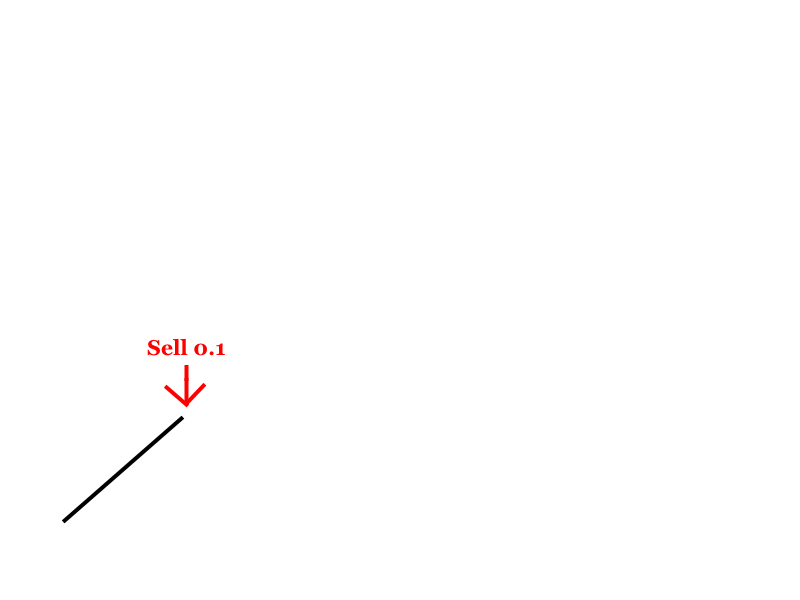
The price, however, entered a trend and went even higher.
We do not close the previous trade, but at the same time open an additional sell position, but now with a 0,2 lot:
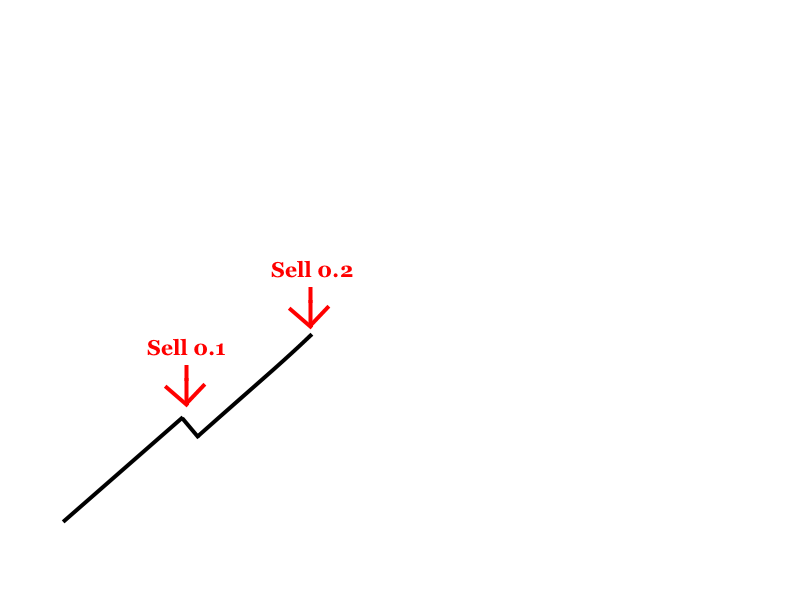
Now we begin to wait for the price to go down again.
Let us imagine that the price does not want to go down and once again heads upward to conquer new heights
Then we open another sell trade, but now with a 0,4 lot, and so on.
If the price still decides to reverse, we will be able to close all our positions and break even or make some profit:
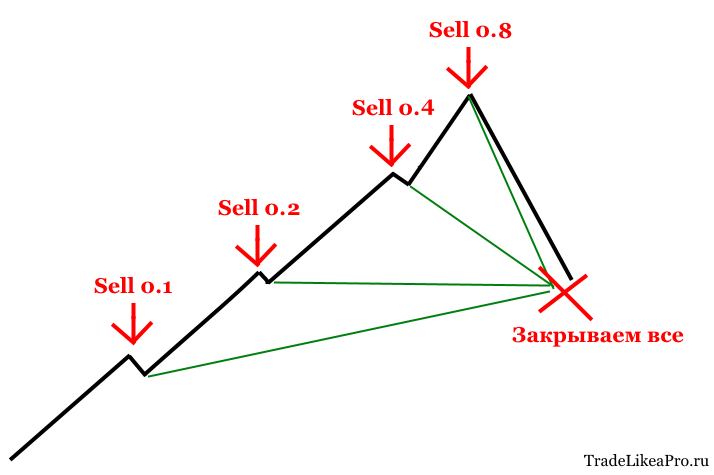
Thus, martingale creates the illusion that losing trades can be avoided. But the problem is that a large lot size leads to enormous risk, and if we get caught in some prolonged trend, you can lose your entire deposit.
Therefore, most martingale systems lead to losses. There are many nuances in this area, and this especially concerns expert advisors.
But it is worth noting that with proper skill, you can earn good money with such advisors.
Let us examine the various elements of martingale that you can use in your trading strategy. At the same time, without using advisors or complex calculations.
We will try to take individual elements from this dangerous tactic and make it safe for our benefit.
Profitable TS + High Leverage

Before we begin discussing the elements of martingale, it is worth saying that you need an initially profitable strategy. It must be profitable even without martingale elements, otherwise nothing will work.
These mini-elements will help us improve its profitability and reduce the moral burden on the trader. But without an initially profitable strategy, it will not be possible to do this.
In addition, we will need high leverage. With adequate money management, 1:100 will in principle be quite enough. High leverage will not bring harm to your trading, of course, if you do not abuse it.
Let us assume that you have a profitable strategy and high leverage. Then we move on to the next point.
Keys to Safe Martingale

Using stops in your trading
Let us consider a common mistake among traders who try to trade using a martingale strategy.
Most of them believe that the essence of the strategy is that trading takes place without stops. However, stops can and should be used. Thus, we can protect ourselves from a large loss.
Trading without stops is foolish and unsafe.
Number of consecutive losing trades in history
As soon as you have found a profitable strategy, you need to check how many losing trades it has in history. It is worth noting that we are interested specifically in the number of losing trades in a row, following one after another. It is also necessary to find not the maximum value, but the average value over the entire tested period of time.
The time period over which you should test your strategy is selected individually. If the trading strategy implies trading on the m5 timeframe, then it is worth testing at least 1-2 months. If trading will be carried out on D1, then it is worth testing at least a couple of years.
I am sure that you will test your strategy properly, and there should be no problems with this point.
For testing, you can use the TradeSystem2 utility or Forex Tester.
At first, we count the number of losing trades in history. And then we introduce the so-called "knee," that is, orders with an increased lot corresponding to this number.
Suppose that according to your strategy there are on average 3 losing trades in a row, accordingly, you will have 3 knees.
What would this look like in practice?
Let us imagine that in your trading strategy the stop loss is 10 points and the take profit is 20 points. You found that your average number of consecutive losing trades is 3.
There is some price movement on the chart, and you decided to sell 0,1 lots:
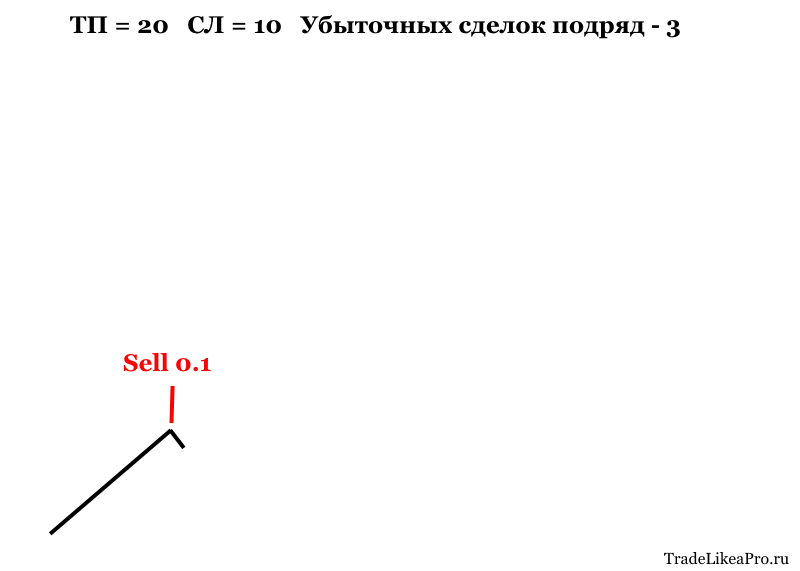
The price moved upward, and the stop loss was triggered. You took a loss of 10 points.
The price goes somewhere further and you get a sell signal again.
You sell again, but now with an increased lot.
Here I will pause a bit on another problem that traders often face. By how much should you increase your lot? For some reason, it is believed that with martingale the lot should always be doubled. This is not necessary at all. You can increase the lot 2 times, 3 times, or by 30%. It all depends only on your desire and risk tolerance.
In our case, let us increase the lot by 50%:
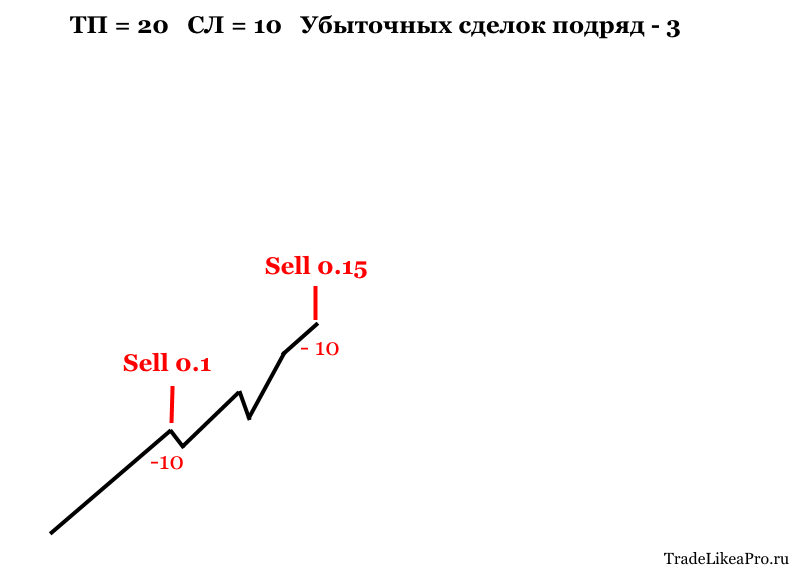
We sold with a 0,15 lot, and once again our system failed. Once again we took a loss of 10 points.
The price is fluctuating on the chart again, and a sell signal appears.
We notice this and place an order with a lot increased by 50%:
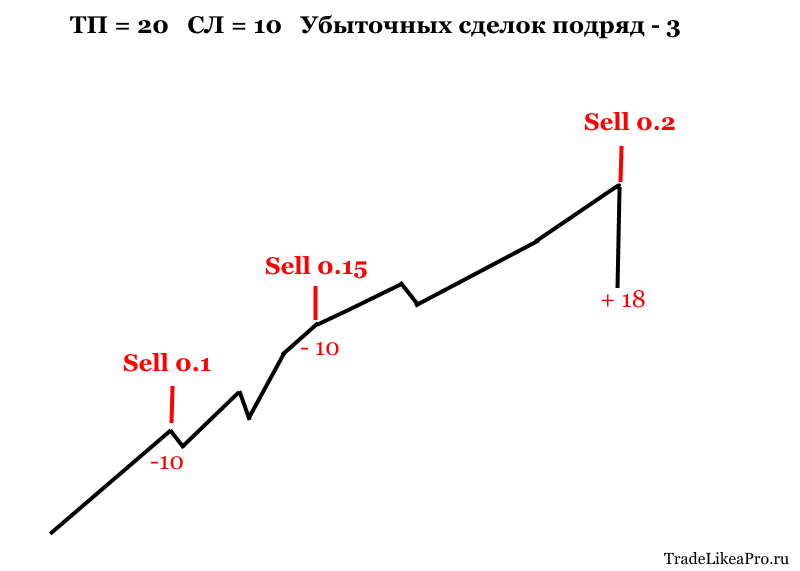
And indeed, the price moves in our direction, and we earn a 20-point take profit.
Now let us calculate what would have happened if we had not increased the lot and had traded all the time with a 0,1 lot.
The first time we lost 10$, the second time we lost 10$ with the same lot, and the third time we would have had a take profit. Since the lot is the same, that comes to 20$.
As a result, we came out at breakeven, which is even good, because we did not incur losses.
Now let us calculate how much we would have received by increasing the lot by 50%. The first time we lose 10$, the second time 15$, and the third time the take profit gives us 40$.
As a result, we get 15$ net profit instead of 0$, as in the case where the lot would have remained constant.
What should we do if the third trade brought us a loss and the chart continued its movement upward?
Suppose that the price began moving further and a signal appeared again. We start selling again. But what lot will be used in that case?
From the history, we found out that on average the strategy can have three losing trades. Consequently, we can increase our position exactly three times. The fourth time is already considered a non-standard case.
If a non-standard deviation occurred against us, it is not worth taking the risk; it would be better to gradually reduce the lot to 0,15, or immediately return to 0,1 and start trading with your standard lot until the strategy returns to its normal mode of losing and profitable trades.
Do not get attached to buys or sells
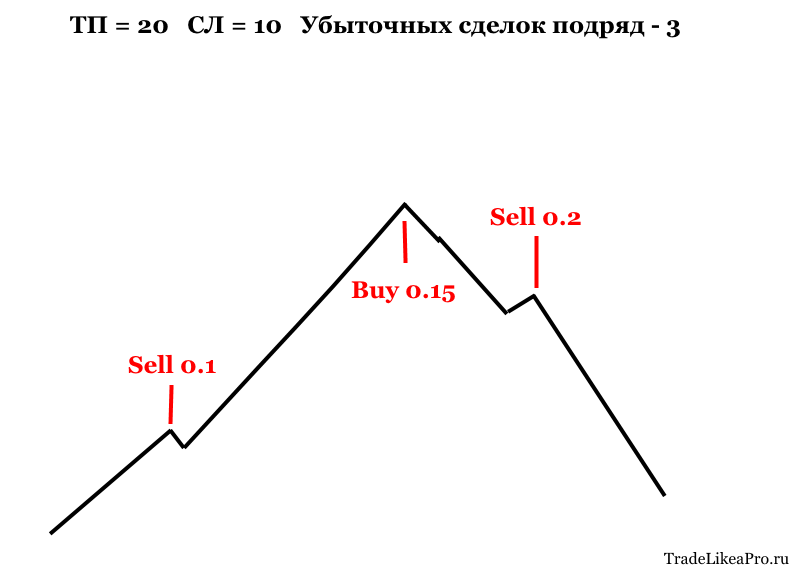
Martingale is usually viewed from the perspective that we cling to a certain chart direction. In fact, this should not be done.
Imagine that you have some losing sell trade.
The price moves against us. It hits the stop loss, and then a buy signal appears.
Why not take it?
We open a buy order, but with an increased lot of 0,15.
Let us imagine that the price once again moved against us and broke through a significant level:
We open a sell order with a lot of 0,2 and subsequently earn:
If our strategy had five losing trades in its history, then we would use 5 legs.
The largest lot is no more than 10% of the deposit

In your trading, you should not forget about money management either. The largest lot in your chain of orders should be no more than 10% of the deposit; this is done in case the stop loss is triggered on the last leg.
Of course, we increase our risks a little, but at the same time we remain prudent, because our task is to make a profit, not to lose the entire deposit.
Enter manually, then use an advisor
One option for applying this strategy is the ability to use technical assistance in your trading. For example, you can find entry points and open positions manually, and then use an advisor that will automatically open additional trades with an increased lot.
But there is also a drawback. With this approach, it will not be possible to use the signals of your strategy. There will be an increase in the lot and the opening of additional orders only at a certain distance from your first entry.
For these purposes, you can use ProTrader, which is available on our website.
Or you can use the advisor: ArgoAverager EA, which does not open trades on its own, but only helps you average in. Everything is configured and adjustable.
Place legs at support/resistance levels
A good option would be to open positions with an increased lot at support/resistance levels.
You can open additional orders at these levels even if there is no signal from your strategy there.
Suppose that at this point we made a buy:
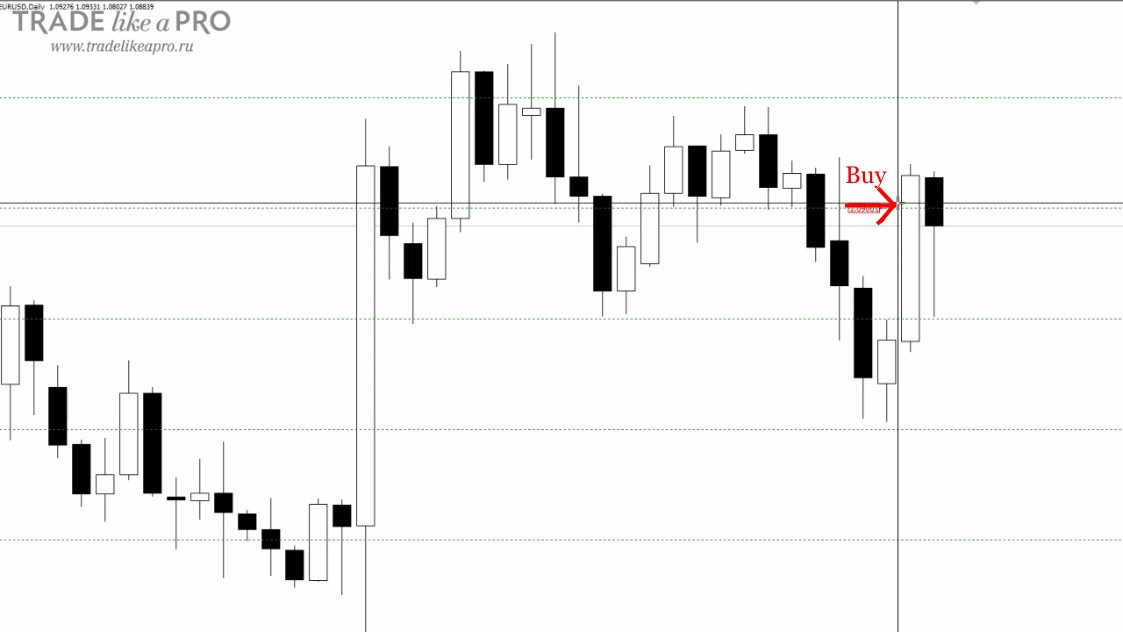
The price did not reach our profit target, reversed, and hit our stop loss.
Where can we place an additional order?
In the event of a negative development, we can place it at the level that passes through the round number 1.08:
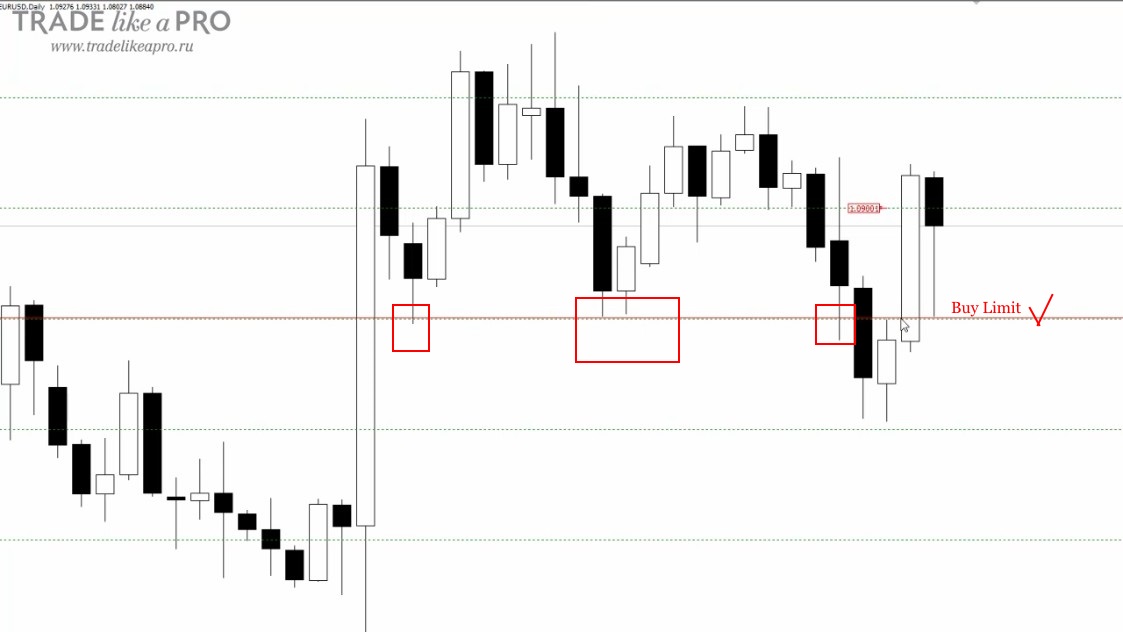
As you may notice, the price has already bounced off this level.
Our order goes into the red, while the additional order is triggered and subsequently brings us profit.
Similar entries are made at resistance levels or any other important values.
Checking Everything on Historical Data

I think you already understand that before going to a demo or real account, you should test everything on historical data.
This will help you test your strategy without losing money from your account.
I hope these tips will help you in your trading.
I remind you that these elements can be applied provided that you already have a profitable strategy. Be careful and do not forget about money management.
I wish you great profits.
Respectfully, Pavel Vlasov
TradeLikeaPro.ru
