
The Russian Market Between Oil, the Ruble, and the Central Bank: The Day's Nervous Equilibrium

Introduction
The Russian market now resembles a trader who has already seen expensive oil but still is in no hurry to press the “buy everything” button. Formally, support is there: commodities help exporters, the currency market is not showing sharp moves, and the ruble is holding near calm levels. But behind this external composure stands a tense structure of sanctions risks, budget flows, foreign-currency liquidity, and expectations for the Bank of Russia's decision.

🛢️ Oil Helps Exporters, but Does Not Heal the Whole Market
Expensive oil remains the main source of support for Russian exporters, especially for the oil and gas sector, where revenue still depends heavily on the external price environment. For exporters, high oil is real support, not just a pleasant picture on a chart. It helps the market maintain basic interest in commodity stories and partly offsets investor caution. But the MOEX Index does not live on oil alone, however convenient that may look in a morning review. Sanctions risks, payment restrictions, logistics, and uncertainty around future measures continue to weigh on company valuations. That is why investors separate support for individual sectors from readiness to buy the broad market. As a result, strong oil creates more of a lower support level than a full-fledged impulse for a rally. Exporters may look more resilient than domestic demand, but even in them the market prices in a discount for external restrictions and future uncertainty. The day's main intrigue is that commodities support the index but do not restore investors' unconditional appetite for risk..
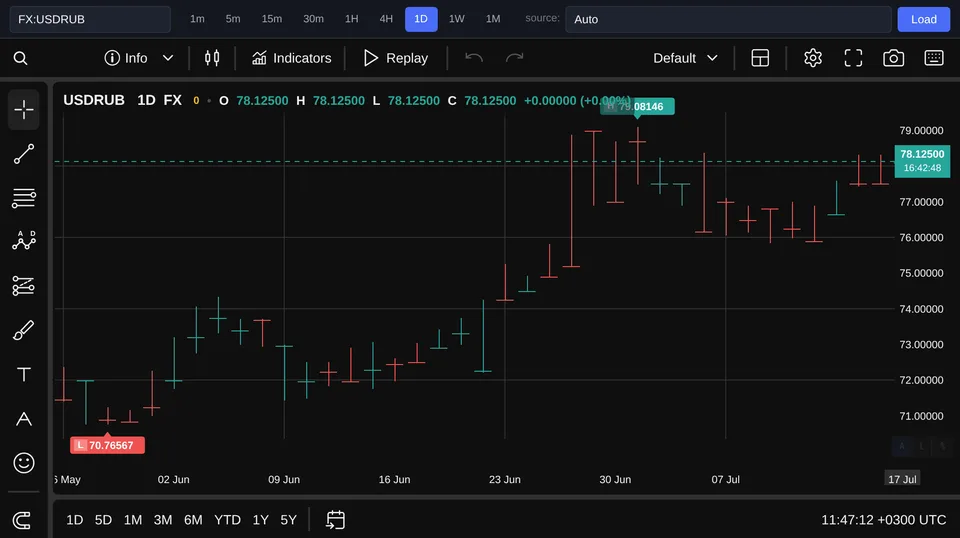
💱 The Ruble at 78.12: Silence on the Screen, Movement Under the Surface
The USD/RUB pair is at 78.12 RUB, while the daily change is +0.04%. At first glance this is almost immobility, but for the currency market such a “flat line” does not mean an absence of tension. The 78.12 RUB rate with a +0.04% change shows not a sleepy market, but a temporary balance between currency supply, demand, and expectations. The ruble is now being read through several channels at once: export revenue, budget operations, foreign-currency liquidity, and currency demand from importers and private capital. For the budget, the ruble valuation of export income matters; for companies, the cost of settlements and the predictability of cash flows matter. That is why even a small move in USD/RUB can change perceptions of exporters' profits and inflation risks. For equities, the ruble is no less important than oil; it simply works more subtly. An overly strong ruble may pressure exporters' ruble revenue, while an overly weak one can revive talk about inflation and a tougher regulator. For now, the market is carefully shifting its stance: the rate is almost standing still, but participants are clearly waiting to see who gives the first new signal: the budget, exporters, the Central Bank, or the external backdrop.

🏦 The Bank of Russia Keeps Risk Appetite on a Short Leash
Waiting for the Bank of Russia's decision remains the key factor restraining equity buyers. A high rate makes deposits and bonds strong competitors to the stock market, especially for investors who do not want to take on extra volatility. As long as there is no clear signal on the trajectory of policy easing, broad demand for equities remains selective. For the domestic market, the rate is especially important in sectors tied to credit, consumer demand, construction, retail, and investment cycles. The more expensive money is, the harder it is for companies to show confident growth, and for investors to justify high multiples. That is why the market is watching not only the rate decision itself, but also the tone of the regulator's comments. If the Bank of Russia gives a cautious signal, participants may continue keeping part of their capital in defensive instruments. If the rhetoric shows greater readiness to ease, interest in equities may expand beyond commodity stocks. But for this, the market needs not hints for the sake of hints, but a clear logic on inflation, liquidity, and the future cost of money.

📊 What the Market Is Really Assessing Today
The current picture does not come down to a simple argument between bulls and bears. Oil supports exporters, USD/RUB at 78.12 RUB with a daily change of +0.04% shows a stable but tense currency backdrop, and waiting for the Central Bank forces investors to maintain discipline. The main trade of the day is not chasing the index, but selectivity in stories where the risk is understandable and there is compensation for it. That is exactly why the market can look nervous even with favorable oil. Investors are not leaving Russian assets completely, but they demand stronger arguments for purchases: a transparent dividend story, stable cash flow, protection from the rate, or a clear benefit from external prices. Securities without such factors receive less attention, especially amid uncertainty over sanctions and liquidity. For traders, this means index moves are now better read through their composition, not only through the final number. If mainly exporters are rising, that is one story; if banks, the consumer sector, and domestic-demand companies revive, that is already a sign of broader confidence. For now, the market remains in input-checking mode, where every new Central Bank comment, currency impulse, or sanctions headline can quickly change the mood.
Conclusion
The day's conclusion is businesslike and fairly simple: the Russian market is not ignoring expensive oil, but it is not ready to treat it as the answer to every question either. Exporters receive support, the ruble near 78.12 RUB with a +0.04% change shows a fragile equilibrium, and the Bank of Russia's decision remains the main filter for risk appetite. Until clearer signals appear on the rate, the sanctions backdrop, and foreign-currency liquidity, the market will probably retain a selective character: investors will buy not the “entire index,” but specific stories with understandable protection and calculated benefit.