
Russian Assets Under the Sanctions Overhang: What the G20 Signal Means for the Ruble and MOEX

Intro

The latest G20 message did not give Russian markets a new direction so much as confirm the existing one. Scott Bessent told Anton Siluanov that economic deals and sanctions relief should not be expected before the war ends, while Europe continues to reinforce its sanctions policy. For investors, the important point is not the diplomatic wording itself but the absence of a credible path toward near-term normalization. Russian assets therefore remain priced against a background of restricted capital flows, complicated foreign trade, and persistent uncertainty over the next round of measures.
🌍 The G20 signal keeps the risk premium elevated
The reported exchange between Bessent and Siluanov matters because markets trade not.
🛢️ Oil supports the system, but the headline price is not the whole story
Oil revenue remains an important stabilizer for the federal budget and a source of foreign-currency earnings. When export receipts are resilient, they can support fiscal flows, corporate cash generation, and the supply of foreign currency in the domestic market. That is why a constructive oil environment can soften pressure on Russian assets even when the external political backdrop remains difficult. Yet the benchmark oil price alone does not describe the cash that ultimately reaches exporters or the budget. Sanctions can widen discounts, lengthen delivery routes, raise freight and insurance costs, complicate settlements, and increase dependence on a narrower group of buyers and service providers. Oil can provide support while sanctions simultaneously reduce the efficiency and predictability of that support. This tension limits the usefulness of a simple “oil up, Russian market up” formula. Export-oriented companies may benefit from revenue and a weaker ruble, but investors must also account for higher operating friction, possible tax changes, capital spending requirements, and the risk that new restrictions target logistics or payment infrastructure. The result is a selective market rather than a uniform one: strong commodity cash flow may defend earnings, but it does not automatically remove the valuation discount attached to those earnings.
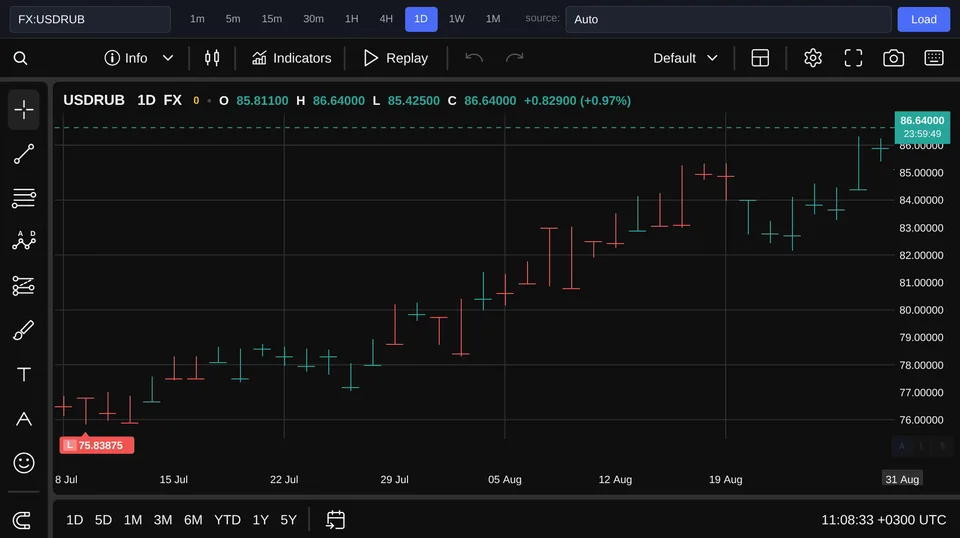
💱 USD/RUB at 86.64: a signal of caution, not a single-cause verdict
At the time of writing, USD/RUB stands at 86.64 rubles, with the dollar gaining 1.78% during the day. The move is consistent with greater caution toward ruble assets, but it should not be assigned to one political statement without supporting evidence. Currency trading also reflects exporter sales, importer demand, tax-payment schedules, liquidity conditions, oil-related flows, and the positioning of market participants. Even so, the direction is informative. A 1.78% daily rise in USD/RUB to 86.64 indicates that the balance of flows currently favors a weaker ruble, while the external backdrop offers little confidence in near-term sanctions relief. The G20 signal can therefore be read as a factor that reinforces existing caution rather than as a complete explanation for the session’s movement. For exporters, ruble weakness can increase the domestic-currency value of foreign revenues, partly supporting reported results and budget receipts. For importers and companies dependent on foreign components, it can increase costs and complicate planning. Households may eventually encounter inflationary consequences if depreciation persists, although a single session is not enough to establish a durable trend. Traders should watch whether the move extends alongside changes in export selling and oil conditions before treating it as a confirmed new currency regime.
📊 What investors should monitor next
The base case remains restrained while there are no confirmed signs of de-escalation or sanctions relief. That is not the same as a guaranteed decline in MOEX or an uninterrupted rise in USD/RUB. Markets can rally on positioning, domestic liquidity, dividends, company-specific results, or stronger commodity revenues even when the strategic risk backdrop remains unfavorable. The most useful signals will be concrete rather than rhetorical. Investors should monitor formally announced restrictions, enforcement details, changes affecting banks and settlement channels, shipping and insurance conditions, observable export discounts, and evidence about the stability of foreign-currency revenue. Diplomatic developments matter when they alter the probability of policy change, but vague expectations should not be treated as completed agreements. The central scenario is continued valuation pressure combined with selective support from oil income and exporter earnings. A more constructive scenario would require credible evidence that geopolitical risk or sanctions intensity is declining. A more adverse scenario would involve new restrictions that increase export costs, delay payments, or reduce access to buyers and intermediaries. Portfolio decisions should therefore distinguish companies with durable cash flow and manageable logistics from those whose investment case depends mainly on an early normalization that has not been confirmed.
Conclusion
The day’s message is straightforward: the G20 provided no basis for pricing imminent economic relief for Russia, and Europe’s sanctions line remains firm. Oil revenue can continue to support the budget, exporters, and currency supply, but discounts, logistics, settlement difficulties, and the possibility of additional measures dilute that support. With USD/RUB at 86.64 and up 1.78% on the day, the market is displaying caution, although the currency move cannot be reduced to politics alone. Until verified de-escalation or sanctions easing appears, the outlook for MOEX and the ruble remains constrained, selective, and highly dependent on observable trade and capital flows.