
Russia’s September Market: A Softer Ruble, Fading Oil Support and Sberbank’s Dividend Pull

Intro

The Russian market is entering September with several potentially important signals, but none of them yet provides a durable direction. Brent failed to hold above $97, the dollar briefly traded above 88 rubles earlier, and the currency market continues to reflect a cautious balance between export flows, domestic demand for foreign currency and investor expectations. Against this restrained backdrop, Sberbank’s comments at the Eastern Economic Forum about possible record dividends for 2026 have created a clear corporate focal point. The key question is whether that promise can attract liquidity beyond one heavyweight stock and improve sentiment across the broader market.
🧭 A market still searching for direction
A sustainable market rally normally needs either a strong external tailwind, improving domestic financial conditions or a broad upgrade in corporate expectations. At the start of September, these ingredients are not yet moving in the same direction. Oil is no longer offering an obvious upward impulse, the ruble remains sensitive to changes in currency flows, and investors still have to assess how interest rates will affect company valuations and the appeal of alternative instruments. This does not automatically imply a bearish scenario. It means that buyers have fewer reasons to increase exposure across the entire market at once, so capital is more likely to move selectively toward companies with visible earnings, credible distributions or specific operating catalysts. The market, in other words, has arrived at September with a map but no clearly marked express lane. The absence of a common driver favors selective positioning over a broad risk-on trade. Until oil, the ruble, rates or corporate results create a stronger shared signal, individual stories may outperform without lifting the whole index with equal force.
💱 The ruble: nervous context, calmer daily move
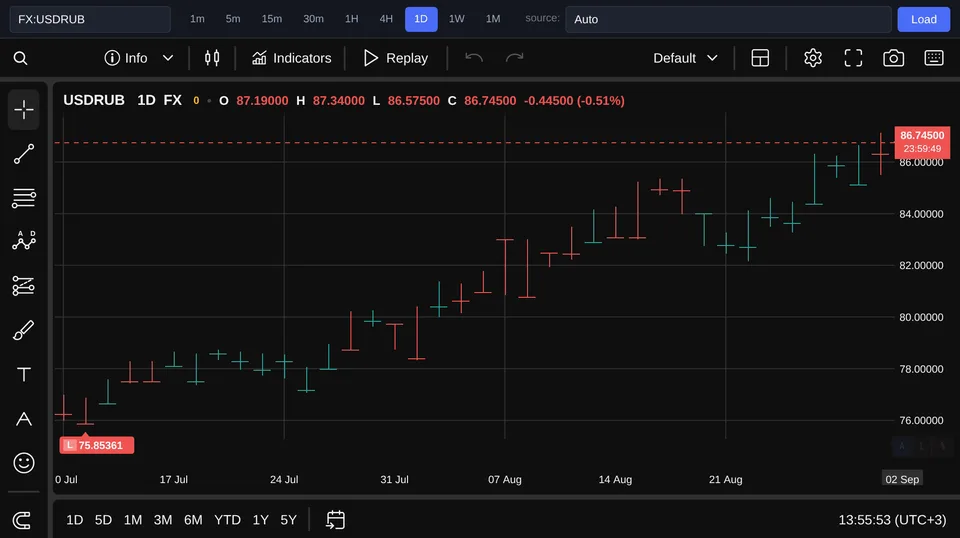
The currency picture requires careful separation of three different observations. The dollar previously moved briefly above 88 rubles, the Central Bank’s official exchange rate for September 3 was set at 86.9963 rubles, and the current market quote for USD/RUB stands at 86.69 rubles, down 0.12% for the day. These figures describe different moments and mechanisms, so treating them as interchangeable would exaggerate the apparent contradiction. The current decline of 0.12% shows modest daily strengthening of the ruble against the dollar, even though the broader background remains unsettled after the earlier move above 88. A single calmer session therefore does not establish a lasting trend. Investors will watch whether the currency can remain stable when demand for imports, exporter conversions and expectations about monetary conditions shift again. For equities, a weaker ruble can support the translated revenue of exporters, but it may also increase cost pressure and reinforce inflation concerns. Domestic businesses can face a different mix of effects, especially when imported equipment or components matter. At 86.69 rubles per dollar and a daily move of −0.12%, the currency signal is currently one of stabilization, not definitive trend reversal.
🛢️ Brent below the threshold of easy optimism
Brent’s failure to hold $97 removes one of the most straightforward sources of support for Russian risk assets. Oil prices influence expected export receipts, fiscal perceptions, currency flows and the earnings outlook for a major part of the listed market. When the benchmark retreats from a psychologically visible level, investors tend to demand stronger evidence from other indicators before assigning higher valuations broadly. The important point is not that every move below $97 must lead to equity weakness. What matters is that oil is not currently delivering a clear additional catalyst capable of overriding uncertainty elsewhere. If energy prices stabilize, investors can return their attention to company results and distributions; if pressure persists, exporters’ ruble revenue may receive some currency compensation, but the market may still apply a larger risk discount. Oil has stopped acting as an automatic argument for buying the entire market. That makes the relationship between Brent and the ruble especially important: a softer currency can cushion corporate revenue in some sectors, yet it cannot fully replace confidence in the underlying commodity environment.
🏦 Sberbank’s dividend promise: powerful, but local
Sberbank’s statement at the Eastern Economic Forum that dividends for 2026 could reach a record level is the clearest positive corporate signal in the day’s agenda. For income-focused investors, the prospect matters because Sberbank is a highly visible and liquid name whose distribution policy can influence demand across the financial sector. A credible path toward a record payout may attract capital that would otherwise remain in cash or fixed-income instruments. However, an expectation is not the same as an approved dividend.
Conclusion
The opening of September leaves the Russian market in a selective rather than directional phase. USD/RUB at 86.69 rubles with a daily change of −0.12% looks calmer than the earlier move above 88, but it does not remove currency uncertainty; the official rate of 86.9963 rubles for September 3 should be read as a separate reference point. Brent’s failure to retain $97 limits external support, while Sberbank’s record-dividend expectations provide a credible local attraction rather than a universal market catalyst. A broader impulse will require several factors to align: confirmed corporate earnings, clear distribution parameters, a more stable currency and oil environment, and financial conditions that make equities competitive for capital.