
Richard Wyckoff: The Strategy of a Legendary Trader
See the latest range markup for 19 instruments in the online Wyckoff scanner.

Hello, fellow traders!
Two years ago marked the 50th anniversary of the publication of Studies in Tape Reading, which laid the foundation for the theory of short-term scalping strategy and Volume spread analysis (VSA). The book's author, Richard Wyckoff, described the relationship between volume and price in detail, first outlining its principles in a series of articles in his two journals, and later publishing 9 books on the subject.
In today's material for you, there is a most interesting overview of Wyckoff's trading path, as well as his strategy, which may be interesting and useful to Forex traders.
The renowned stock market analyst spent 15 years penetrating the secrets of Wall Street and began publishing his own knowledge at the age of 30, passing away at 60. The mark Wyckoff left on the theory of market analysis proved so deep that it became a separate field after the author's death, called Volume spread analysis.
The VSA strategy is actively developing in the 21st century, acquiring new principles and indicators, some of which are described in many related topics on our website.
This article will not become an anthology of the newest modern interpretations of the relationship between volume and price; its task is to introduce the reader to Wyckoff's classical theory and remind traders of the author's contribution to modern exchange trading.
The First After Dow

Regardless of the level of knowledge and involvement in the market, many of us have heard of the theory of Charles Dow, which became the foundation of the first laws describing the movement of quotes of any assets. The discoverer of the principle of index reflection of stock prices formulated the following postulates at the end of the 19th century:
Dow theory remained only a theory: a simple description of facts observed on the chart that gave no particular advantage to the trader, only indirect conclusions for trading strategies:
Richard Wyckoff gave traders a set of rules and tools that, using volume and certain types of charts, determine almost flawlessly all the above postulates of Charles Dow.
Wyckoff devoted more than half of his life to studying scalping intraday trading. In the decentralized Forex market, there is no full-fledged order book or intraday trading volume covering the market as a whole.
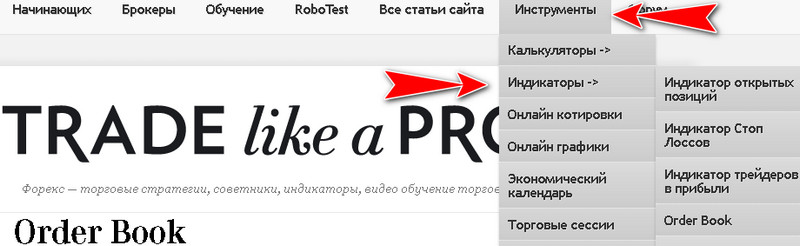
This problem is described in more detail in the "Order Book" service, which contains the positions of Oanda broker clients. There you can also find a brief description of the rules for making trades and analyzing positions in the book. The service opens from the "Tools" menu on the main page of the site, under the "Indicators" option.
Wyckoff devoted himself to scalping researchintraday tradingmore than half of my life. In a decentralized marketForexthere is no full-fledged order book and intraday trading volumes covering the market as a whole.
On our forum, an engaging article about the life of Richard Wyckoff has been published, revealing the founder of VSA from an unexpected side that is little covered in the Russian-language segment of the Internet. Information about the first theorist to describe the connection between price and volume is often mythologized or omits important traits of his character.
What you need to know about Richard Wyckoff?
From the age of 17, Wyckoff was connected with exchange trading, building a career that began as a clerk for a broker, working as a broker, market maker, and financial correspondent. Having decided to share the knowledge he had accumulated, he was forced to become an independent trader in order to pay for the issues of the unprofitable publication The Ticker.
The author set the goal of universal education: to give small traders knowledge so that they would stop losing deposits to large players. Wyckoff was always struck by the huge percentage of small and medium speculators losing money; he believed the reason for this was the lack of publications on trading theory.
The articles made the publisher and trader famous, the books based on them are reprinted to this day, but the magazine with a $3 subscription brought financial losses. Tired of writing and trading at the same time, Wyckoff launched a new one-sheet publication containing only charts and marked entry levels.
The trade signal bulletin "The Trend Letter" solved financial problems in its first year, and in its second year, due to a threefold rise in the subscription price, made the publisher a wealthy man. The only thing that greatly upset Wyckoff was the unwillingness of many traders to undergo training; signals were enough for them.
Many beginners calmly handed over funds to people calling on behalf of a broker, simply because the voice on the phone guaranteed payback and earnings from its investment advice. The stock market at the beginning of the 20th century was a "Wild West." It was flooded with fraudulent brokers who easily gained access to major exchanges. Market makers manipulated stock prices, and there was completely no market oversight from Regulators.
Richard Wyckoff devoted the last 20 years of his short life to fighting for the protection of small traders' rights. Taking advantage of the fact that his third magazine, The Magazine Of Wall Street, became the most popular American financial publication, Wyckoff used its pages to expose "bucket shops" (yes, they already existed at the beginning of the 20th century) and forced major exchanges to revoke the licenses of unscrupulous brokers.
The publisher's "crusade" was supported by almost all significant traders of that time, under whose pressure the Securities Commission began a campaign in the U.S. Congress to change the legislation. By the time of Wyckoff's death, no fraudulent brokers remained on American stock exchanges.
Richard Wyckoff has spent the last 20 years of his short life fighting to protect the rights of small traders. Taking advantage of the fact that his third magazine, The Magazine Of Wall Street, became the most popular American financial publication, Wyckoff exposed the “kitchens” from its pages (yes, they existed already at the beginning of the 20th century) and forced largeexchangesrevoke the licenses of unscrupulous brokers.
As already noted above, Richard Wyckoff's theory is valuable because it reveals the technology of applying Charles Dow's postulates. The founder of VSA never took fundamental analysis into account, believing that the reaction of price and volume before the release of news or macroeconomic indices was the best indicator.
Basic elements of Wyckoff's theory

As noted above, Richard Wyckoff’s theory is valuable because it reveals the technologies for applying the postulates of Charles Dow. The founder of VSA never took into accountfundamental analysis, assuming that the reaction of price and volume before the exitnewsor macroeconomic indices is the best indicator.
Support and resistance levels were determined by Wyckoff without reference to time. At the beginning of the 20th century, traders paid no attention to timeframes, working with a telegraph tape that transmitted the stream of prices.
Determining market levels and turning points

Support and resistance levelswere determined by Wyckoff without reference to time. At the beginning of the 20th century, traders did not pay attention totimeframes, working with a telegraph tape through which the flow of prices was transmitted.
VSA theory was created for the securities market. Richard Wyckoff opened medium-term positions in stocks only with the trend, which was determined by the stock index. The direction of market movement was determined on the timeframe MN (month).
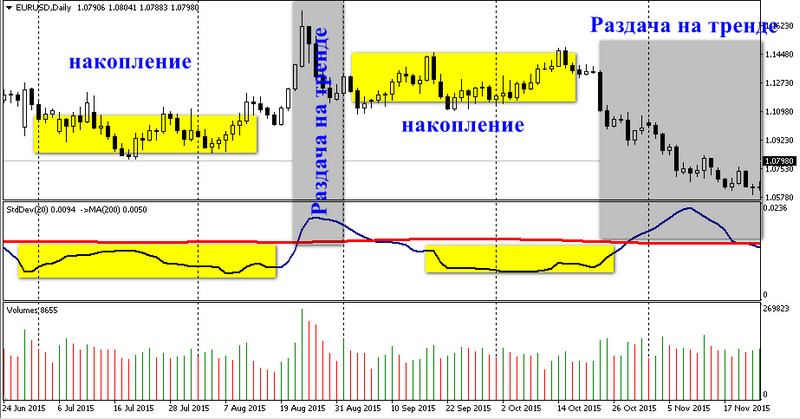
Market cycles are determined by comparing volatility and the current trend on the daily chart. According to Charles Dow's theory, Wyckoff distinguished two main cyclical phases of the market state:
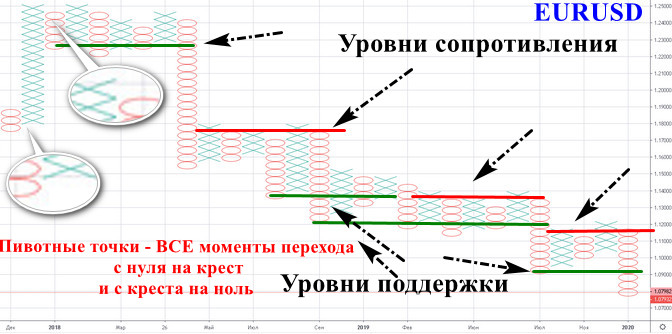
Identifying trends and market cycles
The situation changed only after the formation of the position was completed. Quotes soared or fell for any minor reason. Large players now needed a trend to distribute the accumulated asset and lock in profits.
Strong movements were provoked by hired market makers in order to involve as many traders as possible who, in a FOMO-driven fear, were capable of absorbing the volume of large players' positions being distributed at a profit.
Market cycles are determined by comparingvolatilityand the current trend ondaily chart. According to Charles Dow Theory, Wyckoff identified two main cyclical phases of the market:
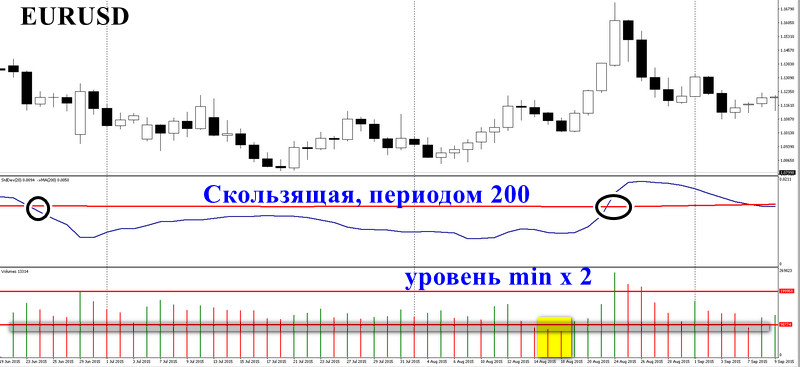
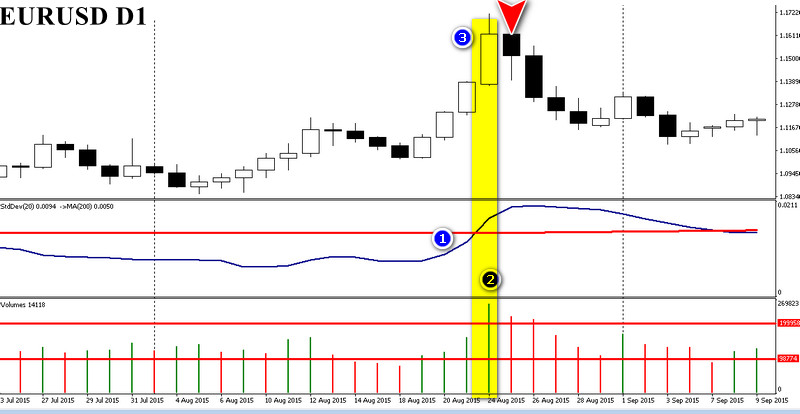
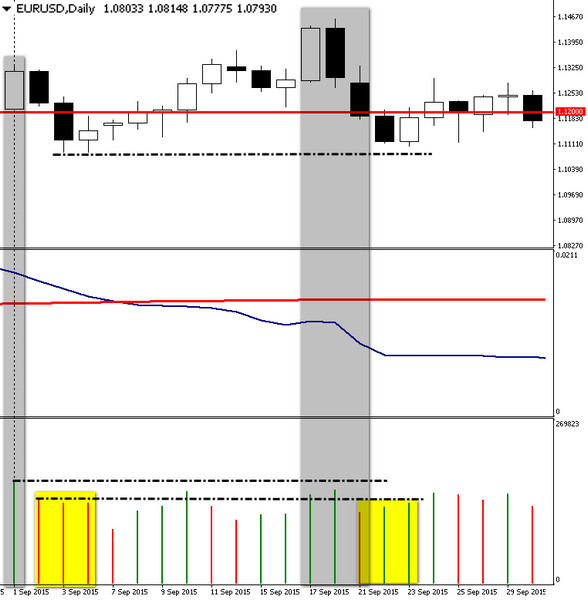
At the accumulation stage (volatility below the moving average with a period of 200), the trader determines the lowest volume value; in the figure below it is marked with a marker. As soon as the minimum intraday volume is determined, multiply the value by two and draw a level above it. This is one of the signal lines for a trade.
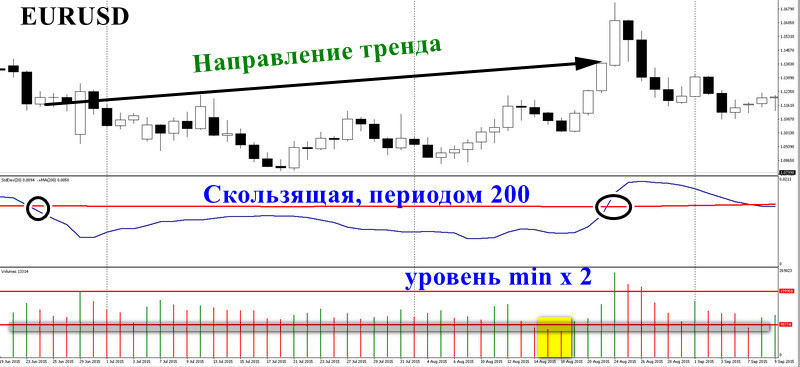
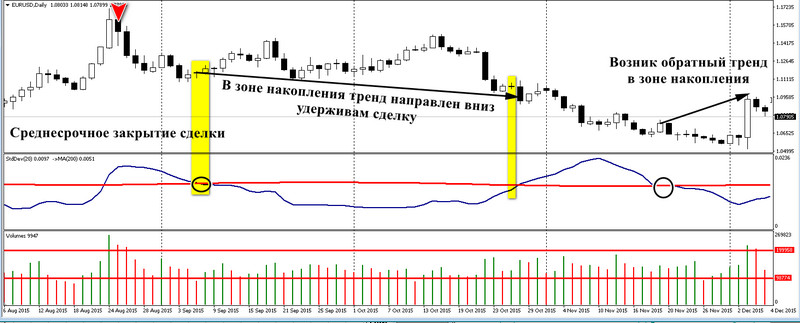
The next step will be determining the trend in which a large player will move the market. The direction can be determined correctly by connecting the starting points of the accumulation zone with the candle corresponding to the reverse crossing of Standard Deviation with the moving average with a period of 200.
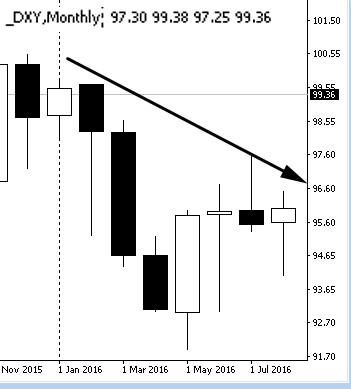
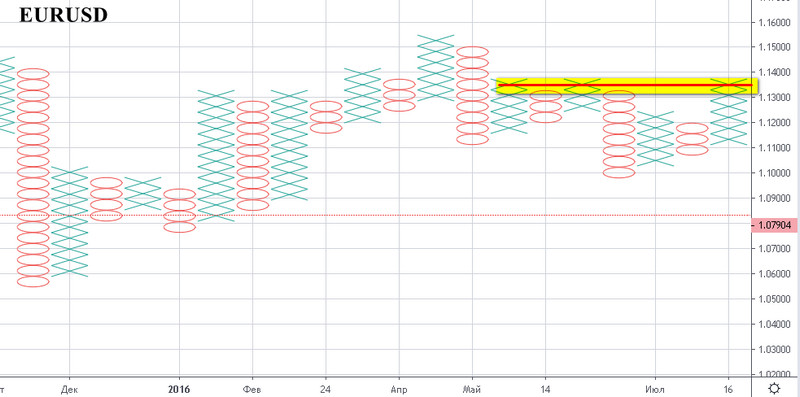
After determining the trend on the daily chart, we look at the global trend on DXY: from the start of the year to August 2016 shown on the chart, it is directed downward, which coincides with the future countertrend Short trade.
A Short trade is opened as soon as three signals coincide:
Richard Wyckoff's Countertrend Rule

The trade can be held until the chart moves into the accumulation zone in a medium-term strategy, and in the long-term version it can be held until the reverse trend found in the low-volatility interval is confirmed.
Short-term countertrend trades lasting no more than two daily candles are given by divergences of trends and volumes. Richard Wyckoff noted the "springboard" pattern, which consists of three consecutive declines in intraday turnover after a local peak.
Having determined the trend on three daily candles corresponding to the volumes, the trader can make trades in the opposite direction. The basic rules for such countertrend trades:
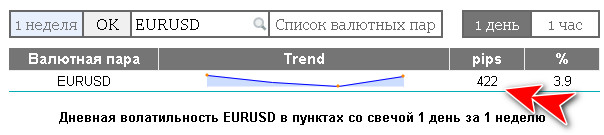
The position is closed with profit on the first candle, and if at a loss, it is held for one more day to close the trade at zero. After a two-day interval, the position is closed with a negative result without waiting for the stop-loss to trigger. It is considered equal to twice the average volatility size, which can be determined in the service on our site.
Richard Wyckoff advised using the "springboard" tactic in accumulation zones; at the distribution stage it is desirable to wait for a jump in volume and price in order to enter a medium-term position.
A trend in the classical definition of market theory is a sequential alternation of extremes (highs and lows). Upward direction indicates growth, and downward indicates decline, but only if the movement is confirmed by volume.
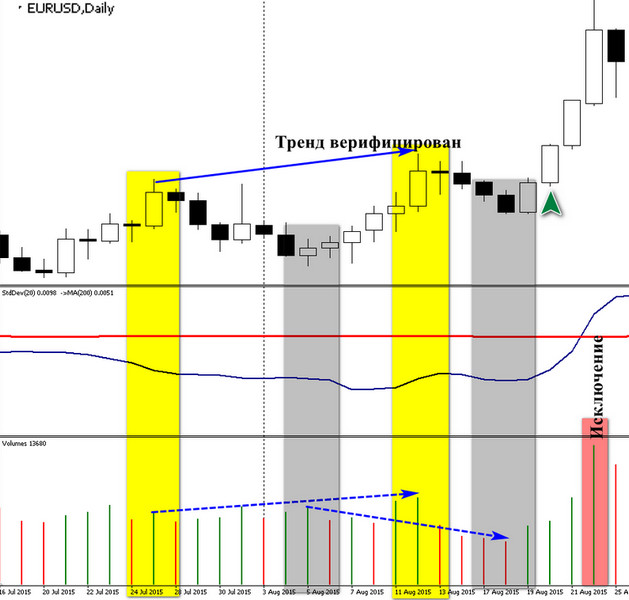
In a rising trend, Richard Wyckoff proposed comparing the volumes on the three candles of the new peak with the figures of the previous maximum. The trend was considered confirmed if the current figure was higher; then the trader received a signal to enter after a pullback, provided that the volumes of the lows were lower than the previous values of the analogous extreme.
Abnormally high volumes are excluded from the trend verification methodology: they signal a possible reversal of the tendency and are suitable for the countertrend medium-term trades described above.
In the case of determining a falling trend, high volumes must confirm new price lows, while the highs must correspond to trading turnover smaller than that of the analogous previous extreme value.
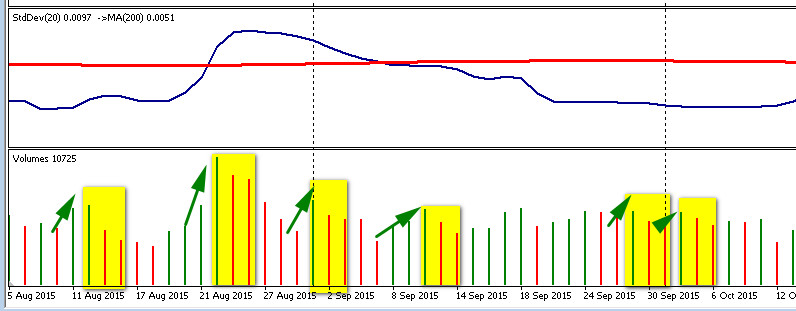
Having determined the trend on three daily candles corresponding to the volumes, the trader can make trades in the opposite direction. Basic rules for such countertrend trades:
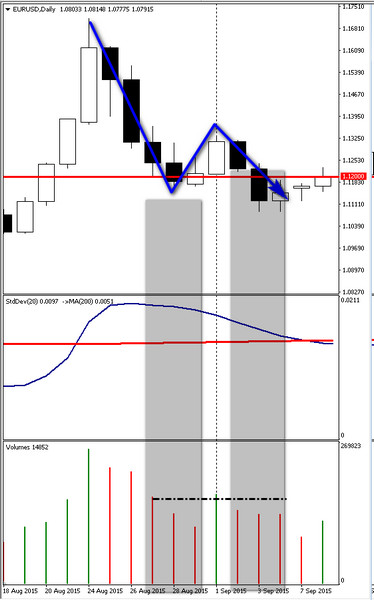
In the picture below, you can see how the retest of the 1,1200 level by the EURUSD pair passed on low volumes, which gives the trader an opportunity to understand that there will be a bounce.
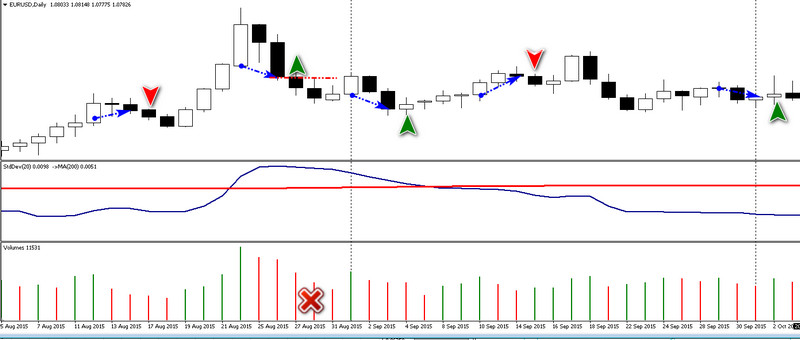
The bounce did not become the beginning of a local rising trend; the volume of the previous maximum exceeded the trading turnover at the new extreme. Exactly the same situation arose with the lows, indicating another false breakout of support. Wyckoff believed that such a situation was normal for the accumulation phase: large players often build a position during a flat period, holding the rate and "killing" local trends.
Trading with the trend

At the same time, volumes did not exceed twice the value calculated from the minimum intraday turnover registered in the accumulation zone. Richard Wyckoff believed that breakout confirmation was the ideal moment for entry on the next candle. The opening price of the previous candle acted as the stop-loss level.
In a growing trend, Richard Wyckoff suggested comparing the volumes on three candles of a new top with the indicators of the previous maximum. The trend was considered confirmed if the current indicator was higher - then the trader received an entry signal afterrollback, if the minimum volumes were lower than the previous values of a similar extremum.
VSA theory was created 30 years after Richard Wyckoff's death; the cycle of articles and books became the foundation for a rather extensive number of market analysis techniques and methods through the relationship between price change and trading volume.
Wyckoff traded more simply, without having the modern capabilities of automatic chart building, visualization of order volumes, or the use of indicators, as used by modern trading terminals. This did not prevent the trader from becoming a recognized master of forecasting, forced to abandon the publication of trading signals because of strong insider influence on the stock market.
False breakouts

Sincerely, Ivan Petrov
Tlap.io
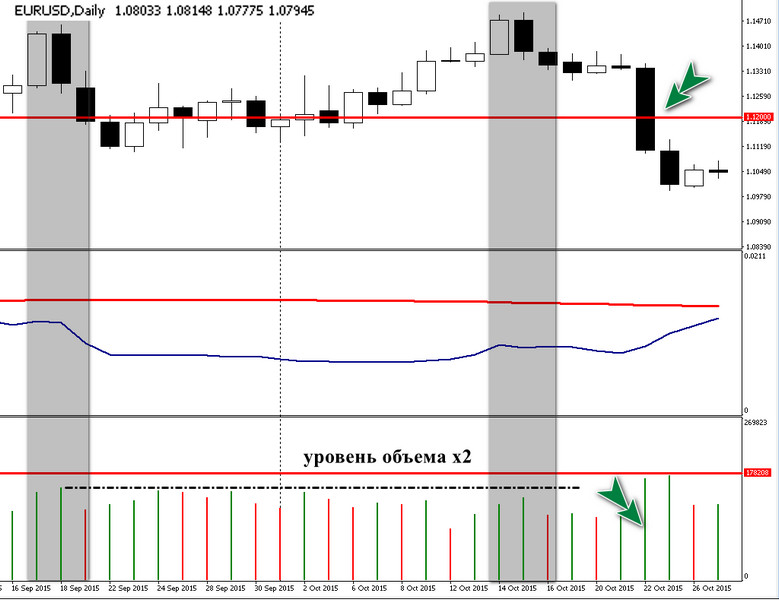
At the same time, the volumes did not exceed two times the value calculated from the minimum intraday turnover recorded in the accumulation zone. Richard Wyckoff believed that confirmation of the breakout was the ideal time to enter on the next candle. The opening price of the previous candle acted as a levelstop loss.
Conclusion

The VSA theory was created 30 years after the death of Richard Wyckoff; a series of articles and books became the basis for a fairly comprehensive number of techniques and techniques for analyzing the market through the relationship between price changes and trading volume.
Wyckoff traded more simply, not having the modern capabilities of automatic charting, visualization of order volumes, applicationindicatorshow they do itmodern trading terminals. This did not prevent the trader from becoming a recognized master of forecasts, forced to refuse to publish trading signals due to strong insider influence on the stock market.
The approaches of the founder of VSA, revealed in the article, are quite simple, effective and understandable evennewbie. The modern interpretation complicates or distorts the author’s ideas, which are worth getting to know better by studying the original books he published and a selection of original articles from his own journal.
Best regards, Ivan Petrov
Tlap.io