
Putting Together a Basket of Currencies on Forex
Hello, fellow traders!
On the market Forex there are no investors as a class due to the specifics of currency movements; this market differs from stocks and other commodity instruments in its volatility trends. Market assets are tied to capitalization, the success of companies, the value of physical goods, and money is an instrument with a very relative political value.
In today's material we will touch on a complex and interesting topic on independently compiling a basket of Forex currencies. Let's see how you can make money with it, and whether it is even possible to do it. In any case, one trader once succeeded. But let's talk about everything in order.

After the abolition of the Bretton Woods system, the exchange rate of any national currency is expressed in relation to the US dollar. The American currency that replaced the gold standard can hardly be called a standard; its value depends not only on the state of the world economy or politics Fed, but also from US President's mood, broadcast via Twitter.
With such exposure to external factors, currencies cannot have clear long-term trends, like stock indices, which are more resistant to political processes and verbal attacks. Any pair of currencies on Forex (in the numerator and denominator) is very dependent on government policy and on the state of the world economy as a whole.
This deprives foreign exchange traders of the opportunity to apply the Buy&Hold strategy - to buy and hold a currency pair, receiving a stable investment income without the need to make forecasts and change positions. In Forex, such consistency can only be ensured by a portfolio assembled from several currencies, which will ultimately increase the value of the basket.
Forex currency baskets
Currency baskets are a common institutional instrument of central banks and international financial organizations. The International Monetary Fund (the main developer of such systems) recommends:
- Dual-currency baskets as a reference point for the exchange rate of national currencies for central banks of developing countries;
- Multi-currency baskets with a set of major currencies to create gold and foreign exchange reserves;
- Credit baskets are special drawing rights (SDRs) to which loans issued to governments are tied.
Previously, SDRs consisted of three freely convertible currencies (yen, dollar, euro), but in 2015 a precedent occurred: the yuan, which will begin to circulate freely only in the coming years if the People's Bank of China agrees to it.
Another institutional benchmark is the WOCU index, owned by the World Bank. It includes the currencies of the G20 countries, an international alliance gaining weight amid globalization trends in the world economy.
Thanks to George Soros, the most famous basket of currencies has become the ECU. Compiled from the currencies of the first European Union states, it was used throughout the path to the single euro currency. The British bank incorrectly assessed the possibility of maintaining the pound exchange rate in a rigid peg to the German mark, for which it was punished by the financier, who became the first and only trader in history, defeating the Central Bank.
Another famous basket was dollar index DXY (USDX); There is a separate article on our website describing the use of this tool. Tied to major currencies in varying proportions, the index reflects the global strengthening or weakening of a world currency. Given the dollar's demand as a defensive instrument, the DXY basket is a measure of the positive and negative of international investors.
At the local level, various investment companies use their own indices, collected from currencies according to some uniform characteristic. For example, the currencies of developing countries allow one to maximize profits from speculation during the period of global economic growth, commodity currencies allow one to hedge the risks of fluctuations in energy prices, etc.
Why should a private investor collect a basket of currencies on Forex?

The main task of an investor is to find an asset with a long-term growing trend. This allows you to save from inflation capitals, increase the income received from another type of activity. If there is none, then investments raised in trust management can bring additional income, subject to a stable result.
Choosing one instrument will not solve the problem; as noted above, currency pairs differ from stock and commodity markets in their volatility trends.Trader must assemble a portfolio of several currencies that can compensate for periods of decline in one of the components in order to maintain an overall positive result.
This method is common in the stock market: examples of such assemblies are stock indices compiled from corporate shares, or ETFs using a mixed type of portfolio, including commodities and bonds.
Their own indices are created by both individual companies, for example, BlackRock, and private investors, among whom Warren Buffett is considered the most famous and successful.
There are no examples of long-term investment strategies in the foreign exchange market. This may be due to the relative youth of such financial instruments. Active currency trading began in the early 90s with the development of the Internet and the emergence of currency futures on the CME exchange in Chicago.
Problems of assembling your own currency index in the Forex market and ways to solve them

The algorithm for assembling a basket of currencies involves selecting a base currency that will be present in all pairs. A logical choice of the dollar will not provide long-term growing returns, since the frequency economic crises leads to large and long-term drawdowns that cannot be hedged with currency instruments.
Our goal is to consistently obtain percentage increase to deposit, distributed over various currency pairs, so we will abandon the base currency in favor of cross pairs.
This approach greatly simplifies the task of building your own index. Anyone trader It is quite easy to pair the national currencies of economically strong and weak regions. It is also possible to correctly combine the distinctive features of the economies of developed countries, ensuring the consistency of trends in cross-pairs.
Having decided on the components of the basket, you next need to place them on one chart, collecting instruments with aperiodic trends into the index.
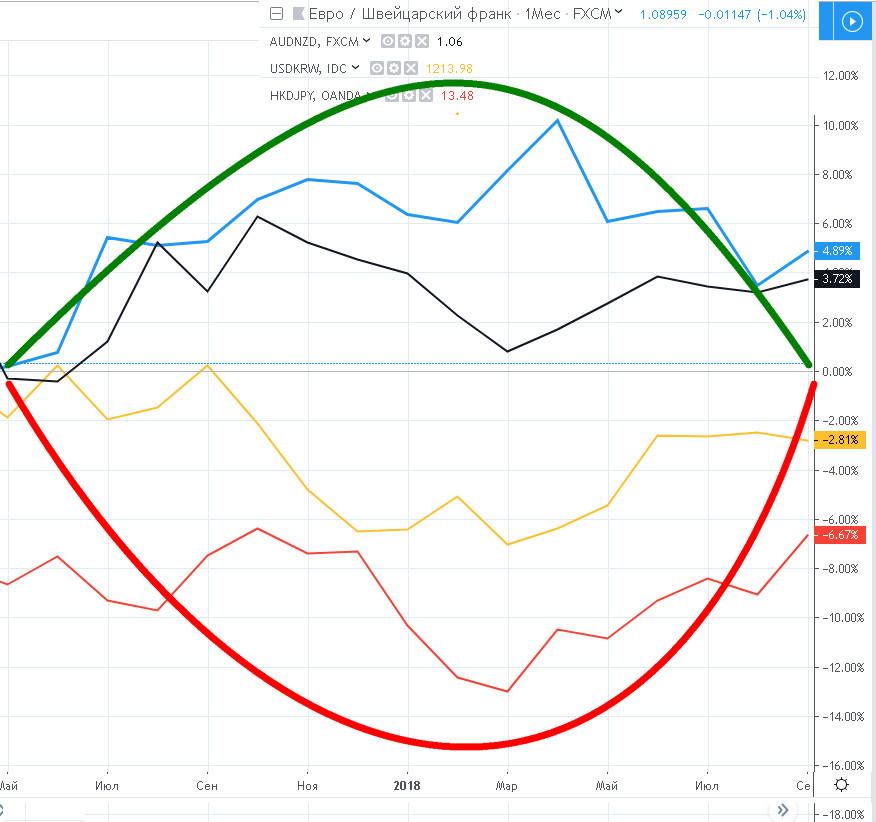
Example of assembling a cross-currency basket

The most popular and liquid currency after dollar USA– euro. We need to oppose it with a stronger currency that can give the pair a growing and long-term trend. It is quite easy to find in the same region.
Perfect for this role Swiss franc, a symbol of economic stability confirmed by reference to gold. The country is one of the world's leaders in precious metal exports. Until recently, the currency was strictly pegged to the euro, but in 2015, the Swiss Central Bank gave the foreign exchange market a post-New Year surprise by abandoning exchange rate calculations through the single currency in mid-January.
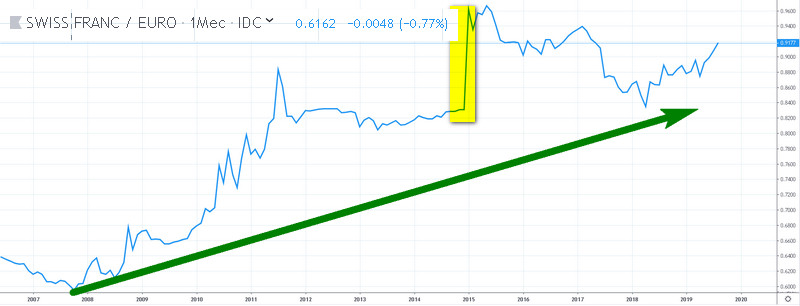
The changes have only strengthened the long-term upward trend, making the currency ideal for our purpose.
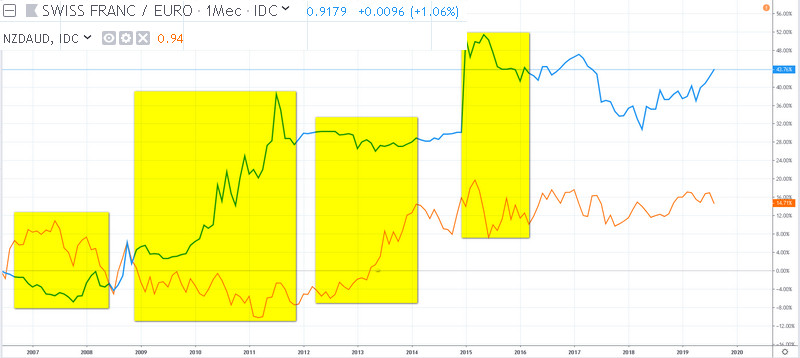
As can be seen from the above example, it is best to look for similar regional currencies, one of which has pronounced beneficial (export) features. In the Pacific region, such a cross pair will be NZDAUD.
Australia's economy is focused on raw materials, the demand for which is subject to cyclical fluctuations. New Zealand is a world leader in the supply of agricultural and livestock products, which generate stable income for the state and add weight to the national currency.
As can be seen from the chart, the new pair ideally complements the CHFEUR cross due to aperiodic sections that provide profit in segments of negative results for the franc and euro.
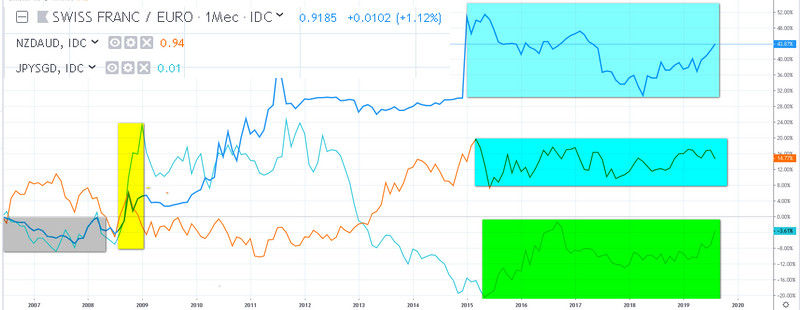
The third component of the basket is obvious - it is the cross pair JPYSGD and the Singaporean national currency paired with the dollar.
The Japanese yen is the reserve currency of the Asian region; it fits well into the created basket for the following reasons:
- Increases the profit of the simulated index in 2009, and the previous minus of 2008 can be removed by weighting coefficients, increasing the share of CHFEUR;
- Gives profit during a period of long flat of the previous two pairs.
The Singapore dollar is preferable to other options:
- The Hong Kong currency is actually a USDJPY pair due to its tight peg to the US dollar;
- The won of South Korea is a direct technological competitor to Japan, capable of competing for primacy.
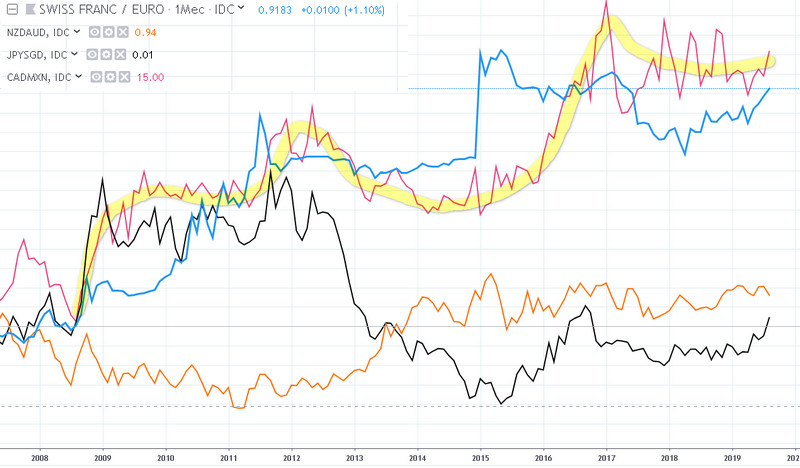
The fourth component of the portfolio we are forming will be the “overseas cross” - a link between the Canadian dollar and Mexican pesos. Both economic systems depend almost equally on the cost of raw materials, but the difference in political systems is obvious.
Mexico is a developing country with big internal problems, while Canada extracts raw materials in difficult climatic conditions, which forces the development of technology. Part of its national business has reached the international level; the state supports the development of innovation and strengthens the stability of the political system.
This is confirmed by the chart of the CADMXN currency pair:
Basket weightings and choice of leverage of currency pairs

In any index, there is a disproportionate distribution of shares between its components. A larger volume of funds is allocated to components with a strong trend, an increased investment allocation ratio is designed to most effectively maximize portfolio profits.
Volatile currency pairs receive the smallest share, so that in case of sharp drops in the exchange rate, the index continues to show a positive result. In our case, these are pairs with the yen and the Mexican peso; it is better to allocate a 15% share to them.
We will choose CHFEUR and NZDAUD as profit drivers, which will account for 35% each. All 4 currencies are included in the main ones, which ensures the liquidity of trading and the stability of rates from falls, which should be offset by the growth of other components of the index.
We will choose the level of leverage based on the maximum drawdown calculated over a historical period of 10 years. It is 20%, exactly the decline shown by the JPYSGD pair. Considering that the drawdown is compensated by the growth of the other components of the basket, we will choose leverage of 1 to 5, i.e. the account will be wiped out if all positions simultaneously fall by 20%.
Results of investing in a basket of cross-currencies

A basket of currencies is assembled to free the investor from the need to forecast the market. The assembled portfolio assumes the use of the Buy&Hold strategy (buy and hold).
The starting point for our self-made index was August 2006, the heyday of the Forex brokerage services market. If the trader had opened a PAMM account at that moment, then by today (2019) - over 13 years - the total investment result would have been 130% with a maximum drawdown of 11% (for the entire trading period).
If we apply the analysis algorithm to the results obtained PAMM accounts, used by the Alpari broker service, the investment portfolio with similar results would repeatedly occupy the first places in the top 10 rating.
A significant drawback of the assembled basket of currencies is the high negative swap structure, which forces the use of swap-free accounts. In this case, brokers do not include a rollover fee, applying fixed charges instead. The trader will have to give up about half the profit received from investing in the currency basket, otherwise the swap will absorb 100% of earnings in the long run.
Another way to avoid swaps is to buy currency offline and keep cash.
Conclusion

Index funds are a common type of investment in the stock and commodity markets. The advantage of this type of investment is obvious: the trader does not waste time on forecasts, adjusting only the weighting coefficients or formatting the composition of the basket.
This method can replace PAMM investing, reducing to zero the risks of the human factor - management errors, algorithm failures robot etc.
The article shows the result of thirteen years of trading, during which the strategy did not change. Long-term scalability is the most important property of a Forex currency basket.
Best regards, Ivan Petrov
Tlap.io