
Price Action: "Rails" Setup
 Hello, friends! We continue to explore the topic of Price Action. In addition to the main setups, which I classify as pin bars, engulfing pattern, inside bar and fakey, there are a number of secondary patterns. They are somewhat less strong, but they do occur on charts, and if there are reinforcing factors, such as support in the form of a level, they can certainly be traded. We will start with the pattern called "Rails".
Definition of the "Rails" Candlestick Pattern
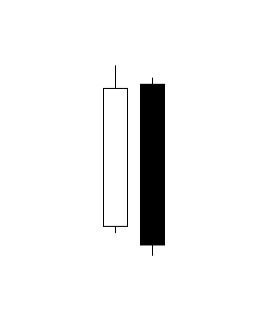 The “Rails” pattern consists of two large candles (they should stand out on the chart), pointing in opposite directions and with large bodies (70 percent or more of the entire candle). This setup indicates a change in market sentiment and is considered a reversal pattern.
Factors That Strengthen the Setup
- The presence of support in the form of a support / resistance level, Fibonacci, etc.
- The formation of the pattern at the end of a correction in the direction of the main trend.
- The size of the candles (the larger, the better)
Market Entry and Stop-Loss
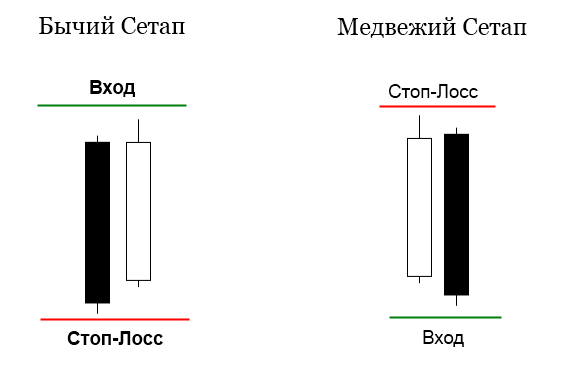
Entry into the market according to the rules of the “Rails” pattern is carried out using pending orders Buy Stop / Sell Stop, placed slightly below / above the extreme of the second candle.
We place the Stop-Loss above / below the opposite extreme (High or Low) of the first candle (or the second: we choose the High / Low point that is farther from the entry).
Exiting the Position
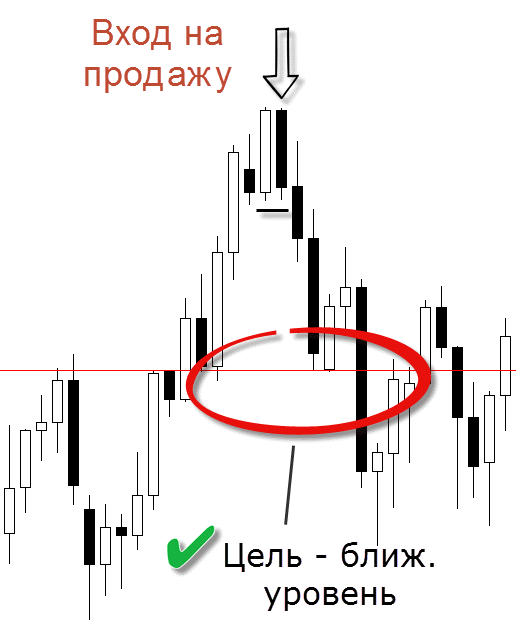
The “Rails” pattern, as a rule, points to a short-term impulse, which soon fades and turns into a flat, so it is not worth setting any large targets when entering the market on its basis. One exit option is the nearest support / resistance level, or a take-profit 1.5 times larger than the stop-loss.
Sincerely, Pavel
TradeLikeaPro.ru