
Oil Loses Its Risk Premium: Iran Talks and OPEC+ Pressure Brent

Introduction
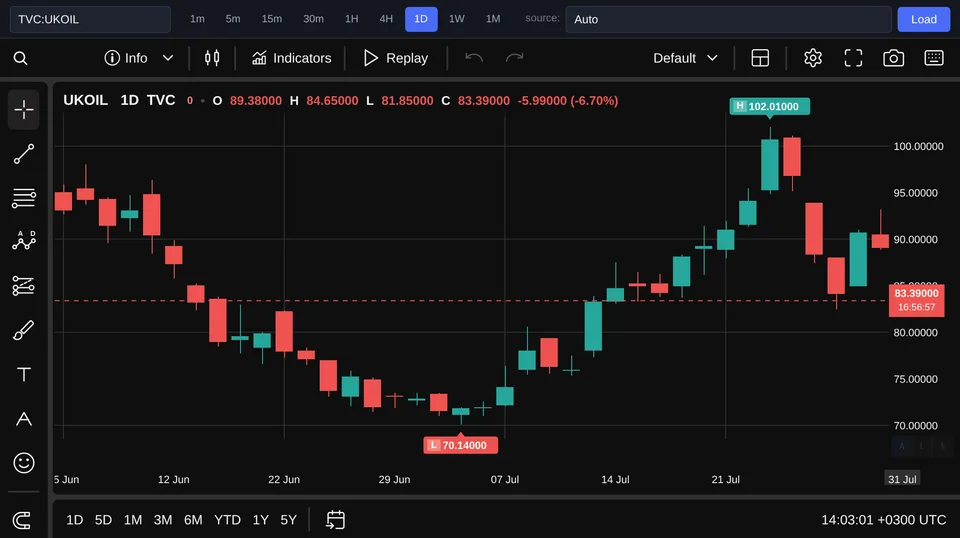
The oil market changed regimes in a single day: until recently traders were buying insurance against disruptions, and now they are checking whether they paid too generously for that insurance. Brent fell to 83.47 USD, losing -7.38% on the day, while WTI dropped to 79.42 USD with a daily change of -6.20%. This does not look like an ordinary technical drawdown: Donald Trump's signal about a possible resumption of talks with Iran, hopes for lower tension around the Strait of Hormuz, and OPEC+'s decision to increase output again from September all converged at one point.
🛢️ Brent and WTI Quickly Remove the War Premium
The sharp drop in oil shows how nervously the market reacts to any shift in the geopolitical scenario. Brent at 83.47 USD after a daily decline of -7.38% and WTI at 79.42 USD after a fall of -6.20% point not to light noise in the order book, but to a full repricing of the probability of a supply shortage. When even a partial hint of a diplomatic track appears, traders start removing part of the surcharge for possible disruptions from the price. The market is simultaneously removing the risk premium and asking whether quotes went too far on fear. Today oil looked like a cat that first arched its back and then pretended it was merely stretching. What matters is that the fall does not cancel the risk itself, but changes the price the market is willing to pay for it. If yesterday buyers were pricing in a harsher scenario, today they had to admit: without new confirmation of tension, holding the old premium is becoming harder.
🌍 Iran Talks and Hormuz Cool the Sharpest Fear
Trump's signal about the possibility of resuming talks with Iran is important not as a ready agreement, but as a change in the probability map. The oil market rarely waits for final signatures and seals: it moves the price in advance if it believes the worst logistics scenarios are becoming less likely. The Strait of Hormuz remains the key focus here, because a significant share of global oil flows passes through it. That is why even cautious hope for lower risk around the route quickly cools prices, especially if speculative positions had previously been built as protection against disruptions. For oil, a smaller perceived threat to transit almost immediately means a lower price for an emergency barrel. But this is precisely a perceived threat, not the final disappearance of the problem: talks may proceed unevenly, statements may change, and in such stories the market can turn faster than analysts manage to finish their coffee.
🏭 OPEC+ Adds a Second Blow to Buyers
OPEC+'s decision to raise output again from September became a second unpleasant factor for oil bulls on the same day. On the one hand, part of the fear of disruptions is being removed from prices; on the other, the prospect of additional barrels appears in a market where demand already needs careful checking against macro data. It is precisely this combination that makes the move in Brent and WTI look like a shift in the market scenario, not a random burst of volatility. The market is now pricing in not only a lower risk of disruptions, but also more supply from producers. For prices, this is a heavy mix: fewer reasons to pay for scarcity and more reasons to argue about the balance. The bearish scenario is simple: if the negotiation track holds, tension around routes eases, and OPEC+ really adds production from September, Brent may remain under pressure. This scenario will become especially sensitive in the case of weak data on industry, transport, or fuel consumption, because extra supply weighs on prices more easily when demand does not show strength.
📉 What Matters to Traders Now
The main debate now is not why oil fell: the set of reasons is fairly clear. Something else is much more important: how sustainable this fall will prove to be, and whether the de-escalation was priced in too quickly. If the market receives confirmation of diplomatic progress and actual production growth, pressure on Brent and WTI may persist. The bullish scenario cannot be written off either. Talks may stall, supply expectations may be revised, and any new alarming signals around logistics could bring the risk premium back faster than it disappeared. That is why oil sellers must not confuse the first impulse with a proven trend. For commodity currencies, inflation expectations, and the broader risk market, this move also matters. Cheaper oil can soften the inflation backdrop, but if the decline is based mainly on political expectations rather than a sustainable supply surplus, the reaction of related assets may prove unstable.
Conclusion
The day's outcome for the oil market looks fairly clear: Brent at 83.47 USD with a change of -7.38% and WTI at 79.42 USD with a change of -6.20% reflect a sharp repricing of the balance of expectations. Traders are simultaneously lowering the probability of acute logistics stress, accounting for the possibility of U.S.-Iran talks, and adding future OPEC+ output growth from September into the model. But a conclusion about a full trend reversal is still premature. The market needs confirmation on diplomacy, actual supply volumes, and demand dynamics. For now this is a release of price tension, not a guaranteed end to oil risk.