
Oil at the risk line: Brent and WTI choose between the geopolitics premium and demand fear

Introduction
The oil market today looks like a negotiating table where everyone is speaking at once: geopolitics demands a risk premium, macro statistics point back to demand, and traders try not to press one button too many. Brent and WTI are falling noticeably, although news on the Middle East, the Red Sea, and Iran still does not let sellers feel too free. The main intrigue of the day is simple and important: is the market really ready to break out of the range downward, or will it again stage a noisy reversal into a sideways channel.

🛢️ Brent at the edge of the range
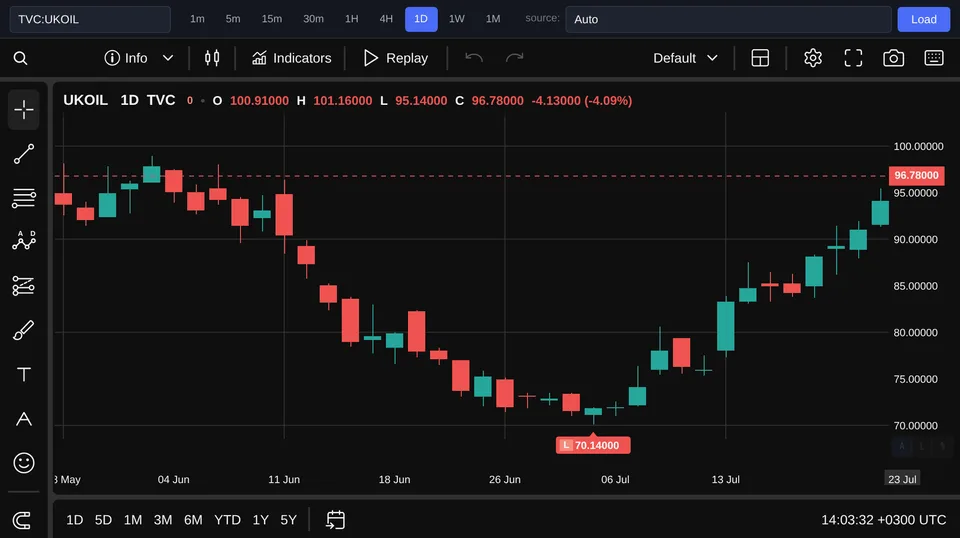
Brent is trading at 96.78 USD at the time of writing and is down -3.88% for the day. This is no longer the kind of drawdown that can be conveniently blamed on ordinary intraday turbulence: the move looks like a test of the lower boundary of current market sentiment. Brent at 96.78 USD is no longer just reacting to news, but testing buyers' patience. If the price settles below the familiar range, some short-term players may begin to see this as a signal to reconsider the bullish scenario. But while the market has not received final confirmation, declaring a full trend reversal would be too bold. The important detail is that the decline is not happening in a vacuum. The geopolitical premium remains in the price, but it has stopped automatically turning into a steady upward impulse. Buyers are ready to return on alarming headlines, but without new facts about supply disruptions their enthusiasm quickly becomes cautious.
🌊 The Red Sea and Iran keep the risk premium alive
News on the Red Sea and Iran remains one of the fastest triggers for oil quotes. Any hint of a threat to supply routes or of rising tension in the region can bring demand for futures back almost instantly, because the market remembers well how quickly logistics turns into a price factor. At the same time, the reaction has become more selective. Traders are no longer ready to pay extra for risk endlessly just because the background looks alarming: they need signs of real impact on supplies, freight, insurance, or crude availability. The market keeps one hand on the risk button, but with the other it is still scanning the demand table. The geopolitical premium is now working as insurance against a sudden shock, not as an independent engine of a rally. This means individual headlines can sharply support prices, but sustained growth needs a combination of actual disruptions, lower inventories, and confident consumption. Without that combination, every rebound risks quickly running into profit-taking.

📉 Demand cools the oil rally
WTI is trading at 89.31 USD and shows a daily decline of -3.12%, confirming that the pressure is not limited to one grade or to Brent's regional specifics. When both key benchmarks move down in sync, the market is usually talking not only about local news, but about a broader reassessment of the balance of expectations. The main counterweight to geopolitics now is doubt about demand. Weak macro statistics force market participants to ask an unpleasant but honest question: can major economies absorb high energy prices without a slowdown in consumption. If data on industry, transport, and inventories do not confirm strong demand, the oil rally starts to stall even against an alarming external backdrop. Until demand is confirmed by numbers, the geopolitical premium remains more like insurance than steady fuel for a rally. For traders, this means a stricter filter on buying: a news impulse alone is no longer enough; what matters is the price's ability to hold levels after the first reaction. Otherwise the market gets not a trend, but a short flash of volatility.

📊 What matters next for traders
The nearest technical question is whether oil will confirm a downside breakout from the range or quickly return to a sideways channel. If Brent starts to stabilize after falling to 96.78 USD, and WTI holds near 89.31 USD without further acceleration in selling, the market may again shift into news-waiting mode. If the pressure continues, sellers will get a stronger argument in favor of a change in the short-term picture. Several groups of signals are worth watching: reports on shipping and supplies through the Red Sea, news around Iran, inventory dynamics, refinery utilization, and fresh macro data from major consumer countries. The combination of factors is especially important: geopolitics can provide a quick impulse, but demand will determine whether that impulse can hold. For trading decisions now, the price reaction after the headline matters more than the headline itself. If the market stops rising on alarming news, this points to buyer fatigue. If even weak statistics do not break support, then the risk premium is still holding the lower boundary.
Conclusion
The day's result for oil cannot be reduced to a simple "bulls versus bears." Brent at 96.78 USD with a drop of -3.88% and WTI at 89.31 USD with a decline of -3.12% show that demand concerns are stronger today than the geopolitical premium. But risks around the Middle East, the Red Sea, and Iran remain close enough that the market cannot relax. The key reference point for the coming sessions is whether the downside exit from the range is confirmed or oil returns again to sideways movement after reassessing news and demand data.