
Oil’s Hormuz Risk Premium Meets the Fed Test
Tlapchik

Intro

🛢️ Hormuz Restores the Geopolitical Premium
The Strait of Hormuz matters because a substantial portion of internationally traded oil passes through this narrow maritime corridor. When reports point to rising tension involving Iran or tanker movements, buyers may pay more for prompt access to barrels, while refiners and trading firms reassess shipping schedules, insurance costs, and the reliability of deliveries. Prices can therefore respond before any physical disruption occurs, because markets trade probabilities as well as confirmed events. The current premium reflects an increased risk of interrupted supply, not proof that flows have already been materially reduced. That distinction is essential for investors. Headlines can lift prices rapidly, but a lasting move normally requires evidence such as delayed cargoes, restricted navigation, higher freight costs, changes in export volumes, or persistent precautionary demand from physical buyers. The premium can also fade if diplomatic signals improve or tankers continue moving normally. Geopolitical pricing behaves a little like an umbrella opened at the first dark cloud: sensible protection, certainly, but not confirmation that the storm has arrived. The durability of the rally will depend on observable conditions in the physical market.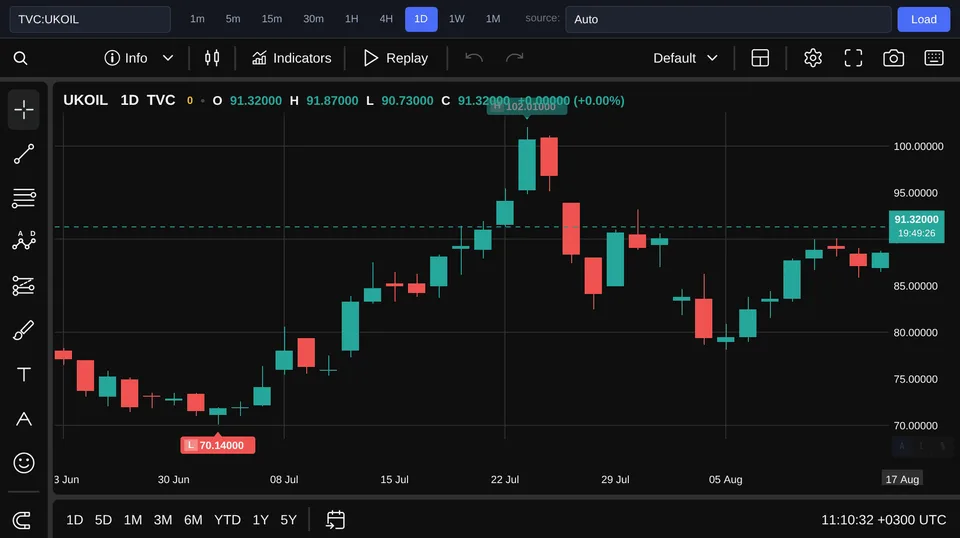
📊 Brent and WTI Are Sending Different Signals
At the time of writing, Brent is priced at 91.23 USD and has gained 0.40% during the day. WTI, meanwhile, is trading at 84.36 USD and has declined 0.17%. These precise moves do not support the claim that both benchmarks are surging together; instead, they show that the geopolitical premium is currently more visible in Brent. That pattern is economically plausible. Brent is the more direct reference for internationally traded seaborne crude, so risks affecting a major maritime route can influence it more immediately. WTI is strongly connected to conditions in the United States, including domestic supply, refinery demand, inventories, pipeline economics, and export capacity. Shared global concerns can move both contracts, but local fundamentals may alter the direction or scale of their daily response. The split between Brent and WTI argues against interpreting every security headline as a uniform oil-market shock. A widening or persistent divergence could indicate that traders see the risk as concentrated in overseas flows rather than in global crude availability as a whole. Conversely, a synchronized and sustained advance would suggest broader concern about supply, inflation, or demand for immediately deliverable barrels. For now, the market is repricing risk selectively rather than displaying clear panic.🏦 A Softer Fed Helps, but It Cannot Settle the Oil Debate
Expectations of easier Federal Reserve policy provide a potential counterweight to worries about expensive energy and weaker growth. Lower interest rates can support economic activity, improve financial conditions, soften the dollar, and encourage investors to hold commodities and other risk assets. Because crude is generally priced in dollars, a weaker US currency can also make oil less expensive for buyers using other currencies. Still, a softer Fed is not automatically bullish for every barrel. If rate cuts are expected because economic momentum is deteriorating, traders may focus on slower transport, industrial, and consumer demand instead of cheaper financing. Higher oil prices can also complicate the central bank’s task by adding to inflation pressures, potentially reducing its freedom to ease policy as quickly as markets hope. Monetary support can strengthen demand expectations, but it cannot remove a physical supply risk or guarantee consumption growth. Traders therefore need to examine why rate expectations are changing, not merely whether expected rates are moving lower. The strongest bullish combination would be resilient demand, easier financial conditions, and a persistent supply premium; weakness in any one of those pillars would make the price advance less secure.🔭 What the Barclays Scenario Actually Requires
Barclays sees Brent near 96 USD by the end of 2026 if negotiations remain deadlocked. That forecast should be read as a conditional scenario rather than a promised destination.Conclusion
The day’s oil picture is defined by two competing forces: concern about the security of supplies passing through the Strait of Hormuz and hope that softer Federal Reserve policy will support demand and financial conditions. Brent at 91.23 USD, up 0.40%, is carrying the clearer geopolitical signal, while WTI at 84.36 USD, down 0.17%, shows that the response is neither uniform nor unequivocally bullish. The next move should be judged through confirmed supply conditions, tanker and export activity, diplomatic signals, interest-rate expectations, and evidence of end-user demand. The Brent-WTI divergence indicates that the market has raised the price of risk, but has not yet shifted into an indiscriminate or panic-driven revaluation.#Strait of Hormuz oil risk#Iran oil risk#Brent oil price#WTI oil price#Brent forecast 2026