
Multi-Element Trading as the Key to Success
 Hello everyone. Traders around the world have been using multi-element trading for a long time. However, many do not use this tactic. And for nothing. This simple technique can be combined with practically any forex strategy, including Price Action, and significantly improve your trading results.
Multi-element trading has been used by traders around the world for a very long time. However, a great many people lose sight of this tactic and do not use it in their trading, which in my opinion is completely in vain.
This trading technique is universal and can be used on any timeframe (whether you trade intraday or on daily, weekly, or even monthly charts). This tactic can be applied with almost any trading system. And it is capable of improving it many times over.
What Is the Essence of Multi-Element Trading?
- We proceed from the assumption that we are wrong from the start and there is no trend, the market is simply correcting. Therefore we close the first position upon reaching a small profit.
- We hold the second order to catch a big move if it happens. After closing the first element, we move the second to breakeven or reduce its stop-loss.
So what is the essence of multi-element trading? Everything is very simple. By elements we mean separate orders, and in multi-element trading we simply enter a position not with one order, but with several, usually two. We proceed from the premise that we are wrong, that there will not be some strong move right now that we are hoping for, and the market will reverse fairly soon after our entry.
Therefore, we close the first order upon receiving some small profit and at the first signs of a possible reversal. In this way, we take part of the profit from the market and get a certain moral satisfaction. Then it is already easier for us to stay in the market, since only half of our full position remains. We leave the second order in case there is still a strong move in the market, and thanks to that order, we will catch this move.
At the same time, after our first order has reached the take-profit level, we move its stop-loss to breakeven, or greatly reduce the stop-loss of this order. Here everything depends on the specific strategy and on the specific case.
But in general, the point is to take part of the money right away, to receive a kind of advance, if compared with a salary at work. And leave the remaining part of the position in case some strong prolonged move suddenly occurs, and in that case there is a chance to get a profit 5-10 or even 20 times greater than the initial risk.
At the same time, after closing our first order, we move the stop-loss of the remainder of the position to breakeven, i.e. if the market really does reverse, we will lose nothing and will even remain in profit, since we closed the first half of the position after achieving some small profit.
Double Risk?
The risk with this kind of trading does not increase under any circumstances: we simply divide our position in half.
At first glance, it may seem that opening several elements, opening a position not with one but with two orders, is a risk twice as large as entering with one order. In fact, this is not so. We simply divide our position in half.
Suppose you want to enter the market with a lot size of 0.1. And instead of opening a position with a 0.1 lot, we open two orders with a 0.05 lot. That is, we simply divide our position in half.
If you cut a pie into two equal parts, the pie does not become smaller or larger because of it. Therefore, there can be no talk of any double risk in the case of multi-element trading.
Let's look at a few examples in practice. I will mark PriceAction patterns, but let me remind you once again that multi-element trading can be used with any strategy, whether it is based on indicators, on levels, graphical analysis, or something else. The tactic of entering the market with a position of several elements can be applied in any trading methodology.
So, here on the H4 chart of the euro/dollar pair we see this not very beautiful pin bar.
We scroll the chart a little further and see that the price had already bounced from this level, and very strongly. That is, despite the fact that the pin bar is not the most beautiful, we can quite well take it for entry into the market.
We placed a pending order slightly above the High of our pin. Everything as required by the pattern rules, and we placed our stop slightly below the tail of our pin bar.
And, suppose, we were going to enter the market with a 0.1 lot. But instead we open two orders of 0.05 lots each, which in total gives us the same 0.1, that is, the lot size with which we were going to enter initially. There is no difference in position size: whether we enter with one large order or with two small ones. If the stop-loss is triggered, the risk remains exactly the same. The stop-loss on both of our orders is the same.
As we can see, our pin bar is countertrend. And at the moment of opening the position there had already been a prolonged downward trend, so we understand that the trade is rather risky. Therefore, for our first order we should set an extremely conservative profit target, an extremely conservative exit point. We mark it at the level of the 21 moving average. Of course, at the moment of entering the position we could not know exactly where it would be in a few candles, so we mark it very approximately.
This is our take-profit for the first order. By means of our first order, we assume that we are most likely wrong. And if there is any movement, it will be quite small. After all, there could well have been a pullback to the average and a continuation of the downward movement, why not?
So, we set the take-profit for our first order. But we will not close the second, more long-term one at this level. For it, we make the assumption that we are still right, and that this movement will serve as the beginning of some prolonged trend. For it, we determine some more distant target. Let us say, this level
We can see that earlier the price repeatedly bounced off this level. And it is quite logical to assume it as a potential distant target for our second order. Of course, you could have set some closer level and some farther level. This depends specifically on your trading system and specifically on your view of the market.
Let us say we have determined a more long-term target for our entry, for our trade. And for the second order we set the take-profit at the level we marked earlier. So, after our pending order was activated, we see that the market is moving in our direction and touches our first take-profit at the level of the moving average with period 21. Part of our trade closes. And we exit it with some take-profit. In this case it came to 58 points. Our first order is closed.
We are left with a second order with a much higher take-profit. We leave it in case the market really has, as we think, reversed and will show us some serious movement. And in case we are still wrong and there will be no serious movement, we move our stop-loss to the trade's opening level. How?
We simply change it to the price at which our second order was opened. Our stop-loss becomes equal to the opening price of the position. And therefore, if the market suddenly decides to reverse, we will lose nothing on our second order. It will close with a profit of 0 points, while we will remain with the profit from the first order, in which, I remind you, we have already earned 58 points. That is, our second position becomes risk-free. And since it is risk-free, we leave it alone. The market makes some movements, corrections, but in general moves upward. We can also additionally enter the market on some other signals, where to collect more profit is up to you. We simply left the second trade alone, since it is more long-term for us, and the stop-loss has been moved to break-even, and we are no longer risking anything. And after some time our second order reaches our long-term take-profit. And in this trade, with our second order, we earn 235 points, while already having a profit of 58 points after the first take-profit was triggered.
As a result, in total we earned on the trade: 235 + 58 = 293 points
And if we had simply opened a position with one order and exited at the moving average level, we would have earned only 58 points. Agree, in the case of two orders, much greater profit potentially awaits us than with one.
Of course, there will be cases, and quite often, when the market will hit the stop-loss moved to break-even on our second position. But here again we lose nothing and remain with the profit from the first order. And the potential opportunity to get a much greater profit will always be present in trades with two orders. And in those cases when it works, those zero-result trades that you will periodically get on the second order will pay off handsomely.
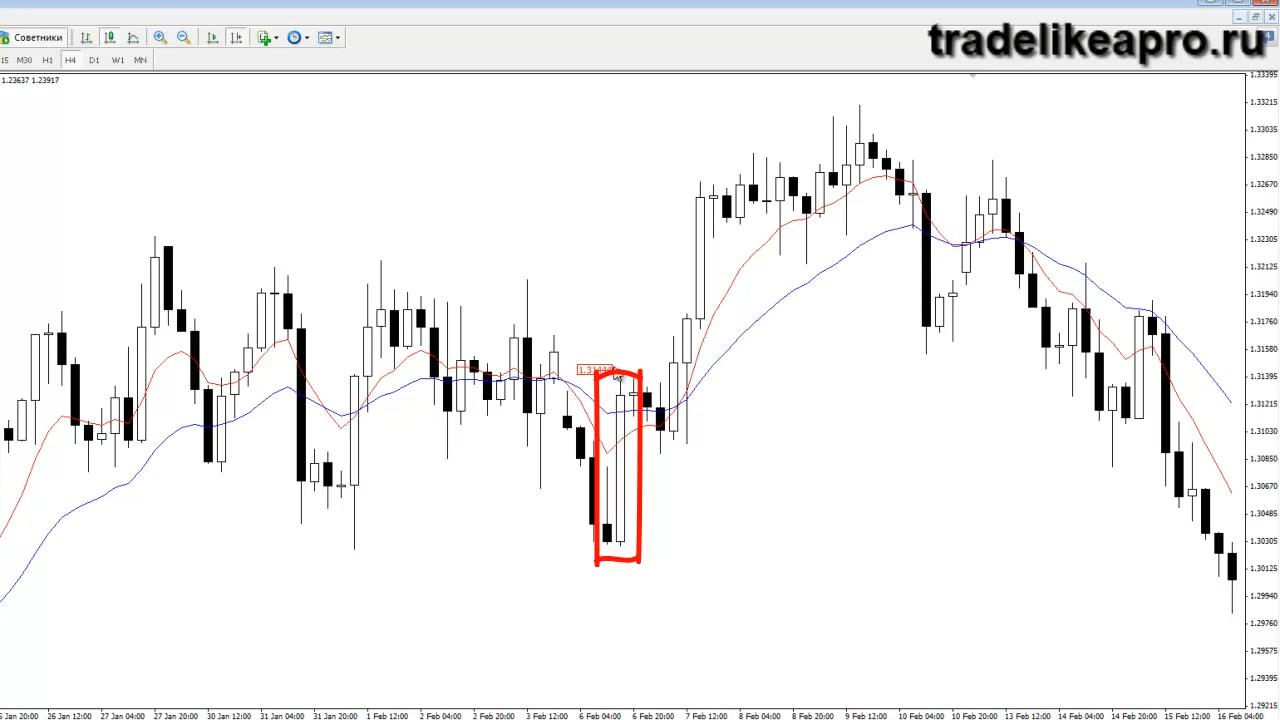
One more example. On the chart we see that an engulfing pattern is forming. Moreover, it breaks through our moving averages and has support. We enter our position with two pending orders, which we place slightly above the High of our engulfing pattern. For our first order, we try to determine a more conservative take-profit. To do this, we look at the nearest possible targets and see a level that stands out on the chart.
And for our second order we mark a more long-term take-profit. To do this, first of all, we zoom out the chart.
And we see such a distant level, which is perfectly suitable for our second order as a long-term target. And we mark it as the take-profit for our second order. Thus, the potential profit for the first order is 85 points, and for the second (if it still reaches our long-term target), the potential profit is 378 points. Thus, the total profit of the two orders, if our position is correct, can amount to almost 500 points (if both take-profits are triggered). Which, you must agree, is very, very good, considering that these are four-hour charts. And on daily charts, the profit from using two orders can be much greater.
So, after some time both of our pending orders were activated. We entered the market. And it went upward. The take-profit of the first position worked safely and with the first order we got a profit of 85 points. We still have the second order in the market with a take-profit of almost 400 points. But in case the market reverses and decides to go against us, we move the stop-loss of our second order to the break-even level. That is, to the price at which we entered the market. And we will no longer lose anything, but we have the potential opportunity to earn a great many points. Let us see what happens. The market still goes upward for some time, continues its movement, and then reverses, crosses the moving averages, goes lower and lower. In the end, it reaches our stop-loss and knocks it out.
It would seem that our trade failed. We earned nothing on it. But do not forget that with the first order we had already taken 85 points, while with the second order we could have earned either almost 400 points or 0. In this case, our idea with two orders gave us nothing in terms of big profit, but we still earned on it, even though the second order closed at break-even.
Recommendations:
- You can use multi-leg trading in any of your trading systems. It can be adapted to almost any strategy.
- It is quite possible to exit the market on the second order based on some other criteria; it is not necessary to focus on levels.
- If you trade intraday, you can close the second position at the end of the American session, when the market has already calmed down and no strong movements are expected before the London session.
- If you trade on daily charts, and by the end of the month you already have an impressive profit on the second order, then it is quite possible to close it before the first day of the next month.
In general, the target for the second order should be determined based on each trading system, but the essence remains the same. For the first order, we use a conservative nearby target, the probability of reaching which is very high. And for the second order, we use a more long-term, higher take-profit that, if the price still reaches it, will give us an impressive profit. And at the same time, we move the stop-loss of our second order to break-even after the take-profit of the first one is triggered, so that if the market goes against us, we lose nothing.
Sincerely, Pavel TradeLikeaPro.ru