
MOEX Under Pressure Again: Market Takes Profit and Waits for Ruble Signals

Introduction
The end of July for the Russian market came without panic, but also without fanfare: after the previous rebound, the Moscow Exchange Index again came under pressure. Investors began taking profits, no new strong reasons for buying appeared, and the external backdrop is in no hurry to give the market a convenient cushion. Today the focus is on oil below $90, sanctions uncertainty, NLMK reports, expectations for Norilsk Nickel, and the ruble, which for now is holding up better than the mood in equities.
📉 Moscow Exchange: the rebound meets profit taking
The main story of the day is the return of caution after the recent rebound. When the market has already given traders a chance to make money, and no new drivers for continued growth have appeared, profit taking becomes an almost natural move. The decline in the Moscow Exchange Index now looks less like a new collapse and more like a test of the strength of the previous recovery. Buyers have a harder time in this environment: individual stocks may look interesting, but one impulse is no longer enough. For sustainable growth, the market needs confirmation in the form of strong reporting, a clear dividend picture, commodity support, or an improvement in the external backdrop. For now, the market has carefully stepped onto the ice, heard the crack, and taken a step back without extra drama. The sanctions backdrop adds caution even without one bright negative event. Uncertainty in itself raises the required risk premium, which means investors react faster to weak signals and are more willing to lock in profits after short rises. The index remains fragile precisely because it has little fresh fuel to continue growing.
🛢️ Oil below $90: not a catastrophe, but less support
Oil below $90 per barrel matters for the Russian market not as a separate scare story, but as a weakening of one of the basic arguments in favor of broad buying. For exporters, the budget, and expectations for the ruble, commodity prices remain a key benchmark. When oil does not help, investors become more selective and less willing to buy the whole index in one move. This backdrop is especially sensitive at a moment when there are also few domestic drivers. If the commodity market does not provide confident support, more weight falls on corporate stories, reporting, and forecasts for individual issuers. In practice, oil below $90 shifts the market from a general bet on growth into a mode of careful stock selection. For traders, this means increased sensitivity of oil and gas and metallurgical companies to any changes in expectations for commodities, currency, and export margins. At the same time, the importance of the budget rule and the parameters of foreign exchange operations is growing, because they can affect short-term sentiment on the ruble. In such an environment, hopes without numbers quickly grow thin, like a patty under Tlapchik's close stare.
🏭 NLMK and Norilsk Nickel: corporate facts matter more than general noise
The corporate block comes to the fore today because the market needs not slogans, but proof. NLMK's reporting is important for assessing margins, domestic demand, export opportunities, and potential room for dividends. For steelmakers, this is not just a look at the past period, but a test of their ability to protect profit in a less comfortable macro environment. Norilsk Nickel remains a separate benchmark for the entire commodity and metals segment. Investors look at forecasts for the company through metal prices, production expectations, logistics, sanctions sensitivity, and cash flow prospects. Even neutral comments can strongly affect sentiment if the market is already in a defensive position. The general conclusion on corporate stories is simple: the direction of the index now depends increasingly on specific reports, not on one big idea about the market. Strong numbers may hold back sellers, but weak or vague signals will strengthen the desire to reduce risk. In this phase, companies have to bring real indicators to the table, because the market's patience is not unlimited.
💱 Ruble and budget rule: USD/RUB at 79.18 waits for August
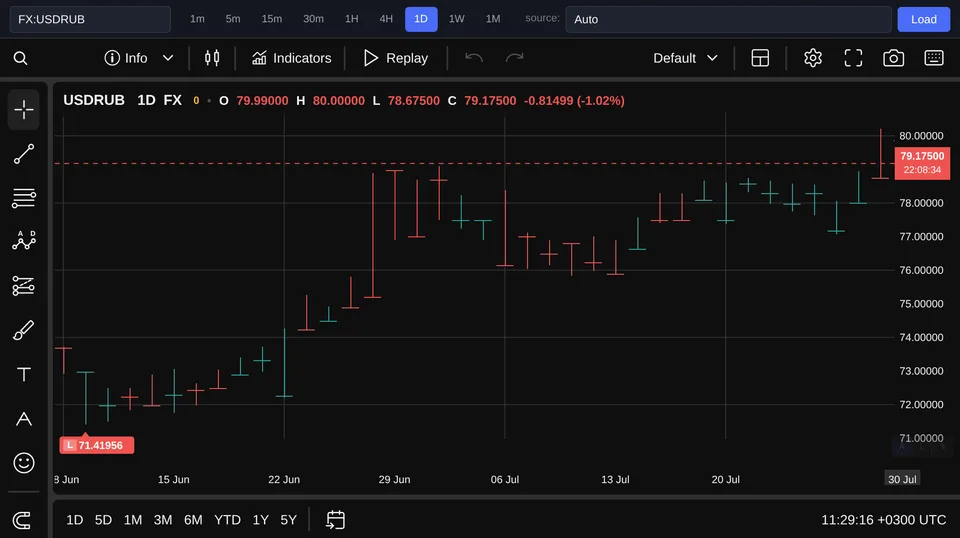
The ruble today does not look like a source of panic, but it remains an important part of the overall picture. At the time of writing, the USD/RUB pair is at 79.18 RUB, with the daily change at -0.84%. This means the ruble is strengthening in the current session, but the market is not yet rushing to draw far-reaching conclusions before the budget rule parameters for August are announced. For equities, the exchange rate matters through several channels at once: exporters' revenue, inflation expectations, rate forecasts, and investors' general attitude toward risk. A stronger ruble can pressure the ruble revenues of some exporters, while a noticeable weakening of the currency could revive inflation concerns. Therefore the current 79.18 RUB and the daily move of -0.84% look more like a calm currency signal against the backdrop of a more nervous equity market. The budget rule parameters are becoming the next benchmark, because they may influence expectations for currency operations and liquidity. Until these details appear, market participants will probably be more cautious with large bets on one ruble scenario. The practical conclusion: the currency market is now waiting not only for headlines, but also for specific decisions for August.
Conclusion
The day's result is cautious but not dramatic: the Moscow Exchange Index is under pressure again because the previous rebound did not receive enough fresh support. Oil below $90, sanctions uncertainty, and a selective corporate agenda are keeping investors from broad risk appetite. Going forward, the key benchmarks remain NLMK's reporting, forecasts for Norilsk Nickel, and the ruble: USD/RUB at 79.18 RUB with a daily change of -0.84% shows that the currency is still calmer than the equity market, but the final short-term tone may be set by the budget rule parameters for August.