
MOEX Rallied Over the Week, but the Ruble Complicated the Picture for the RTS

Introduction

The Russian market ended the week with a result that changes noticeably depending on the benchmark chosen. The MOEX Index gained 2.5%, although by the evening of August 7 it had retreated to around 2280 points due to profit-taking. The RTS Index fell 0.9% over the same period: the ruble’s earlier weakening reduced the dollar value of Russian stocks even as their ruble prices remained positive. Attention is now shifting from the weekly gain itself to its sustainability. To continue moving, the market needs not only an absence of new sellers but also fresh demand capable of keeping the index within the 2200–2300-point range. Its possible sources remain dividend liquidity and favorable oil conditions, while the ruble exchange rate is the main variable.
📈 A Positive Week With a Cautious Finish
The MOEX Index’s weekly gain of 2.5% confirms that demand for Russian stocks persisted. However, the evening pullback to 2280 points shows that after the rise, some participants preferred to take profits rather than continue buying at higher prices. The market remained positive for the week, but buyers became noticeably more selective near the upper boundary of the current range. Profit-taking does not in itself mean a downward reversal. After a rapid move, it allows short-term positions to be closed and tests whether new demand will emerge at lower levels. A different picture would be a negative signal: selling on every approach to 2300 points, declining activity, and a lack of corporate or macroeconomic reasons to buy. In the coming sessions, not only the index level but also the breadth of the advance matters. If the rise is driven by a few heavyweight stocks, the sustainability of the whole market remains limited;.
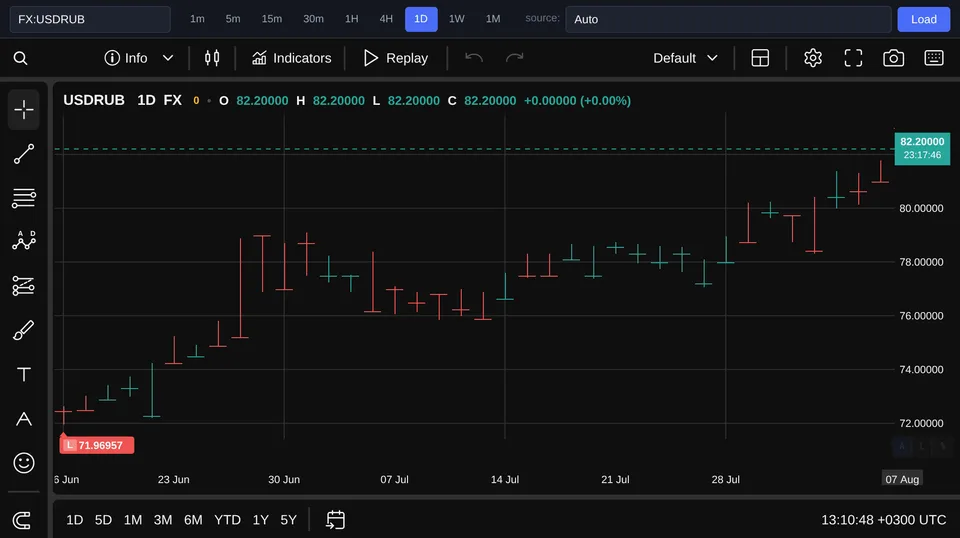
💱 Why MOEX Rose While the RTS Fell
The divergence between the indices is primarily related to their calculation currencies. The MOEX Index reflects stock values in rubles, while the RTS converts a basket with a similar composition into dollars. Therefore, a weakening Russian currency can leave the ruble-denominated indicator positive while simultaneously worsening the dollar index’s result. This mechanism helped produce the RTS decline of 0.9% as the MOEX Index gained 2.5% for the week. During the period under review, the official dollar exchange rate rose by 2.7 rubles, intensifying the negative effect of currency revaluation. This does not mean that investors assessed the same companies in diametrically different ways: part of the divergence arose when ruble-denominated market capitalization was converted into dollars. At the time of writing, USD/RUB stands at 82.20 rubles and is down 0.96% for the day, meaning the ruble is strengthening locally. The daily USD/RUB decline of 0.96% reduces the current pressure on the RTS but does not eliminate it.
💰 Dividend Cash as a Source of Demand
Paid dividends may become one of the market’s main sources of domestic support. After the money reaches their accounts, investors may direct some of it back into stocks—both former dividend leaders and companies with attractive valuations or anticipated future payouts. In a market where domestic participants generate a significant share of marginal demand, such cash flow is indeed noticeable. However, dividend liquidity does not return to the exchange automatically or all at once. Capital owners may keep the funds in cash, choose bonds, or concentrate purchases in a small number of the most liquid stocks. Dividend support is real, but its strength depends on the share of payouts reinvested and how demand is distributed among companies. For the index, whether purchases are broad-based is crucial. Reinvestment in only a few major issuers may support the indicator itself but will not confirm.
🛢️ Oil and a Test of the 2200–2300-Point Range
Expensive oil remains a potential source of market support because energy companies carry significant weight in Russian indices. Favorable commodity conditions improve expectations for exporters’ revenue and cash flows and also support the external balance. But the relationship is not mechanical: the outcome for shareholders also depends on the ruble exchange rate, taxes, costs, production volumes, and dividend policy. The 2200–2300-point range is becoming a practical map for the next trading sessions. Holding above 2200 points would preserve the structure of the recent recovery, while a sustained move beyond 2300 would require renewed active buying. The mere disappearance of sellers is insufficient for a full breakout: the market will need turnover, broad demand, and a clear new reason to raise valuations. Expensive oil and reinvested dividends can keep the index within the 2200–2300-point range, but a move higher requires more.
Conclusion
The week confirmed the presence of demand for Russian stocks but did not produce equally strong results across all measurement systems. The MOEX Index’s 2.5% gain and its pullback to 2280 points combine positive weekly momentum with increased caution, while the RTS decline of 0.9% underscores the impact of currency revaluation. The current USD/RUB level of 82.20 rubles, with a daily decline of 0.96%, provides short-term relief, although the ruble’s stability must be confirmed in subsequent sessions. The market’s ability to remain within the 2200–2300-point range will be determined by the volume of reinvested dividends, oil-market conditions, the breadth of buying, and currency dynamics. For now, consolidation within this corridor appears more justified than either an immediate confident breakout or a sharp collapse of support.