
MOEX Near Two-Year Lows: Buy the Easing Rumor or Wait for Evidence?

Intro

The MOEX Russia Index has returned to the 2,060–2,070 area, close to its lowest levels in roughly two years, after losing about 7% over the past month. That decline leaves investors facing an awkward choice: buy depressed equities while reports of direct Russia–US contacts support hopes of geopolitical easing, or wait until sanctions, oil, and the currency stop arguing with the optimistic narrative. The market has heard a potentially encouraging knock at the door, but it has not yet seen the visitor’s documents.
📉 What the decline is actually pricing in
The slide toward 2,060–2,070 points is not merely a verdict on one diplomatic headline. Russian equities are carrying several overlapping discounts: sanctions constrain access to capital and technology, oil uncertainty clouds export revenues, high required returns reduce acceptable valuations, and domestic investors have limited alternatives for sharing risk with foreign capital. A market near a two-year low is cheap for reasons that remain economically relevant. A monthly loss of about 7% also changes market mechanics. Some investors see attractive entry levels, while others reduce exposure because a falling trend can trigger further defensive selling and discourage buyers who prefer confirmation. Low valuations can support a sharp rebound, but they do not provide a timetable; an asset may remain inexpensive while uncertainty continues to dominate earnings expectations and risk premiums. The important distinction is between bad news already reflected in prices and risks that can still worsen. If sanctions remain stable, oil avoids a deeper decline, and the domestic backdrop does not deteriorate, current levels may contain a meaningful cushion. If any of those assumptions fail, the apparent discount can prove less generous than it first appears.
🤝 Why direct contacts matter—and why they are not enough
Reports of direct Russia–US contacts matter because markets price expected changes before official policy catches up. Even a modest reduction in the probability of further restrictions can lower the geopolitical premium demanded by investors, helping shares recover without an immediate improvement in corporate earnings. The most sensitive companies may move first, especially where sanctions, settlement constraints, or access to foreign markets have produced an unusually large valuation discount. That is the constructive case for buying the rumor. When positioning is cautious and prices are already depressed, a small improvement in expectations can generate a disproportionate rebound as short-term sellers retreat and sidelined capital returns. Geopolitical easing has option value because the upside from credible progress may be larger than the market’s initial reaction. However, direct communication is a channel, not an agreement. It does not automatically remove sanctions, restore cross-border investment, improve payment infrastructure, or change companies’ cash flows. Markets are fond of turning a diplomatic comma into an entire chapter, so investors should separate confirmation that talks occurred from evidence that they produced enforceable economic consequences. Until policy changes become specific, the easing thesis remains a probability rather than a new fundamental baseline.
💱 The ruble is sending a less comforting signal
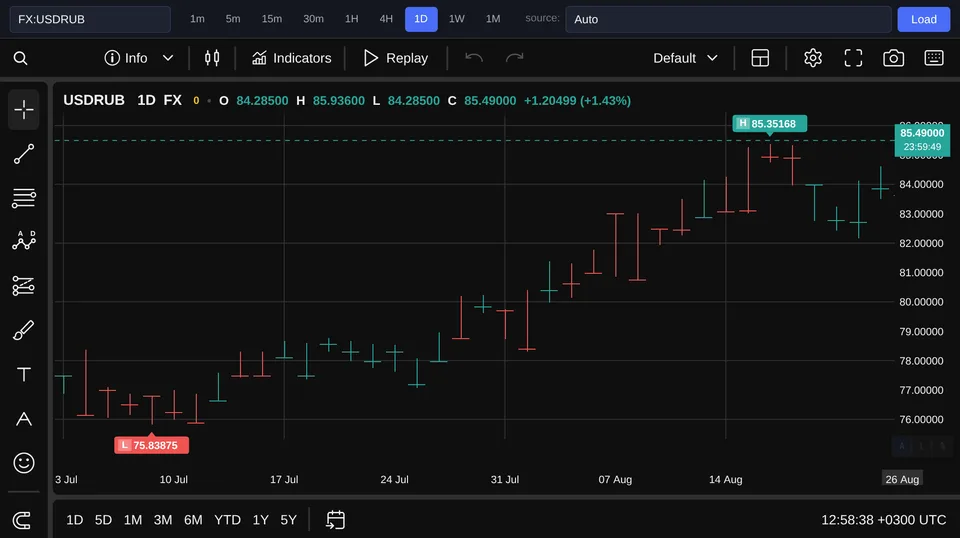
The currency market currently offers an important counterweight to the optimistic interpretation. USD/RUB stands at 85.49 rubles, up 2.20% for the day, meaning the ruble has weakened even as discussion of possible geopolitical easing remains active. A 2.20% daily rise in USD/RUB shows that demand for protection and caution has not disappeared. A weaker ruble has mixed effects on listed companies. Exporters may receive more rubles for foreign-currency revenue, which can support reported income, but the benefit depends on commodity prices, taxes, operating costs, and the ability to repatriate earnings. Import-dependent businesses face more expensive equipment and inputs, while households may encounter renewed price pressure that weighs on consumption. Currency weakness can also complicate expectations for interest rates. If depreciation contributes to inflation risks, monetary conditions may need to remain restrictive for longer, increasing the discount rate applied to future corporate profits and making bonds or deposits more competitive with equities. For the broad index, ruble weakness is therefore not a simple bullish gift to exporters; it can reinforce the valuation pressure affecting the rest of the market.
🔎 What would turn the rumor into an investment thesis
The first confirmation should come from diplomacy itself: concrete arrangements, a visible timetable, or official language that narrows uncertainty rather than merely acknowledging communication.
Conclusion
The MOEX Russia Index near 2,060–2,070 points offers genuine recovery potential, but the fundamental case has not yet caught up with the diplomatic speculation. Direct Russia–US contacts could reduce the geopolitical premium, yet persistent sanctions, uncertain oil conditions, and USD/RUB at 85.49 after a 2.20% daily rise argue for discipline. For now, geopolitical easing is best treated as an option with meaningful upside, not as the base scenario. Investors who buy early should use measured exposure and tolerate volatility; those seeking confirmation should watch for specific agreements, practical sanctions changes, a steadier ruble, supportive oil dynamics, and broader participation in an equity recovery.