
MOEX Near 2,110: Why Record Dividends Cannot Erase the Risk Discount

Intro

The MOEX Russia Index slipped toward 2,110 points on August 21 and remained far below its level a year earlier. That weakness may look surprising after Sberbank distributed record dividends, giving investors fresh cash that could potentially return to equities. Yet the day’s trading showed that domestic liquidity is only one part of the valuation equation: oil, sanctions, currency movements, and the required premium for uncertainty still carry more weight.
💰 Dividends Provide Support, Not a New Market Cycle
Sberbank’s record payout created a meaningful pool of liquidity, and some of that money can return to shares through reinvestment. This mechanism supports demand because shareholders who want to maintain equity exposure must decide where to place the cash they have received. Banks, energy companies, and other established dividend names are natural candidates, especially for investors seeking income rather than rapid price appreciation. The effect, however, is neither immediate nor uniform. Some recipients withdraw the money, use it to meet other obligations, or move it into deposits and bonds when their risk-adjusted yields appear more attractive. Institutional portfolios may also reinvest gradually instead of buying on a single day, which spreads the impact over several trading sessions and makes it less visible in the headline index. Dividend liquidity can cushion demand, but it does not cancel the sanctions discount embedded in Russian equity valuations. Dividends are useful fuel, but the market is a heavy vehicle carrying quite a bit of macroeconomic luggage. Without a broader improvement in expected earnings and perceived risk, even an unusually large payment is more likely to establish a floor under selected stocks than launch the whole index into a durable rally.
🛢️ Oil and Export Earnings Remain the Main Transmission Channel
The MOEX index is heavily influenced by companies whose cash flows depend directly or indirectly on commodity exports. Oil therefore matters not only through the spot price but also through export volumes, logistics costs, discounts, taxation, and the exchange rate at which foreign revenue becomes rubles. A stable commodity quotation can coexist with weaker corporate economics if transportation, settlement, or market-access costs rise. This explains why investors are reluctant to treat dividend inflows as a sufficient bullish signal. Current distributions are based mainly on profits already earned, while share prices reflect expectations for future cash flows. If the market sees uncertainty around energy demand, export routes, or realized prices, it can accept a generous historical payout while simultaneously assigning a lower multiple to the next reporting periods. For the index to recover sustainably, investors need evidence that exporters can defend margins and cash generation, not merely confirmation that past profits were strong. Corporate reports will therefore matter more than broad reassurance. Revenue quality, operating costs, capital expenditure, free cash flow, and management guidance can show whether the sector is absorbing external pressure or simply postponing its financial effect.
🛡️ New European Measures Keep the Risk Premium Elevated
The latest European restrictions target Russian energy flows, financial services, and crypto-related infrastructure. For the stock market, their importance lies less in the announcement itself than in the additional uncertainty they introduce into payments, counterparties, logistics, and access to external infrastructure.
💱 A Stronger Ruble Sends a Mixed Signal to MOEX
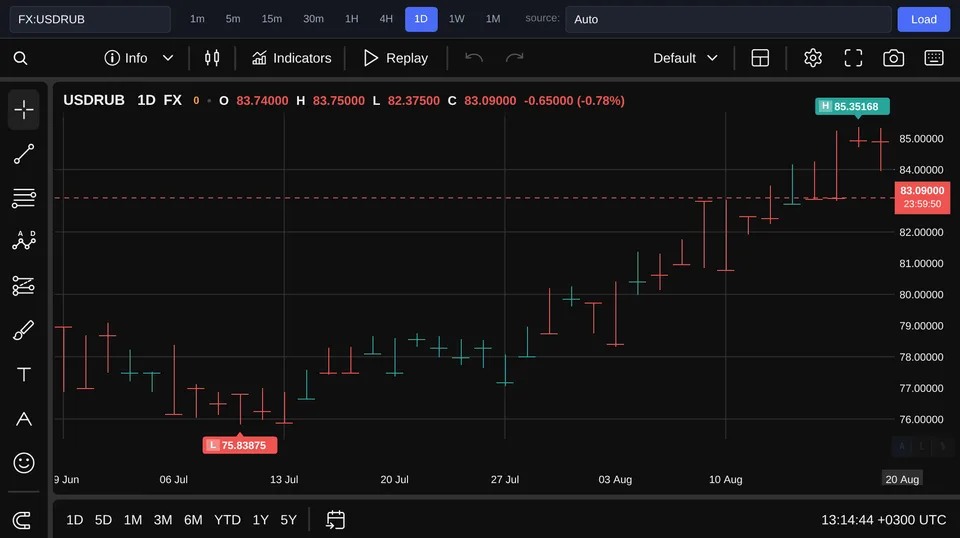
The currency market added another layer to the day’s cautious tone. USD/RUB stood at 83.09 RUB, with the pair down 1.08% for the day, meaning that the ruble strengthened against the dollar. For households and domestically oriented businesses, a firmer currency can ease inflation concerns by reducing the ruble cost of imported goods and equipment, although the eventual effect depends on how long the move lasts. For major exporters inside the MOEX index, the interpretation is less comfortable. Dollar-denominated revenue converts into fewer rubles when the domestic currency strengthens, all else being equal. Costs, taxes, and dividends are often substantially ruble-based, so the translation effect can narrow reported margins or reduce the ruble value of cash generation even if foreign-currency sales remain unchanged. The actual impact varies by company because exporters use different pricing arrangements, hedging policies, tax structures, and mixes of domestic and foreign expenses. A one-day currency move also cannot establish a lasting earnings trend. Even so, it changes the short-term balance of expectations: the stronger ruble may improve the broader macroeconomic mood while limiting upgrades to forecasts for export-heavy index constituents. With USD/RUB at 83.09 RUB after a daily decline of 1.08%, currency strength is a mixed input for MOEX rather than an automatically positive signal.
Conclusion
The market’s weakness near 2,110 points reflects a contest between tangible domestic support and a persistent external risk premium. Record Sberbank dividends can sustain selective demand, but they cannot by themselves resolve uncertainty around energy earnings, settlement channels, sanctions, or the ruble translation of exporters’ revenue. A credible recovery would require several factors to align: a more supportive oil backdrop, evidence that companies are preserving margins and free cash flow, and lower uncertainty around trade and financial infrastructure. Until corporate results confirm that combination, dividend reinvestment is more likely to soften market pressure than redefine the trend.