
Position Locking vs Stop Loss: Which Risk Management Works Better?

Hello, fellow Forex traders! Today I would like to touch upon a topic that you often ask me to talk about. Namely, position locking in Forex. In brief, locking allows you to avoid losing trades. That is, you will be able to open 100% profitable trades with your strategy. In theory.
In practice, as you have probably guessed, there are many pitfalls. So, in this article we will discuss: what is locking positions on the currency market, pros and cons of this approach, how and when it can be used, what to pay attention to, as well as various tactics of working with "locks" (blocked orders).
What is locking?
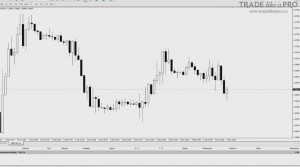
Above is a chart with the GPBUSD currency pair open. The timeframe is H1, that is, it is an hourly chart.
Let's try to sell:
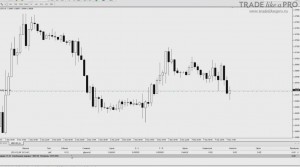
We sell 0.1 lots. Some time passes and the price goes up. At this point, our position is at about 12 pips of loss:
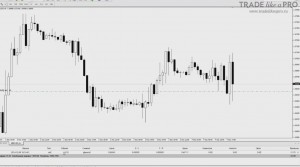
Let's now open a buy trade at the current price with the same lot:
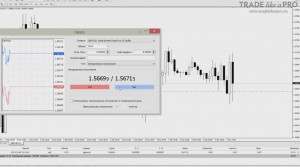
A buy trade is opened with a lot of 0.1:
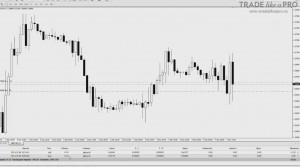
At this moment we have 2 trades at the same time. One deal to sell with lot 0.1 and one deal to buy with the same lot, but at different prices. The distance between our positions is about 12 pips:
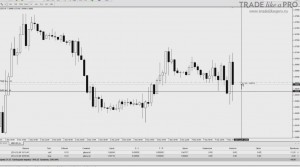
Now we have opened a lock. That is, we have put our chart on lock. And now, when the price will change, our loss will remain approximately at the same level. Because the profit from the buy position will offset the loss from the sell position.
Now we can see that the price is going up:
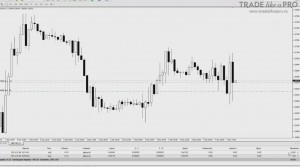
We have an increasing loss on the sell trade, but at the same time our open buy trade is making a profit and so our total loss remains at the same level, about 12 pips. These two positions are "locked".
So, we come to the definition that locked positions are opposite long and short positions of the same volume, opened on the same instrument on the same trading account.
Setting a lock means opening a trade of the opposite direction. For example, a buy trade was created, and the opposite trade became a sell trade. Why do we do this? In order to prevent further loss growth in case of incorrect opening of the initial deal. Thus, we fix our total loss at the same level.
Exiting the Loc

We are interested to get out of this situation and close both trades with profit. Closing both positions is nothing else than exiting the lock. They may not necessarily be closed with a profit. It can be a loss. But nevertheless, the closing of locked positions is called the exit from the lock.
This is the most complicated thing about locking. Otherwise, if it were so simple, everyone would use it and would be billionaires by now. Basically, all the pitfalls of this technique lie in getting out of the lock.
Ideally, we need one position to be in profit first, i.e. the price goes up and the buy position turns out to be in profit. We close it, and then the price turns around and makes a profit on our Sell position. And as a result we have both positions closed with profit. But in reality everything does not go so smoothly.
Let's say the price went up, we closed the buy position with some profit. But our loss on the sell position continues to grow. The price goes higher, and we decide to open a new buy position:
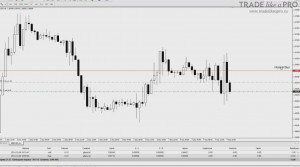
What happens next? Maybe we close the new buy position again with a profit, and the price goes higher again. Thus, the distance between the blocked orders increases. If at the beginning it was 12 pips, now it is 16 pips:
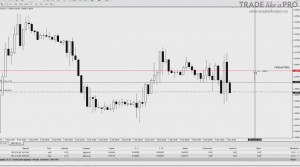
And this growth can lead to 100 points and more. And the greater the distance between the blocked orders, the more difficult it will be to get out of this lock. At the same time, it is desirable that either both positions were closed in plus or at least their total amount was positive.
Let's say we closed a buy position +10 and a sell position -5. Thus 5 pips will be in the plus.
Now we can see that the price on the chart has moved down:
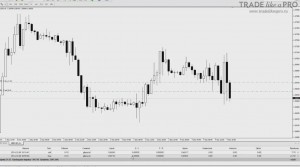
Let's try to close our Sell position and thus get out of it with a profit.
Let's close it and see:
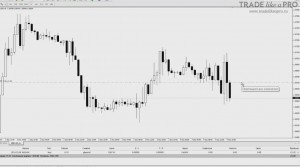
We still have a Buy position with a loss of 21 pips. And we opened it to protect ourselves from the loss on selling.
Now we have to open a new Sell order if we continue to follow the locking strategy:
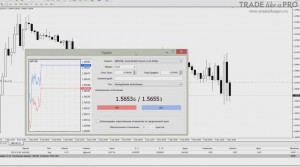
We reopen the order with the same 0.1 lot, but now we open a new Sell order:
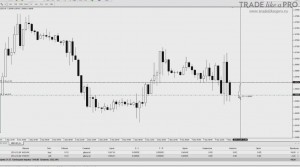
The distance at the beginning of the strategy was 12 pips. Now it is already 17 pips:
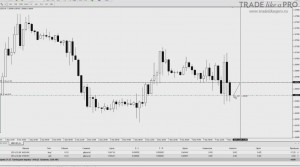
This is not favorable for us, because if the lock is wider, then it will be more difficult to break it to a plus. Thus, we move on to the options for exiting the lock.
Options for exiting the lock

The easiest thing to do is to close one position in profit and wait for the price to come back so you can close the second position in profit. But again, that is only if the price comes back. To put the second option into action, we need to determine the trend of the currency pair.
If we have formed a lock, we wait until the price goes beyond the limits of this lock and at this point determine in which direction the trend follows. In this case, we can assume that there is a downward trend:
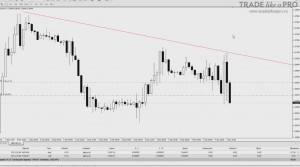
The price goes down outside the loc. We can assume that there is a bearish trend and open another Sell position with the same lot towards the main trend:
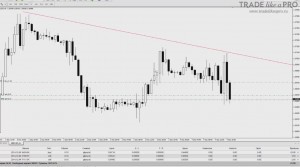
What do we do next? We have two sell positions at several different prices. At the same time, we have one Buy position left. We need to wait until the profit on the two sell positions exceeds the loss on the buy position. As soon as this happens, we either close all positions to zero, or close the losing buy position, and then follow up on both sell positions.
In general, our task is to close the losing position when the total profit on selling becomes equal to the loss on buying and then track only two orders with profit. We open an additional position in the direction of the current trend and wait until the loss on the position against the trend becomes equal to the profit on the two positions on the trend. When this moment comes, we close the position against the trend and work with two positions on the trend.
This was the second option of getting out of locking positions.
Naturally, here we have a situation when we have incorrectly determined the trend and the price has gone somewhere upwards. As a result, the loss will grow on two Sell positions, while the profit on Buy positions will be at least twice less. What can we do in such a situation? We will try to open another buy position. And if the price reverses again and we decide that we have incorrectly determined the trend, then we can open another sell position and as a result there will be 5 orders in the market:
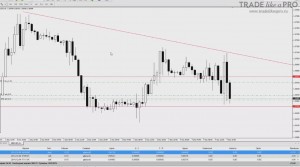
The total loss will grow and become one of the obvious disadvantages of using locking in practice. I am now specifically telling not only the positive but also the negative aspects of using locking. So that you do not think that this is some super-secret technique that will get rid of stop losses and you will be able to trade in profit always and everywhere.
This technique works. Experienced traders work with it. But it is not simple, and I want you to understand it for yourself. Getting out of locked positions is very, very difficult. You may have already seen that we have correctly identified the trend, but the price goes back up:
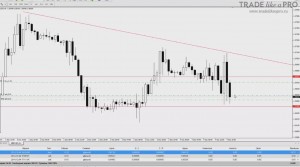
This is where we can panic. We may open another sale, which will lead to an increase in the volume of locked positions and to an increase in the total loss.
In the next, third variant, our task is to wait until the price reaches the opening level of one of the orders:
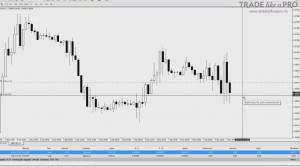
Then we wait for the price to pass the distance between our positions, when the profit of one of the positions reaches 17 pips in our case:
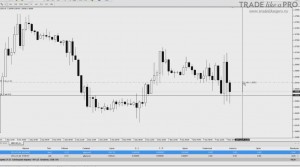
Let's assume that the price went down:
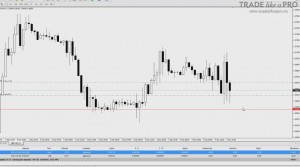
We will exit the sale and place a stop loss for the buy position just below the level where we exited. If the price goes lower, we will have a loss, but we will exit the lock:
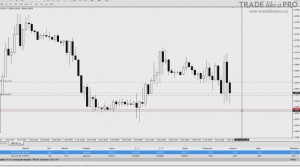
If the price reverses, we can then wait for a profit on the second position. This option is suitable when we exit from locked positions with a loss. That is, to get out at least somehow, while minimizing the loss. At the same time, there is a possibility that the price will turn in the right direction and we will be able to close the second position with a profit.
The next, fourth variant is again designed to determine the trend. In this case, let's imagine that our trend is going down:
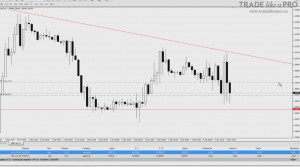
After we have determined the trend, we close positions for sale, as they are profitable, judging by our analysis. When the price goes lower, we close the Sell position. We wait for a pullback and close the sell position again, while the buy position continues to hang. And as soon as the price reaches the opening level of the buy, we close it at zero or 1-2 points. We assume that now the trend is going down and only selling is relevant. Therefore, we do not consider a buy position for profit, but just try to exit it.
In principle, the same variant can be used if you work, as in the second case, on the trend. If you are sure that the trend is against you, you open an opposite position and exit from it in the same way. And you work only with positions on the trend. If possible, you close the position against the trend at zero or at a very small loss.
When the price is between the locked positions, as on the screenshot below:
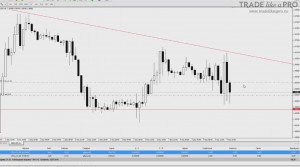
We assume that the trend will move down. We can open another sell position according to our understanding of what the trend is now:
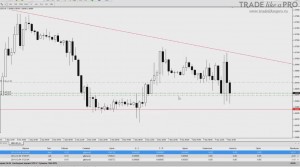
Again, when the total profit on the trend reaches the size of the loss on the position against the trend, we close the losing position and work with the remaining two profitable ones. If you have a large lock, you can reduce it by opening positions inside the lock like this:
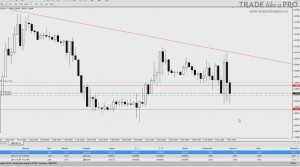
Because it is easier to get out of a small lock. You can once again reduce the lock and close profitable positions. This way we try to get out of the situation.
Another, fifth variant of getting out of a lock is when the price is between two positions and there is some economic news or some statistics coming out. You carefully watch the impulse that will appear after this news and open additional positions in the direction of the impulse. For example, the price is between positions:
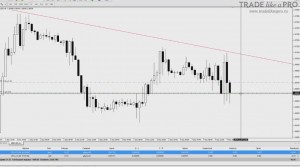
We know that statistics related to the currency pair are coming out now. When it comes out, we follow the momentum. If you notice that there is a sharp downward movement, you start opening additional positions to sell or to buy if you see that the momentum has moved upwards. As soon as the total profit on these positions exceeds the loss on the opposite position, you close it and work with the remaining profitable positions. This is a variant of exiting the lock on impulses. You can also experiment with position sizes.
For example, if you are sure that the trend is moving downward, you can open an opposite position in two smaller sizes. Not 0.1 lot, but 0.05. In this case, our loss will grow a little slower on the losing position. And, at the same time, you slow down the growth of the loss on the main positions.
Now I have listed the basic options for exiting locked positions. By the way, there are a great number of them. Some are based on support/resistance levels, while others rely on various indicators or the use of martingale.
In general, I want you to understand that locking allows you to fix a loss at one level, but it is not easy to get out of this loss with profit. It requires experience and understanding of what you are doing.
Pros and cons of locking

At the beginning of this article, I mainly talked about the cons of the locking technique to show you the complexity of this technique. But let's take a look at the pros:
- The biggest plus of locking is the psychological point that you just don't close your trades at stop loss. You always close your trades on the plus side. This gives you some illusion of control over the situation. However, in essence, a lock is the same as a stop loss, but only deferred in time. You could just as well fix a loss and then take some additional profit, which covers the loss. However, psychologically locking is perceived in such a way that you close both positions in plus all the time. Thus, the most important advantage of locking is psychological comfort.
- Locking allows you to wait out unclear times when there are zigzag movements on the chart. When there is no clear trend like this:
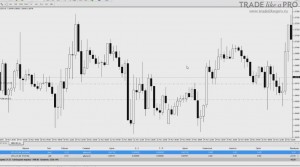
When you can rack up a bunch of stop losses, locking becomes a distinct advantage. Because you don't take unnecessary losses. Again, you don't worry about any mistakes made when you entered the market inaccurately, closed a position early or closed a deal without waiting for a stop loss.
- You have time to calmly think everything over, as the position will not go into some big minus. The most important advantage of locking, besides the psychological moment, is working on non-trending pairs and situations when there are strong zigzag movements without a clear trend. In such places, working with a lock has a real advantage.
Now let's move on to the disadvantages of the locking technique.
- Naturally, the main disadvantage is the difficulty in getting out of locks. It is hard not to make mistakes and develop a technique suitable for you to get out of locking and, most importantly, to apply it correctly.
- It is very easy to increase the volume of a lock and its size by additional orders. And then try to handle them. If there are a lot of orders, it can lead to a margin call.
- For many people this technique is not comfortable, because if you can't settle the lock for a long time, swaps start to accrue. You pay the spread or commission for opening a trade not once, but twice or more as there are two or more positions. Therefore, brokerage costs increase somewhat.
- Besides, if you feel uncertainty or panic, you can open a lot of incomprehensible orders and as a result close them with a loss. You may decide that "let there be no profit, but at least I will get out of this situation" and close the order with a minus. And then the point of using locking is lost. As you have noticed, locking has both psychological pluses and minuses. It is just like the technique of standard work with Take Profits and Stop Losses.
Tips for using locking

First of all, as I think, this technique is primarily intended for intraday work on zigzag movements. When there is no clear trend. This can be traced, for example, with GBPUSD:
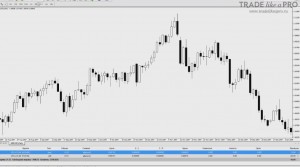
Pairs such as GBPJPY or EUR/JPY are also suitable. That is, pairs that are subject to zigzag movements during intraday trading. At the same time, you should try to set a small take profit. Try to open a lock as early as possible when the market turns against you, so that the loss is minimal. And carefully monitor the chart to make money on any pullback. Otherwise, there is no sense in using locks. Our task is not just to get out of the lock, but also to make a profit.
And, of course, I advise you to test the use of locks together with your strategy on your favorite currency pair, first of all on a demo account. And also on the trading strategies simulator. It is advisable to trade a large number of situations on historical data. And to see how you would get out of locked positions.
Otherwise, it may turn out that either you do not have enough skill to work with this technique, or it is not suitable for your strategy, or it is not suitable for your currency pair or timeframe. Therefore, everything should be thoroughly tested to be absolutely sure that the technique works.
In conclusion

To summarize, I would like to repeat that locking is not a technique for beginners. I recommend them to use locking only on a demo account and for some long-term training for the future.
The technique should be used with small Take Profits. The distance between the locked positions should be as small as possible. And it works best on zigzag market movements. When there is no clear trend on the chart. As we have discussed, the locking technique has its pros and cons, and it should be used with great caution, having trading experience. And preferably a lot of experience. You should test the strategy on a demo account and in the strategy tester.
Do you use locking in your trading ?
Obsudit na forume
S uvazheniem, Pavel Vlasov TradeLikeaPro.ru
