The Influence of Broker Time on Price Action Trading Results
 Greetings, fellow forex traders!
It is no secret that dealing centers use different server times to transmit quotes to the MetaTrader 4 terminal. On small periods (below one hour) this does not bother anyone at all, but on higher periods different server times do have an effect: candles begin to look slightly different. There is an opinion that differences in the GMT offset can very strongly affect trading results for strategies such as Price Action.
Today we will find out whether this is really so and, if the effect does exist, how large it is and whether it is worth being afraid to trade Price Action with brokers whose server time is, say, GMT-6 or, for example, GMT+8.
The Essence of the Research

In order to determine the influence of the GMT offset on trading with Price Action, we will take a simple trading system based on several of the most common patterns: the pin bar, outside bar, inside bar with the trend and on reversals, as well as trading the doji patterns. By and large, tests on one currency pair will be enough for us, and these tests may even be losing ones, that is not important: we will evaluate the result by the principle of better or worse than the benchmark. In addition, our tests will not take into account any trade filtering, whether by trend, by levels, or any other method; obtaining a beautiful result is not important for our task. We will take EURUSD as the currency pair for the tests, as the most popular one. Our benchmark will be a test on Alpari quotes with GMT+3, as the "most correct" GMT for trading Price Action strategies. We are interested in several periods. Let these be H1, H4, and D1.
Research Tools

So, as with any task, we need some preparation, because without tools it is impossible even to hammer a nail. Any research begins with data preparation, and we need to obtain quotes for the selected pair with different deviations from GMT 0. After searching the web, I found nothing to solve this task. So I wrote a simple script that, when attached to the chart of the required period, saves files with deviations from GMT -12 to GMT 12 into the terminal's MQL4 - Files folder. You can download this script using the link at the end of the article; perhaps it will be useful to you for your own research. We have prepared the data; now we need to obtain the tests. In the past I had already studied Price Action and wrote an auxiliary expert advisor for this. Therefore, I used it as the basis so as not to reinvent the wheel. After tweaking the code a bit and removing everything unnecessary, I left only the trailing stop, setting the stop loss by the ATR indicator, and the take profit, which is set as the stop loss multiplied by a coefficient specified in the settings. Then I optimized each pattern in the expert advisor on the benchmark GMT and saved the settings in .set files. These are the exact settings we will use for tests on data with deviations from the benchmark GMT. You can also download the expert advisor itself at the end of the article together with the script.
Research Results

After the long and tedious work of saving the test statements and compiling the final table, we can finally evaluate the results. By the way, there were 375 tests in total. In order not to post 375 pictures, I made summary tests: I collected all the patterns of each timeframe into one file and got only 75 tests. But even that seemed too many to me, so I decided to present all the results in the form of three tables, one for each timeframe. And you will be able to see the results themselves in the appendix to the article.
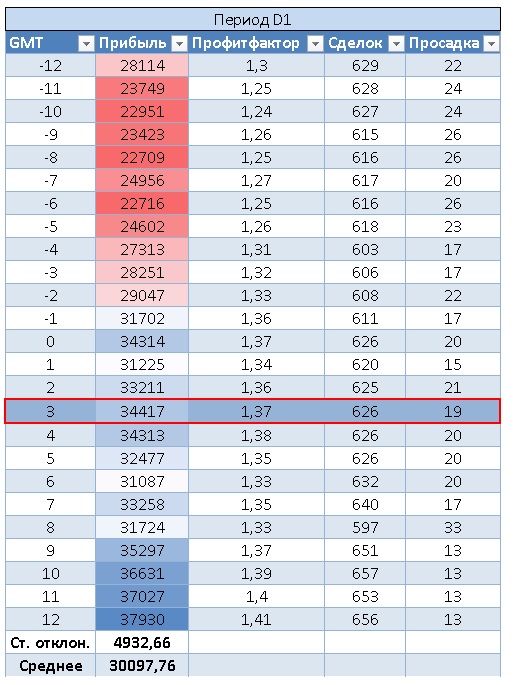
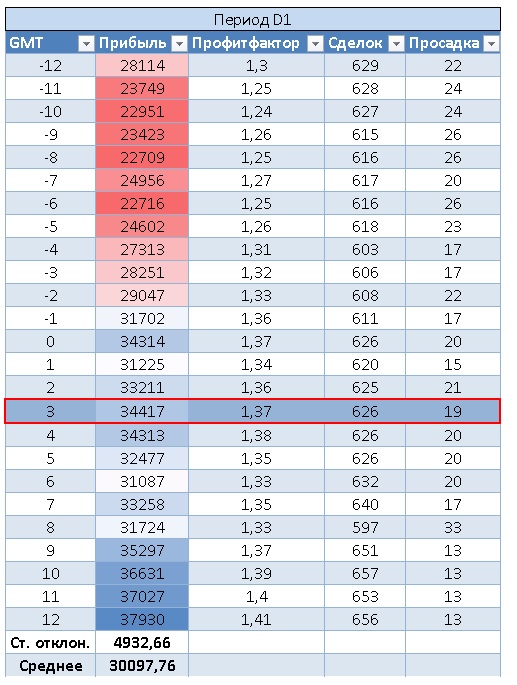
Let us start with the daily charts:
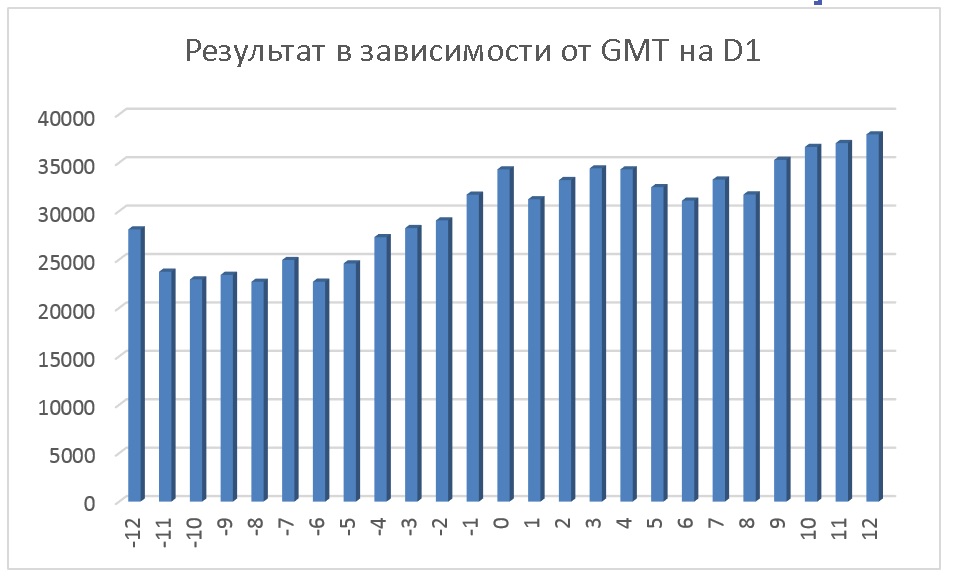
 And the same information in histogram form:
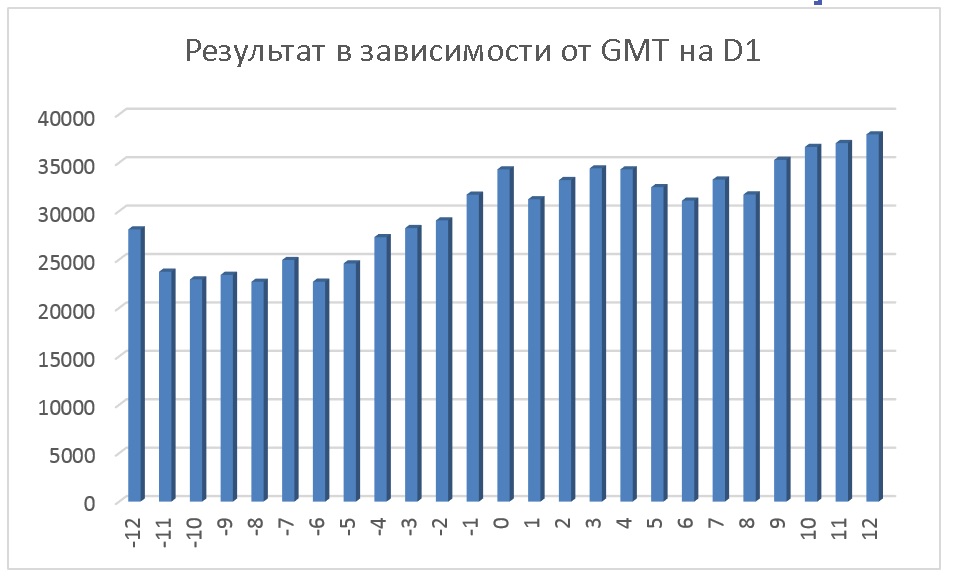 On the D1 period we observe a deviation of 4932$ from the average result of 30097$. And this is a spread of about 16%, which is quite substantial. From this we conclude that the difference in GMT moderately affects results on the D1 period (within 20%). All of this is quite clearly visible on the histogram.
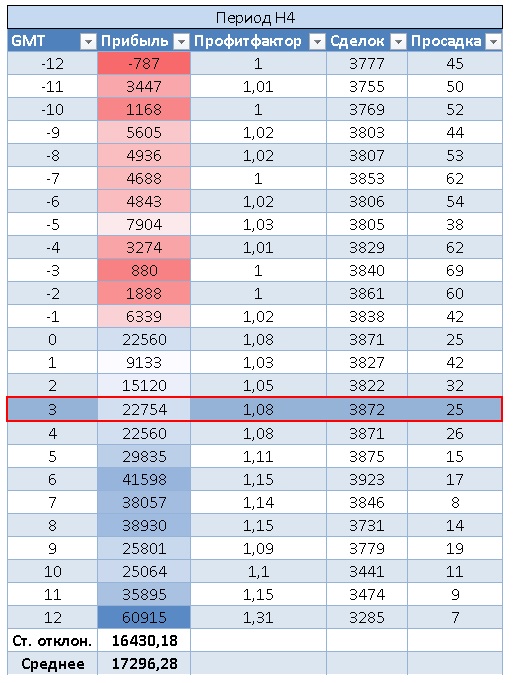
Now it is the turn of the H4 period:
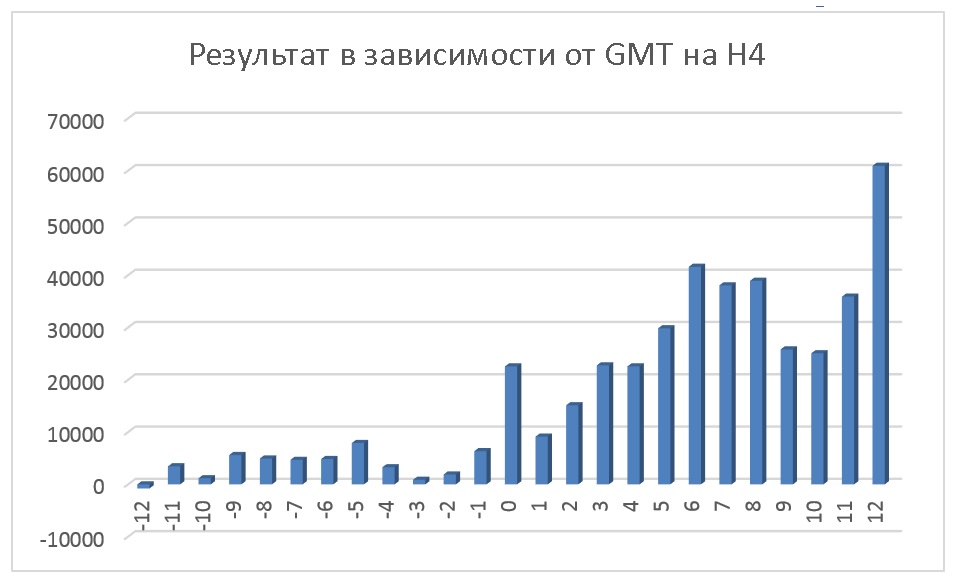
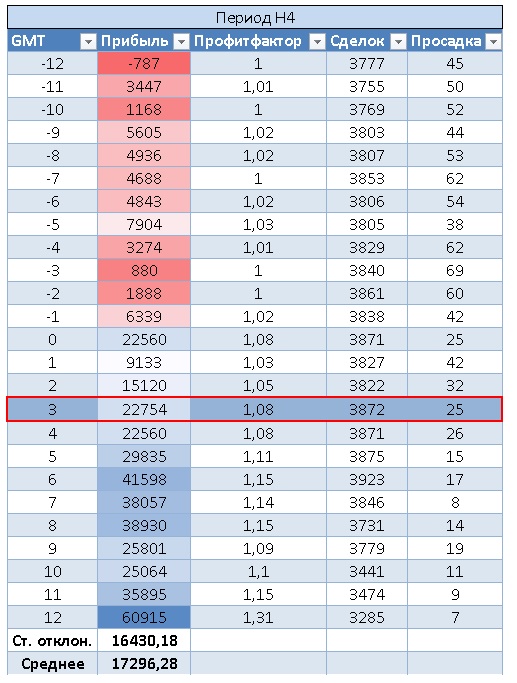 Chart:
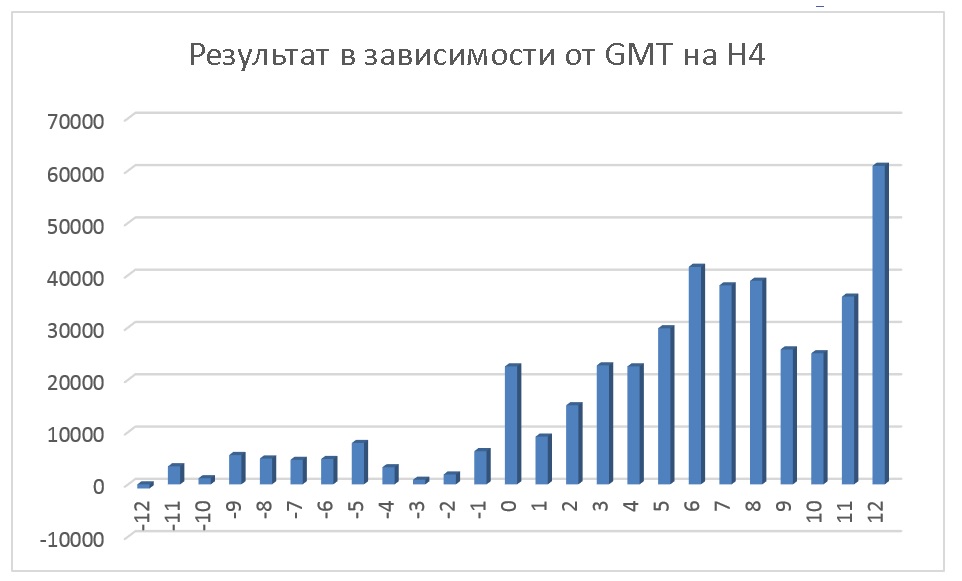 On the H4 period we observe a deviation from the average value of about 100%, which is very much. The GMT difference definitely has a very strong effect on the final result, to the point that it can turn a profitable system into an unprofitable one. The histogram confirms the data from the table: indeed, there is substantial variability in the data obtained. And what is interesting is that as the deviation from GMT 0 increases, the system's profitability also increases.
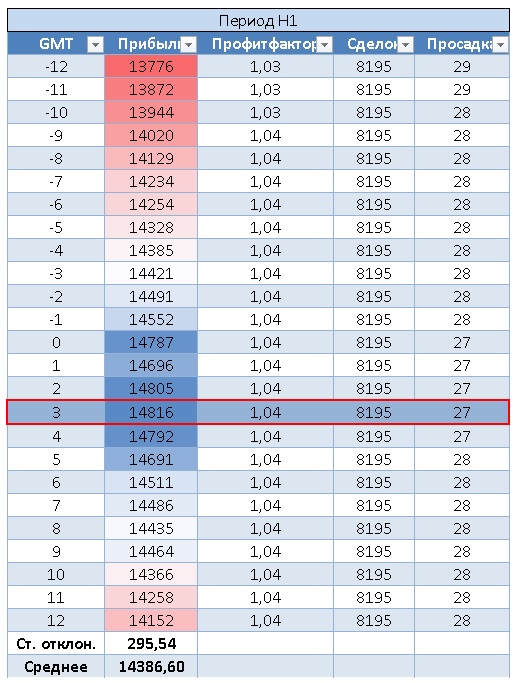
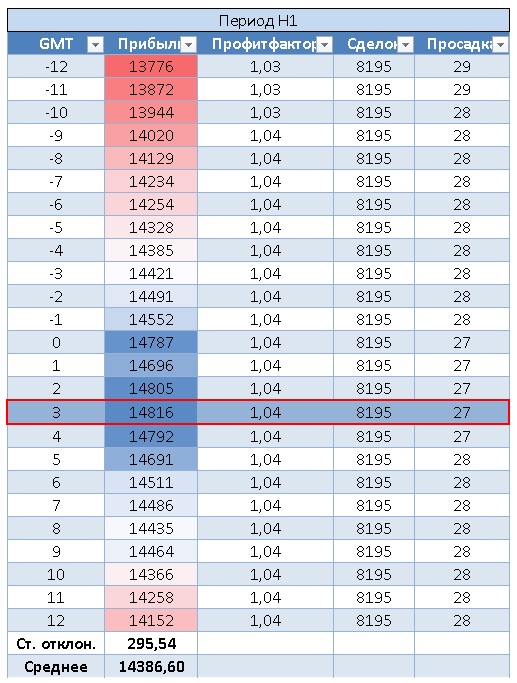
And the H1 period:
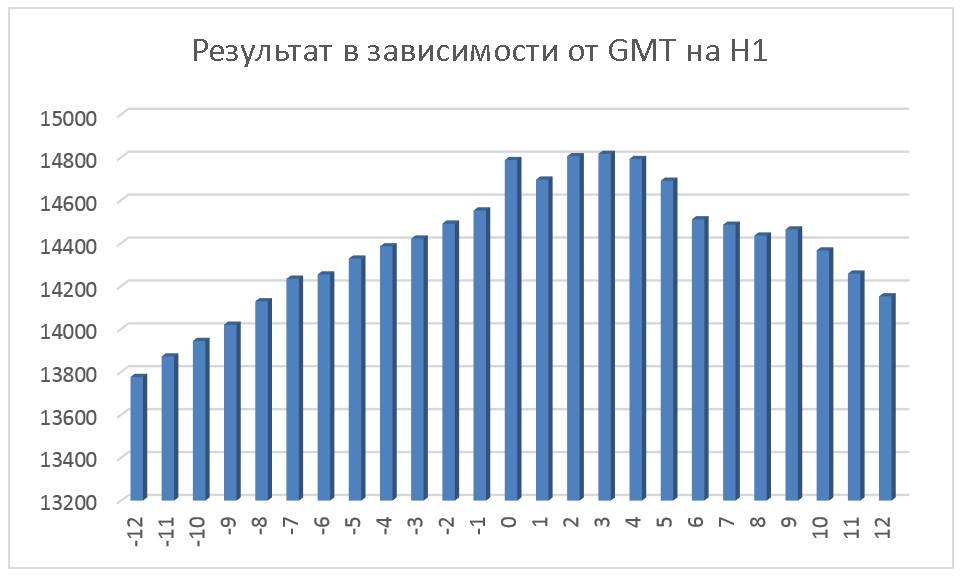
 In histogram form:
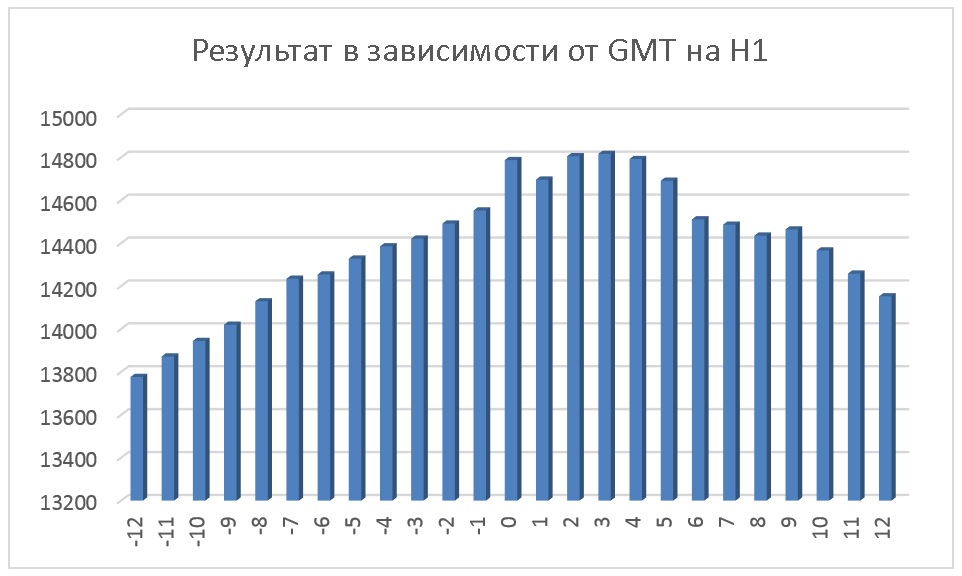 As you can see, the smallest deviations from the average profit (295 dollars or 2%) are observed on the H1 period. These deviations are most likely the result of inaccuracies in conducting the tests. In any case, on the H1 period the difference in GMT has practically no effect on the result. As for those same 2%, if you look at the histogram, doubts arise about their randomness: the returns decrease too neatly to the left and right of the peak value belonging to the data with GMT +3. I cannot say for sure what this may be, but it is quite possible to accept the hypothesis of the influence of the swap on open positions. And what ideas do you have?
Conclusion

Today we gained quite useful knowledge. It turns out that trading systems intended for the hourly period are completely insensitive to different broker GMT settings. At the same time, when trading on daily charts, the results with brokers having different GMT values may differ, but not critically. That is, if your D1 trading system makes a profit with one broker, it will most likely work at least not much worse with another, and may even work a little better. But those who trade on the H4 period should be very careful! Apparently, a trading system developed for a specific GMT will lose substantially in effectiveness even in the case of a difference of just one hour. Naturally, everything said above also applies to trading robots. Therefore, be careful when moving to another broker with a GMT different from yours if you trade on the H4 period and above. And, of course, profits to everyone and until next time!
Download All Research Results
 Respectfully, Dmitry aka Silentspec
TradeLikeaPro.ru
Respectfully, Dmitry aka Silentspec
TradeLikeaPro.ru