
Indicator Repainting - Is It Always a Bad Thing?

Almost every beginner is sure that somewhere in the secret sections of niche Forex forums there are grail indicators that give nothing but profitable signals. Those who seek will always find, and indeed, over time they find expert advisors or scripts that show exceptional results on the chart.
Often such amazing results are a consequence of the so-called “repainting” of indicators. This is exactly what we will talk about in today’s material. The article will describe in detail what repainting of indicators is, how and why it occurs, whether it is always bad, and we will also look at some ways to protect against repainting.
When faced with such a situation, trading professionals who monitor forums for new ideas will immediately ask about repainting. This is the name given to an indicator's ability to change its readings in the past as new candles appear.
Changes in the past create a beautiful picture on the chart of 100% correct trades. But in real trading, repainting will turn all the signals of such a Forex indicator into losses, causing a beginner who did not check a purchased or freely downloaded indicator to blow their deposit.
What is indicator repainting and what does it look like?

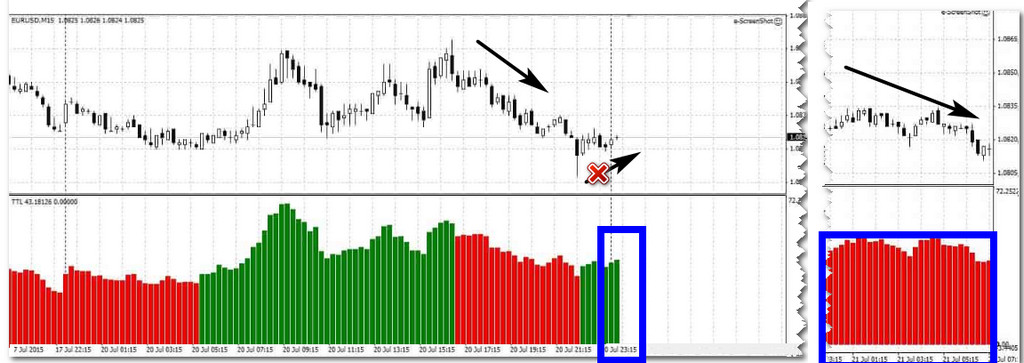
The picture below shows an indicator where a change in the color of the histogram gives an entry signal. On the left side you can see how the rebound produced several green bars - a confident Buy. After some time the green zone disappeared, giving way to red - the signal was completely repainted.
Lost money gives a novice trader “strong immunity” to any kind of repainting, and having reached professional heights, he unconditionally closes the topic of such indicators for himself.
But is the situation so critical when a signal changes in the past if the trader knows about it? Are there trading systems with Forex indicators, the repainting of which allows you to get profit?
Why do Forex indicators repaint signals?
Technical indicators are based on a formula that, in the classic version, calculates a signal over a period specified by the settings - the historical period. The initial reference point, as a rule, is located on the current closed candle, the final one is N bars in the past - this algorithm guarantees the invariance of the calculated value.
A simple example is a moving average with a period of 10. As soon as the candle closes, its price will be added to 9 previous same values and will be divided by 10. Trader will receive a point and a line that will not change in history, since in the past it is no longer possible to change quotes, participating in the calculations.
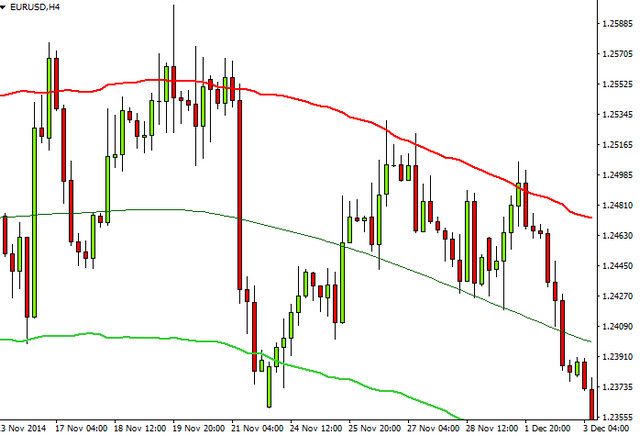
The situation is completely different in the formula triangular moving average TMA. The indicator formula gives the main weight to the average, rather than the price values in the previous period, changing the pattern of the channel formed by the indicator curves with a strong jump in the volatility of the current candles.
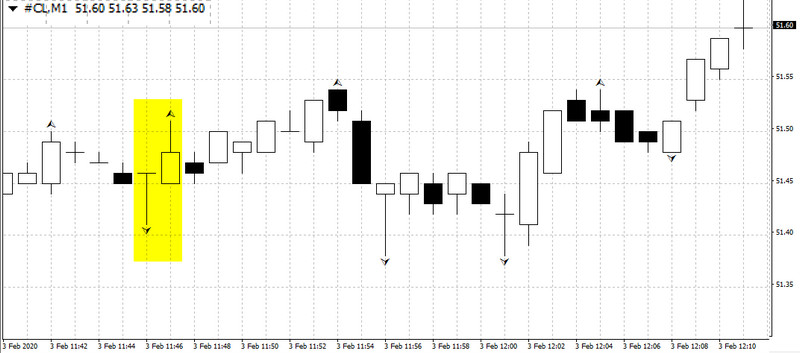
In the Williams fractal formula, which marks the highest maximum or minimum in a formation of five candles with arrows, the situation is roughly the same. The fractal falls on the third, middle candle, and its signal can be repainted when the current quote closes if it updates the minimum or maximum of the five-bar pattern.
The most striking and disturbing example of repainting for beginners is the ZigZag indicator, which represents an ideal picture of the grail when applied to a chart. The accuracy of “guessing” tops and bottoms is colossal if you don’t know that the indicator changes the already displayed last top or bottom as new candles are added to the chart.
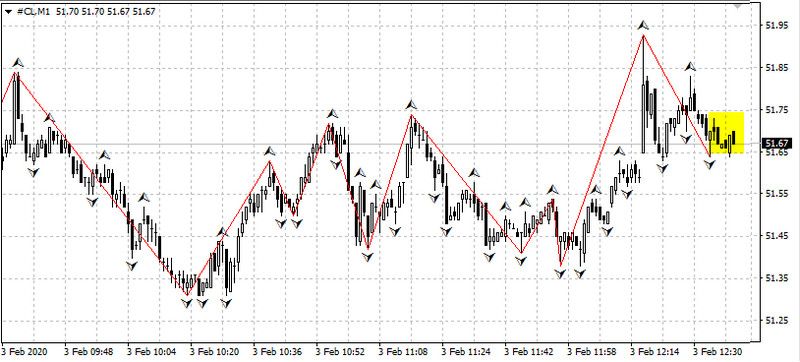
The chart shows how the indicator “lets” the price move several candles ahead; their minimum number is determined by the Backstep setting, while the maximum is effectively unlimited in a strong trend. ZigZag necessarily takes new candles into account when forming tops and bottoms: if they exceed previous extremes by the percentage specified in the Deviation settings, the indicator curve will be rebuilt.
The given example clearly shows the absence of “malicious intent” in repainting - it is embedded in the formulas and is visible in advance to any trader who can read. ZigZag and Fractals are included in the standard package of MetaTrader 4 and 5, they are intended only to optimize the search for graphic formations.
On fractals, lines of support and resistance, which provide for the simultaneous use of multiple signals “from the past”, are built, and zigzag lines help to build various Wolfe waves, Gartley figures, etc., where the role of repainting the last top or bottom is not so important.
Thus, repainting is normal, for indicators with calculation features, as in the examples above. And in this case, there is no malicious intent in the repainting; it is simply worth knowing and taking into account.
Do Forex indicators without repainting make sense?

As has already been shown above, indicators with repainting are included in the standard package of trading terminals on an equal basis with other tools of technical analysis. The authors specifically created their formulas and appearance for specific strategies.
In particular, fractals brought Bill Williams a fortune in the Profitunity strategy, ZigZag serves as the basis for many profitable wave strategies and the construction of graphic patterns. An attempt to correct the code by removing repainting will change the rules and tactics, without which the trading system will lose its meaning.
Another reason not to remove the built-in repainting is the absence of strategies that use the current signals of such indicators. The only exception is the histogram by John Ehlers, which uses the mathematical Fisher transform.
The complex mathematical formula implemented in the Fisher indicator, which describes with high accuracy the Forex currency cycles, is very sensitive to the last closed candles.
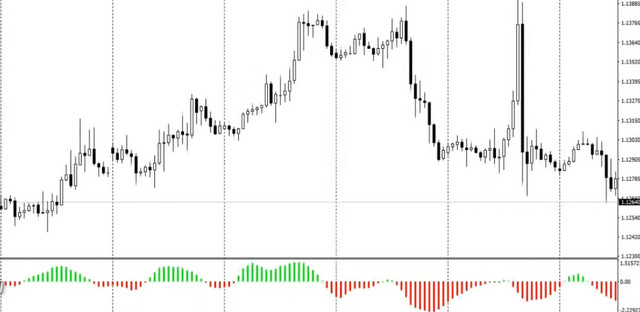
Ehlers suggests dealing with signal changes by using the three screens method, where changing values on the lower timeframe will not be significant for the medium-term and long-term trend.
To summarize, we can characterize repainting as an attempt by the author to achieve an advanced signal. Versions from the Internet that offer code without repainting will lead to delays or recording of readings that will not be able to warn the trader about changes in the market situation.
If modified indicators without repainting are used in proprietary strategies, then unchangeable signals will distort the patterns built on their basis, which will lead to an increase in the signal error.
Is repainting indicators a scam for traders?

Indicator repainting that is not related to a strategy feature or to the indicator operating in leading-signal mode has two causes: unprofessionalism or deception.
The first is a banal coder error, which leads to the recalculation of the formula values on each new candle and changes all the signals. There can be many specific reasons for this; in this case there is no malicious intent, but a trader will lose their deposit just the same if they entrust the creation of an expert advisor to such a “professional,” just as in the case of fraudulent repainting.
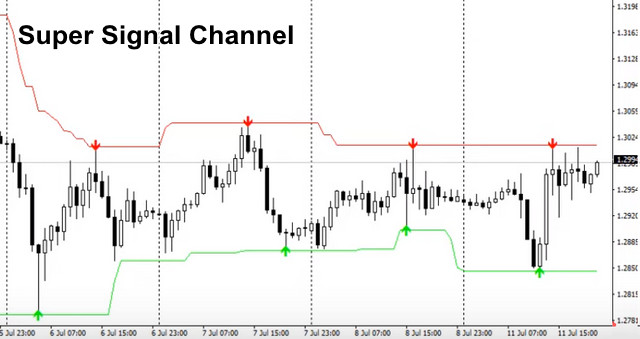
It is introduced into the code specifically: the built-in value return function “peeks into the future”, changing signals in the past to show an ideal picture of trades. Fraudsters sometimes only need screenshots of trades and fake test results to sell a broken indicator.
Here is an example of a “grail” that in real trading will lead to losses:
A simple way to protect yourself from indicator repainting

A trader cannot suffer from Forex indicators whose repainting is intentionally built into the algorithm if they follow the axioms of trading:
Repainting is possible if the system uses the fractal method for the signal - comparing two short periods made up of several candles. You need to track the sections on the chart at moments of trend reversal - there should be a losing signal;
An advisor or indicator can be quickly tested in the strategy tester built into MetaTrader. Use the visualization window to monitor and verify whether signals are unchanged or redrawn;
An advisor or indicator can be quickly tested in the strategy tester built into Metatrader. Use the visualization window to monitor and verify whether signals are immutable or redrawn;
Expert advisors can include several tools at once, producing the final result of their analysis. Such systems must not repaint, because that would make the trading result unpredictable. In this case, we are dealing with fraud or a code error.
Conclusion

Sincerely, Ivan Petrov
Tlap.io
Advisorscan include several tools at once, giving the final result of their analysis. Such systems should not produce redrawing, which will make the trading result unpredictable. In this case we are talking about fraud orcode error.
Therefore, redrawing indicators is neither bad nor good, but simply a technical feature that is worth knowing and taking into account when interpreting signals and analyzing indicator readings on history.
Best regards, Ivan Petrov
Tlap.io
