
IMOEX at the Nerve Line: What Could Drive the Russian Market’s Next Move
Tlapchik

Intro

📉 What the 3.01% sell-off changed
The fall in IMOEX was large enough to alter short-term positioning and force investors to reassess risk. When an index loses 3.01% in one move, leveraged participants may reduce exposure, cautious funds postpone purchases, and short-term traders concentrate on the nearest support levels. This combination can amplify volatility even if the underlying corporate picture has not deteriorated at the same speed. The sell-off has raised the burden of proof for buyers. A rebound driven only by closing short positions may look impressive during a trading session, but it does not automatically signal that the market has found a stable floor. Sustainable demand normally requires investors to see either attractive valuations backed by business performance or a clear reduction in the risks that triggered the retreat. That distinction matters because a sharp decline can produce tempting prices without producing immediate confidence. The market is now behaving like a committee that has received an urgent document five minutes before the meeting: everyone is reading, but few are ready to sign. Until conviction returns, intraday recoveries may remain vulnerable to renewed selling.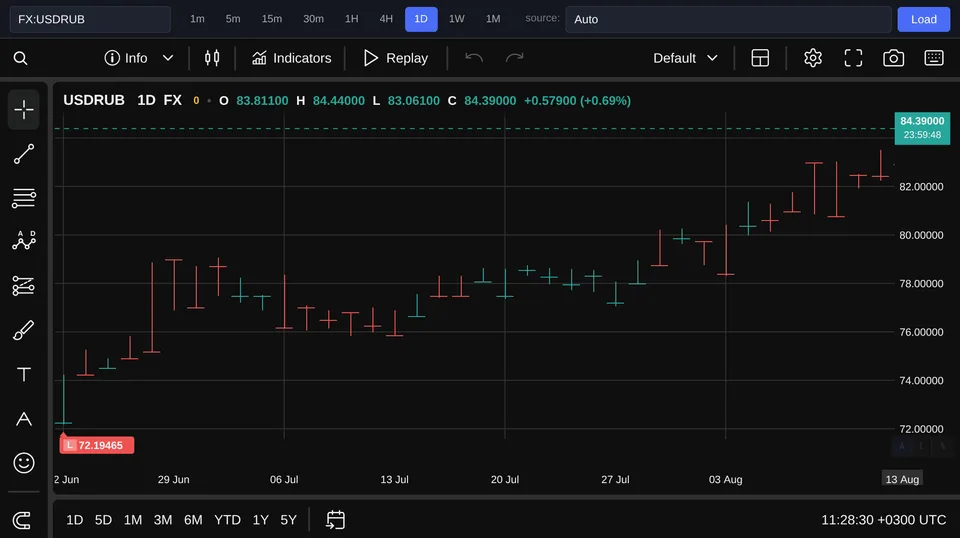
🧭 Why 2,200–2,300 points became the key corridor
Freedom Global expects IMOEX to trade within a range of 2,200–2,300 points, making this corridor the central zone for the near-term outlook. The lower boundary is important as an area where buyers may attempt to defend valuations, while the upper boundary is a test of whether demand can absorb supply from investors seeking to exit after the recent shock. A move inside the range would indicate stabilization, not yet a confirmed change of trend. Repeated tests of 2,200 points without a strong recovery would suggest that buyers are present but cautious. Conversely, an approach to 2,300 points would become more constructive only if it were supported by broader participation and persistent demand rather than a brief technical reaction. The index needs to demonstrate that it can hold recovered ground when the initial emotional pressure fades. The corridor should therefore be treated as a decision area rather than a precise forecast carved in stone. Trading near its lower edge increases sensitivity to negative headlines, while consolidation closer to the upper edge would show that investors are gradually rebuilding positions. The quality and durability of demand matter more than a single closing level.📊 Reports and geopolitical signals as rebound catalysts
Corporate reporting is one of the clearest potential sources of support because it gives investors something measurable to compare with depressed market prices. Resilient revenue, manageable costs, healthy cash generation, or credible shareholder-return policies could help selective buying spread beyond isolated names. Weak results or cautious management language, however, would make it harder for the broader index to leave the 2,200–2,300 corridor on the upside. The likely sequence is selective rather than universal. Investors may first favor companies whose earnings are easier to assess and whose balance sheets offer protection against uncertainty, while businesses with weaker visibility continue to trade at a discount.💱 The weaker ruble complicates the picture
The currency market is adding another layer of tension. The Bank of Russia raised its official US dollar rate to 83.8058 rubles, while the current market quote for USD/RUB stands at 84.39 rubles, up 1.80% for the day. The move to 84.39 and the daily increase of 1.80% show that pressure on the ruble is not merely a background detail. A weaker ruble can support the translated revenues of exporters that earn foreign currency, but the effect is not automatically positive for every company or for the index as a whole. Import-dependent businesses may face higher costs, consumers may become more cautious, and investors may demand additional compensation for currency and inflation uncertainty. The final impact depends on each company’s revenue structure, expenses, debt, and ability to adjust prices. The gap between the official rate of 83.8058 and the market level of 84.39 also gives traders a clear signal about the direction of current pressure. If USD/RUB remains elevated, export-oriented shares may receive relative support, yet broader equity sentiment can still suffer if currency weakness is interpreted as a sign of rising macroeconomic risk. For IMOEX, the ruble is simultaneously a sectoral earnings factor and a confidence indicator.Conclusion
The near-term outlook centers on whether IMOEX can stabilize within 2,200–2,300 points after its 3.01% decline and then build enough demand to challenge the upper boundary. Corporate reports must provide fundamental support, geopolitical signals must reduce uncertainty in practical terms, and the currency market must stop adding fresh pressure to investor expectations. With USD/RUB at 84.39 rubles and up 1.80% for the day, currency risk remains material. A durable recovery will require several supportive signals to align; without them, another test of the corridor’s lower boundary remains a credible risk.#IMOEX outlook#IMOEX 2200–2300 points#Russian stock market#USD/RUB 84.39#ruble exchange rate