
How to Trade CFDs - Trying Our Hand at Stocks, Metals and Commodities
 Hello, dear fellow Forex traders!
The Forex market is quite naturally associated with trading currency pairs. Nevertheless, the decentralization of the market gives freedom in choosing trading assets and, accordingly, earning opportunities. This is a substantial advantage that makes it possible to profit from price differences in instruments on the largest exchange venues, while greatly lowering the minimum entry threshold into the “big game.” More on that in today’s article.
Where to Find CFDs?

Traditionally, in the Forex market a trader’s attention is focused on currency pairs. However, when adding yet another pair in the Market Watch window of MetaTrader4, one notices a section of symbols with CFD contracts.
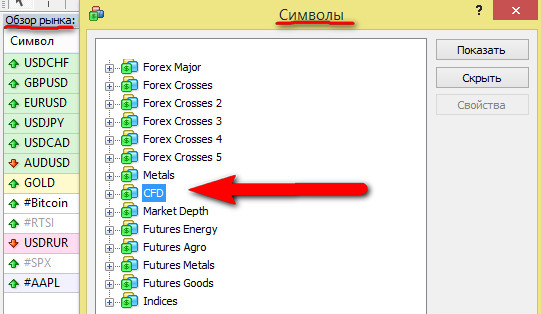
The option opens access to a long list of assets encrypted under strange icons, like a Twitter hashtag. These are tickers, the conventional designations of instruments on global exchanges.
What Is a CFD?
Three hundred years ago, an auction-based procedure for determining the price of agricultural goods was established by concluding deals when supply and demand were equal on a special venue, an exchange. Now this rule has spread to all goods and raw materials, corporate securities such as stocks and debt obligations (bonds).
Standing apart is the Forex market, which, being decentralized in essence, rules out manipulation of countries’ national currencies. Currencies are traded on the international interbank market without being tied to an exchange venue and are not subject to regulation, as the rate is determined by global supply and demand.
Speculators of the 20th century introduced a new class of instruments, derivatives of exchange-traded assets. Futures and options on stocks, financial instruments, and commodities made it possible to reduce costs for exchange commissions, avoid taxes, and use leverage.
Leverage allows trading a package of an asset (100 stocks or 1000 bonds, etc.) for 10% of its value. At the same time, profit or loss is accrued at 100%.
CFD (Contract For Difference) is a derivative contract: a percentage of the value is taken from a package of stocks (or any other asset, called the “underlying”), equal to 1 lot. Unlike a futures contract, a lot can be split like a currency lot down to the minimum value of 0.01 lot.
Such pricing explains the emergence of the contract. Securities of US or European companies trade at values from tens to hundreds of US dollars. The prices of futures and options reach the cost of a used car. A small investor has only one way out: buying one stock at a price equal to 5% of its value.
CFD contracts are an over-the-counter offer between a broker and a trader, in which the price of buying or selling an asset (from the broker’s list) is taken as zero. The trader who enters into the contract puts up collateral (2 or 5% of the asset’s market value), understanding that when closing the position they will either receive profit from a positive trading result or have a loss debited from the account.
Types of CFD Instruments

Over-the-counter assets, which include CFDs, can be written on any type of underlying asset if the pricing and settlement terms are understood by both parties (seller and buyer).
As a rule, CFDs on shares of well-known brands are in demand. The quotes and instrument codes (tickers) coincide in Forex brokers’ trading terminals and on the exchanges where those securities, placed during the IPO, are traded.
Each exchange has its own index, which includes the securities of the country’s economic “flagships” (“blue chips”), calculated according to the venue’s methodology. Buying or selling the index is possible through CFD contracts. The index value is relative; it is measured through the constant recalculation of stock prices. Therefore, the underlying asset that determines the value and difference calculation for a CFD is an index futures contract.
Energy futures, as well as bonds and currencies, can be purchased as CFD contracts. The breadth of the offer of underlying instrument types defining contracts for difference is limited by the offerings of global exchanges and the broker’s imagination.
Dividends on Stocks

If previously stocks on the equity market were bought in expectation of future growth, dividend payments were not taken into account. The successes and business achievements of individual companies made it possible to provide shareholder payouts in the form of dividends that exceeded bank deposit yields, which caused speculative growth in blue chips bought in a “dividend hunt.”
At the end of each quarter (the frequency is set by the shareholders’ meeting), after summing up financial performance, the joint-stock company decides on dividend payment.
The percentage of net profit designated for payment is divided by the total number of shares, after which a decision is made on the timing of payment.
Before the shareholders’ meeting begins, a “cutoff” is made, the timing of which is known in advance. A special registrar company records the owners of securities at the time of the cutoff so that, in the event of a positive decision, the dividend amount can be sent to their account.
Any purchaser of a stock before the cutoff moment has the right to expect the amount of quarterly (annual) dividend payments.

CFDs, like any stock derivatives (futures and options), are not legally entitled to payment. The broker decides how to act in this case, so read carefully on the website and in the Agreement texts the terms of dividend payments and accruals.
The general practice of such payments by a Forex dealer is as follows: if at the time of the cutoff the client was short CFDs on stocks, the dividend amount will be withheld from the account, and it will be credited if the stock CFDs were bought.
The amount is multiplied by the number of shares in the CFD specification. 1 full lot equals 100 shares. The dividend is calculated per share.
After the cutoff, some time later there will be a vote of shareholders and financial payouts. In the trading terminal, on the broker’s website, and in the media, the dates of cutoffs, meetings, dividend amounts, and results known in advance are published after the fact.
The amount of dividends, expectation and reality, strongly influences the value of securities, causing growth or decline (“dividend gap”). Investors and speculators carefully track information and corporate news in search of short-term guaranteed earnings.
Stocks, as a rule, rise before the cutoff and fall on the fact of dividend payment. Rumors of high payouts cause trends, but a beginner investor should take into account the “external background,” the general rise of the economy, which can ignore negative news.
Pros and Cons of CFDs

- Ideally suited to the “small investor.”
The cost of “entry” to global exchanges starts at $5,000 US. The minimum purchase is 10 shares, the maximum leverage is 1 to 3, and the average annual change in stock prices is about 30%. A Forex broker gives an investor access to the stock market with a deposit from $100 and leverage reaching 1 to 500.
- Low transaction costs.
When trading stocks, an exchange broker charges for account maintenance, for the depository (storage and record-keeping of shares assigned to the trader), a percentage for maintaining the trading account, and a commission for each transaction. If the trader decides to sell the stocks, the broker will bill for using credit.
- One account and terminal.
Stocks are traded on various venues. An exchange broker splits accounts by exchanges and instruments. The difficulty of accessing venues because of regulators’ requirements does not allow the client to be given all exchanges of interest. As a result, the trader has to split funds, transferring them to different accounts to buy currencies, stocks, or options, or open accounts with different brokers.
Trading platforms may differ from broker to broker; there is no single coverage on stock markets like MetaTrader.
Negative Sides of CFDs
- There are both risks of problems with a Forex broker’s licensing documents and the chance of a “scam”;
- An investor who incorrectly takes into account the “leverage effect” is exposed to the risk of losing the entire size of the deposit;
- CFDs do not grant ownership rights, so the mechanism and fact of dividend payment depend on the broker’s decision;
Secret opportunities of CFD trading that everyone knows about but pays no attention to
If you are tired of draining funds on currency pairs, it is worth trying the stock market with predictable dividend yield. Open the S&P chart and assess the trend, which mostly goes in one direction:
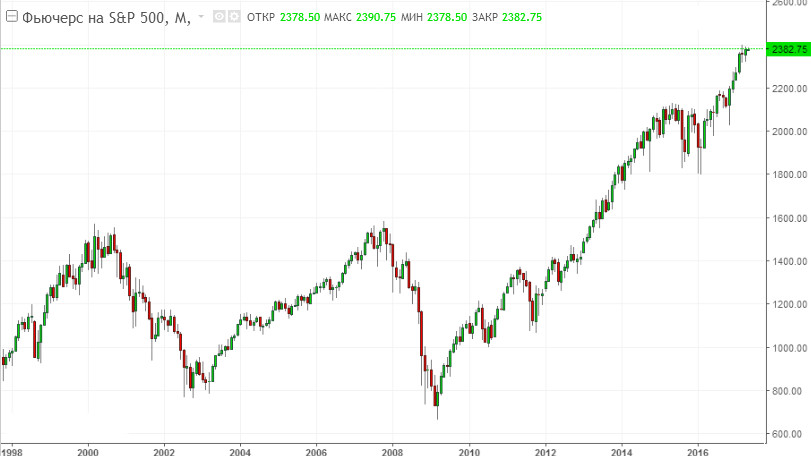
The growth of stocks is predetermined by the mechanism of the market. Taking the direction of the trend as a constant, the investor only needs to choose the right portfolio of stocks and diversify the investments (“put eggs in different baskets”).
All Forex brokers provide access to CFD contracts. Therefore, choosing a company comes down to studying forum and website ratings, licenses, and reviews, which will help ensure portfolio protection.
 It is worth paying attention to Roboforex Stocks; the broker is in the top 10 of any Forex ratings. The difference is that this Roboforex division specializes specifically in stocks. If a trader decides to become an investor and earn income from the market, learn to select securities and work properly in the stock market using CFDs, it is convenient to do this with this firm.
What Strategies to Use for a CFD Investment Portfolio?
Work with stock CFDs is carried out mainly “from the buy side”; growing trends are determined using moving averages with period settings of 50, 100, or 200.
Oscillators (mainly MACD) are used as a filter so as not to make trades in overbought conditions, adding to the position when the market is oversold.
The reliability of buying CFDs is determined according to Alexander Elder’s “Three Screens” tactic. Trading from levels of Murray or DeMark is also widely used.
Conclusion

If you have not traded CFDs before, at the very least you should not ignore such an opportunity. Exchange contracts provide much more variety than currency pairs while possessing unique patterns. Perhaps it is precisely from CFD instruments that you will be able to assemble your ideal trading portfolio.
Sincerely, Alexey Vergunov
TradeLikeaPro.ru
