
How to Trade AUDUSD? Features of Trading the Australian Dollar
 Hello, Forex trader friends! As is well known, most players on Forex, especially beginners, focus only on trading the euro-dollar, and pay little attention to other pairs. And that is a mistake. Today we will talk about the features of trading the Australian dollar. Namely the currency pair AUDUSD, which is easier to trade (more on that below) than the same EURUSD, while the movements are more productive. Strategies, secrets, and tactics for working with AUDUSD - you will learn all this from the video lesson.
Australia's Economy

Let me remind you that Australia was discovered in 1770 by James Cook. This is a relatively young country compared to others, as it is a little over 200 years old.
But at the same time, despite its youth, Australia's economy is one of the largest capitalist economies in the world. GDP is estimated at approximately 1,57 trillion dollars.
Australia is rich in natural resources: there are deposits of gold, iron ore, diamonds, mineral resources, uranium, and coal. It is quite a resource-rich country, and there is an opinion that its economy directly depends on the mining sector, which is not entirely true in fact. Because if you believe Wikipedia, the largest share, namely 68% of the country's GDP, comes from the services sector. The mining sector together with mineral extraction accounts for approximately 19% of GDP.
But nevertheless, in general we can say that the country's economy depends both on economic factors and on various external factors in foreign policy. On what is happening in the world. As well as on various economic indicators. Still, Australia's economy also depends on the cost of the resources the country extracts. For example, gold charts and Australian dollar charts have much in common, and we will return to this later.
In general, Australia's economy depends both on resource prices and on economic indicators. This is all we need to know. The Reserve Bank of Australia (Resrve Bank of Australia) is directly responsible for the currency, its circulation, and monetary policy:

The interest rate at the time of writing the article is 2,5% per annum. At the current moment, the Bank of Australia is trying with such an interest rate to stimulate the inflow of cheap funds into sectors of the economy unrelated to mineral extraction, so that investors pay attention not only to natural resources, but also in general to other sectors of the Australian economy.
The Australian Dollar

The Australian Dollar is the sixth most traded currency in the world, after the US dollar, euro, yen, Pound sterling, and Swiss franc. It accounts for approximately 5% of global currency operations on the international foreign exchange market. And it is part of the six main currency pairs that are also called "majors".
The Australian dollar has had a free floating exchange rate, not pegged to the dollar or pound, since 1983. Let's move on to the currency pair charts and see what is worth paying attention to and how to trade it.
Let's start with the global trend. If we open the monthly charts and zoom out a bit, then starting from 93 up to the present day, overall it is clear that the global trend of the Australian dollar is upward:
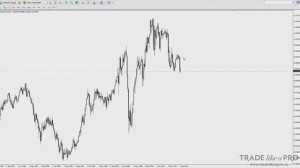
If you trade on daily charts, then first of all you should pay attention to buys, especially in long-term positions. But do not forget that there are also quite prolonged downtrends:
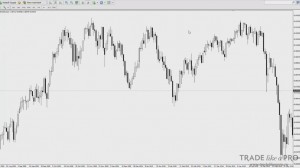
In general, the global trend, judging by the last 20 years, is upward in appearance. But if we consider prices from 1919, then the global trend will be downward. Because from 1919 and up to 1931 the Australian dollar against the American one was in a range between 2,43 and 2,22. That is, the rate was much higher than it is now. The Australian dollar was more expensive than the American one.
From 1940 to 1943 the fixed exchange rate was 1,61. Let me remind you that the currency has had a free floating rate since 1983. Earlier the rate was fixed and was set by the Reserve Bank, which performs the role of the central bank in Australia.
In 1919 the price was 2,23. In 1940 it was 1,61. In 1945 - 1,60. From 1945-1949 it was 1,61. From 1949-1971 there was a fixed price of 1,12. And gradually from 49 to 71 there was a decline to 1,11.
If we draw very broad parallels and look at trends from 1919, then the global trend for the Australian dollar goes downward. But if we consider the last 20 years, then the global trend tends upward.
We give priority to long positions provided that we open them with some long-term perspective. But at the same time we remember that history may quite well continue and the global 95-year downtrend may continue.
And this can be observed now:
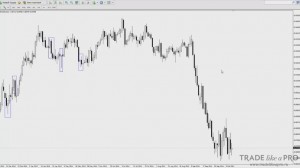
On the daily chart, a decline is visible that has already been going on for more than one month. And if you look at the first price available to us in 93, it is approximately at the 0,7 level, while now it is 0,87. The price has not gone that far upward.
As I wrote earlier, the interest rate of the Australian central bank is 2,5%. Therefore, carry trade operations do not have any great meaning. That is, attempts to earn on the swap will be unsuccessful.
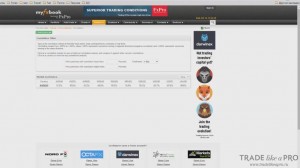
For long positions, the swap is 0,5 points; for short positions, the swap is negative and also amounts to 0,5 points:
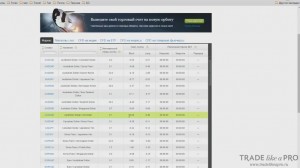
There is no real point in trying to earn on these 0,5 points. Therefore, I do not advise opening any positions with the expectation of earning on the swap.
At the same time, since the swap is small, there is no point in worrying that the swap will "eat up" the profit when opening shorts. We will not be able to earn on swaps, but at the same time it will not be possible to lose a large amount because of swaps on this pair either.
The value of one point with a 0,1 lot is 1$, which is very convenient in money management calculations. Therefore, carrying out calculations is quite simple. That is, if the price moved 10 points and our lot is 0,1, then we earned 10$. The price moves 10 points and our lot is 1,0, which means we earned 100$. Very convenient and simple, just like with any other "major" pair.
What time is best for trading the Australian dollar?
As with other major currency pairs, the greatest activity is observed at the opening of the London session and roughly the first 3 hours of America. After that, activity declines until the next London session.
You can see this for yourself in the picture below:
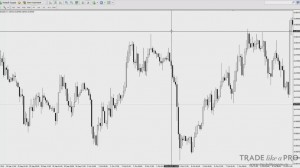
London opens, and the bears join the action. Then London closes and after roughly 3 hours of America, a lull begins until the opening of the next London session:
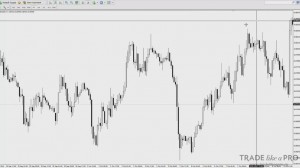
Therefore, for those who trade intraday, I draw your attention to this: it is better to trade only from the London open through the beginning of the American session. After that, there is no point in trading actively intraday. Only close positions and wait for the next day.
How exactly should you trade and which strategies should you use?
Classic trend-following strategies work best on this currency pair. This is the main bulk of strategies available on the internet, including on our website.
I want to note that overall, movements in the Australian dollar are clearer and more straightforward than on EURUSD:
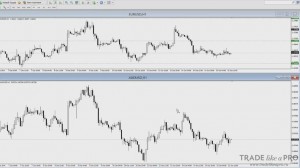
Above you can see the EURUSD charts and the hourly chart of the Australian dollar. If you compare them, you can notice that the movements are similar, but on the Australian dollar the movements stand out more clearly. They are easier to understand and more noticeable. In general, you can say that trading AUDUSD is easier, although all beginners lean on the EURUSD pair.
There is also an opinion that the Australian dollar is similar to the NZDUSD pair. But I believe that since the Australian economy is more developed than the New Zealand economy, they should not be compared. I think it is better to compare the Australian dollar with the euro.
The volatility of AUDUSD compared with EURUSD
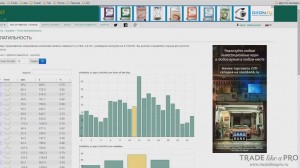
Both pairs have daily volatility of around 70-80 points. But note that the histogram for the distribution of volatility during the day for the euro shows that one hour stands out strongly:
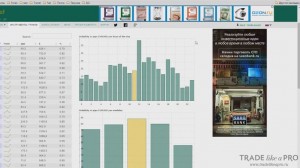
It is 12 GMT
And if we compare the volatility chart of the Australian dollar, we will see that it is distributed more evenly:
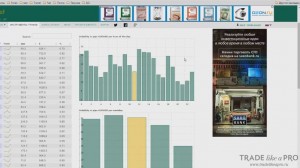
Overall, volatility is distributed within the day. This is undoubtedly a plus in trading this pair. Technically, it is easier to trade, since the volatility within the day is the same.
Correlation with other pairs
What is worth paying attention to? It should be noted that the movements of AUDUSD are most similar to AUDCAD. Let's open both pairs on the chart:
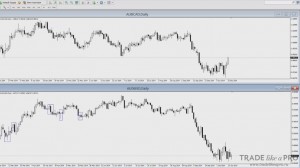
On top is the daily chart of the Australian dollar, and below is the Canadian dollar. The similarity is visible, but it is not perfect, since the currencies are different. The movements are also similar to USDCAD:
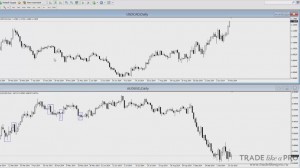
We really do see that the pairs mirror each other, just like the Canadian dollar.
And one more point I would like to draw your attention to. It is not so obvious, since AUD is a money currency, but it has a positive correlation with the gold chart:
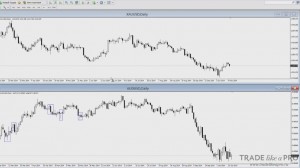
They quite often move together. You really can notice a certain similarity, but it is rather in the general direction of the trend than in any specific patterns.
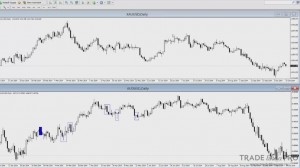
But we should not forget that gold is first and foremost a metal, and the Australian dollar is a currency. And different factors influence them. But overall, the trends quite often coincide.
Therefore, for lovers of multi-currency analysis when trading the Australian dollar, it is worth paying attention to the price charts: XAUUSD, USDCAD, AUDCAD, and EURUSD. You can also add USDJPY to this list:
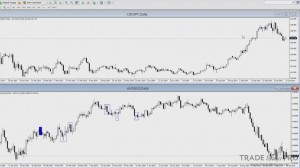
Since the correlation of USDJPY is negative, the charts will move in opposite directions. That is, they are mirror images of each other.
The chart shows that, with certain reservations, prices move in opposite directions:
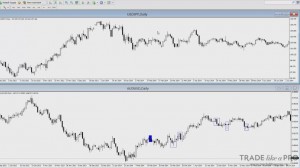
A dependency is indeed observed. When trading, it is worth paying attention to yen prices as well. But that is provided that you use correlation analysis in your trading.
What news affects the Australian dollar?
First of all, these are the news items where the impact on AUD is indicated. See the Economic calendar
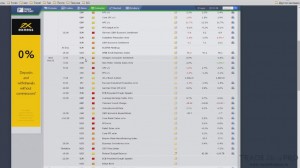
In addition, news on USD has an impact, since news on the dollar affects all currencies. Including gold. News on EUR has an effect, but very weakly, so you can ignore it. Therefore, when trading AUD, we watch news on the Australian dollar and important news concerning USD.
Conclusion

Summing up, we can say that the Australian dollar is a stable currency that has come through all economic crises over the last 200 years without any consequences. The country is one of the largest economies in the world. The Australian dollar is traded quite actively and is among the six major currency pairs. Daily volatility is 70-80 points, approximately the same as that of the euro-dollar.
We use strategies approximately the same as for the EURUSD pair. First of all, these are trend-following strategies. The pair shows a noticeable correlation with gold, USDCAD, AUDCAD, EURUSD, and USDJPY. If you use multi-currency analysis, then monitor these instruments when determining the trading direction on the Australian dollar.
On daily charts when trading, we give preference to long positions, since the pair's global trend is upward, but we also remember that if we judge the trend from 1919, then it will be a 100-year downward trend.
The interest rate of the Reserve Bank of Australia is 2,5% per annum. Therefore, swaps are small and there is no point in paying attention to them, either for the purpose of earning on them or in terms of not going into some serious loss when opening long-term positions.
Respectfully, Pavel Vlasov Tlap.io