
How to Make Money on Gaps?

Hello, friends! At the opening of the forex market on Monday, there are often significant price jumps called gaps. GAP literally means a break, a jump. And in this video lesson we will talk about how to find these jumps, where they come from, and we will examine a strategy for trading gaps (everything is not as simple as it may seem).
Gap (GAP) is the difference between the Forex market closing price on Friday and the opening on Monday.
Gap Trading Strategy
Currency pairs: EURUSD, GBPUSD, EURJPY, GBPJPY
Probability of gap closure ≈ 70%
Timeframe: M30
Trading time: Half an hour after the market opens at the beginning of the week
Recommended brokers: Alpari, RoboForex
What Is a Gap?
First of all, let us find out what a gap is.
If translated literally, GAP is a break, the difference between the quotes on Friday and the market opening on Monday. And if the difference between the closing price on Friday and the opening on Monday is substantial, then a jump is formed. That is, the price turns out to be noticeably higher or lower than the price that existed on Friday, and this is clearly visible on the chart, as in the example below:
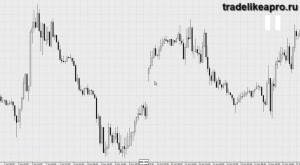
We can see that the closing price on Friday was about 1.5467, while the opening price on Monday was 1.5511. That is, about 43 points higher than the market closing price on Friday:
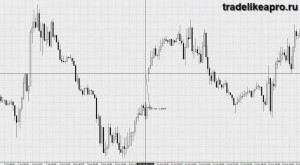
And this very gap, which is formed between the market closing prices on Friday and the opening on Monday, is called a GAP. Naturally, a GAP does not form all the time. On average, it can be seen on each pair once a month. Sometimes more often, sometimes less often, but the fact is that gaps happen and money can be made on them.
Why Do Gaps Occur?
Gaps occur because during the time when the market is inactive, namely over the weekend, a certain number of sell and buy orders accumulates. And when the market opens on the night from Sunday to Monday, these very orders come down and create the jump, as we looked at on the chart earlier.
Of course, this does not happen all the time, but only when there is a substantial imbalance in buy or sell orders accumulated over the weekend. Market makers see a huge number of buy or sell orders, and accordingly we get a price visually higher or lower than the market closing values on Friday. One important point should be noted. As a rule, gaps tend to close.
Let us consider an example:
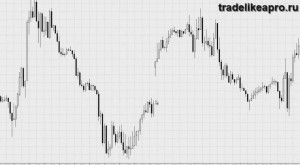
The market opened on Monday significantly higher than the Friday close. For some time it moved upward, and then it turned around and went downward. This situation happens constantly and after a gap appears, the price as a rule tends to close the formed interval.
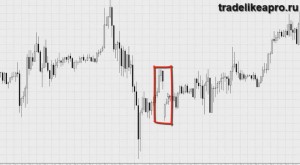
That is, if there was an upward gap, then the price will subsequently tend downward in order to cover this jump. And if there was a downward gap, as in the picture below, then the price will tend upward in order to close this gap:
Why Do Gaps Tend to Close?
The point is that when the market opens significantly higher or significantly lower than Friday's price, many orders are activated, many pending buy or sell orders. Naturally, the stops of these orders are located not far from Friday's closing price. And in this way market makers strive to knock out the stops of those very guys whose orders were triggered at the market open and take their money for themselves.
After the gap has been covered, the market can go in absolutely any direction. There are no special patterns here. In general, gaps tend to close, but sometimes it happens that a price jump occurs at the opening on Monday and it continues. This happens only when there is a strong trend movement or some fundamental factors come into play. For example, something could have happened in the economy over the weekend. That is, gaps tend to close, but not always. This should be remembered!
How Will We Trade Gaps?
It would seem, just buy or sell in the direction of gap closure at the market opening and that is all. There is nothing to think about here. But it is not that simple. First, not all pairs show good gap follow-through, and second, there are certain patterns in entries. In addition, you need to determine the stop loss. Because very often the price moves in the opposite direction before closing the gap.
Far from all currency pairs show good gap follow-through, that is, closure after they appear. The best statistical indicator, about 70%, is shown by the pairs EURUSD, GBPUSD, EURJPY, GBPJPY. The probability of gap closure on these pairs is approximately 70%. Moreover, EURUSD has the lowest closing probability of these 4 pairs. About 66%, while the remaining pairs have 70-71%.
That is, for trading the closure of the Gap, we should watch these four pairs. It may even make sense to exclude EURUSD and leave only three pairs. There is no point in paying attention to other pairs.
Any time frame can be used, but we will look at a chart with the M30 period. Each candle will make up half an hour. A little later I will explain why. Trading time under the system is once a week, if a Gap appears.
First, after the market opens, we check whether there is a Gap. Whether there is a substantial difference between the Friday closing price and the Monday opening price.
The Gap, if it exists, must be at least 20 points. If it is 10-15 points, then these are more likely insignificant fluctuations. There is no point in paying attention to them. We will consider a break of 20 points or more to be a Gap.
We will enter the market not immediately when it opens, but after the first M30 candle closes, that is, half an hour after the market opens. Why so? Statistically, during the first 30 minutes, Gaps as a rule do not tend to close. After a Gap has occurred, in most cases the market moves in the direction of the Gap for the first half hour. And not toward closing it.
So, the market has opened:
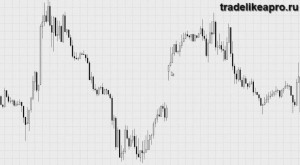
First we check whether our Gap is a Gap. That is, whether the distance between the market closing price on Friday and the opening price on Monday exceeds 20 points. If there are at least 20 points, then we can quite reasonably consider this Gap to have taken place. In this case, on the chart, the Gap was 42 points:
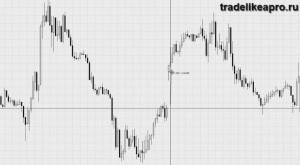
So it can be considered a full-fledged one. After the market has opened, we do not immediately open our order in the direction of closing the Gap.
In this case, we should look for an opportunity to enter a sell trade. Only after half an hour will we enter the market, as soon as the first M30 candle closes. The first one after the market opens. In the figure below you can see that it has closed here and approximately where the red line is located is where we will enter the market:
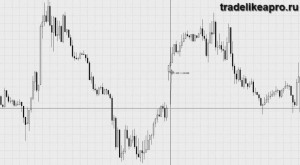
What will our target be? What will our take-profit point be?
We will not take Friday's closing point. We will take a point slightly above the high or low of the last closed candle on Friday. In this case, since the Gap was upward, naturally the high point of the last closed candle on Friday is closer to us:
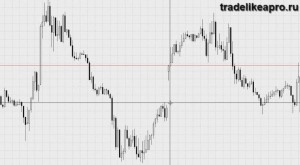
And a little above it we place the take profit:
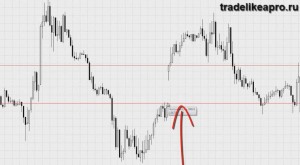
A little above the high point of the last closed candle on Friday. Thus the target in our trade is 45 points:
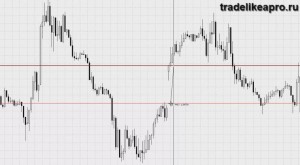
Next we need to determine the stop loss. As you have probably already noticed, before moving toward closing the Gap, the price does strange things and often goes the wrong way:
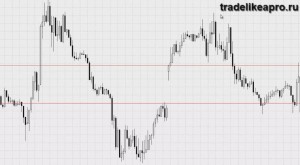
Why does this happen? Because a great many people trade the closing of Gaps, and market makers seek to knock such smart guys out of the market. Therefore we need to take such fluctuations into account in our stop loss so that they do not knock us out of the market, and at the same time preserve the system's overall profitability. So, if the stop is too large, then even with 70% profitable trades we may end up in the red.
So, we will determine the stop loss based on the take profit value multiplied by one and a half:
TP * 1,5
If you make the stop loss larger, the profitability of the system is lost. And if you make it smaller, multiplying by 1,4, then in that case stop losses are very often hit. And thus we will incur losses.
Let's return to our example and measure our target. The take profit is about 45 points:
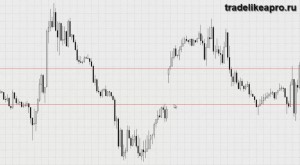
We multiply 45 by 1.5 and get 67.5
We round it to 68 and add a couple of points for some random fluctuations and get 70-71 points. That is, our stop loss in this trade will be approximately right here:
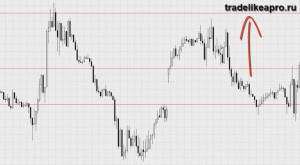
As you can see, for some time the price moved not in our direction, but it did not touch the stop loss and in the end the GAP closed. GAPs sometimes close quickly, within a few hours after the market closes, and sometimes they can remain unclosed for quite a long time, up to a day. So if the jump does not close immediately, there is nothing wrong with that. This is normal.
Important point!
If after the first M30 candle has closed, but at the same time it moved toward the GAP and the distance to the target remains very small, as in the case below:
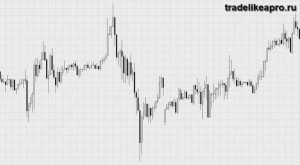
Then it is better not to open such a trade. If there is no possible target of at least 20 points before the close, then it is better not to get into the market. Of course, the market may close this GAP, and you will get a profit of 13 points, but it is not worth taking extra risk, since the target does not justify the means.
Let's consider one more example:
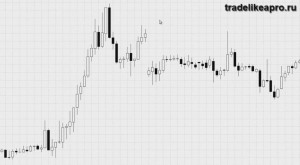
But this time our GAP goes downward. We will consider buys. We measure the market opening on Monday and see that it is 40 points:
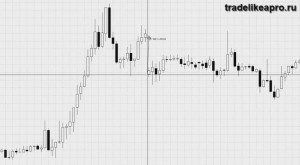
We can quite classify it as a full-fledged one.
Next, we wait for the first M30 candle:
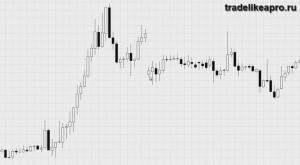
As you can see, the market does not always move toward the GAP in the first half hour; sometimes it can move toward closing it. For the first half hour we do nothing and wait for the first M30 candle after the opening to close, and as soon as it has closed we enter the market:
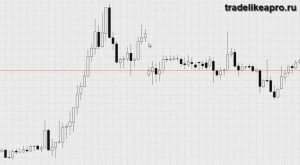
We set our target slightly below the low point of the last closed candle on Friday:
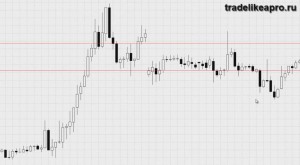
Why do we set our target not at the market close, but slightly above the low point? Because the market strives to close the GAP, but at the same time it does not strive to close it exactly at Friday's closing point. Very often the price comes just a little short of Friday's market close and turns around. That is, we determine our target approximately near Friday's market close, but not exactly. In this way we increase our chances of making a profit.
Now all that remains is to set the stop loss. I remind you that we determine it by multiplying the take profit by 1.5. We measure the take profit and get a value of 29 points:
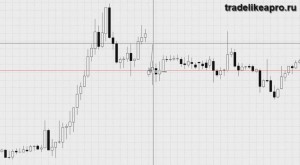
We multiply it by 1.5 and get 43.5 and add a couple of points for random fluctuations. It turns out that our stop loss in this trade will be somewhere around 46-47 points:
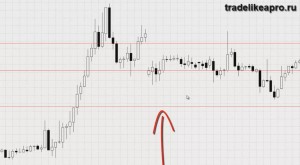
As we can see on the chart, the price was in a flat range for some time. It was almost standing still. But then the GAP was successfully closed, and we exited the market:
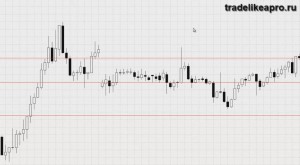
Such an easy and at the same time profitable strategy!
Its downside is that trades will not be opened as often as many would like. Since, as I wrote earlier, GAPs occur at most once a week. And sometimes once a month. But at the same time, this is an excellent opportunity to earn some extra money. You can trade using some strategy of your own and at the same time glance once a week to see whether a GAP has appeared.
And if it appears, then you can open a position using this system and make a profit!
The GAP trading strategy is analyzed in more detail in the video.
P.S. Also note that different brokers open at different times; read more about this in the article Important Information for Trading on Daily Charts .
Rules
- The gap must be at least 20 points!!!
- We enter after the close of the first M30 candle at the market open
- Target: 3-4 points below/above the Low/High point of the last Friday M30 candle
- Stop-Loss = Take-Profit X 1.5
P.P.S. A service of online statistics on GAPs has appeared on our website - with its help you can learn the average values of the size, duration, and probability of closing GAPs for different pairs.
Sincerely, Pavel Vlasov TradeLikeaPro.ru