
How to Develop Your Own Trading Strategy
 Hello. Sooner or later, every beginner Forex trader comes to understand that they need their own trading system. Of course, you can use ready-made Forex strategies, but they should also be adapted to suit you: to match your own trading style. In this lesson, we will discuss the mandatory components of a trading strategy, why a trader needs it, and what questions you should ask yourself when developing a system that is right for you.
What Is a Trading Strategy?

A trading strategy is a set of rules that allows you to systematize trading, giving the trader a clear understanding of when to enter a trade, when it is time to exit it, and when it is better to refrain from trading altogether. The system also specifies at what time and on which timeframe to trade, which currency pairs to use, and with what lot size to enter trades. A trading system helps switch off emotions and protect against their negative impact on trading.
Advantages of a Trading System

There are several obvious advantages to trading with a strategy:
- Statistical edge. The trader knows that, provided the rules of the trading system are followed, there will be more profitable trades than losing ones, and as a result they will end up in profit (if this was confirmed by preliminary historical testing). Even if a series of losing trades occurs, the trader knows that the situation will most likely recover;
- The trader does not need to guess every time whether it is worth opening a trade or not. They simply follow the signals of the trading system;
- It is psychologically easier for the trader. Greed, fear, and the desire to win back losses by increasing the lot are easier to control when there are clear rules that make the trader more of an executor than a decision-maker.
You could say that a strategy turns Forex trading from an exciting activity into a routine, but most traders come to the market to make money, not to play, and a trading system helps them achieve that main goal.
Why Create Your Own Trading System?

There are many ready-made trading systems on the market, both simple and quite complex, understandable only to professionals. Beginners, as a rule, start trading using a ready-made trading system, and not the most complex one. However, over time almost each of them realizes that truly effective trading is possible only with a strategy developed personally, based on their own experience and preferences.
A trading system is not always developed from scratch. Often (especially if this is the trader's first experience in creating a strategy), a ready-made system is taken and some changes are made to it: indicators are added, the parameters of already installed tools are changed, and so on.
Regardless of whether a trader creates a strategy from scratch or modifies a ready-made one, it is necessary that it suits their character: scalping is unlikely to suit a thoughtful and deliberate person, just as long-term trading may not suit someone else because of their personality.
Mandatory Components of a Trading Strategy

Each strategy should include certain points that together ensure trading stability:
- Logical rationale. This is the main idea on which the trading strategy is built. It is the foundation on which all the other components are based;
- Currency pairs for trading;
- Timeframe and trading time (trading session);
- Entry rules (signals to open a position);
- Exit rules. How stop-loss and take-profit are set;
- Trading lot size and risk limits.
If all these parameters are taken into account, you can begin testing the strategy on historical data or on a demo account.
An Example of Developing a Trading Strategy Structure

To better understand the mechanism of creating a trading system, let us examine its structure using a specific example.
Logical Rationale
First of all, you need to decide on the main idea of the strategy. This may be some specific relationship or pattern in price behavior on the basis of which its further movement can be predicted.
For example, we noticed that the market, even while being in a trend, never moves evenly and smoothly: there are always some corrections and price fluctuations opposite to the main movement. We will build our trading system on this idea: by entering the market after a correction, you can gain more profit and increase the chances that the price will, in principle, move in the desired direction.
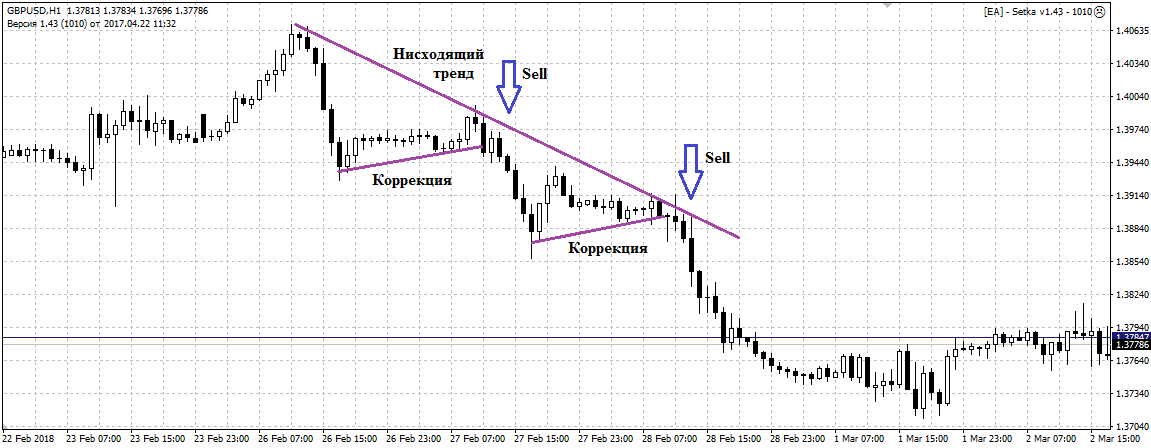 Based on the general concept, the entry rules are immediately defined as well: at the moment when the price reverses in the direction of the global trend. To determine these moments, tools are selected, a timeframe and currency pair are chosen, and so on.
Another example: we noticed that the EURUSD and USDCHF currency pairs often move as mirror images of each other, and when one pair starts moving upward, the second will soon start moving downward, and vice versa. Therefore, having noticed that a new trend has begun on one of the assets, you can open a trade on the other currency pair in the opposite direction, having every reason to expect a move soon.
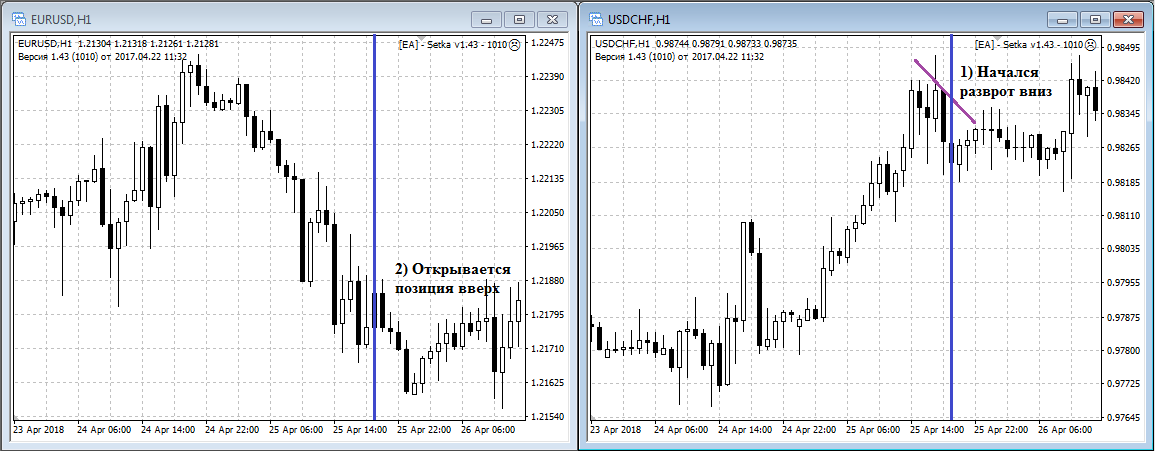 In this case, the issue of trading assets is immediately resolved as well, since there are no other currency pairs on the market that are this highly correlated.
Timeframe
The choice of timeframe depends on how much time the trader is ready to devote to trading. If on daily charts the formation of a candle takes a whole day, then, accordingly, only a few minutes a day will be needed to assess the situation and make a decision, whereas on M1 everything changes every minute and the trader will need to be constantly present at the trading terminal. The smaller the timeframe, the more signals will arrive and, accordingly, the greater the potential profit. However, not everyone has the opportunity to devote the whole day to trading, and for working people the daily chart will be the optimal option.
It is also believed that technical analysis works better on daily charts than on hourly or, especially, minute charts, so D1 will be the optimal choice for beginners. Most often, traders work on D1-M15; five-minute and one-minute charts are too unpredictable, and only narrowly specialized professionals can earn steadily on them.
Currency Pairs
In most cases, it is optimal to choose EURUSD or another major currency pair as the trading asset. In the MetaTrader 4 trading terminal, you can choose to display only the needed assets by right-clicking on the “Market Watch” field and selecting “Symbols Set”-“Forex”.
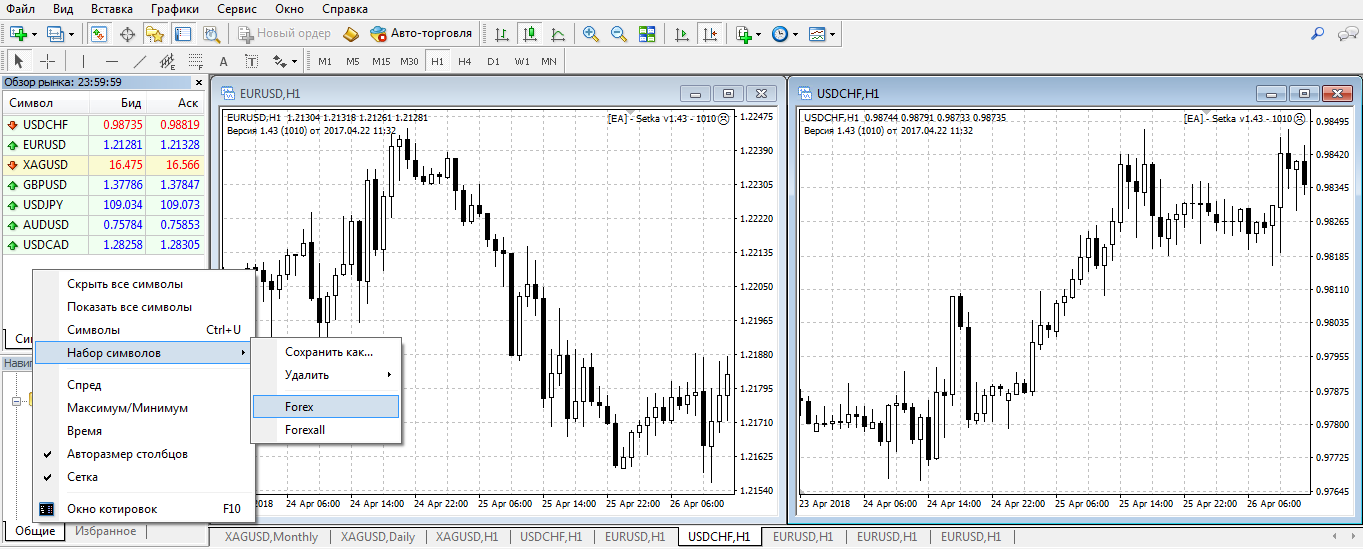 In a case where the idea itself is tailored to a specific asset (for example, gold or the S&P 500 index), the choice is completely obvious.
Choosing Analysis Tools
Once the trading idea becomes clear, the timeframe is chosen, and the currency pairs for trading are selected, it is necessary to decide on the tools for analysis and for determining entry and exit points. The main rule here is not to overdo it. As a rule, simple systems show themselves most effectively in real trading. In those trading systems that are oversaturated with indicators, various constructions, and other signals, these tools often contradict each other, only confusing the trader and provoking mistakes.
If the strategy is indicator-based, then, as a rule, it should contain from 2 to 5 tools. The necessary minimum is one trend indicator that determines the direction for opening a trade, and one overbought/oversold indicator (an oscillator) that helps avoid false entries.
If the strategy is focused on candlestick analysis, then the trader needs to be well versed in Price Action patterns. If the use of chart analysis is planned, then good knowledge of chart patterns will be required (triangles, flags, and pennants, double tops, etc.).
It is also necessary to decide whether news and important economic events will be taken into account (if the trading system itself is built on technical analysis). If the system is built on fundamental analysis, it is necessary to decide which specific news to trade. News can be tracked using an economic calendar and special indicators.
Entry and Exit Rules
First of all, it is necessary to decide which type of orders will be used to enter the market: pending or market orders. Pending orders, on the one hand, help avoid false entries, but on the other hand, they take away part of the profit because the price travels a certain distance before it activates the order.
It is also necessary to decide in advance according to what principle take profit and stop loss will be set. In some trading systems, setting a take profit is optional (for example, when using a trailing stop), but a stop loss must always be set. A stop loss is primarily a risk limiter and protects the trader’s capital from force majeure, for example, from an internet or power outage.
After all the rules are defined, they must be recorded on paper or in a separate file, that is, a checklist is needed. Then you can proceed to testing the trading system.
Testing on Historical Data and a Demo Account
First of all, the strategy must be tested on historical data. This will provide statistics and an initial understanding of its profitability. However, historical data loses relevance over time, so the strategy’s behavior in the real market will provide more useful information.
Before going to a real account, the trading system must be tested on a demo. The testing time depends on the timeframe: when trading on H1-H4 or, even more so, D1, determining profitability will require at least several months, while the effectiveness of a scalping strategy can be determined in a week.
Conclusion

Every trader should have a trading system. Sometimes beginners think they will be able to trade solely by intuition, especially if this misconception is reinforced by a couple of successful trades. In addition, there are known cases when experienced traders opened trades by intuition or against the rules of the system and earned huge amounts of money.
However, in this exception the key factor is experience. A professional trader is able to understand when intuition can be switched on and when one should work strictly according to the system. As a rule, intuition is used very rarely, and rather in order not to enter the market on a signal than in order to open a trade against the rules and take a loss.
In any case, only professionals with years, or even decades, of experience can afford such actions without serious risk to their capital. For beginners who have firmly decided to learn how to make money on Forex, there is only one correct path: the path of systematic trading.
Besides this, there is one point that even experienced traders very often miss in their trading. This is the Logical Rationale of the trading strategy. This is very important, so even if you already have extensive practice working in Forex, watch at least part of the video that explains that every system must have a Core Idea on which it is built.
Best regards, Pavel Vlasov TradeLikeaPro.ru